Key event
Treaty of Brest-Litovsk
- Category:
- Diplomacy
- Front:
- Eastern Front
- Date:
- 3 March 1918
- Author:
- Łukasz Skowroń
- Battle:
- Operation Faustschlag
- Tags:
- Russia, Germany, Austria-Hungary, Poland
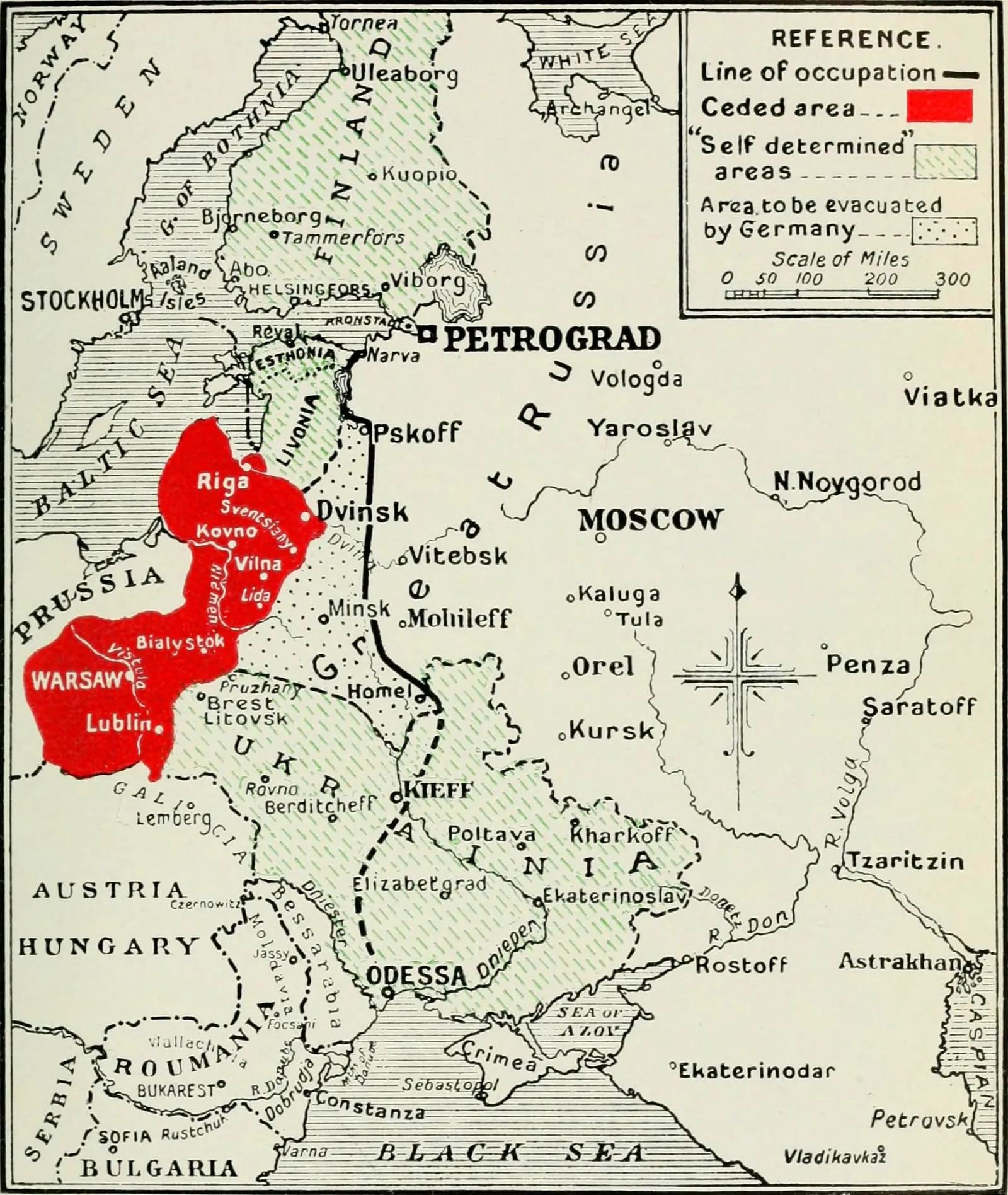
On Sunday 3 March 1918, in the White Palace of the Brest Fortress, the delegation of Soviet Russia signed a peace treaty with Germany, Austria-Hungary, Bulgaria and Turkey. After three months of negotiations, broken off in February by Trotsky’s “neither war nor peace” and the German offensive, Russia left the war on terms dictated to it by force. It renounced sovereignty over Poland, Lithuania and Courland, agreed to evacuate Livonia, Estonia, Finland and Ukraine, and to hand over to Turkey the districts of Kars, Ardahan and Batum. That day the war in the east, which since August 1914 had claimed millions of victims, came to an end.
Signed without discussion
The Soviet delegation, led by Grigori Sokolnikov, arrived in Brest on 28 February with a single task: to sign the peace and go home. At the session of 1 March its chairman declared that Russia accepted the terms which Germany had dictated to its government “with arms in hand”, and would not discuss them, so as not to give the appearance of negotiations. He asked only for the texts of the treaty and the supplementary agreements. The head of the German delegation, the envoy Frederic von Rosenberg, and the Austro-Hungarian ambassador Kajetan Mérey protested that Russia could of course accept or reject the peace, and that all the matters had been discussed in detail in January. The Russians refused to be drawn into debate. After looking through the documents, the delegation’s secretary Lev Karakhan telegraphed Lenin that the terms were worse than the February ultimatum and that the delegation would sign them without discussion. What was new above all were the Turkish demands concerning Transcaucasia.
The foreign ministers of the Central Powers, Richard von Kühlmann and Count Ottokar Czernin, did not wait in Brest, because they were negotiating with Romania in Bucharest. Signing for Germany were Rosenberg, General Max Hoffmann and Commander W. Horn; for Austria-Hungary, Mérey; for Bulgaria, the envoy Andrey Toshev with two assistants; and for Turkey, the former Grand Vizier İbrahim Hakkı Pasha. Kühlmann and Czernin added their signatures in Bucharest on 7 March. On the Soviet side, alongside Sokolnikov, the treaty was signed by Grigory Petrovsky, the deputy commissar for foreign affairs Georgy Chicherin and Karakhan.
Before signing, Sokolnikov read out a statement that has gone down in history. “This peace is not a peace of understanding and agreement, but a peace which Russia, grinding its teeth, is compelled to accept,” he said. In his view the treaty, under the pretext of liberating the border provinces, turned them into German states, gave the land back to the landowners and drove the workers back into bondage to the factory owners. The Soviet government, however, was unable to resist the armed advance of German imperialism and, to save the revolution, accepted the terms put to it. The delegation was signing the treaty presented to it as an ultimatum, but refused any discussion of its content. According to the British historian John Wheeler-Bennett, the ceremony ended at about five in the afternoon. Other accounts, based on the minutes, state that the session was closed a few minutes before six.
What Russia gave up
The treaty had 14 articles and 5 annexes. The most important was Article 3. The territories lying west of an agreed line, which had previously belonged to Russia, were no longer to be under its sovereignty. This line, running from the Gulf of Riga along the Dvina through Dünaburg and then through the areas of Święciany, Oszmiana and Zelwa to the Ukrainian border, was marked on an attached map, and its details were to be laid down by a German-Russian commission. Russia renounced all interference in the affairs of these territories, and Germany and Austria-Hungary intended “to determine their future fate in agreement with their populations”. This meant the Kingdom of Poland, Lithuania and Courland, the lands the Central Powers had occupied since 1915.
Article 6 went further. Russia had to make peace at once with the Ukrainian People’s Republic and recognise its treaty with the Central Powers, and withdraw its army and the Red Guard from Ukraine. It also had to evacuate Estonia and Livonia, which were to be occupied by a German “police force” until order was restored. The eastern border of Estonia was set by the river Narva, and that of Livonia by lakes Peipus and Pskov. The Russians were to withdraw their troops and ships from Finland and the Åland Islands, and to dismantle the fortifications on the islands. Article 4 obliged Russia to evacuate the provinces of eastern Anatolia and the districts of Kars, Ardahan and Batum, whose fate was to be decided by the population “in agreement with the neighbouring states, especially Turkey”. Russia thereby lost its gains from the war of 1877–1878.
The remaining articles required the complete demobilisation of the army, including the units being formed by the new government, and the return of warships to Russian ports, where they were to stay until a general peace, or their disarmament. Both sides renounced war indemnities, prisoners of war were to return home, and diplomatic relations were to be resumed after ratification. Russia undertook to cease propaganda against the governments and institutions of the Central Powers, including in the territories they occupied. The parties undertook to respect the independence of Persia and Afghanistan. On the same day supplementary agreements were signed with each of the four states on the restoration of legal relations, the exchange of prisoners and an amnesty, and the economic annexes restored for trade with Germany the 1904 tariff, which was unfavourable to Russia.
The scale of the losses was enormous, although the figures differ depending on whether Finland and Ukraine are included. According to frequently cited data, about 56 million people lived in the severed territories, roughly a third of the population of the European part of the empire. Wheeler-Bennett states that Russia lost 34 per cent of its population, 32 per cent of its agricultural land, 54 per cent of its industrial enterprises and 89 per cent of its coal mines. The Viennese Arbeiter-Zeitung wrote that Russia’s borders had been pushed back to the days before Peter the Great.
Poland in the treaty
The word “Poland” did not appear in the treaty. The Kingdom of Poland, which after the Act of 5 November 1916 the Central Powers had announced as an independent state, and which since the autumn of 1917 had had a Regency Council and its own government, lay entirely west of the new line. Under Article 3 its future was to be decided by Germany and Austria-Hungary in agreement with the population. Representatives of the Kingdom were not admitted to the negotiations, which all the parties had opposed. At the same time Russia recognised the treaty with Ukraine, which gave the new state the Chełm Land, the former Chełm Governorate, and part of Podlasie. In February it was precisely this provision that set off a wave of protest in the Kingdom and in Galicia and the resignation of the Kucharzewski government. The peace with Russia completed the picture. The former partitioning power renounced its rights to Polish lands, but not in favour of the Poles: in favour of Berlin and Vienna, which now decided their fate without the participation of those concerned.
End of the offensive
The signing of the treaty brought to an end Operation Faustschlag, in which since 18 February the Germans and Austro-Hungarians had occupied, almost without a fight, Livonia, Estonia and a large part of Belarus and Ukraine. In the north, however, operations went on to the last moment. On 3 March the defenders of Narva abandoned the town, and the Germans entered it on the morning of the following day. In Ukraine the advance continued, now as “assistance” to the allied government of the Central Rada. Lenin, moreover, did not believe the peace would last. On 2 March, the day before the signing, he ordered the demobilisation of the new army to be halted, the demolition of railways and bridges to be prepared and the evacuation of stores into the interior to continue, because he expected the supporters of further war against Russia to gain the upper hand in Germany.
What came next
The treaty still had to be ratified by both sides. On the Soviet side this was done in mid-March by the Extraordinary Congress of Soviets in Moscow, and on the German side by the Reichstag, where only the Independent Social Democrats voted against. The question of peace broke up the governing coalition, as the Left Socialist Revolutionaries left the Council of People’s Commissars. The Entente refused to recognise a peace imposed by force. For Germany the treaty was to be the prelude to a great offensive in the west, and at the same time it opened the way to the grain and raw materials of the east. Their occupation, however, required hundreds of thousands of soldiers who were then lacking in France.
The Brest peace lasted less than nine months. On 27 August 1918 a supplementary treaty was signed in Berlin, in which Russia agreed among other things to pay Germany 6 billion marks. In the Armistice of Compiègne of 11 November 1918 Germany had to renounce the Treaty of Brest-Litovsk, and on 13 November the All-Russian Central Executive Committee declared it null and void.
Remember the articles you have read? Only in this browser; nothing is sent anywhere.How it works
Read ·
A voice from the front
“And therefore more shameful than any harsh and extremely harsh peace imposed by the lack of an army – more shameful than any shameful peace – is shameful despair. We shall not perish even from a dozen extremely harsh peace treaties if we take insurrection and war seriously.”
Translated · Original (ru)
И потому позорнее всякого тяжкого и архи-тяжкого мира, предписываемого неимением армии, — позорнее какого угодно позорного мира — позорное отчаяние. Мы не погибнем даже от десятка архи-тяжких мирных договоров, если будем относиться к восстанию и к войне серьезно.
Spotted a mistake?Report an error
Meanwhile
(04)Elsewhere in the same days.
- 4 March 1918 · SocietyFirst flu cases at Camp FunstonOn 4 March 1918 a cook, Albert Gitchell, fell ill with flu at Camp Funston in Kansas. Within three weeks more than 1,100 soldiers had been hospitalised.
- 1 March 1918 · DiplomacyTreaty between Red Finland and Soviet RussiaOn 1 March 1918 in Petrograd Lenin's government and the Finnish Reds signed a treaty of friendship. Russia ceded its property in Finland and promised Petsamo.
- 5 March 1918 · Balkan FrontPeace of BufteaOn 5 March 1918 at Buftea Romania signed a preliminary peace with the Central Powers. It ceded Dobruja and accepted a border correction and demobilisation.
- 5 March 1918 · Military operationsGermans land on the Åland IslandsOn 5 March 1918 a German squadron carrying a Jäger battalion reached Eckerö in the Åland Islands, held by the Swedes since February. Sweden gave way.
Related events
(04)The same battle, people or subject.
- 28 February 1918 · Eastern FrontPeace talks resumeOn 28 February 1918 a Soviet delegation under Sokolnikov reached Brest to sign peace on German terms. The Germans refused to halt their offensive.
- 18 February 1918 · Eastern FrontOperation Faustschlag beginsAt noon on 18 February 1918 the armistice on the Eastern Front expired. The Germans advanced and that same day, almost without a fight, took Dvinsk and Lutsk.
- 10 February 1918 · Eastern FrontNeither war nor peaceOn 10 February 1918 at Brest Trotsky said Russia was leaving the war and demobilising but would not sign an annexationist peace. The Germans were stunned.
- 23 January 1918 · Eastern FrontBrest-Litovsk talks suspended againOn 23 January 1918 the last delegations left Brest. By radio the Bolsheviks accused the Central Powers of hiding their demands from their peoples.