Key event
Operation Faustschlag begins
- Category:
- Military operations
- Front:
- Eastern Front
- Date:
- 18 February 1918
- Author:
- Łukasz Skowroń
- Battle:
- Operation Faustschlag
- Tags:
- Germany, Russia, Ukraine, Vladimir Lenin
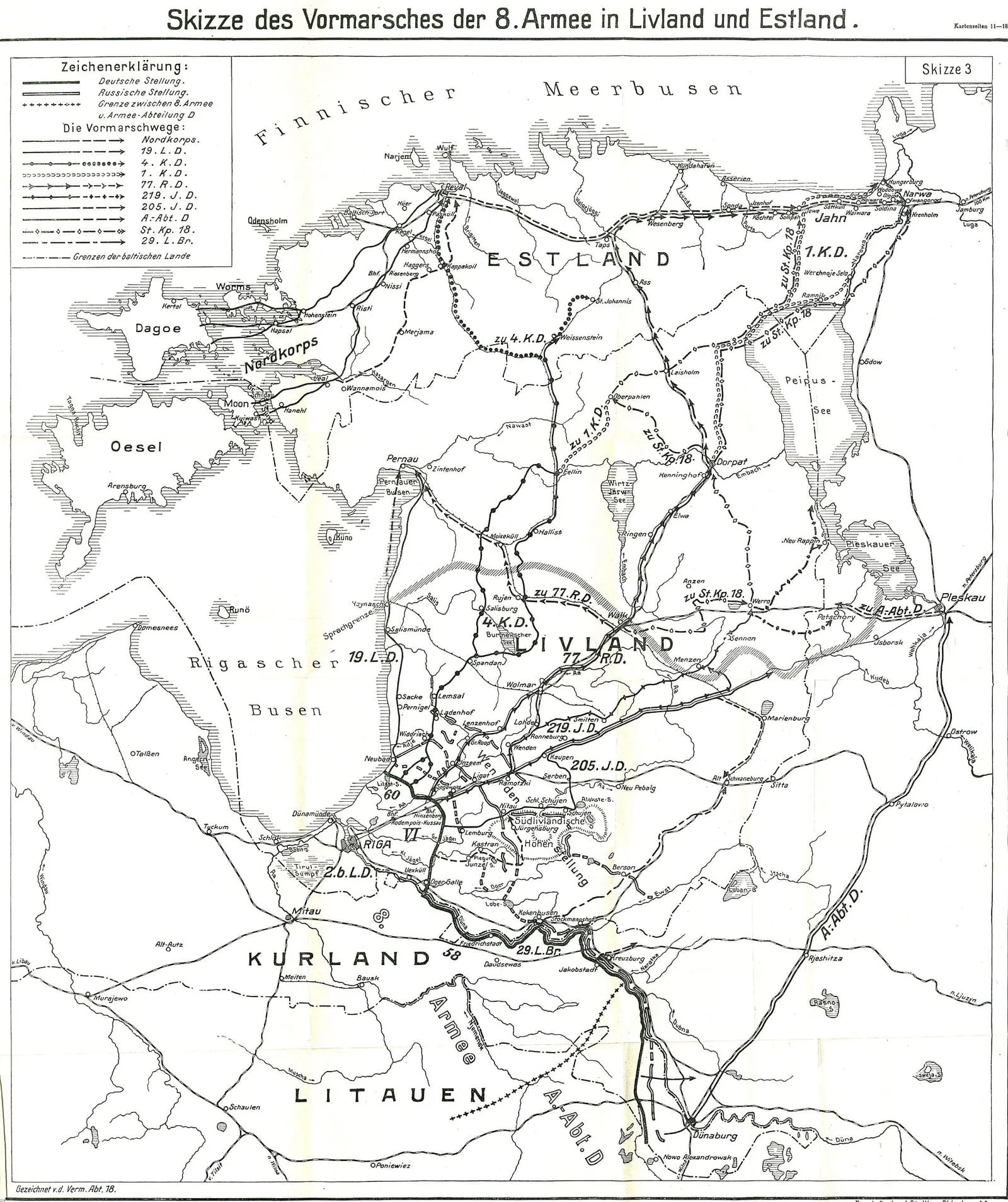
At noon on 18 February 1918 the armistice that had halted the fighting on the Eastern Front since mid-December expired. A few hours later German troops moved forward along the whole length of the front, from the Gulf of Riga to Volhynia. Operation Faustschlag (“fist punch”), the last great offensive in the east, had begun. By the evening the Germans were in Dvinsk, which they had failed to take in 1915, and in the south in Lutsk. The formula of “neither war nor peace” that the Bolsheviks had proclaimed at Brest had lasted a little over a week.
The end of the armistice
On 10 February Leon Trotsky announced at Brest-Litovsk that Russia was ending the war and demobilising its army, but would not sign an annexationist peace. The Bolsheviks counted on the Germans not daring to attack again. The armistice agreement of 15 December required seven days’ notice before hostilities were resumed, and no one had formally given it. The German command, however, held that Trotsky’s declaration was itself the notice. On 16 February General Max Hoffmann, chief of staff to the Commander-in-Chief East, informed the Russian general Aleksandr Samoylo, who had been left behind at Brest, that the armistice would end at twelve noon on 18 February and that the war would be resumed that day. On 17 February Trotsky asked by radio whether the telegram might not be a forgery. Hoffmann did not reply.
“Tomorrow we begin hostilities against the Bolsheviks,” Hoffmann wrote in his diary on the evening of 17 February. “There is no other way out, otherwise these brutes will wipe out the Ukrainians, the Finns and the Balts, and then quietly raise a new revolutionary army and turn the whole of Europe into a pigsty.” The Commander-in-Chief East, Prince Leopold of Bavaria, issued a proclamation that the Germans were coming as saviours, not conquerors, to put an end to a tyranny that had “raised a bloody hand” against the best Russians, and also against Poles, Lithuanians, Latvians and Estonians. To the soldiers he spoke of a new danger from the east, a “moral plague” with which sick Russia wanted to infect the world. In reality the aim was to force a peace on German terms, to occupy Livonia and Estonia as far as Narva, and to secure for the Central Powers the grain from Ukraine guaranteed in the peace of 9 February. The Ukrainian delegation, whose government had just lost Kiev to the Bolsheviks, had itself asked for German military help on 12 February.
The first day
Throughout 17 February German aircraft circled over the Russian trenches. According to the figures of the German historian Winfried Baumgart, 47 infantry divisions and 5 cavalry divisions went into the attack. Most of them were weaker formations, because the best divisions were already travelling west ahead of the spring offensive. It made no difference, because almost no one resisted. Most Russian soldiers had already gone home, and on 11 February the Commander-in-Chief, Nikolai Krylenko, had issued an order ending the war. Regiments still standing in their positions scattered or surrendered in whole crowds. The British historian John Wheeler-Bennett cites a case in which a lieutenant with six soldiers accepted the surrender of six hundred Cossacks.
Dvinsk, a great railway junction on the Dvina that housed the headquarters of the Russian Fifth Army, fell into German hands that same evening. According to Russian accounts it was taken by a detachment of fewer than a hundred men. In 1915 the German army had spent two months vainly assaulting its approaches, and had then stood for more than two years a dozen or so kilometres from the town. In the south the Germans took Lutsk in Volhynia, according to some sources only on 19 February. There they appeared as allies of the Central Rada and at once set off by rail towards Rovno, Zhitomir and Kiev. Ludendorff later wrote that operations were resumed in the afternoon of 18 February and on the morning of 19 February, depending on the sector. Austria-Hungary did not for the time being take part in the offensive, because Emperor Karl did not want to resume the war.
Petrograd
By the morning of 18 February the Soviet government already knew of the German movements, and soon news came of the loss of Dvinsk and Lutsk. Vladimir Lenin, who since January had been pressing for peace to be signed, believed that there was not a moment to lose. When Samoylo’s telegram arrived, he told Trotsky that waiting for the German attack meant losing Dvinsk and a great deal of artillery. On the morning of 18 February, however, his motion was defeated in the Bolshevik Central Committee by one vote. The committee met again in the evening, and after several hours of argument Lenin won by the narrowest of majorities. At about midnight the radio station sent a telegram to Berlin stating that the Soviet government accepted the peace terms dictated at Brest.
The Germans were in no hurry. Before negotiations resumed they wanted to reach at least Lake Peipus. So the offensive went on. Over the following week the Germans took Minsk, Dorpat, Reval and Pskov, and on 23 February they presented Russia with a new, much harsher ultimatum. Lenin forced through its acceptance, and on 3 March the Soviet delegation signed at Brest the peace treaty in which Russia renounced Poland, Lithuania and Courland, evacuated Livonia and Estonia, and recognised the independence of Finland and Ukraine.
Remember the articles you have read? Only in this browser; nothing is sent anywhere.How it works
Read ·
Voices from the front
“It is the most comical war I have ever known – it is waged almost entirely by rail and motor car. You put a handful of infantrymen with machine guns and one gun on the train and set off to the next station, take it, arrest the Bolsheviks, bring up more troops by rail and go on.”
Translated · Original (de)
Es ist der komischste Krieg, den ich je erlebt habe — er wird beinahe nur auf der Eisenbahn und mit Kraftwagen geführt. Man setzt eine Handvoll Infanteristen mit Maschinengewehren und einer Kanone auf die Bahn und fährt los bis zur nächsten Station, nimmt die, verhaftet die Bolschewiki, zieht mit der Bahn weitere Truppen nach und fährt weiter.
“On the other hand, agonisingly shameful reports of regiments refusing to hold their positions, refusing to defend even the Narva line, failing to carry out the order to destroy everything during the retreat; not to mention the flight, chaos, ineptitude, helplessness and slovenliness.”
Translated · Original (ru)
С другой стороны, мучительно-позорные сообщения об отказе полков сохранять позиции, об отказе защищать даже нарвскую линию, о неисполнении приказа уничтожать все и вся при отступлении; не говорим уже о бегстве, хаосе, безрукости, беспомощности, разгильдяйстве.
Spotted a mistake?Report an error
Meanwhile
(04)Elsewhere in the same days.
- 16 February 1918 · PoliticsAct of Independence of LithuaniaOn 16 February 1918 the Taryba in Vilna proclaimed the restoration of an independent, democratic Lithuania with Vilna as capital, now with no tie to Germany.
- 16 February 1918 · War at seaShelling of DoverJust after midnight on 16 February 1918 a German submarine shelled Dover. 22 shells fell in three minutes, killing a girl of 13 and wounding 7 people.
- 20 February 1918 · DiplomacyBalfour on the Ukrainian treatyOn 20 February 1918, says the British war chronicle, Balfour told the Polish National Committee that London rejected the Central Powers' peace with Ukraine.
- 15 February 1918 · DiplomacyAllied Maritime Transport Council is set upOn 15 February 1918 four powers' representatives settled at the Foreign Office how the Allied Maritime Transport Council would work, and convened it for March.
Related events
(04)The same battle, people or subject.
- 10 February 1918 · Eastern FrontNeither war nor peaceOn 10 February 1918 at Brest Trotsky said Russia was leaving the war and demobilising but would not sign an annexationist peace. The Germans were stunned.
- 28 February 1918 · Eastern FrontPeace talks resumeOn 28 February 1918 a Soviet delegation under Sokolnikov reached Brest to sign peace on German terms. The Germans refused to halt their offensive.
- 9 February 1918 · Eastern FrontPeace of Brest-Litovsk with UkraineOn 9 February 1918 the Central Powers made peace with the Ukrainian People's Republic at Brest. For grain they promised it Chełm Land, angering the Poles.
- 19 February 1918 · Eastern FrontBolsheviks agree to peaceOn the night of 18–19 February 1918 Lenin's government told Berlin by radio it would sign peace on the Brest terms. The Germans did not halt their offensive.