1917: Flanders
First Battle of Passchendaele
- Dates:
- 12 October 1917
- Front:
- Western Front
- Location:
- The Passchendaele (Passendale) ridge and the Bellevue spur above the valley of the Ravebeek stream, from the Keiberg hill by the Ypres–Roeselare railway to Poelcappelle (Poelkapelle) and the edge of Houthulst Forest, West Flanders (Belgium)On the battle map →
- Sides:
- United Kingdom, Australia and New ZealandDouglas Haig, Herbert Plumer, Hubert Gough, Alexander Godley, John Monash, Andrew RussellGerman EmpireRupprecht, Crown Prince of Bavaria, Friedrich Sixt von Armin
- Result:
- German victory. The attack on Passchendaele village and the Bellevue spur was repulsed and almost all the ground gained was given up. In the north the British advanced a little towards Houthulst Forest.
- Author:
- Łukasz Skowroń
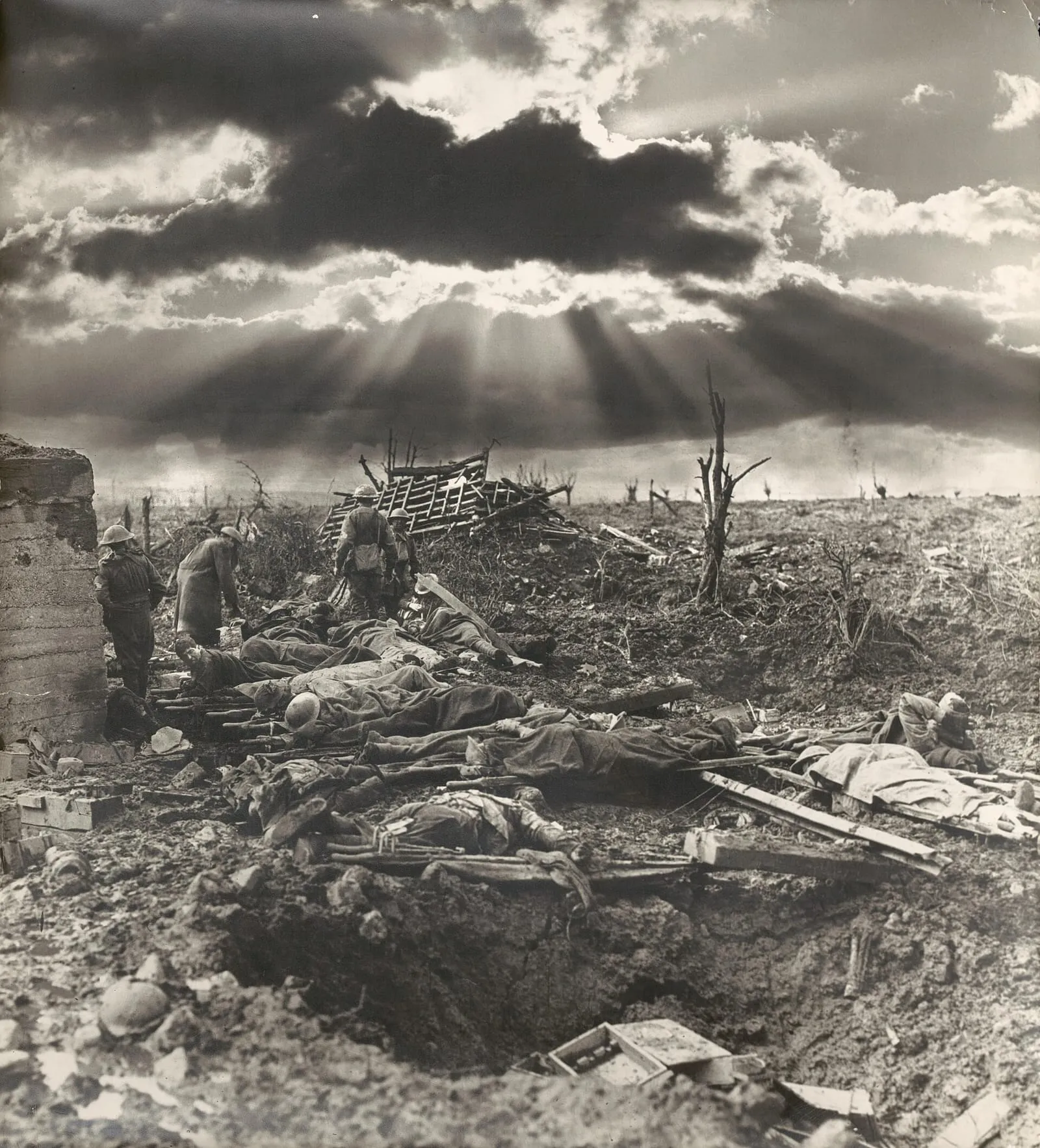
The First Battle of Passchendaele was the second and last October attack with which the British command tried to take the Passchendaele ridge before winter brought the Third Battle of Ypres to an end. On 12 October 1917 at 5.25 a.m., only three days after the failed attack at Poelcappelle, General Alexander Godley’s II Anzac Corps advanced in the rain on the village of Passchendaele and the Bellevue spur. General John Monash’s 3rd Australian Division was to take the village, and General Andrew Russell’s New Zealand Division the spur, in front of which stood concrete machine-gun pillboxes protected by broad belts of uncut wire. The artillery, stuck in the mud, provided only a weak and ragged barrage. The New Zealanders were held up in front of the wire and within a few hours lost about 2,700 men, including about 845 killed or mortally wounded. It was the most tragic day in New Zealand’s history. A handful of Australians reached the church in Passchendaele, but in the afternoon the whole 3rd Australian Division fell back almost to its start line. After this defeat Field Marshal Douglas Haig halted the attacks until the weather improved and entrusted the capture of Passchendaele to the Canadians.
Name and dates
The name “First Battle of Passchendaele” was given after the war by the British Battles Nomenclature Committee, which counted the fighting of 12 October 1917 as the seventh of the eight battles of Ypres in 1917. The battle lasted one day. The second battle of the same name was the Canadian attacks of 26 October – 10 November. Charles Bean’s Australian official history counts differently: it calls the attack of 9 October “Passchendaele I” and the fighting of 12 October “Passchendaele II”. In New Zealand people usually speak of the attack on the Bellevue spur, while the Germans counted this fighting as part of the Battle of Flanders (Flandernschlacht), in Ludendorff’s division of it its fourth period (2–21 October).
Times are given in British time as it was then. On 8 October the British army switched to winter time, so 5.25 a.m. corresponded to 6.25 a.m. by the earlier summer time.
Background
After the victory at Broodseinde on 4 October Haig was convinced that the German army in Flanders was close to collapse, and he brought forward the next attacks to 9 and 12 October. The first was to bring the troops to the approaches of Passchendaele, the second to take the village. The attack of 9 October, made by exhausted British divisions, broke down, however, in the mud in front of the Bellevue spur. In the evening, while parts of the 66th Division were still holding on near the first objective, General Herbert Plumer, probably after talking to Godley, reported that the line reached would give II Anzac Corps a good jumping-off point for taking Passchendaele on 12 October. On 10 October Haig issued the order for the attack before anyone knew exactly what had happened.
Only when the 3rd Australian Division and the New Zealand Division relieved the 66th and 49th Divisions on the night of 10/11 October did it become clear that the line had hardly moved. Instead of about 1,400 metres to the final objective, the troops would have to cover 1,800–2,300 metres, and according to Bean even more in places, at a pace that had not been attempted even in the dry September weather. The interval between attacks was three days instead of the six to eight of Plumer’s September “bite and hold” attacks. The guns could not reach their planned positions: many batteries stood on the exposed slope below Frezenberg, more than a mile and a half behind the intended positions, on platforms that sank into the mud after every shot. Ammunition was brought up on mules, and a journey that normally took an hour lasted, according to the diary of one Australian battery, as long as 17 hours. On 11 October the commander of the New Zealand artillery reported that effective support could not be counted on.
The wire was the greatest danger. A patrol of the 2nd Otago Battalion examined it on the night of 10/11 October: in front of the pillboxes of the Bellevue spur, part of the old Flandern I line, ran belts of wire 25–50 yards (about 20–45 metres) deep, which the Germans had strengthened further since 9 October. The heavy artillery could do little against them. Russell later wrote that the precise information came a day too late to ask for a postponement or to change the barrage plan. Bean and some later historians blamed Godley’s staff for this. On the evening of 11 October, after a whole afternoon of rain, General Hubert Gough, commander of the neighbouring Fifth Army, telephoned Plumer proposing that the attack be put off. Plumer consulted his corps commanders and replied that the attack would go ahead.
At General Headquarters optimism nonetheless prevailed. On 11 October Haig told war correspondents that on Tuesday only the mud had beaten the army, and that the Germans now had nothing in front of it but “flesh and blood, not pillboxes”. His chief of intelligence, General John Charteris, on the other hand, had already written in his diary on 10 October that there was no longer any chance of complete success here this year.
Plan and forces
The main attack was the task of II Anzac Corps of the Second Army. The 3rd Australian Division was to advance with its 9th Brigade along the ridge beside the Passchendaele road and with its 10th Brigade along the valley of the Ravebeek, and take the village. One of the units carried an Australian flag to be planted in Passchendaele. Haig told Monash that the news would be telegraphed to Australia at once. The New Zealand Division attacked the Bellevue spur with its 2nd Brigade (Otago and Canterbury battalions) and 3rd Rifle Brigade, and was then to go on to the Goudberg spur north of the village. Each of the three objectives, red, blue and green, was to be taken by a different battalion passing through the previous one. The final objective lay about 400 metres beyond the village and was to be reached around noon. On paper the New Zealand Division had the support of 144 field guns and 48 howitzers.
On the right flank the 12th Brigade of the 4th Australian Division from I Anzac Corps was to take the saddle of the Keiberg hill by the railway cutting and cover the flank. In the north the Fifth Army covered the attack with brigades of the 9th (Scottish) Division and the 18th Division from XVIII Corps, and of the 4th and 17th Divisions and the Guards Division from XIV Corps, which were to advance towards Houthulst Forest.
Opposite them stood the same divisions of General Friedrich Sixt von Armin’s Fourth Army that had repulsed the British on 9 October, among them the 195th Division at Passchendaele and the 233rd Division at Keiberg, with the fresh 18th Division in the Poelcappelle sector. The Germans expected an attack. On the night of 11/12 October their artillery shelled the approach roads with gas as part of the long-planned “Mondnacht” operation. In the Australian sector a strong wind dispersed the gas, but the Guardsmen in the north suffered severe losses from it.
Course of the battle
Night and dawn. The Australian brigades set out at about 6 p.m. from near Potijze, where they had spent the previous night in wet grass because the promised tents had not been delivered. The duckboard tracks were accurately shelled with high explosive and gas shells. At about 1.30 a.m. it began to rain, and by 3.30 it was pouring. The men moved in single file in complete darkness, holding on to the equipment of the man in front. The New Zealanders crossed the Ravebeek on five bridges of coconut matting laid by the engineers and arrived in time. At about 5 a.m. the Germans shelled their start positions, destroying some of the mortar ammunition, and the Australian battalions lying on the tapes also suffered losses even before the attack.
The Bellevue spur. When the barrage opened at 5.25, the New Zealanders realised at once that they would have to rely on themselves. The fire was weak and uneven, some shells fell on their own lines, and howitzer shells sank into the soft mud and failed to explode or threw up only fountains of slime. Machine-gun fire opened from the pillboxes on the ridge and from the trenches near Crest Farm. At about 6 a.m. the wind rose and the drizzle turned into a downpour. On the left flank the 3rd Rifle Brigade took the cemetery at the edge of the spur and reached the edge of Wolf Copse, but got no further. At about 8 a.m. Lieutenant-Colonel Edward Puttick ordered three battalions to dig in on the slope. In the 2nd Brigade’s sector the men of the 2nd Otago Battalion reached the wire and tried in vain to cut it under fire. The only passage, the sunken Gravenstafel road, was a trap in which machine guns on both sides mowed down everyone who entered it. The 1st Otago and 1st Canterbury Battalions threw themselves in turn at the same wire. A few men got through both belts of wire and were killed at the loopholes of the pillboxes. The commander of the 1st Canterbury Battalion, Lieutenant-Colonel George King, was killed by a shell soon after the attack began, as his staff moved forward along the road. The only success came in the swamps along the Ravebeek, where Second Lieutenant Arthur Cockerell’s platoon took two pillboxes and about 60–80 prisoners. Of the whole platoon only one man remained with him, and he garrisoned the pillboxes together with Australians who came up from the valley.
The Ravebeek valley and the ridge. On the Australian side the 9th Brigade, which started about 300 metres behind the rest of the line and was to make up for it at the double, became mixed up from the start. The machine-gun nests at Hillside Farm and a pillbox by the road on the crest of the ridge were taken only after an hour, largely thanks to Captain Clarence Jeffries of the 34th Battalion, who twice led an attack on the German positions. The second time he was killed, and he was awarded the Victoria Cross posthumously. At about 8.30 a.m. the remnants of three battalions, roughly a hundred men under Captain Carr, halted on the eastern slope, on a line they took to be the second objective, and sent several hundred prisoners to the rear. One company reached a point on the road about 550 metres from the church in Passchendaele. The 10th Brigade in the Ravebeek valley lost many men under fire from Augustus Wood and the Waterfields pillbox, and then from the Bellevue spur, which the New Zealanders had not taken. Among the dead was Sergeant Lewis McGee of the 40th Battalion, posthumously awarded the Victoria Cross for the fighting at Broodseinde. Major Giblin gathered 100–200 men near the first objective and at 8.40 a.m. reported that he did not have the strength to go on.
About twenty soldiers, mainly from the 38th Battalion, seeing no barrage they could follow, nevertheless went up the Ravebeek valley as far as Passchendaele. The garrison of the pillbox at Crest Farm surrendered to them without a fight, and they reached the church in the village and found no Germans there. Seeing no one from their own side either, they turned back. On the way they saw the Germans returning to Crest Farm and opening fire from it.
The withdrawal. For a long time the command did not know the true situation. Until noon Monash heard mostly good news, and he learned only at 10.50 a.m. that the New Zealand Division had been held up along its whole front. Corps ordered the New Zealanders to renew the attack at 3 p.m. The battalion commanders protested unanimously and were already preparing to go with their men to certain death when the order was cancelled. The 3 p.m. barrage went ahead anyway, and one of its shells fell on a New Zealand post. It also, however, broke up German units forming up for a counter-attack. Meanwhile, at about 3 p.m., it began to rain again. The German artillery fired over open sights at the Australian posts on the ridge, and from the Bellevue spur the Germans came down into the rear of the 10th Brigade. Giblin withdrew his men in small groups, and by 3.30 p.m. they were back on the start line. In the 9th Brigade the withdrawal, ordered at about 3.45 p.m., was disorderly. The 12th Brigade, which had taken the cutting at Keiberg and repulsed two German counter-attacks, had to fall back along the railway embankment when it lost its cover on the left. By evening both Australian divisions stood practically on their morning positions, and the New Zealanders, leaving posts on the slope, withdrew a little lower down.
The Fifth Army. In the north the attack also failed almost everywhere except on the left flank. The 9th (Scottish) Division was mostly held up about 100 yards from its start line, and in the sector of the 18th and 4th Divisions at Poelcappelle the German 18th Division repulsed the attacks and in the afternoon went over to counter-attacks. Private Albert Halton of the 1st Battalion, King’s Own (Royal Lancaster Regiment), of the 4th Division captured a machine-gun nest that day and received the Victoria Cross. Things went best in the low ground by the boundary with the French, where the barrage was stronger: a brigade of the 17th Division reached its final objective on the Broembeek stream at about 11 a.m., taking 218 prisoners, and the 3rd Guards Brigade occupied higher ground at the edge of Houthulst Forest.
Losses
According to the British official history the New Zealand Division lost 2,735 men, of whom 845 were killed or died of wounds, many of them left lying in no man’s land. The New Zealand historian Glyn Harper gives 846 killed and about 2,000 wounded, of whom 138 died within the following week. According to the New Zealand official history the bodies of 40 officers and 600 men lay around the wire and along the Gravenstafel road. According to Bean the 3rd Australian Division lost 3,199 men, and the 12th Brigade of the 4th Division about a thousand. Total British and dominion losses that day are estimated at about 13,000, and the British official history gives 10,973 men for the Fifth Army on 9–14 October, including the Battle of Poelcappelle.
German losses for 12 October alone cannot be established. The German official history gives about 12,000 killed, wounded and missing for the Fourth Army in the ten-day period 11–20 October. The 195th Division, which defended Passchendaele, lost 3,325 men on 9 and 12 October and had to be relieved. The British took more than a thousand prisoners, and the Germans about 56 unwounded Australians and many wounded.
The fate of the wounded was especially terrible. The battlefield was still strewn with wounded from 9 October, and six or even eight men were needed for each stretcher. On 13 October an informal truce took hold on the slopes of the Bellevue spur: German riflemen did not fire on the stretcher-bearers, and in several places they themselves pointed out wounded Australians to them. According to the New Zealand official history the last living wounded were carried off the field only on the afternoon of 14 October.
Significance
The defeat of 12 October finally dashed Haig’s hopes of a great strategic victory in Flanders in 1917. On 13 October it was decided to halt the attacks until the weather improved and the roads were repaired, and then to take the Passchendaele ridge by methodical steps as a winter line, to pin down the Germans ahead of the French attack at Malmaison and to divert attention from the tank attack being prepared at Cambrai. The task went to the Canadian Corps of General Arthur Currie, who had commanded it since June. On 18 October the Canadians took over the sector of II Anzac Corps, and on 26 October they began the Second Battle of Passchendaele. They took the Bellevue spur itself on the very first day, and the ruins of the village on 6 November, more than three weeks after the Australians and New Zealanders had tried to take them in a single blow.
The battle showed that Plumer’s method of limited attacks did not work when its foundations were missing: time for preparation, artillery in position and rested infantry. Bean wrote that no infantry in the world could have crossed the mud of the Ravebeek and the dense wire at Bellevue behind a barrage that did not even provide a screen. On the German side it brought relief. The Crown Prince of Bavaria, Rupprecht, wrote in his diary that the rain was his “most effective ally”, and Erich Ludendorff changed his mind again: he judged that the British had at most about two weeks left before the weather made attacks impossible, and ordered that as little ground as possible be given up.
In New Zealand 12 October 1917 remains the blackest day in the country’s military history and the day with the greatest number of deaths in its history. In a few hours more New Zealanders were killed or maimed than on any other day, more even than on the heaviest days at Gallipoli in 1915. The division that had taken Messines in June and the Gravenstafel ridge on 4 October suffered its only major defeat here. The New Zealanders killed at Broodseinde and Passchendaele whose graves were never found are commemorated by a separate memorial in Tyne Cot Cemetery. For the Australians the battle practically ended the active part of their infantry in the Flanders offensive.
Spotted a mistake?Report an error