Key event
Battle of the St Quentin Canal begins
- Category:
- Military operations
- Front:
- Western Front
- Date:
- 29 September 1918
- Author:
- Łukasz Skowroń
- Battle:
- Battle of the St Quentin Canal
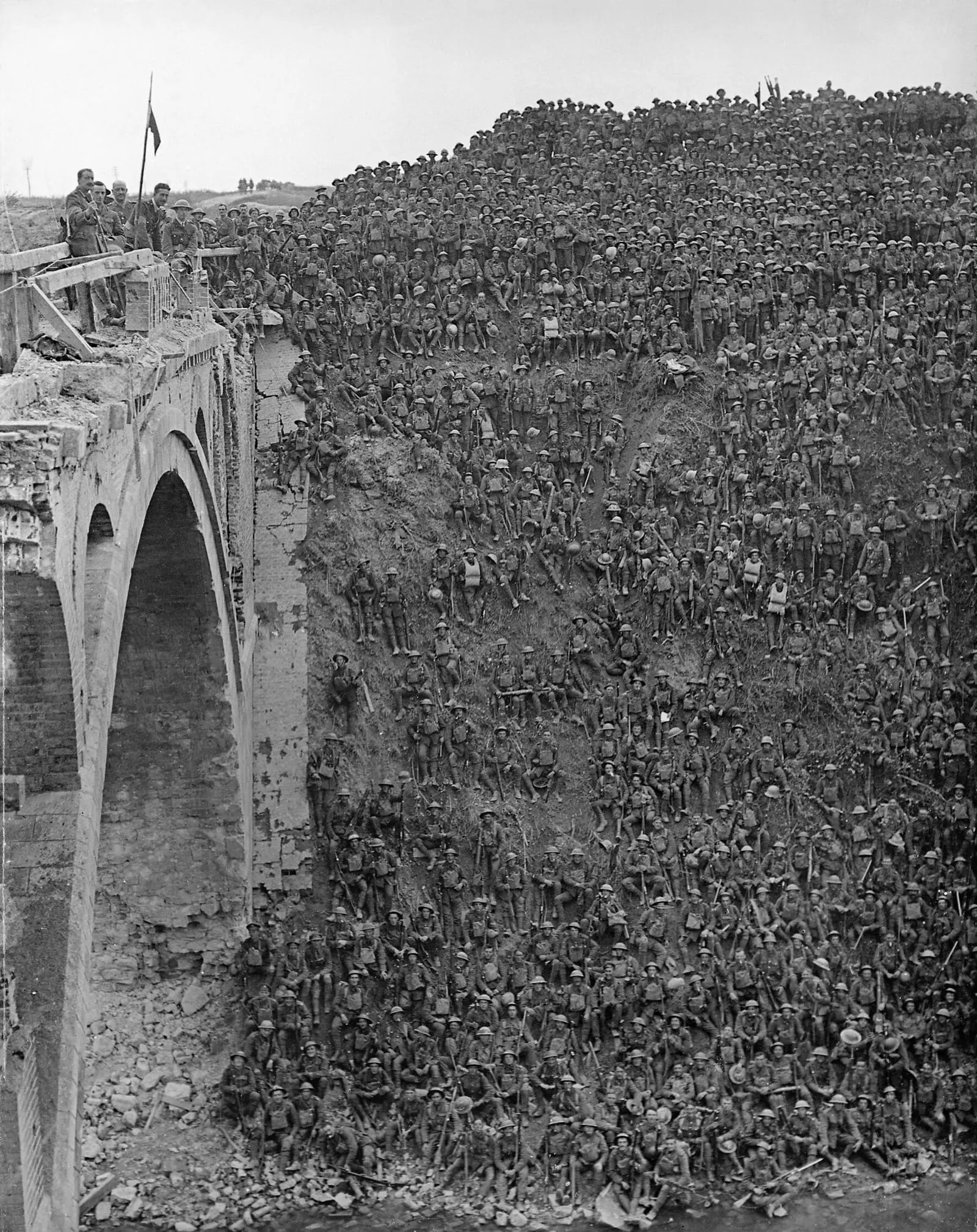
At 5.50 a.m. on 29 September 1918 General Henry Rawlinson’s British Fourth Army attacked the Hindenburg Line north of Saint-Quentin. It was the last of four blows that Marshal Ferdinand Foch dealt the Germans on successive days: on 26 September the Meuse-Argonne offensive began, on 27 September the Canadians and British crossed the Canal du Nord, and on 28 September the Belgians and British attacked at Ypres. That day, in thick fog, the British 46th Division crossed the deep cutting of the canal at Bellenglise and Riqueval and took more than four thousand prisoners. To its north, over the underground stretch of the canal at Bellicourt, two American and two Australian divisions fought heavy and confused battles all day. The Battle of the St Quentin Canal had begun, the most important of the battles of the Hindenburg Line.
Night and fog
From 10.30 p.m. on 26 September more than 1,600 British guns shelled the German positions, first with mustard gas shells and then with high explosive and shrapnel. For three nights two batteries of six-inch howitzers fired a shell every minute into the defences above the bend of the canal at Bellenglise, so that the defenders could get no rest. The night of 28–29 September was dark and stormy, and towards morning, as the army’s meteorologists had forecast, fog settled over the ground. Together with the smoke of the screens and of the guns, it meant that for several hours the airmen of the Royal Air Force could see almost nothing. The tanks drove up to their start positions at night, the noise of their engines drowned by the cannonade.
The fog was a bad omen for the American 27th Division. Its preliminary attack on 27 September on the Quennemont and Gillemont farms and the Knoll had failed, and since small groups of Americans, including wounded, might still be lying in front of the line, the barrage had not been brought closer. So at 4.50 a.m., an hour before the rest of the army, the division’s leading units set off to fight their way, on their own and with the help of tanks, to the line from which the barrage was to start at 5.50.
The crossing at Riqueval
On the front of General Gerald Boyd’s 46th (North Midland) Division the canal ran in a cutting in places more than ten metres deep, between walled banks. In the south there was little water in it, but about two and a half metres of mud. In the north the water was two to three metres deep. The attack was made by the 137th Brigade, made up of three battalions from Staffordshire. Boyd had the barrage moved twice as fast as usual, a hundred yards every two minutes, so that the men would run down the slope to the canal before the Germans came out of their dugouts. Five minutes after zero hour the German counter-barrage came down, hitting the British and the Germans’ own trenches at the same time, but the Staffords reached the canal on schedule and with light losses, taking 120 prisoners.
They crossed by every means prepared: on rafts, along ropes, over a footbridge left by the Germans, and on the deeper stretch on lifebelts collected from the cross-Channel ferries, and on planks. A company of the 1/6th Battalion, North Staffordshire Regiment, was to seize the bridge at Riqueval, by which the Germans supplied their trenches on the western bank. An officer and nine men burst out of the fog, put out of action the machine gun guarding the bridge and shot the German engineers who, having sat out the bombardment in a dugout, were running to blow it up. The bridge fell into British hands intact, and beyond it the company took 130 prisoners, including a battalion staff.
At 7.30 a.m. the barrage moved on. The battalions of the 137th Brigade followed it, clearing trenches and cellars. At Bellenglise they entered the canal tunnel, whose western entrance had earlier been collapsed by twelve-inch howitzer shells, and led out about 800 Germans. The prisoners showed the engineers the charges prepared for blowing up the tunnel. Around 8.20 the brigade stood on the second intermediate line, capturing a battery of four guns on the way. Observers in the fog could see nothing, and the news that the canal had been crossed was brought to divisional headquarters by a wounded sergeant from an improvised mounted unit. Boyd ordered the 138th and 139th Brigades to cross the canal, but they had already set off on their own, around 8.30. At 9.30 he asked for a cavalry brigade, which, however, arrived only around 2.30 p.m., when it was too late to use it.
At 11.20 a.m. the two brigades went forward behind another barrage. The fog was thinning, and the 139th Brigade was stopped by the fire of a German battery on the far bank of the canal, which destroyed its tanks. A group of men from the 6th Battalion, Sherwood Foresters, went back across the canal and killed the gun crews, and the battalion commander, Lieutenant-Colonel Bernard Vann, an Anglican clergyman, ran up to the line and rallied the men for a further attack before the barrage had got away from them. For this he was awarded the Victoria Cross, posthumously, as he was killed a few days later. By 3.30 p.m. both brigades had reached the day’s objective. Magny-la-Fosse had fallen earlier, and Lehaucourt half an hour later. The Germans surrendered in masses. On the northern edge of the breach men of Major Blair Wark’s Australian 32nd Battalion, advancing from the direction of the tunnel, met British soldiers of the 1/4th Battalion, Leicestershire Regiment, who had come from across the canal.
In the evening the 32nd Division passed over the canal at Bellenglise and across the bridge at Riqueval. At 6 p.m., as darkness fell, it advanced behind a barrage and took Le Tronquoy and the nearby wood, capturing 300 prisoners and three twelve-inch howitzers. To its right the 1st Division had advanced by 2.30 p.m. along the western side of the canal to the road from Saint-Quentin to Bellicourt. According to the British official history, IX Corps took about 5,100 prisoners and 90 guns that day, 4,200 prisoners and 72 guns of them by the 46th Division, which lost fewer than 800 men. It was the same Territorial division whose attacks at the Hohenzollern Redoubt in 1915 and at Gommecourt in 1916 had ended in disaster.
Over the tunnel
Over the tunnel at Bellicourt the attack was led by General John Monash’s Australian-American Corps. In the first line were the American 30th Division on the right and the 27th Division on the left. Their artillery, 818 guns, was provided by the British, and in the attack they were supported among others by the American 301st Tank Battalion in British Mark V tanks. For both divisions it was their first great battle. Before that, the Americans had fought alongside the Australians only in the small Battle of Hamel, and then with only a few companies.
The 30th Division went right behind the barrage. Its 120th Infantry Regiment passed in the fog through the main and support positions of the Hindenburg Line, with their maze of trenches and wire, and reached Nauroy, more than three kilometres from the start line. The Americans took Bellicourt and the southern entrance to the tunnel. In the fog and smoke, however, no one had control over the mopping up of the captured ground, and German machine-gunners who had sat out the first wave in their dugouts opened fire on the backs of the following units. Around nine a group of armoured cars and light tanks drove along the road to Bony, found the village in German hands and lost half its vehicles.
On the left wing the 27th Division fought from the start without the cover of the barrage, which fell far ahead of it. Of the 34 tanks that set off with it, twelve were hit by shells, seven got stuck, and several drove onto a British minefield laid in March and not marked on the maps. German field guns sited for firing at tanks destroyed seven vehicles right by Gillemont Farm. The 107th and 108th Regiments were held up in front of the farms and the Knoll, and the 105th and 106th Regiments, which were to mop up and cover the flank, were also drawn into the fighting. By eleven the Americans had almost reached the line they were to have taken two days earlier, but left behind them many uncleared German posts. Some groups broke through as far as the Hindenburg Line but were surrounded there and killed or taken prisoner.
The Australian 3rd and 5th Divisions set off at seven, intending to pass through the American lines around eleven and carry on the attack. After nine, however, they ran into fire from positions that should already have been taken, and in the fog and smoke no one knew where the Americans were. The commander of the 3rd Division, General John Gellibrand, threw his brigades into the fight without waiting for reports. The Australian official historian Charles Bean wrote that around ten Monash’s plan “went with the wind”, and from then on the attack was directed by battalion and company commanders. In the 5th Division, General Harold Elliott’s 15th Brigade passed through the Hindenburg Line and by eleven had reached the embankment above the tunnel. At 3 p.m. both divisions attacked again. The tanks of the 15th Brigade were mostly destroyed within a quarter of an hour, but the Australians took the support position south of Bony, and the 3rd Division finally captured the Quennemont and Gillemont farms. One battalion of the 8th Brigade got as far as Joncourt, but, isolated, had to withdraw.
Afternoon and evening
The Germans, who brought up the 21st Division and the 2nd Guard Division from reserve in the afternoon, repulsed further attacks, and the positions above the tunnel changed hands several times. German regimental histories blamed the defeat on the fog, the gas and the tanks, and one of them observed that the fog which in March had helped the Germans in the same place this time helped their opponents. By evening the Fourth Army had driven into the German positions on its right wing to a depth of about five kilometres, taking the greater part of the main position of the Hindenburg Line and roughly half of the support position. The result, however, was more modest than expected, and over the tunnel, where the main blow was to have fallen, the fighting was still going on.
After conferring with Monash and with the commander of the American II Corps, General George Read, Rawlinson decided to withdraw the Americans to rest and to continue the attack with the Australians and British. In his diary he wrote that the Americans were “in a hopeless state of confusion” and that their losses were probably heavy. General John Pershing later wrote approvingly that the 30th Division had broken the Hindenburg Line along its whole front and by noon had taken Bellicourt and part of Nauroy. The heaviest losses were suffered by the 27th Division, whose 107th Regiment, according to the American Battle Monuments Commission, lost more men that day than any other American regiment in a single day of the war. At 11.45 p.m. Rawlinson issued orders for the next day: to complete the capture of the Hindenburg Line and its support position, and then to attack the last line, at Beaurevoir. On the morning of the same day, at Spa, Ludendorff and Hindenburg presented the Kaiser and the foreign minister with a demand for an immediate armistice.
Remember the articles you have read? Only in this browser; nothing is sent anywhere.How it works
Read ·
A voice from the front
“Two telegrams then came in which caused me serious anxiety. […] These were only the first symptoms of a miscarriage of the plans. Evidences rapidly multiplied that all was not going well. But, concurrently, there came a stream of messages from the air that our troops and some of our Tanks were east of both Bellicourt and Le Catelet. The situation was therefore confused and uncertain, and it had to be diagnosed without delay.”
Spotted a mistake?Report an error
Meanwhile
(04)Elsewhere in the same days.
- 29 September 1918 · PoliticsLudendorff demands an armisticeOn 29 September 1918 at Spa Hindenburg and Ludendorff demanded an immediate armistice request. The Kaiser agreed to appeal to Wilson and to parliamentary rule.
- 29 September 1918 · Middle EastThe Ma'an garrison surrendersOn 29 September 1918 at Ziza, south of Amman, the Turkish garrison of Ma'an, surrounded by Bedouin, surrendered to Australian light horsemen.
- 29 September 1918 · AfricaLettow-Vorbeck returns across the RovumaAt the end of September 1918 Lettow-Vorbeck's force crossed the Rovuma and, after ten months in Mozambique, returned to German East Africa.
- 29 September 1918 · Asia and the PacificHara cabinetOn 29 September 1918 Seiyūkai leader Takashi Hara became prime minister of Japan, the first premier from outside the aristocracy, heading a party cabinet.
Related events
(04)The same battle, people or subject.
- 2 October 1918 · Western FrontEnd of the Battle of the St Quentin CanalOn 1–2 October 1918 the British Fourth Army took Joncourt and the rest of the Hindenburg Line at Bony and broke into the Beaurevoir Line, but lost Sequehart.
- 8 August 1918 · Western FrontBattle of Amiens beginsOn 8 August 1918, in fog, Canadians, Australians and tanks broke the front at Amiens, taking over 15,000 prisoners. Ludendorff called it the "black day".
- 3 October 1918 · Western FrontStart of the battle of the Beaurevoir LineOn 3 October 1918 the British and Australians broke the Beaurevoir Line, the Hindenburg Line's last position. Montbrehain fell, but the Germans retook it.
- 8 October 1918 · Western FrontBattle of Cambrai beginsOn 8 October 1918 the British Third and Fourth Armies and the Americans attacked between Sequehart and Cambrai. At Niergnies the Germans used captured tanks.