Key event
Ludendorff demands an armistice
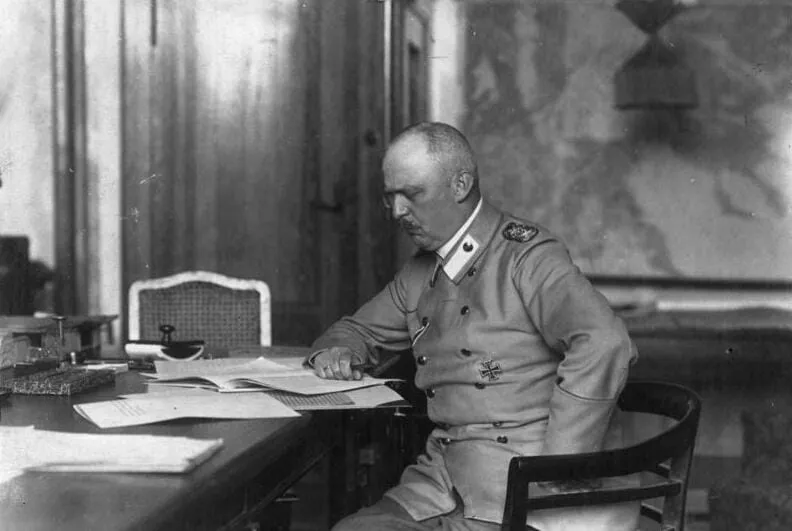
On 29 September 1918 at Spa, the Belgian spa town that housed German General Headquarters, the army’s leaders told the Kaiser and the foreign secretary that the war could no longer be continued and that Germany must immediately ask for an armistice. Field Marshal Paul von Hindenburg and General Erich Ludendorff, First Quartermaster General and the real head of the Supreme Army Command, had assured everyone as late as July that the offensive would bring victory, and in mid-August at the Spa conference they had argued that the army would hold its ground on French soil. Now they themselves demanded that peace and a ceasefire be proposed to the enemy through President Woodrow Wilson. Kaiser Wilhelm II agreed. On the same day the decision was also taken to hand power to a government based on a majority in the Reichstag. It was the beginning of the end of the German Empire.
A week of defeats
Since August the Western Front had been falling back without respite, but the last week of September brought blow after blow. On the evening of 26 September news reached Spa from Vienna that the Tsardom of Bulgaria, whose army was disintegrating under the blows of the Vardar offensive, wanted to conclude a separate peace and that its delegates were on their way to Salonika to ask for an armistice. Ludendorff ordered several divisions sent to the Balkans, but he knew they would not arrive in time: the collapse of Bulgaria cut off Turkey, opened the way to the Danube for the Allies and threatened the Romanian oil. That same morning the Americans and French had attacked between the Meuse and the Argonne and in Champagne; on 27 September the British and Canadians forced the Canal du Nord before Cambrai; and on 28 September the Belgians, British and French recovered at Ypres in a single day all the ground that had been fought over for months in 1917. An attack on the main position of the Siegfried Line on the St Quentin Canal was already being prepared for 29 September.
Ludendorff had been at the end of his strength for weeks. He worked a dozen or more hours a day, slept little and flew into rages at his subordinates. His colleagues were so alarmed that at the end of the summer they brought a doctor, a specialist in nervous diseases, Dr Hochheimer, to headquarters, who urged the general to rest. Some staff officers, led by Colonel Wilhelm Heye, had already concluded that the war was lost and, according to some historians, warned the Foreign Office of this even before Ludendorff’s decision. Ludendorff himself later wrote that he had reached the conclusion that peace must be sought “not suddenly, but step by step”, from the beginning of August.
Six in the evening
According to Ludendorff’s memoirs, at six in the evening on 28 September he went down to Hindenburg’s room in the Hotel Britannique, one floor below. He set out his view: the situation could only get worse, if only because of the Balkans, even if the front in the west held, so an offer of peace and a request for an armistice must be made without delay. The field marshal listened, moved, and replied that he had intended to tell him the same thing that evening. They agreed that the armistice terms must allow an orderly evacuation of the occupied territories and a resumption of the fight on Germany’s own frontier, and they did not intend to give up the lands conquered in the east, counting on the Entente also fearing Bolshevism. “The field marshal and I parted with a firm handshake,” Ludendorff wrote, “like men who have buried their dearest hopes.”
On Sunday 29 September the Secretary of State for Foreign Affairs, Paul von Hintze, arrived at Spa. In Berlin the ground was already being prepared. A memorandum drawn up in his office on 28 September stated that the condition for peace was the formation, “on the free initiative” of the Kaiser, of a new government on a broad national basis, with the participation of the party leaders. The new government was to ask Wilson to restore peace on the basis of the Fourteen Points and, “in accordance with the wishes of our military authorities”, also for an immediate armistice.
The meeting at the Hotel Britannique
The meeting began at ten in the morning at the Hotel Britannique, in Heye’s presence. The participants’ accounts differ. Ludendorff claimed that Hintze began straight away with domestic politics: the position of Chancellor Georg von Hertling was so shaken that he could no longer hold office, a change of the whole system and the formation of a parliamentary government were necessary, and otherwise revolution threatened. According to Hintze’s notes, which historians cite, it was Ludendorff who opened the meeting with a statement that the army’s situation required an immediate ceasefire to avoid catastrophe. Hintze replied that so abrupt a turn would shake the country, and pointed to two paths: dictatorship or a “revolution from above”, that is, admitting representatives of the parliamentary majority into the government. Everyone rejected dictatorship.
On the road to peace the soldiers agreed with the minister. Hintze thought it best to turn directly to Wilson, who had repeatedly and solemnly announced his terms and, thanks to the American army in France, could impose them on London and Paris. Ludendorff merely proposed that an identical note be sent to the British and French for their information. He knew that an exchange of notes through Washington would take time and that an armistice could not be obtained overnight.
With the Kaiser
Immediately afterwards both commanders and Hintze went to the Kaiser, who had come to Spa from Kassel. Hintze presented the domestic situation and the proposal of an offer to Wilson, Hindenburg described the military situation, and Ludendorff briefly confirmed it. According to Ludendorff, Wilhelm II was “remarkably calm” and accepted both proposals. The Chancellor was not present. Hertling arrived at Spa only in the afternoon and found the decisions taken without him. An opponent of parliamentary government, he did not want to lead such a government and asked to be relieved that same day. When Ludendorff asked when the new government would be formed and the note agreed with the allies and ready to be sent, Hintze replied: on Tuesday, 1 October.
At 9.40 p.m. Hintze telegraphed to Berlin that, on the Kaiser’s orders and with the Chancellor’s consent, he intended to propose peace to Wilson on the basis of the Fourteen Points, to ask him to convene a peace conference in Washington and at the same time to ask for an immediate cessation of hostilities. If the allies agreed, the proposal was to be presented by “the new imperial government, which is now in the process of formation”, so that it would appear to have come from it. Vienna and Constantinople were informed that same night. In the evening Major Baron Erich von dem Bussche left for Berlin to explain the situation at the front to the party leaders.
Escaping responsibility
The decision of 29 September took by surprise the politicians who had for months been told of imminent victory. Ludendorff did not intend to take the blame. On 1 October he told the assembled staff officers that he had asked the Kaiser to bring into the government the people to whom the army “owed” the fact that matters had come to such a pass: “Let them now eat the soup they have cooked for us.” Historians see in this sentence the germ of the stab-in-the-back myth. They still argue whether the demand for an armistice was an outburst of panic by an overworked general or a cold calculation to shift the responsibility for defeat onto parliament, and whether Ludendorff was not simply counting on a breathing space of a few weeks, after which the army could fight on.
In the following days the Supreme Army Command pressed Berlin to send the note at once, without waiting for the new government, because “today the troops are still holding; what will happen tomorrow, no one knows”. The new chancellor was Prince Max von Baden, who considered such haste harmful but gave way. The note requesting an armistice, dated 3 October, was passed to Wilson through Switzerland. The exchange of notes dragged on throughout October, and the armistice was not signed until 11 November.
Remember the articles you have read? Only in this browser; nothing is sent anywhere.How it works
Read ·
A voice from the front
“Our names were linked with the greatest victories of the World War. Now we were agreed that it was our duty to lend our names to this step, which we had done everything conceivable to avoid.”
Translated · Original (de)
Unsere Namen waren mit den größten Siegen des Weltkrieges verknüpft. Jetzt waren wir uns in der Auffassung einig, daß es unsere Pflicht sei, unsere Namen für diesen Schritt herzugeben, den zu vermeiden wir alles Erdenkliche getan hatten.
Spotted a mistake?Report an error
Meanwhile
(04)Elsewhere in the same days.
- 29 September 1918 · Western FrontBattle of the St Quentin Canal beginsOn 29 September 1918 the British 46th Division crossed the St Quentin Canal in fog, while Americans and Australians stormed the Hindenburg Line at Bellicourt.
- 29 September 1918 · AfricaLettow-Vorbeck returns across the RovumaAt the end of September 1918 Lettow-Vorbeck's force crossed the Rovuma and, after ten months in Mozambique, returned to German East Africa.
- 29 September 1918 · Middle EastThe Ma'an garrison surrendersOn 29 September 1918 at Ziza, south of Amman, the Turkish garrison of Ma'an, surrounded by Bedouin, surrendered to Australian light horsemen.
- 29 September 1918 · Western FrontAllies retake PasschendaeleOn 29 September 1918 the Belgians consolidated on the retaken Passchendaele ridge, took Moorslede and recovered Diksmuide, lost in November 1914.
Related events
(04)The same battle, people or subject.
- 4 October 1918 · DiplomacyPeace notes to WilsonOn 4 October 1918 Germany and Austria-Hungary sent President Wilson notes asking for an armistice and peace talks on the basis of the Fourteen Points.
- 3 October 1918 · PoliticsMax von Baden becomes chancellorOn 3 October 1918 Prince Max von Baden became Reich chancellor. For the first time in the Empire's history Social Democrats joined the government.
- 23 October 1918 · DiplomacyWilson's third noteOn 23 October 1918 Wilson passed the armistice question to the Allies and warned that with Germany's old rulers he could discuss only surrender.
- 8 October 1918 · DiplomacyWilson's first replyOn 8 October 1918 Wilson asked Germany whether it accepted the Fourteen Points and for whom the chancellor spoke. On 12 October Berlin answered yes.