Key event
Fifth Battle of Ypres begins
- Category:
- Military operations
- Front:
- Western Front
- Date:
- 28 September 1918
- Author:
- Natalia
- Battle:
- Fifth Battle of Ypres
- Tags:
- Belgium, Great Britain, Germany, Albert I
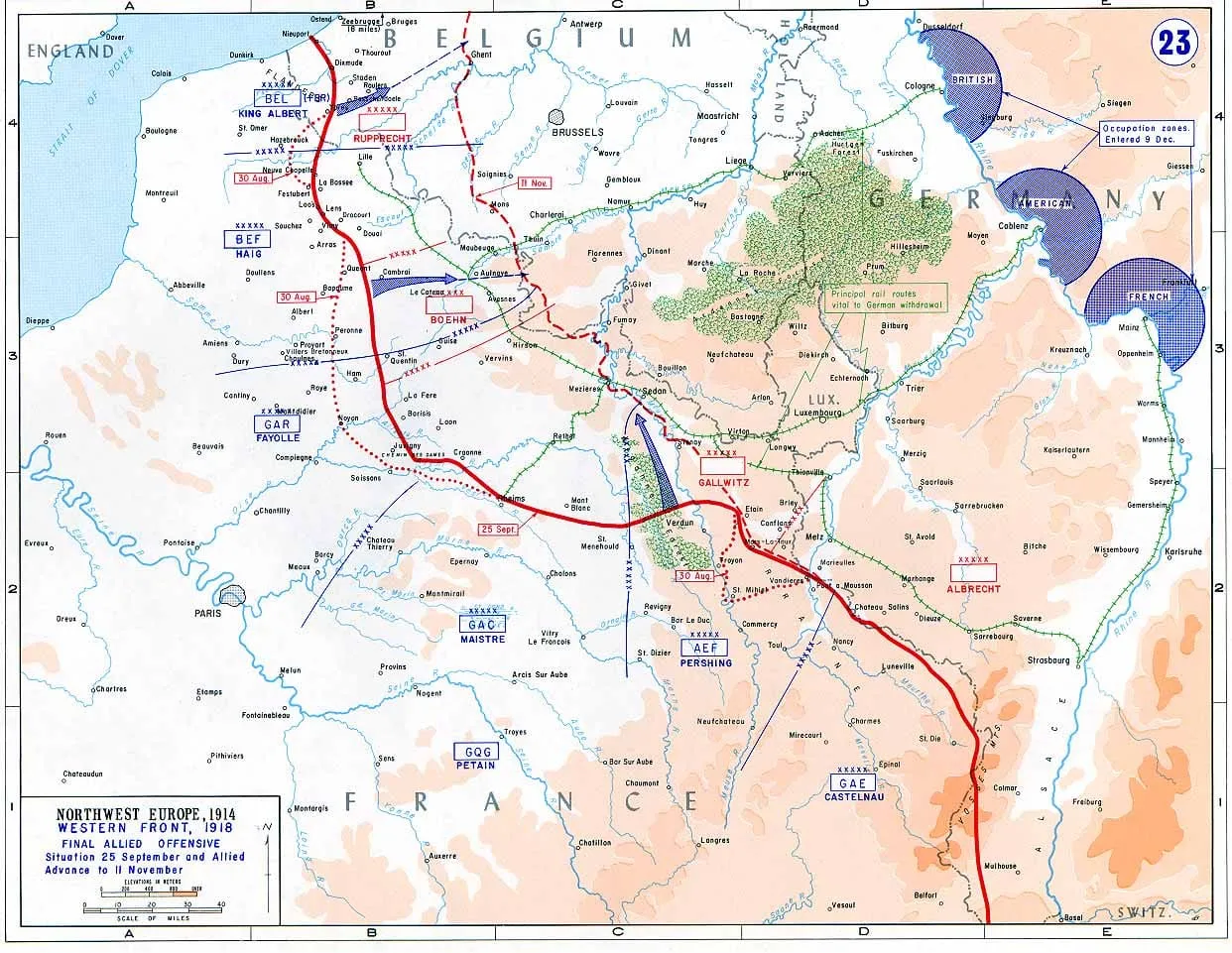
On 28 September 1918, at 5.30 a.m., in pouring rain, the Belgian Army and the British Second Army went into the attack from Ypres. They were commanded by the King of the Belgians, Albert I, at the head of the newly formed Flanders Army Group. By evening the Allies had taken the Passchendaele ridge, the Gheluvelt plateau and Houthulst Forest, that is almost all the ground the British had fought for from July to November 1917, and had advanced in places by 8–10 kilometres. The German Fourth Army, which for four years had defended these heights with great tenacity, gave way that day almost without a fight. It was the third of the great blows that Marshal Ferdinand Foch dealt the Germans day after day: on 26 September the Americans and French attacked between the Meuse and the Argonne, on 27 September the British forced the Canal du Nord, and now it was Flanders’ turn.
Before dawn
The attack was prepared in under three weeks and in great secrecy. Troops and guns were moved only at night, and the new batteries did not fire a single shot before zero hour. The Belgians and the British, however, differed over method. The Belgian command wanted to precede the attack with a bombardment of several hours, while the British believed that fire in the dark, without observation, would destroy little and only give away their intentions. At a conference on 24 September it was agreed that the Belgians would fire for three hours, while General Herbert Plumer’s Second Army would attack without preparation.
The Germans expected something. On the evening of 27 September the Fourth Army’s chief of staff reported that an attack on both sides of Houthulst Forest was imminent. The warning reached a Bavarian infantry regiment at the junction of the Belgians and the British at 10.30 p.m., but that night the regiment happened to be changing over in its positions. When at 2.30 a.m. the Belgian artillery opened fire with high-explosive and gas shells, as its history records, the bombardment “made any orderly movement impossible”. The reply of the German guns was weak, and the British infantry assembled on its start lines in the rain, undisturbed by anyone.
The British on the Gheluvelt plateau
At 5.30 a.m. two British corps, II and XIX, advanced behind a creeping barrage on a front of just under 7.5 kilometres, from the Ypres–Zonnebeke road south to the Ypres–Comines canal. When it grew light and a south-westerly wind got up, the smoke screened the German machine-gun nests and pillboxes, which proved easier to surround than expected. The British official history calls it “a day of uninterrupted success”: the German artillery was soon silenced by counter-battery fire, and the infantry’s resistance was “half-hearted”.
On the left wing the 9th (Scottish) Division took the Westhoek ridge by 8 a.m., and after a short pause to bring up the guns it went, despite wire and groups of pillboxes, over Anzac ridge and by 11.30 a.m. stood on the main ridge from Polygon Wood to Broodseinde. In the afternoon its 27th Brigade turned south towards the village of Becelaere. Just short of the village three German batteries galloped onto the slope and opened fire on the Scots, but they were quickly silenced, and by 4 p.m. the village was in British hands. The 29th Division reached Hooge by 6.30 a.m., and its first objective between 8.30 and 8.45 a.m. At 10.15 a.m. the 4th Battalion of the Worcestershire Regiment retook Gheluvelt (PL) with many prisoners and a battery of heavy howitzers. It was a special moment for the regiment: on 31 October 1914 the 2nd Battalion of the same regiment had retaken Gheluvelt in one of the most famous counter-attacks of the First Battle of Ypres. At Kruiseecke the British had to wait until 12.15 p.m., because shells from their own heavy artillery were still falling on the village, and in the meantime a German reserve division arrived and they went no further.
In XIX Corps the 35th Division surprised the Germans and took its first objective by 8.30 a.m. with light losses, then, under machine-gun fire from Shrewsbury Forest and guns firing over open sights, reached the ruins of Zandvoorde. The 14th Division, re-formed in England in the summer from men of lower medical category, took by encirclement The Bluff, a hill above the canal bristling with machine guns, and the White Château, and the 41st Division came up from reserve, passed through its lines and in the evening reached Kortewilde on the canal. The Second Army’s left wing advanced 7–10 kilometres and stood far beyond the ridge that for years had dominated Ypres. Infantry losses were light. The air arm suffered most, losing 26 aircraft in low-flying attacks over the German lines.
South of the canal X and XV Corps sent strong patrols onto the Wytschaete–Messines ridge. The 34th and 30th Divisions reached their first objectives, and in the afternoon and evening tried to go further. Sergeant Louis McGuffie of the 1/5th Battalion, King’s Own Scottish Borderers, who that day took one German post after another, was awarded the Victoria Cross for it posthumously; he was killed a few days later. At about 6.30 p.m. a patrol of the 30th Division entered Messines. The British chronology of the war gives 28 September as the day Messines was retaken, and the despatch of Field Marshal Douglas Haig speaks of Wytschaete being taken that day. According to the British official history, however, the villages were finally occupied only on the morning of 29 September, when the Germans withdrew from the ridge during the night. During the night a brigade of the 31st Division advanced in the dark across the shell-hole fields against the flank of the German garrison of the ridge. The German rearguards fell back from pillbox to pillbox, with green flares as the signal for each successive withdrawal.
The Belgians on the Passchendaele ridge
North of the British the attack was carried out by nine Belgian divisions, seven in the front line, on a front of nearly 14 kilometres from the Ypres–Zonnebeke road to the Blankaart lake. French divisions stood in reserve. At 5.30 a.m. the Belgians advanced behind a barrage of six hundred field guns. Between 10 and 11 a.m. they had four of the six German defence lines behind them. After an hour’s pause the attack moved on against increasingly stiff resistance, as the Germans threw a Bavarian reserve division into the fight. By evening the Belgian right wing had taken Zonnebeke and the ruins of Passchendaele, retaken according to Belgian sources by the 4th Carabiniers Regiment and the Grenadier Regiment, and stood beside the British east of Broodseinde. The ridge which the British had given up without a fight in mid-April 1918 was recovered by the Belgians in a few hours. The centre took Poelcappelle and most of Houthulst Forest, which the Germans had turned into a fortress over four years. On the left wing the Belgians cleared the ground near Woumen, covering themselves on the side of Diksmuide. They had not yet taken the northern end of the ridge with Westrozebeke and Staden.
Evening
By evening the whole ridge east of Ypres, except its northern end and the sector at Messines, was in Allied hands. British and Belgian divisions reported that the way was open for cavalry, but a French cavalry brigade could not be brought through the belt of shell holes before dark. The first difficulties that were to halt the attack in the following days were already visible: the 36th (Ulster) Division, sent from reserve at 11 a.m., reached Ypres along blocked and churned-up roads only at 11 p.m., and the Belgian artillery, moving along the Zonnebeke road, delayed the march of the British batteries. At 7 p.m. Plumer issued orders for the next day: the Second Army was to turn south-east, clear the Messines ridge and come out on the Lys. Jean Degoutte, the French chief of staff of the Army Group, ordered the attack to continue without a break, even at night.
On the German side the mood was grim. Crown Prince Rupprecht of Bavaria, commander of the army group in Flanders, wrote in his diary that day that, according to the Fourth Army’s report, its troops “could no longer withstand a serious attack”. At the Supreme Army Command headquarters in Spa the news from Flanders arrived together with reports of the crisis in Bulgaria and of the attacks on the Meuse and at Cambrai. That evening General Erich Ludendorff came to the conclusion that Germany must ask for an armistice. The Belgians, who since the autumn of 1914 had held only a scrap of their own country behind the flooded ground along the Yser, went into a great attack for the first time in four years.
Remember the articles you have read? Only in this browser; nothing is sent anywhere.How it works
Read ·
Spotted a mistake?Report an error
Meanwhile
(04)Elsewhere in the same days.
- 29 September 1918 · PoliticsLudendorff demands an armisticeOn 29 September 1918 at Spa Hindenburg and Ludendorff demanded an immediate armistice request. The Kaiser agreed to appeal to Wilson and to parliamentary rule.
- 29 September 1918 · Middle EastThe Ma'an garrison surrendersOn 29 September 1918 at Ziza, south of Amman, the Turkish garrison of Ma'an, surrounded by Bedouin, surrendered to Australian light horsemen.
- 29 September 1918 · AfricaLettow-Vorbeck returns across the RovumaAt the end of September 1918 Lettow-Vorbeck's force crossed the Rovuma and, after ten months in Mozambique, returned to German East Africa.
- 29 September 1918 · Asia and the PacificHara cabinetOn 29 September 1918 Seiyūkai leader Takashi Hara became prime minister of Japan, the first premier from outside the aristocracy, heading a party cabinet.
Related events
(04)The same battle, people or subject.
- 2 October 1918 · Western FrontEnd of the Fifth Battle of YpresOn 2 October 1918 Belgian, French and British attacks in Flanders failed. In the evening Plumer ordered the Second Army to dig in and wait for artillery.
- 17 April 1918 · Western FrontStart of the First Battle of Mount KemmelOn 17 April 1918 the Germans attacked the Flanders hills near Kemmel and the Belgians at Merkem. British, Australians, French and Belgians beat off the attacks.
- 14 October 1918 · Western FrontBattle of Kortrijk beginsOn 14 October 1918 the Belgians, British and French attacked again in Flanders. They broke through the last German position and retook Roeselare.
- 19 October 1918 · Western FrontBelgians retake BrugesOn 19 October 1918 the Belgians entered Bruges and Zeebrugge and the British Kortrijk. The next day the whole Belgian coast was free of Germans.