Key event
Start of the Battle of the Canal du Nord
- Category:
- Military operations
- Front:
- Western Front
- Date:
- 27 September 1918
- Author:
- Łukasz Skowroń
- Battle:
- Battle of the Canal du Nord
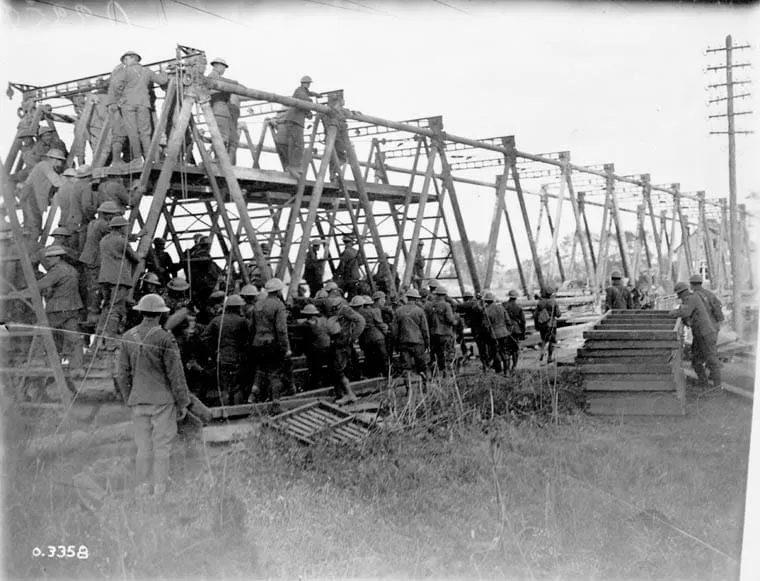
At 5.20 a.m. on 27 September 1918 General Arthur Currie’s Canadian Corps and the left wing of the British Third Army attacked west of Cambrai. The Canadians crossed the dry bed of the unfinished Canal du Nord on a stretch less than two and a half kilometres wide and then fanned out to the north and east. By the evening they had taken two lines of defences, the village of Bourlon and Bourlon Wood, and on the left wing had reached the road from Cambrai to Douai. South of them British corps fought their way through the maze of trenches of the Hindenburg Line at Flesquières. The day before, the Americans and French had attacked between the Meuse and the Argonne. Now came the turn of the second of the four blows planned by Marshal Ferdinand Foch.
The night before the attack
For more than three weeks the Canadians had stood on the canal, which they had reached after breaking the Drocourt–Quéant line at the beginning of September. North of Sains-lès-Marquion the Germans had flooded the marshes along the canal and blown the bridges, so Currie decided to cross where the canal was dry: at the southern edge of his sector, opposite Inchy-en-Artois and Mœuvres. In the first phase two divisions were to pass through this bottleneck, the 4th Canadian on the right and the 1st Canadian on the left, followed by the 3rd Canadian and the British 11th Division. The Canadian Corps had 22 field artillery brigades and 9 heavy brigades at its disposal. There was no preliminary bombardment, so as not to give away the place of the attack. Some of the batteries were to move up behind the infantry immediately after zero hour.
The night of 26–27 September was tense. Infantry, machine guns and guns were crammed into cramped assembly positions. The commanders feared that the German artillery would open fire on these packed masses of men before the attack started. It began to rain, and the ground became slippery. Before dawn the rain stopped, but the morning was cloudy and dark. During the night British bombers attacked the railway stations at Denain, Busigny and Le Cateau, through which German reinforcements were passing, and to deceive the enemy the British 8th Division attacked at midnight far to the north, at Arleux-en-Gohelle. At 5.35, in two divisions of XXII Corps further north, soldiers raised dummy figures painted on canvas above the trenches to simulate an infantry attack, and the artillery shelled the German lines for an hour. Edmonds writes that the Germans paid almost no attention to it.
Across the dry bed
At 5.20 the guns opened up. Shells mixed with smoke fell in front of the attackers, and the wind carried the smoke towards the Germans, who could see little that morning. On the right wing the 10th Brigade of the 4th Canadian Division crossed the dry bottom of the canal with two battalions without difficulty, together with eight Mark IV tanks. In front of the Marquion line, about one and a half kilometres beyond the canal, it met heavy machine-gun fire, and one tank was blown up on a mine. Even so, at 7.30, exactly to plan, the line was taken.
On the left wing two guns of the 1st Battery of Canadian field artillery were pushed forward in front of Inchy to fire over open sights at the German positions along the canal. The leading company of the 1st Brigade crossed the bed in twelve minutes, and the whole 4th Battalion rushed forward and took its stretch of the Marquion line. The 3rd Brigade had to cross on a stretch about 300 metres wide. Its leading battalion turned north beyond the canal and attacked the village of Sains-lès-Marquion from the rear. Machine guns firing from the upper floors of houses inflicted losses on it, but in the village itself resistance was weak, and with the help of four tanks about 350 prisoners were taken. The brigade’s second battalion was held up in front of Marquion by machine-gun fire and thick wire. Only when fresh troops, the Canadian 15th Battalion and the British 11th Battalion of the Manchester Regiment, crossed the canal on the engineers’ footbridges at about eleven did the whole line rise to the attack. The Germans broke, Marquion fell, and by half past two the 1st Canadian Division had reached all the objectives of the first phase.
Meanwhile the engineers were building bridges under fire. In the 4th Division the first three crossings for horse-drawn wagons were ready between 6.50 and 8.00, and on the same day the bridge on the road from Inchy to Bourlon was taking lorry traffic in both directions. The engineers of the 1st Division first had to fight their way to the building site at Sains-lès-Marquion, but by ten they had put up four footbridges, and in the afternoon bridges for wagons. Some of the batteries moved right behind the infantry up to the canal itself, from where they fired further, and once the crossings were ready the artillery began to move to the far bank.
Bourlon Wood
At 8.20 the 11th and 12th Brigades of the 4th Division passed through the lines of the 10th Brigade. According to the plan Bourlon Wood was not to be attacked frontally but blanketed with smoke and surrounded from the north and the south. The plan only half succeeded. The neighbouring British 52nd Division of XVII Corps could not keep up, so the Canadians came under fire from their right flank, and the 102nd Battalion, instead of advancing, had to cover the flank along the road from Bapaume to Cambrai. After heavy fighting the 87th Battalion broke into the southern part of Bourlon village at 9.45, and the 54th Battalion went round the wood from the north and pressed on towards Fontaine-Notre-Dame, although it found itself in a deep salient and suffered mounting losses. At about seven in the evening it halted just short of the village. To its left the 12th Brigade, shelled not only by the Germans but by mistake also by its own artillery, broke through the trenches of the Marquion line and came out on the high ground beyond the village. The last German strongpoint in its sector was taken by the 78th Battalion only in an attack at eight in the evening. By the evening the wood had been cleared.
For that day the Victoria Cross was awarded to two lieutenants of the 4th Division, Graham Lyall of the 102nd Battalion and Samuel Honey of the 78th Battalion, who led attacks on German strongpoints near the wood. Honey died of wounds a few days later. In the 1st Division Lieutenant George Kerr of the 3rd Battalion single-handedly attacked a German strongpoint by the road from Arras to Cambrai, capturing four machine guns and 31 prisoners. In front of the wood the German 188th Infantry Regiment of the 187th Division was defending. Its history called 27 September “the blackest day of the regiment”: by the evening only “a small handful of men” was left of it, and “that day we buried all hopes of victory”.
In November 1917 the British 40th Division had broken into Bourlon Wood and fought a battle of several days for it, but the village remained in German hands, and at the beginning of December the British gave up the whole salient. Now the wood was taken in a single day.
Second phase: Haynecourt, Épinoy and Oisy
The second phase began at three in the afternoon, late, because the 11th Division first had to smoke out machine-gun nests that had been overlooked. The Canadian 2nd Brigade took Haynecourt without much difficulty, but the 4th Canadian Division was still far behind, and the fire from the right flank grew ever heavier. Even so, the two leading battalions cut through two belts of wire by hand and reached the road from Cambrai to Douai, about five kilometres beyond the third objective. The brigade’s reserves had been used up covering the flank, and it was impossible to go further. The British 11th Division had to fan out from less than two to more than six kilometres and turn almost at a right angle. At 6.15 p.m. its 32nd Brigade took Épinoy, and at about 6.30 p.m. the 8th Battalion of the Northumberland Fusiliers took Oisy-le-Verger with two hundred prisoners. To its left the British 56th Division advanced northwards along both banks of the canal. Edmonds sums up that, apart from the right wing, the First Army’s operations ended in “complete success”, and the 1st Canadian Division and the 11th Division got beyond the line set for exploitation.
The Third Army at Flesquières
South of the Canadians, at the same hour, XVII and VI Corps of General Julian Byng’s Third Army attacked. Before them lay ground well known from the Battle of Cambrai in 1917: the Hindenburg Line, its second position (the Hindenburg Support) and the Flesquières ridge. The British 52nd Division cleared both banks of the canal at Mœuvres, while the 63rd (Royal Naval) Division was held up for several hours in front of the sugar factory, known from the fighting of the previous autumn. In the afternoon, supported by the 57th Division, it took the factory and before four o’clock occupied Graincourt and Anneux. In the evening a strong German counter-attack was repulsed here, but the left wing of XVII Corps remained almost three kilometres behind the Canadians. Edmonds writes that it was a pity that no rested, first-class division could attack alongside the 4th Canadian Division.
In VI Corps the Guards Division crossed the dry bed of the canal. At the destroyed bridge on the road from Demicourt to Graincourt Captain Cyril Frisby of the 1st Battalion, Coldstream Guards, with four men captured a machine-gun nest that was holding up his battalion. Both Frisby and Lance Corporal Thomas Jackson received the Victoria Cross, Jackson posthumously. The Victoria Cross was also awarded to the commander of the 1st Battalion, Grenadier Guards, Lieutenant-Colonel John Vereker, Viscount Gort, later commander of the British Expeditionary Force in 1939–1940. Wounded, he led a tank against the German positions, and, wounded a second time, after a moment on a stretcher he got up and went on directing the attack. His battalion took more than 200 prisoners and two batteries of field guns. By eleven the British 3rd Division had taken Flesquières, and at 11.30 Ribécourt. Troops of the 62nd Division briefly reached the outskirts of Marcoing, but a German counter-attack pushed them back. IV Corps fared worst: on Byng’s orders it moved off only several hours later, in full daylight, and lost many tanks. According to the returns, seven Victoria Crosses were awarded for this one day.
Evening
Edmonds judges that the Third Army that day went through carefully prepared defences, something that on the Somme in 1916 would have been hailed as a great victory, and that the results could have been even better had the corps attacks been better coordinated. During the night of 27–28 September the commander of the German Seventeenth Army, Otto von Below, ordered a retreat behind the river Sensée and to the rear “Hagen” position, running from Aubigny-au-Bac through Marcoing. Currie noted in his diary that evening: “Today’s success jeopardises the enemy’s hold on the Quéant–Drocourt system north of the Scarpe, and he may be expected to withdraw to Douai.” The Canadians hoped to take Cambrai soon. The following days showed, however, that the Germans would not give up the city without hard fighting.
Remember the articles you have read? Only in this browser; nothing is sent anywhere.How it works
Read ·
A voice from the front
“While I was trying to see what the trouble was, a young officer, called Cope, of the 8th Battalion came up to me. […] I said, “How old are you, Cope?” He replied, “I am twenty.” I said, “What a glorious thing it is to be out here at twenty.” “Yes,” he said, looking towards the valley, “it is a glorious thing to be out here at twenty, but I should like to know what is holding them up.” He had hardly spoken when there was a sharp crack of a machine-gun bullet and he dropped at my side.”
Spotted a mistake?Report an error
Meanwhile
(04)Elsewhere in the same days.
- 28 September 1918 · DiplomacyPolish Army becomes an allied armyOn 28 September 1918 France and the Polish National Committee agreed to recognise the Polish Army as autonomous, allied and co-belligerent with the Entente.
- 29 September 1918 · PoliticsLudendorff demands an armisticeOn 29 September 1918 at Spa Hindenburg and Ludendorff demanded an immediate armistice request. The Kaiser agreed to appeal to Wilson and to parliamentary rule.
- 25 September 1918 · DiplomacyItaly and the Yugoslav stateAt the end of September 1918 Italy declared that the Yugoslavs' striving for independence and a state of their own accorded with Allied principles.
- 25 September 1918 · Middle EastCapture of AmmanOn 25 September 1918 New Zealand and Australian horsemen took Amman and cut the Hejaz Railway. That day the battles of Megiddo came to an end.
Related events
(04)The same battle, people or subject.
- 1 October 1918 · Western FrontEnd of the Battle of the Canal du NordOn 1 October 1918 the Canadians attacked north of Cambrai for the last time. They gained 1.5 km and a hill above the city, after which Horne halted the advance.
- 2 September 1918 · Western FrontBreaking of the Drocourt–Quéant LineOn 2 September 1918 the Canadians broke the Drocourt–Quéant Line near Arras, and at noon the German command ordered a retreat to the Hindenburg Line.
- 21 August 1918 · Western FrontSecond Battle of Albert beginsIn thick fog on 21 August 1918 Britain's Third Army attacked with tanks north of the Ancre, took Bucquoy and Achiet-le-Petit and reached the Albert–Arras line.
- 8 October 1918 · Western FrontBattle of Cambrai beginsOn 8 October 1918 the British Third and Fourth Armies and the Americans attacked between Sequehart and Cambrai. At Niergnies the Germans used captured tanks.