Key event
Battle of Hill 70 begins
- Category:
- Military operations
- Front:
- Western Front
- Date:
- 15 August 1917
- Author:
- Natalia
- Battle:
- Battle of Hill 70
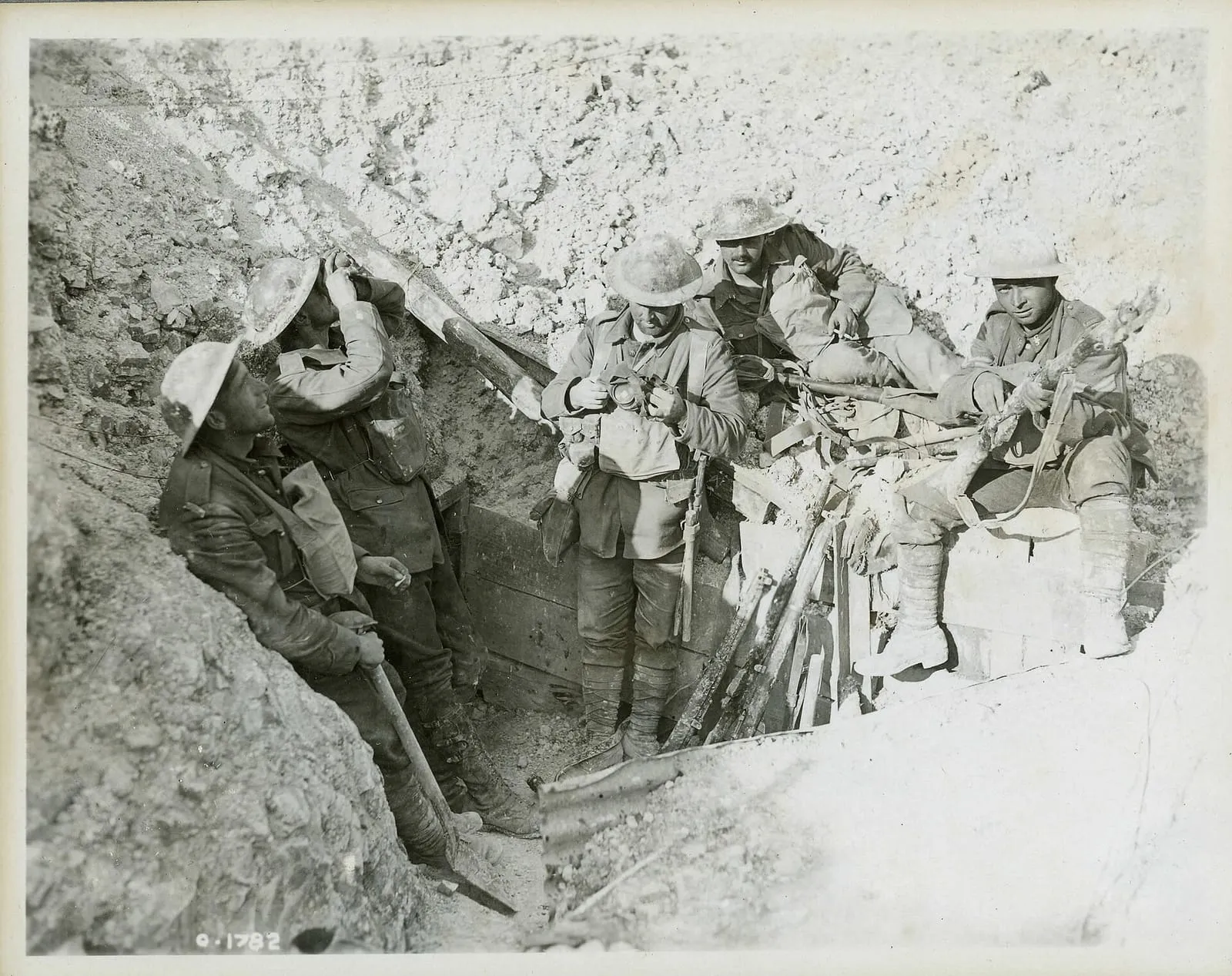
On 15 August 1917 at 4.25 a.m., as day was beginning to break, two divisions of the Canadian Corps went into the attack on Hill 70, a treeless chalk rise on the northern outskirts of the mining town of Lens in northern France. Within twenty minutes they stood on its crest, and before six in the morning they had taken almost all their objectives. For the rest of the day the Germans counter-attacked again and again, but their waves of infantry perished under the fire of the Canadian artillery, directed by observers on the captured summit. It was the corps’ first battle under a Canadian commander, General Arthur Currie, and it went exactly as Currie had planned.
A diversion for Flanders
For two weeks the Third Battle of Ypres, the main British offensive of 1917, had been under way in Flanders. The attack, launched on 31 July, had stalled in rain and mud. The other British armies were meanwhile to pin the Germans down on their own sectors so that they could not shift reserves north. On 7 July General Henry Horne’s First Army passed on to Currie, who a month earlier had taken command of the corps, an order from the commander-in-chief, Douglas Haig: take Lens, a ruined town at the heart of the French coalfield, and threaten an advance from there on Lille.
Currie considered the order a mistake. The town lay in a basin and was dominated by two hills: Hill 70 to the north and the hill near Sallaumines to the south-east. Whoever took Lens while leaving the hills to the Germans would be sitting in ruins under their fire. At a conference on 10 July Currie persuaded Horne to make Hill 70 the main objective. The Canadians knew the place from history: in September 1915, in the Battle of Loos, the Scots had gone over the top of the hill but failed to hold it. Currie reckoned that the Germans would not accept the loss of a hill from which Lens and the Douai plain far behind their lines could be seen. They would try to retake it, and every counter-attack on the open slope, in full view of the observers, would be smashed by the Canadian artillery. According to the plan the hill was to become a place of “killing by artillery”.
Preparations
Currie wanted to strike on 30 July, but heavy rain delayed the attack by more than two weeks. In that time the Canadian artillery destroyed wire and shelled German batteries, while the British Special Companies of the Royal Engineers drenched Lens with gas. By 15 August they had fired more than 3,500 gas drums and 900 gas shells on the town. The battalions rehearsed the attack on ground resembling the battlefield. The preparations could not be hidden, and the Germans knew an attack was coming. On 14 August the neighbouring British I Corps staged a feint attack with dummy tanks west of Lens to mislead them about the place.
The attack was to be made by General Archibald Macdonell’s 1st Canadian Division on the left, from the direction of Loos, and General Henry Burstall’s 2nd Division on the right, from the direction of Lens, each with two brigades, ten battalions in all. The objectives were set in three stages: the first German trenches, the Blue Line on the crest, and the Green Line, the old German third line on the eastern slope, about 1.4 kilometres from the jumping-off positions. Most important was what was to follow the capture of the objective. Each brigade was to dig in 48 Vickers machine guns at once, around which infantry strongpoints would be formed, and artillery observers were to take up positions on the summit straight away.
The hill was defended by the German 7th Infantry Division of General Otto von Below’s Sixth Army. Nearby the 4th Guards Division and the 220th Division waited in reserve, ready for a rapid counter-stroke. On the night of 14–15 August the Germans, expecting an attack, brought their reserve battalions closer, and at 3 a.m. they detected the Canadians assembling in their jumping-off positions.
The attack
At 4.25 the barrage began. The field guns, 102 per division, laid down a creeping barrage, “with beautiful precision” according to the Canadian official history. Howitzers pounded several hundred metres ahead of it, and heavy guns hammered known German strongpoints. The engineers fired drums of burning oil onto the Cité Ste. Élisabeth housing estate and other targets, laying a thick smoke screen. The German artillery replied after three minutes but was quickly neutralised.
In the smoke the Canadians moved fast, dealing with the trench garrisons as they went. The 2nd Division fought its way through the rubble of the mining settlements of St. Édouard and St. Laurent, once built up with rows of brick cottages and now turned into a maze of ruins cut through with trenches. Even so, it did not lose momentum. Within twenty minutes both divisions stood on the Blue Line, on the crest of the hill. On the right the 4th Brigade covered the attack from the direction of Lens, and the 5th Brigade passed through the St. Émile settlement. On the left the 3rd Brigade cleared Bois Hugo wood of machine guns. By about 6 a.m. the Green Line was in Canadian hands everywhere except in the centre.
There the 2nd Brigade, which had the longest way to go, set off after the pause laid down in the timetable towards the last trenches and a large chalk quarry on the edge of the St. Auguste settlement. During the pause, however, the smoke had cleared and the Germans had had time to recover. Machine-gun fire swept the whole eastern slope, and the attack broke up into individual rushes from shell hole to shell hole. A company of the 7th Battalion broke into the quarry and took about 50 prisoners, but the rest of the 7th and 8th Battalions had to fall back to an intermediate line.
Meanwhile the 4th Canadian Division staged a feint attack on Lens from the west. It fired 200 gas bombs on the German positions near Avion and drew more fire upon itself than the main attack. Its patrols entered the outskirts of Lens, but the Germans had no intention of giving up the town and pushed them back.
Counter-attacks
The Canadians at once began building strongpoints and setting up machine guns. When between 7 and 9 a.m. the Germans from the nearest reserves attacked at four points, the artillery observers on the summit saw their preparations and every attack was broken up before it had properly begun. Attacks by troops brought in from neighbouring regiments ended the same way. A captured German officer said that on its way to the front his regiment had run into one bombardment after another and had been bled white before it even made contact with the Canadian infantry.
The Germans quickly brought up reinforcements. During the day seven battalions of the 4th Guards Division and the 185th Division joined the eight battalions of the 7th Division. The great counter-stroke was to start at 11 a.m., but it was delayed until early afternoon and, instead of one coordinated attack, took the form of a series of disjointed assaults. According to German accounts four waves of infantry went across open ground “through fountains of earth thrown up by heavy shells” and then “through a hail of shrapnel and rifle bullets”, and were almost completely wiped out. Airmen of No. 16 Squadron, Royal Flying Corps, called down heavy artillery fire on the approaching columns and strafed them with machine guns. The Germans managed only to break into Chicory Trench on the 2nd Division’s right, but at 6.40 p.m. the Canadians retook it.
In the afternoon the commander of the 2nd Brigade still wanted to take the rest of the Green Line, but the 7th and 8th Battalions together had only about 200 men left fit to fight. The attack was postponed twice and finally cancelled. The barrage prepared for it, laid down at 6 p.m., nevertheless broke up another German attack. Until evening the Germans kept trying, but each time the artillery overwhelmed them. At one point all the guns of the Canadian Corps and the neighbouring I Corps were firing simultaneously in front of the three Canadian divisions.
The day’s toll
Hill 70 was in Canadian hands. According to the Canadian official history it cost 1,056 killed, 2,432 wounded and 39 taken prisoner. German losses are not known but were heavy, and by 9 p.m. the Canadians had counted about 350 prisoners. Haig noted in his diary that the attack had gone “very well”, and Horne called it “an unqualified success”. Among those decorated that day was a stretcher-bearer of the 7th Battalion, Private Michael O’Rourke, who for three days carried wounded men out under fire and received the Victoria Cross for it.
The fight for the hill was only beginning. The next day the Canadians took the rest of the Green Line with the quarry, and by 18 August, according to Currie, they had repulsed 21 German counter-attacks, made also with flamethrowers and under cover of a new gas, mustard gas. The Germans never regained Hill 70.
Remember the articles you have read? Only in this browser; nothing is sent anywhere.How it works
Read ·
A voice from the front
“It was a lovely night; the stars were shining beautifully, and the constellation of Orion hung on the horizon in the eastern sky, with the pale moon above. A great silence, stirred only by the morning breeze, brooded over the wide expanse of darkness. Then, at four-twenty-five, the guns burst forth in all their fury […]. Nothing but the thought of what it meant to human beings took away from our enjoyment of the mighty spectacle.”
Spotted a mistake?Report an error
Meanwhile
(04)Elsewhere in the same days.
- 13 August 1917 · PoliticsPassports refused for the Stockholm conferenceOn 13 August 1917 Bonar Law told the Commons that Britons would get no passports for the socialist congress in Stockholm. The conference never met.
- 17 August 1917 · Italian FrontStart of the eleventh battle of the IsonzoOn 17 August 1917 Italian batteries on the Isonzo were firing almost as in a barrage. The Eleventh Battle of the Isonzo, Italy's largest offensive, began.
- 17 August 1917 · PoliticsMétin becomes under-secretary for the blockadeOn 17 August 1917 the Radical Albert Métin replaced the Catholic Denys Cochin as head of the French blockade, a crack in the "Sacred Union".
- 18 August 1917 · DiplomacyAgreement on Asia MinorOn 18 August 1917 Italy and Britain exchanged notes approving the Saint-Jean-de-Maurienne agreement. It was conditional on Russia's consent, never given.
Related events
(04)The same battle, people or subject.
- 25 August 1917 · Western FrontEnd of the Battle of Hill 70On 25 August 1917 the Canadians took Aloof Trench near Lens, ending the Battle of Hill 70. They held the hill, but the attacks on Lens itself failed.
- 26 October 1917 · Western FrontStart of the Second Battle of PasschendaeleOn 26 October 1917 the Canadians attacked the Passchendaele ridge in rain. After hard fighting they took the Bellevue spur, where the New Zealanders had failed.
- 6 November 1917 · Western FrontCanadians capture PasschendaeleOn 6 November 1917 two Canadian divisions took the ruins of Passchendaele, goal of the offensive since 31 July, in under 3 hours, and Mosselmarkt and Goudberg.
- 9 June 1917 · Western FrontCurrie takes command of the Canadian CorpsOn 9 June 1917 General Arthur Currie officially succeeded Julian Byng in command of the Canadian Corps. He was the first Canadian to lead the whole corps.