Key event
Start of the Second Battle of Passchendaele
- Category:
- Military operations
- Front:
- Western Front
- Date:
- 26 October 1917
- Author:
- Natalia
- Battle:
- Second Battle of Passchendaele
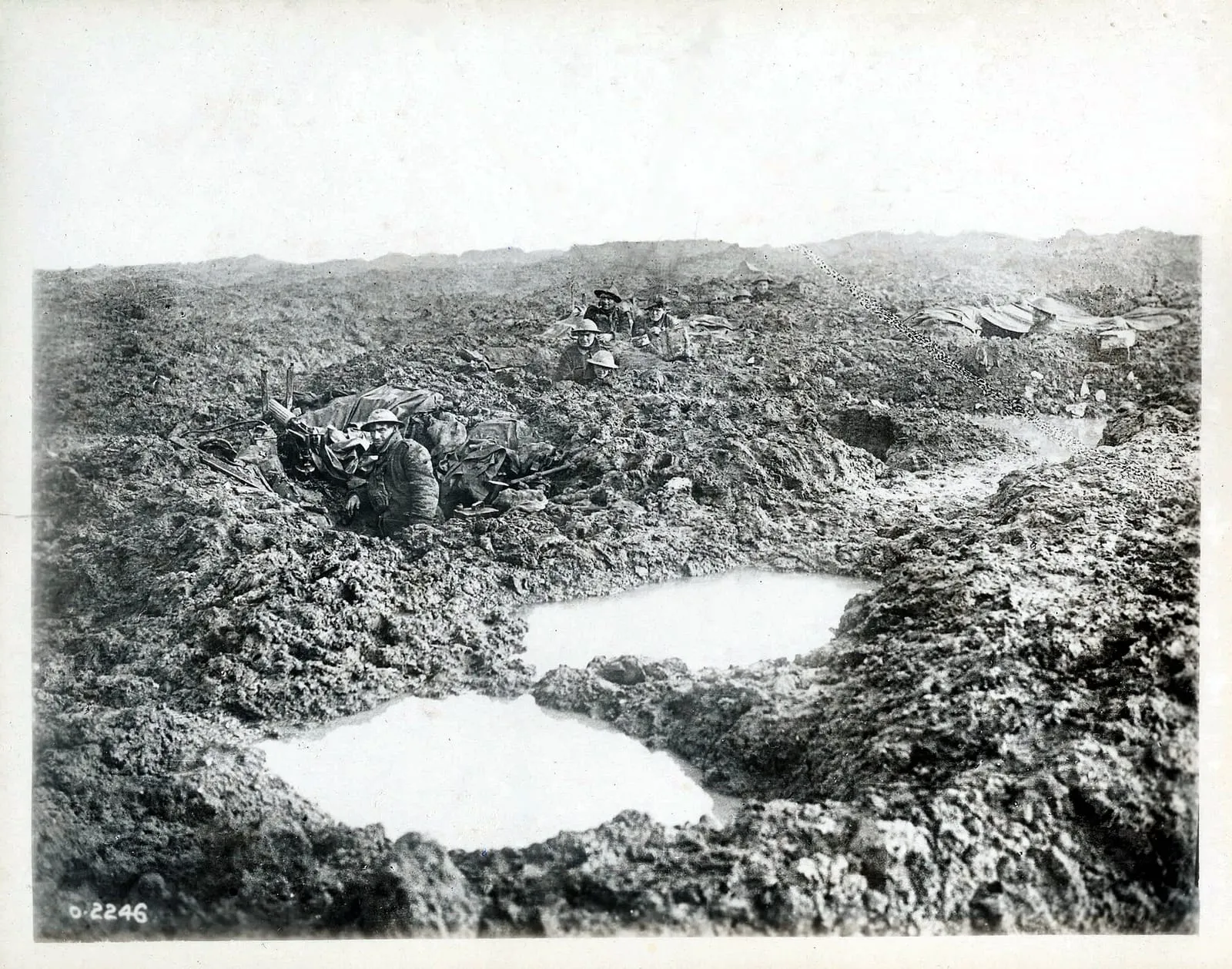
At 5.40 a.m. on 26 October 1917, in mist and rain, General Arthur Currie’s Canadian Corps attacked the German positions in front of the village of Passchendaele, on the ridge east of Ypres. So began the Second Battle of Passchendaele, the last stage of the three-month British offensive in Flanders. The Canadians struck where, two weeks earlier, on 12 October, the New Zealanders and Australians had bled themselves white. It was a hard day, full of reversals. In the morning the attack on the Bellevue spur nearly collapsed, but in the afternoon the Canadians took the pillboxes before which the previous attacks had stopped. On the ridge south of the Ravebeek swamp a Canadian battalion took all its objectives. The subsidiary British attacks on both flanks failed, and only the French advanced on the far north. The Canadians paid for the day with more than 1,500 killed, wounded and missing, and three of them won the Victoria Cross for the fight for Bellevue.
Before the attack
The Canadians came to Flanders from Lens, where in August they had taken Hill 70. On 18 October they took over from II ANZAC Corps the front in the valley of the Stroombeek stream, almost in the same place where in April 1915 they had met the first German gas attack. Field Marshal Douglas Haig wanted to take the village before winter, while Currie, who had commanded the corps since June, considered the attack too costly. He predicted that the whole operation would cost 16,000 killed and wounded. He did, however, obtain time to prepare. For more than a week sappers and pioneers built plank roads and gun platforms, and the artillery shelled the whole German line every morning and afternoon so that the defenders could not guess when the real attack would come. Currie asked for the date to be put back to 29 October, but Haig pressed, and General Herbert Plumer, commander of the Second Army, agreed on 26 October with him.
The ground in front of the Canadians was cut by the valley of the Ravebeek stream, turned by shelling into a swamp several hundred metres wide in places. The attack therefore had two arms. To the right of the swamp, on the main ridge by the Zonnebeke road, the 46th Battalion of the 4th Division was to advance just under 600 metres and take Decline Copse by the Roeselare railway. To the left of the swamp General Louis Lipsett’s 3rd Division attacked with two brigades towards the Bellevue spur, a hill sloping westwards from the ridge, where on 12 October the New Zealand Division had been stopped by uncut wire. The objective, the Red Line, lay about 1,100 metres from the jumping-off positions. The leading battalions had been in the line for four days, most of the men in shell holes, covered with rubber groundsheets. During the night before the attack it began to rain again.
Opposite stood three regiments of the 11th Bavarian Infantry Division. After the defeat at Broodseinde the Germans had changed their way of defending. The first line of shell holes was now held only by scattered outposts with light machine guns, and the main line of resistance lay several hundred metres further back. The backbone of the defence was concrete pillboxes for several dozen men, built above ground because in the waterlogged soil dugouts could not be dug. A whole row of them stood at Bellevue.
Bellevue
At 5.40 a.m. the barrage began. It moved forward about 45 metres every four minutes, slowly, so that the infantry could keep up in the mud. On the 3rd Division’s right flank two battalions of the 9th Brigade, the 43rd and the 58th, found the wire well cut and within an hour began taking the pillboxes on Bellevue, sending prisoners to the rear. At the intermediate line of the attack, however, they came under violent artillery fire, which the Germans directed onto their own abandoned positions, and under machine-gun fire from the valley. At about nine o’clock the brigade as a whole was falling back towards the start line.
On the spur remained Lieutenant Robert Shankland of the 43rd Battalion, a Scot from Ayr who before the war had been a cashier at a dairy in Winnipeg. He gathered the remnants of his platoon, men from other companies and two machine-gun crews from the 9th Machine Gun Company, and for about four hours held, in shell holes and captured pillboxes, a small but important patch of ground just north of the Mosselmarkt road. He beat off a counter-attack and then, with both flanks exposed, handed over command to another officer, made his way through the shellfire to battalion headquarters, gave a detailed report on the brigade’s position and returned to his men. The Victoria Cross citation stated that his courage and example “undoubtedly saved a critical situation”. Shankland lived on Pine Street in Winnipeg, where two other holders of the Victoria Cross from this war also lived. The street was later renamed Valour Road.
Around noon a company of the 52nd Battalion from reserve closed the gap between Shankland’s group and the rest of the brigade, and the other companies began clearing the spur. They went from pillbox to pillbox southwards along the ridge. Riflemen with Lewis guns and rifle grenades (PL) fired at the loopholes, while small groups worked round to the blind side of a pillbox and threw grenades inside. Captain Christopher O’Kelly led his company more than 900 metres under heavy fire without the cover of the barrage, and then in a series of attacks it took six pillboxes, about a hundred prisoners and ten machine guns. By mid-afternoon the 52nd Battalion held Bellevue and Laamkeek, the strongpoints that had stopped II ANZAC Corps on 12 October. By the morning of 27 October the 9th Brigade had dug in only about 270 metres short of the Red Line.
On the left flank the 4th Battalion, Canadian Mounted Rifles, of the 8th Brigade took Wolf Copse and the intermediate line in bitter fighting. Nineteen-year-old Private Thomas Holmes from Owen Sound, Ontario, at a critical moment ran forward alone and with two grenades put the crews of two machine guns out of action, then went back for another grenade and threw it into the entrance of a pillbox. Its garrison of 19 surrendered. He is regarded as the youngest Canadian to be awarded the Victoria Cross. The British 63rd (Royal Naval) Division, attacking to the left of the Canadians, got stuck in the mud, however, so the battalion fell back about 270 metres so as not to lose touch with it.
On the ridge and on the flanks
To the right of the swamp the 46th Battalion, attacking astride the Passchendaele road, took all its objectives on the main ridge, and one company even advanced more than 200 metres further. Beside it a battalion of the 1st Australian Division took the Keiberg railway cutting beyond Decline Copse and captured several dozen prisoners. During the day the Germans counter-attacked on both sides of the Ravebeek, and the 46th Battalion was fired on from the flank from Laamkeek as long as the defenders held out there. As a result of misunderstandings between the Canadians and the Australians, who had been given the same objective, Decline Copse was gradually abandoned and the Germans returned to it.
The subsidiary British attacks achieved almost nothing. In the south X Corps attacked Gheluvelt (PL) and Polderhoek Château. Men of the 7th Division reached the church in Gheluvelt and the 5th Division took the château, but at about ten o’clock German counter-attacks drove them back to their starting positions, and many rifles, clogged with mud, could not be used. In the north the divisions of the British Fifth Army waded through swamps, lost the cover of the barrage and, under counter-attacks, mostly returned to their start lines. According to British figures, X Corps lost more than 3,300 men that day, and the Fifth Army’s two corps together more than 5,400. On the far northern flank the French of the First Army crossed the Steenbeek stream and took Papegoed Wood, beginning the occupation of the flooded Merkem peninsula. In the evening the Germans sent the 8th Bavarian Reserve Division there to help.
The day’s balance
According to the Canadian official history, 26 October cost the Canadians 585 killed, 965 wounded and 8 taken prisoner. Despite the rain and the morning withdrawals, by evening the corps stood higher and on drier ground, and on the Bellevue spur it had broken through defences that two earlier battles had failed to take. Not everything succeeded: the Red Line was not reached along the whole front, and Decline Copse had to be retaken. The 44th Battalion did this on the night of 27–28 October. In three days of fighting the Canadians lost 2,481 men and took 370 prisoners. The next attack, aimed at Crest Farm just in front of the village, was set for 30 October.
Remember the articles you have read? Only in this browser; nothing is sent anywhere.How it works
Read ·
A voice from the front
“With 22 October began the fifth act of the harrowing drama in Flanders. Enormous quantities of ammunition, such as human reason had never conceived before the war, were hurled against human bodies which, scattered in deeply mud-filled shell craters, barely kept themselves alive. The horror of the crater field before Verdun was surpassed. That was no longer life, it was unspeakable suffering.”
Translated · Original (de)
Mit dem 22. Oktober begann der fünfte Akt des ergreifenden Dramas in Flandern. Ungeheure Munitionsmengen, wie sie Menschenverstand vor dem Kriege nie erdacht hatte, wurden gegen Menschenleiber geschleudert, die, in tiefverschlammten Geschoßtrichtern zerstreut, ihr Leben notdürftig fristeten. Der Schrecken des Trichterfeldes vor Verdun wurde noch übertroffen. Das war kein Leben mehr, das war ein unsägliches Leiden.
Spotted a mistake?Report an error
Meanwhile
(04)Elsewhere in the same days.
- 25 October 1917 · PoliticsBoselli resignsOn 25 October 1917, the day after the front was broken at Caporetto, the Chamber of Deputies refused confidence to Paolo Boselli's government. The cabinet fell.
- 27 October 1917 · PoliticsRegency Council takes officeOn 27 October 1917 the regents took their oath in Warsaw cathedral and took up office at the Royal Castle. The September patent came into force.
- 24 October 1917 · Italian FrontBattle of Caporetto beginsOn 24 October 1917, after a gas bombardment, Germans and Austrians struck on the upper Isonzo. By evening they had broken the Italian front and taken Caporetto.
- 28 October 1917 · Italian FrontFall of Gorizia and UdineOn 28 October 1917 the Austrians retook Gorizia and the Germans took Udine, the Italian headquarters. The Italian army fell back behind the Tagliamento.
Related events
(04)The same battle, people or subject.
- 6 November 1917 · Western FrontCanadians capture PasschendaeleOn 6 November 1917 two Canadian divisions took the ruins of Passchendaele, goal of the offensive since 31 July, in under 3 hours, and Mosselmarkt and Goudberg.
- 10 November 1917 · Western FrontEnd of the Third Battle of YpresOn 10 November 1917, in pouring rain, the Canadians took the heights north of Passchendaele. This attack ended the Flanders offensive that had begun on 31 July.
- 15 August 1917 · Western FrontBattle of Hill 70 beginsAt dawn on 15 August 1917 the Canadian Corps took Hill 70 above Lens and then broke a series of German counter-attacks with artillery fire.
- 12 October 1917 · Western FrontFirst Battle of PasschendaeleOn 12 October 1917 Anzacs advanced in the rain on Passchendaele. By evening they were back on their old lines, and 845 New Zealanders were dead.