1915: The Second Battle of Ypres
Second Battle of Ypres
- Dates:
- 22 April – 25 May 1915
- Front:
- Western Front
- Location:
- The salient around Ypres (Ieper) in West Flanders, from the Ypres–Yser canal at Steenstrate and Boezinge in the north, through Langemarck, Sint-Juliaan, Gravenstafel and Frezenberg, to Bellewaarde and Hooge in the east, BelgiumOn the battle map →
- Sides:
- United Kingdom and CanadaJohn French, Horace Smith-Dorrien, Herbert Plumer, Edwin AldersonFranceFerdinand Foch, Henri PutzBelgiumArmand De CeuninckGerman EmpireErich von Falkenhayn, Albrecht, Duke of Württemberg, Otto von Hügel, Hugo von Kathen
- Result:
- Inconclusive, with the advantage to the Germans. They took the northern and eastern part of the Ypres salient and came within a few kilometres of the town, but did not break the front or take Ypres.
- Author:
- Łukasz Skowroń
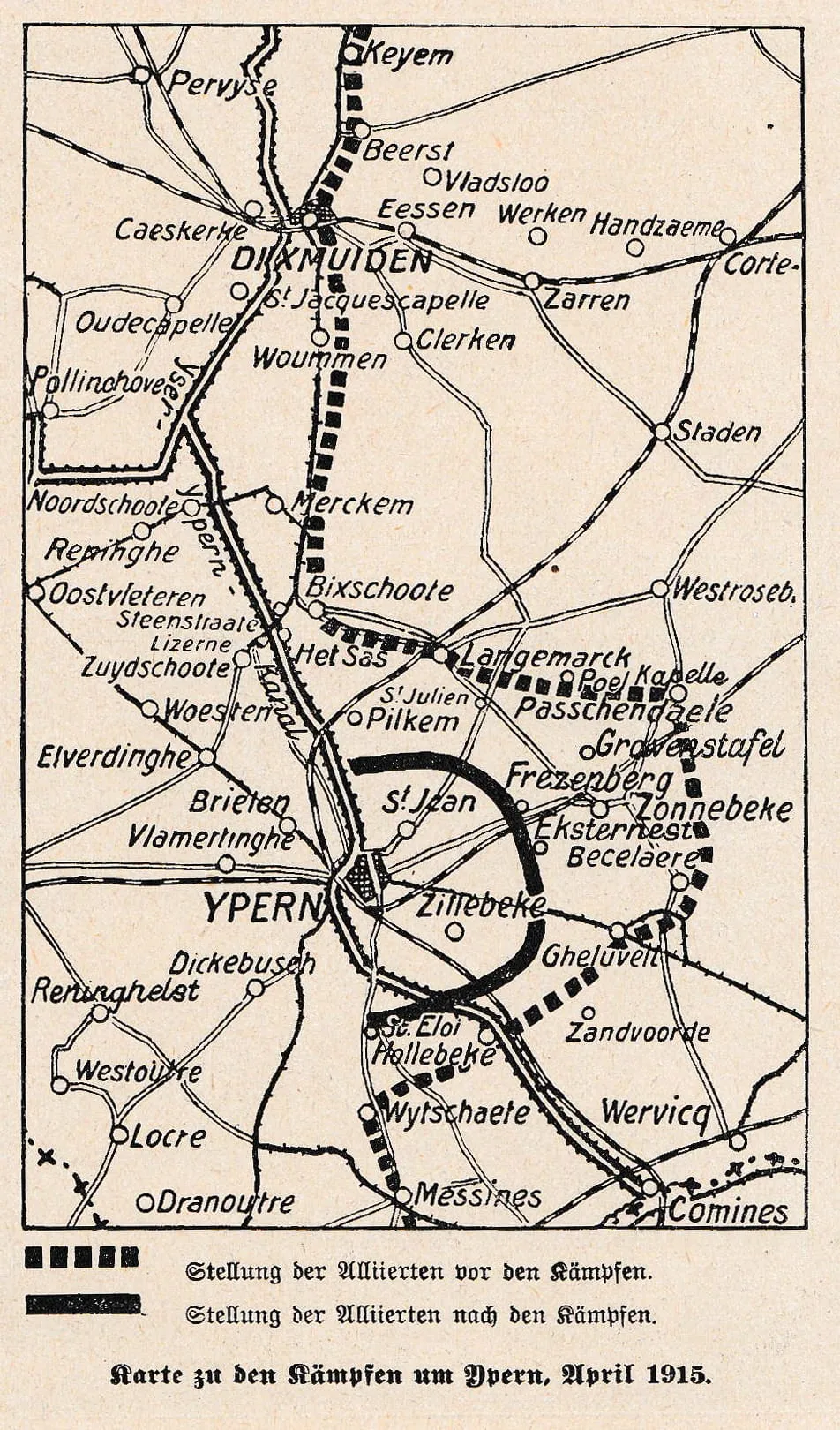
The Second Battle of Ypres, fought from 22 April to 25 May 1915, was the only major German offensive on the Western Front in 1915. It is remembered above all as the battle in which the Germans first used poison gas on a large scale in the west. A cloud of chlorine, released on 22 April from thousands of cylinders, broke two French divisions and opened a gap north of Ypres. The Germans, who treated the attack as a trial of the new weapon, had no reserves to exploit it. The gap was hastily closed by Canadians, British and French, at the cost of enormous losses. Over the following weeks the Germans, supported by superior heavy artillery and further gas clouds, pushed the Allies back step by step into the salient. When the battle died down, the front stood several kilometres closer to Ypres, but the town, although reduced to ruins, remained in Allied hands.
Name and dates
After the war the British Battles Nomenclature Committee grouped the fighting from 22 April to 25 May under the common name “Battles of Ypres 1915” and distinguished four battles within it: Gravenstafel Ridge (22–23 April), St. Julien (24 April – 4 May), Frezenberg Ridge (8–13 May) and Bellewaarde Ridge (24–25 May). The fighting for nearby Hill 60, which the British took on 17 April and the Germans recaptured at the beginning of May, is usually counted as part of the same battle. The British official history already noted that some of the names fit the course of the fighting poorly: on 22–23 April the fighting took place mainly west of Gravenstafel Ridge, not on it.
In Germany the fighting was called the Second Battle of Flanders (Zweite Flandernschlacht) or the Battle of Ypern 1915, and in France the Second Battle of Ypres. Polish studies speak of the second, or II Battle of Ypres.
Background
After the First Battle of Ypres in the autumn of 1914 the front around the town formed a deep salient, projecting east towards the German lines and surrounded by them on three sides. In the spring of 1915 its southern part, from Hill 60 to the area of Poelkapelle, was held by the British V Corps of General Herbert Plumer from General Horace Smith-Dorrien’s Second Army: the 27th and 28th Divisions and the 1st Canadian Division, which had arrived in France in February and in mid-April relieved the French at Ypres. The northern edge of the salient, up to the Ypres–Yser canal, belonged to General Henri Putz’s French Détachement d’Armée de Belgique, indirectly directed by General Ferdinand Foch. Further north, along the canal, stood the Belgians.
In the spring of 1915 the German high command decided to stand on the defensive in the west and seek a decision in the east. The Chief of the General Staff, General Erich von Falkenhayn, nevertheless wanted the armies in the west to tie down the Allies and divert their attention from the transfer of troops to Galicia. He also judged it a good opportunity to test a new weapon. After an unsuccessful trial of tear-gas shells at Bolimów, the chemist Fritz Haber proposed releasing from cylinders a cloud of chlorine to be carried by the wind. The cylinders were first dug in on a sector south-east of Ypres, then, when the wind was unfavourable, on the northern edge of the salient, opposite the French. The commander of the German Fourth Army, Albrecht, Duke of Württemberg, was ordered to take the ridge at Pilkem (Pilckem), but was given no additional reserves. Meanwhile German communiqués in April carried accusations against the French and the British of using gas.
Forces
At the start of the battle the Ypres salient was held by three divisions of the British V Corps (including the Canadian) and two French ones: the 45th (Algerian) Division and the 87th Territorial Division. In the following days the Allies brought up reinforcements: the British 13th Brigade from Hill 60, the 50th (Northumbrian) Division of the Territorial Force, which had arrived in France only a few days earlier, the Lahore Division of the Indian Corps, the 4th Division and the cavalry corps, and the French the 153rd Division and other units. Allied troops, however, were sent into action battalion by battalion, and commanders on the spot had to combine them into improvised groups. The British were short of heavy guns and ammunition. Besides a few more modern batteries they had mainly obsolete 4.7-inch guns from the Boer War.
On the German side fought the corps of the Fourth Army: General Otto von Hügel’s XXVI Reserve Corps and General Hugo von Kathen’s XXIII Reserve Corps in the north, the XXVII Reserve Corps and XV Corps in the east and south of the salient, as well as Landwehr brigades and units brought from other sectors. The Germans had superiority in heavy artillery, including a 42 cm mortar which shelled Ypres from 20 April. The gas cylinders were handled by a special pioneer unit under Colonel Peterson, from which Pioneer Regiments Nos. 35 and 36 were formed at the end of April and the beginning of May.
Course of the fighting
22–23 April: the gas attack and the Battle of Gravenstafel Ridge. After almost two weeks of waiting for the wind, the Germans opened the cylinders on 22 April at about 5 p.m. Allied time. About 150 tonnes of chlorine drifted onto the trenches of the French divisions between Poelkapelle and Steenstrate. The French fled, abandoning their guns, and within an hour the Germans took Langemarck and the ridge at Pilkem, after which, as ordered, they began to dig in. In the west they crossed the canal at Het Sas and Steenstrate, but the Belgians of General Armand De Ceuninck’s 6th Division prevented any further advance. Between the canal and the left flank of the Canadians a gap several kilometres wide opened. During the night the Canadians counter-attacked Kitchener’s Wood west of Sint-Juliaan, and on 23 April they and hastily brought-up British battalions, despite enormous losses, built a new line from the wood to the canal. The promised French counter-attacks hardly materialised.
24 April – 4 May: the Battle of St. Julien. Before dawn on 24 April the Germans released gas on the Canadian trenches at the apex of the salient. The Canadians, covering their mouths with wet handkerchiefs, held on for several hours, but during the day they had to give up the village of Sint-Juliaan and fall back. It was their bloodiest day of the battle. On 25 April the British 10th Brigade tried to retake the village and suffered heavy losses. On 26 and 27 April the Lahore Division and battalions of the 50th Division, together with the French, attacked north of Ypres under artillery fire and clouds of gas, without significant gains. Smith-Dorrien concluded that further counter-attacks without French support were pointless and on 27 April proposed a withdrawal to a shorter line closer to the town. The British commander-in-chief, Field Marshal John French, long at odds with him, removed him the same day from command of the troops in the salient and handed it to Plumer. In the end, however, he agreed to a similar withdrawal. On 1–3 May Plumer’s troops withdrew by night to a new line in front of the village of Frezenberg, and the Germans noticed the withdrawal only on 4 May. In the south of the salient the Germans, after gas attacks, recaptured Hill 60 on 5 May.
On 6 May Smith-Dorrien, who felt he had lost French’s confidence, himself offered to step down. That same evening he was ordered to hand over the Second Army to Plumer and return home.
8–13 May: the Battle of Frezenberg Ridge. On 8 May, after a very heavy bombardment, the Germans struck the British 27th and 28th Divisions. They took Frezenberg Ridge and opened a gap several kilometres wide, which the British patched with counter-attacks and their last reserves. The Canadian battalion Princess Patricia’s Canadian Light Infantry, fighting as part of the 27th Division, held out on Bellewaarde Ridge until only about 150 of its men were left. In the following days dismounted cavalry units, thrown into the trenches, also fought here. On 13 May the Germans attacked again and pushed them out of part of their positions, but exhaustion and lack of ammunition forced them to break off the attack. In mid-May the French regained the west bank of the canal at Steenstrate and Het Sas.
24–25 May: the Battle of Bellewaarde Ridge. At dawn on 24 May the Germans released their widest chlorine cloud yet, on a front about 7 kilometres long. The British soldiers now had primitive masks, but many did not manage to put them on in time. The Germans took Mouse Trap Farm and part of Bellewaarde Ridge, and British night counter-attacks recovered only a small part of the lost ground. On the evening of 24 May the German Fourth Army command forbade further major operations, and the fighting died down. The British battle nomenclature regards 25 May as the last day of the Second Battle of Ypres.
Losses
According to the British official history, the British army lost 59,275 killed, wounded and missing from 22 April to 31 May, including the fighting for Hill 60. The 1st Canadian Division lost more than 6,000 men from 15 April to 3 May, almost half its infantry. French losses have not been precisely established. Estimates vary widely, but in most studies they range from over ten thousand to more than 20,000 men. According to French studies the Belgians lost about 1,500 men in the defence of the canal at Steenstrate, most of them to gas.
After the war the Reichsarchiv put German losses at Ypres from 21 April to 30 May at 860 officers and 34,073 NCOs and men, a total of 34,933. The Germans thus lost fewer than their opponents, which the British official history attributed to the hasty Allied counter-attacks, poorly supported by artillery, and to the superiority of the German guns.
Significance
The Second Battle of Ypres was only a partial success for the Germans. They took the high ground north and east of the town, from which their observers could now see almost the whole salient, but they did not break the front or force the Allies to abandon Ypres. They themselves admitted later that the gas attack had been made without reserves and towards evening, so the greatest opportunity offered by the new weapon was not exploited. The effect of surprise could not be repeated. Within a few weeks Allied soldiers received their first masks, and in the autumn at Loos the British released a chlorine cloud on a large scale for the first time.
The battle opened chemical warfare on the Western Front. The Allies regarded the attack as a violation of the Hague Conventions and as barbarism, and propaganda exploited it throughout the war. The German method also foreshadowed a new way of fighting: short attacks on a limited objective, after a massed bombardment by heavy artillery, with the captured ground immediately fortified.
For Canada it was the first great battle of the war and a source of national pride. The Canadians paid dearly for the defence of the salient, but gained a reputation as soldiers who could be relied on. During the battle the Canadian army doctor John McCrae wrote the poem In Flanders Fields, which became one of the best-known works about the war. Ypres itself, shelled by heavy guns, was already mostly in ruins by May 1915. The Ypres salient, smaller and even harder to defend, remained in Allied hands until the end of the war.
Spotted a mistake?Report an error
Battles and phases
(04)- 22–23 April 1915Battle of Gravenstafel RidgeOn 22–23 April 1915 Canadians and British troops closed the gap at Ypres left by the first chlorine attack, paying for it with thousands killed and wounded.
- 24 April – 4 May 1915Battle of St. JulienFrom 24 April to 4 May 1915 Canadians, British, Indians and French defended the northern edge of the Ypres salient against Germans attacking with chlorine.
- 8–13 May 1915Battle of Frezenberg RidgeFrom 8 to 13 May 1915, after a massive bombardment, the Germans drove the British off Frezenberg Ridge near Ypres but did not break the front. Losses were huge.
- 24–25 May 1915Battle of Bellewaarde RidgeOn 24–25 May 1915, after their largest chlorine attack yet, the Germans took Mouse Trap Farm and part of Bellewaarde Ridge. It ended the Second Battle of Ypres.