1915: The Second Battle of Ypres
Battle of Frezenberg Ridge
- Dates:
- 8–13 May 1915
- Front:
- Western Front
- Location:
- Frezenberg Ridge and the area of Verlorenhoek, Wieltje, Bellewaarde Ridge and Hooge, east and north-east of Ypres, between the Menin road and Mouse Trap Farm, West Flanders (Belgium)On the battle map →
- Sides:
- United Kingdom and CanadaJohn French, Herbert Plumer, Edmund Allenby, Thomas Snow, Edward Bulfin, Henry de LisleGerman EmpireAlbrecht, Duke of Württemberg, Otto von Hügel, Richard von Schubert, Berthold von Deimling
- Result:
- Inconclusive. The Germans took Frezenberg Ridge and moved the front about a kilometre closer to Ypres, but did not break the British defence.
- Author:
- Łukasz Skowroń
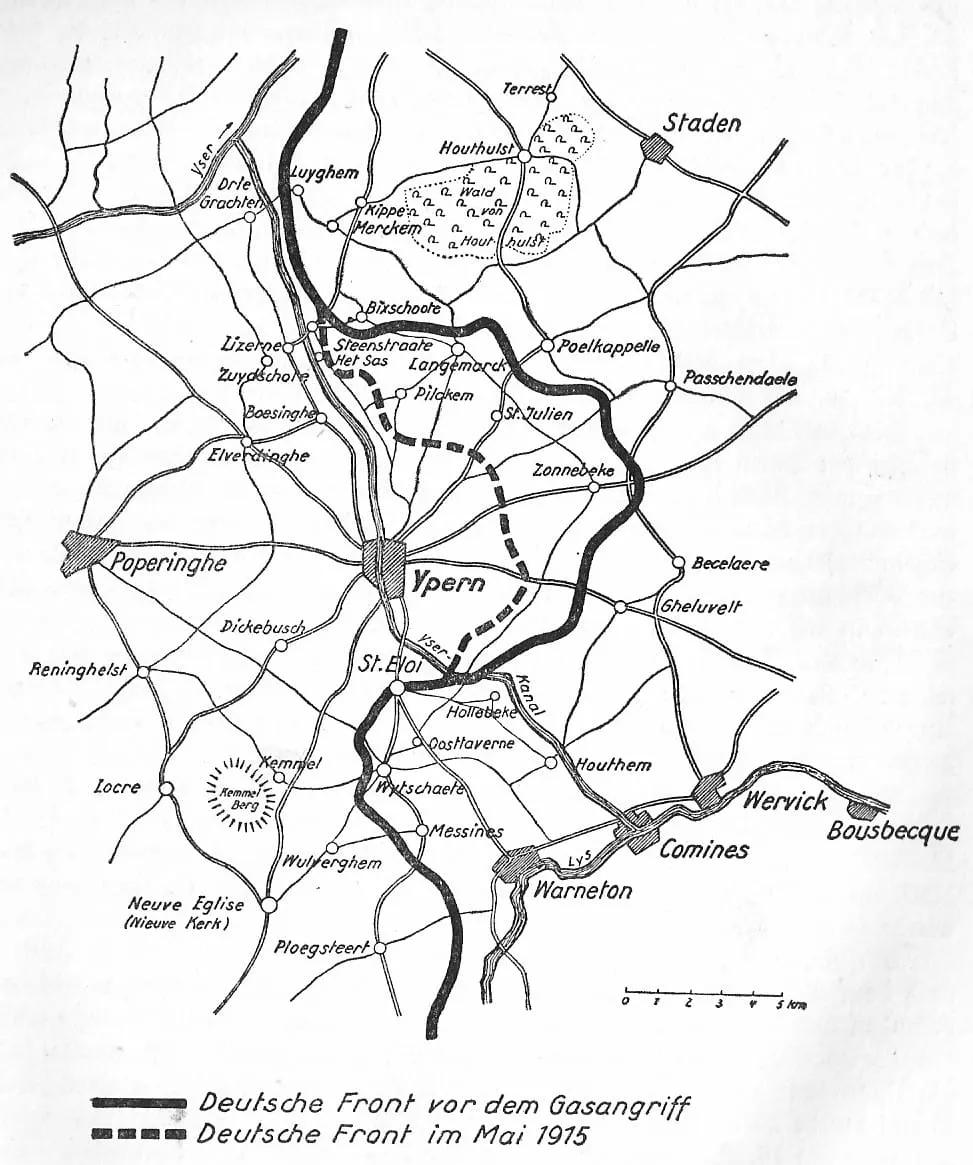
The Battle of Frezenberg Ridge, fought from 8 to 13 May 1915 east of Ypres, was the third stage of the Second Battle of Ypres. A few days after the British had withdrawn from the tip of the salient to a shorter line, the German 4th Army massed most of three corps and a superiority in heavy artillery against two exhausted British divisions. On 8 May a hurricane bombardment levelled the trenches on the exposed slope of Frezenberg Ridge, and the German infantry opened a gap more than 3 kilometres wide in the British front. The last reserves closed it, and in the following days dismounted cavalry replaced the worn-out infantry in the trenches. The Germans gained a strip of ground about a kilometre deep, but they did not reach Ypres. Both sides paid an enormous price for it.
Name and dates
The name and dates of the battle, 8–13 May, were fixed after the war by the British Battles Nomenclature Committee. On the first day the Germans attacked the ridge, and on the last they made their final great assault before a lull in the fighting. The British official history noted, however, that the German bombardment of the new line had begun as early as 4 May and the first infantry attacks had come on 5 May, so the battle could be regarded as lasting ten days. The Germans did not distinguish it separately. For them it was part of the Second Battle of Flanders.
Frezenberg is a hamlet on the road from Ypres to Zonnebeke, today lying where the municipalities of Zonnebeke, Ieper and Langemark-Poelkapelle meet. The ridge that gave the battle its name is low, but in flat Flanders even a slight rise gave a view over a wide area.
Background
From 22 April the Germans, helped by clouds of chlorine, had been pushing the Allies out of the northern part of the Ypres salient. At the end of April Field Marshal John French took command of the troops in the salient away from General Horace Smith-Dorrien and gave it to General Herbert Plumer. On the night of 3–4 May, in accordance with Plumer’s plan, the infantry of the 27th, 28th and 4th Divisions left the projecting tip of the salient unnoticed. This ended the Battle of St Julien. The new line formed a semicircle with a radius of about 5 kilometres around the town. On 5 May the Germans, using gas, retook Hill 60 at the southern edge of the salient. On 6 May Smith-Dorrien was ordered home, and on 7 May Plumer succeeded him in command of the Second Army. Command of V Corps passed to General Edmund Allenby.
The new line was not a good one. In the south, in the woods between the Menin road and Bellewaarde Lake, it was held by General Thomas Snow’s 27th Division, partly screened by trees. Further north, General Edward Bulfin’s 28th Division stood on the long forward slope of Frezenberg Ridge, visible from the German heights at Zonnebeke and Gravenstafel and under fire from the flank. To its left, from Mouse Trap Farm towards the canal, stood the 4th Division. The trenches, dug in haste, were narrow and shallow, less than a metre deep, because any deeper one struck water. There was a shortage of sandbags, barbed wire, communication trenches and dugouts. All three divisions of V Corps had only six modern 60-pounder heavy guns and twelve obsolete 4.7-inch guns in support, some of them so worn that their shells fell short and erratically. Ammunition was also short.
Duke Albrecht of Württemberg, commander of the German 4th Army, still wanted to eliminate the salient. For four days he moved up heavy artillery and concentrated most of three corps against the 27th and 28th Divisions: General Berthold von Deimling’s XV Corps in the south, General Richard von Schubert’s XXVII Reserve Corps in the centre and General Otto von Hügel’s XXVI Reserve Corps in the north. The main blow was to fall on Frezenberg.
Course of the fighting
8 May. At 5.30 a.m. the Germans opened fire along the whole front of V Corps, heaviest on the 83rd Brigade of the 28th Division, which stood on both sides of the Zonnebeke railway and around the village of Frezenberg. Between 7 and 9 a.m. the bombardment was so violent that most of the parapets were levelled and many soldiers were buried in the trenches. The defenders beat off the first two assaults of the German infantry, but the third, at about 10, broke into the line on both sides of the village. Sending reinforcements down the exposed slope was impossible. The King’s Own battalion fought to the end in the support trenches, and its commanding officer was killed. Of the two companies of the 3rd Battalion, Monmouthshire Regiment, that had been in the front line, thirty men answered the evening roll call. On the brigade’s right flank two companies of the King’s Own Yorkshire Light Infantry and a company of the Monmouthshires, sheltered by the lie of the land, held their ground until nightfall.
South of the breach, on Bellewaarde Ridge, two battalions of the 80th Brigade of the 27th Division were holding out: the British 4th Battalion, King’s Royal Rifle Corps, and the Canadian Princess Patricia’s Canadian Light Infantry, a regiment of volunteers raised in August 1914 and named after Princess Patricia of Connaught, daughter of the Governor General of Canada. The bombardment turned the woods into an inferno, but when the German infantry advanced, Major Hamilton Gault, commanding the battalion, threw signallers, pioneers, runners and orderlies into the trenches. The Canadians rebuilt their line three times and beat off attacks until the afternoon. Gault was wounded twice, and command then passed from one officer to the next. That day bullets and shell splinters also struck the battalion’s colour, sewn by the princess herself. By the evening about 150 men were left of the battalion, and its losses came to nearly 400 killed, wounded and missing. The commander of the 27th Division extended the brigade’s line to the north-west and bent back its flank along the railway, so that the Germans were unable to widen the breach to the south.
North of the breach, from Frezenberg to Mouse Trap Farm, stood the 84th Brigade. Its battalions, though their right flank was exposed, held on in their trenches. At about 11.15 a.m. its commander sent them his last reserve, the London territorial battalion of the Rangers, by then only about two hundred strong. Advancing across the flat ridge under fire from every kind of artillery, the battalion partly reached the front line, but ceased to exist as a unit. Fifty-three men answered the roll call. Meanwhile the enemy was pouring into the gap and rolling up the brigade’s line from the flank. At about 1 p.m. the Germans broke through the front of the Cheshire battalion, whose commanding officer was killed. The Suffolk battalion fought on in isolated groups until the afternoon, and the 1st Battalion, Monmouthshire Regiment, was surrounded at about 5 p.m. About 120 of its men escaped, and its commanding officer and second in command fell. Only the Northumberland Fusiliers battalion at Mouse Trap Farm beat off attacks from the front and flank. Its commanding officer was taken prisoner, but one company held its sector for another full day.
At about 2 p.m. a gap more than 3 kilometres wide yawned in the British front between the Canadian battalion and the Northumberland Fusiliers. General Bulfin threw his last reserve, the 85th Brigade, into a counter-attack, supported by the remnants of other battalions. It set off at about 3 p.m. but under artillery fire did not reach the Germans, and its battalions dwindled to a few hundred men, some to a few dozen. In the evening, at about 7.30 p.m., battalions of the 4th Division came up from the other side of the gap and advanced a little in front of the GHQ Line, a belt of fortifications in the rear. These two moves were enough. The Germans, who had begun to dig in after taking the ridge, were driven off the hill east of Wieltje. According to German accounts, both reserve corps then gave up part of the ground they had won, and the 4th Army went over to the defensive on that sector for several days. During the night the British laid out a new line behind Verlorenhoek Ridge, about 1.2 kilometres behind the morning’s front.
9–12 May. The next day the French opened their offensive in Artois and the British First Army attacked at Aubers, so the Germans had to send part of their ammunition and troops south. At Ypres, however, they kept on attacking, this time against the 27th Division on both sides of the Menin road. On 9 May they wiped out by shellfire a platoon of the Gloucestershire battalion in a forward trench and occupied it, while the attack on its neighbours collapsed under rifle fire. On 10 May, after several hours’ bombardment by heavy howitzers, they attacked, using a small quantity of gas. The British by then had makeshift respirators and repulsed the attack, but at night they had to fall back from the most badly damaged trenches to a second line behind Bellewaarde Lake. On 11 May the wind blew back onto the German troops the gas released opposite the Scottish battalion of the Cameron Highlanders, but after another bombardment the Germans took the highest point at the bend of the road and the corner of Sanctuary Wood. As early as 9 May the 1st Cavalry Division had been sent to support the decimated 28th Division, and on the night of 12–13 May the infantry of the 28th Division was relieved by the 1st and 3rd Cavalry Divisions, dismounted and combined into General Henry de Lisle’s “Cavalry Force”.
13 May. From 3.30 a.m. to 1 p.m. the Germans kept up a bombardment that V Corps headquarters judged the heaviest of the whole battle. It rained all day and the trenches turned to mud. At about 8 a.m. the Germans broke into the line of the 7th Cavalry Brigade, which was holding the exposed forward slope by the railway, and drove the two regiments of Life Guards and most of the Leicestershire Yeomanry out of their trenches. The cavalrymen had no grenades with which to reply. One squadron of the Leicestershire Yeomanry in the support trenches, however, blocked any further advance. At 2.30 p.m. the 8th Cavalry Brigade, with the Royal Horse Guards, the 10th Hussars and the Essex Yeomanry, counter-attacked. It drove the Germans out of part of the ground, but under shrapnel and machine-gun fire could not hold the old line and dug in about 900 metres behind it. To the left of the cavalry the 4th Division beat off several attacks, and Mouse Trap Farm, which by British reckoning was being hit by more than a hundred shells a minute, was briefly lost and retaken in the evening. Lance-Sergeant Douglas Belcher of the London Rifle Brigade, a territorial battalion, held a wrecked trench with a handful of men and kept the Germans off with his fire, for which he received the Victoria Cross. The Germans went no further and did not even occupy the abandoned ground. According to a German account, the great attack planned for 13 May had to be called off for lack of ammunition. With that the battle ended. For the next ten days relative calm reigned at Ypres, broken only on 24 May by another gas attack.
Losses
According to the British official history, from 8 to 13 May V Corps lost 456 officers and 8,935 other ranks killed, wounded and missing, a total of more than 9,300 men. The 28th Division suffered most, losing more than 3,800 men in those days, most of them missing, that is killed, wounded or taken prisoner in the wrecked trenches. Since the start of the Second Battle of Ypres the division had lost more than 15,000 soldiers. On 8 May alone eleven battalion commanders were killed or wounded. The Germans announced that they had taken about 800 prisoners between 1 and 8 May. The British official historian took this small number as proof that most of the defenders had fought to the end. On 13 May seven regimental commanders and one brigade commander of the cavalry were killed or wounded. The Leicestershire Yeomanry lost 187 killed and wounded out of 281 men.
German losses were not given separately for this battle. According to figures from the German Reichsarchiv, the infantry strength of the two divisions of XXVI Reserve Corps, the 51st and 52nd Reserve Divisions, fell between 20 April and 11 May from about 13,000–13,500 to about 8,700–9,200 men each, although it is not known how many replacements they received in that time.
Significance
The Battle of Frezenberg Ridge showed what the war on the Western Front had become in 1915. The Germans did not need great masses of infantry. Their heavy artillery destroyed the shallow trenches and their defenders, and the infantry occupied the cleared ground and dug in at once. The British, short of guns and ammunition, replied with counter-attacks that broke down under fire in open country. The British official history concluded that it was the superiority of the German artillery, more than gas, that decided the course of the whole Second Battle of Ypres. The shortage of shells, felt at Ypres and at the same time at Aubers, became a political issue in Britain in May 1915.
At the same time the Germans, despite their enormous superiority in firepower, gained only a strip of ground a kilometre deep and did not break the front. The British soldiers, among them many poorly trained recruits from drafts and territorials, did not give way even when their battalions dwindled to a few dozen men. The defence of Bellewaarde Ridge by the Canadians of Princess Patricia’s Canadian Light Infantry became one of the most important episodes in the regiment’s history. On the ridge, on a street named after Princess Patricia, stands the regiment’s memorial, unveiled in 1964, on the fiftieth anniversary of its founding.
Spotted a mistake?Report an error