1915: The Second Battle of Ypres
Battle of Bellewaarde Ridge
- Dates:
- 24–25 May 1915
- Front:
- Western Front
- Location:
- The eastern and north-eastern part of the Ypres salient, from Hooge and Bellewaarde Lake through Railway Wood and Wieltje to Mouse Trap Farm and Turco Farm, West Flanders (Belgium)On the battle map →
- Sides:
- United KingdomJohn French, Herbert Plumer, Edmund AllenbyGerman EmpireAlbrecht, Duke of Württemberg
- Result:
- Inconclusive, with a slight German advantage. The Germans took Mouse Trap Farm and part of Bellewaarde Ridge but did not break through the front. Both sides then halted their attacks.
- Author:
- Natalia
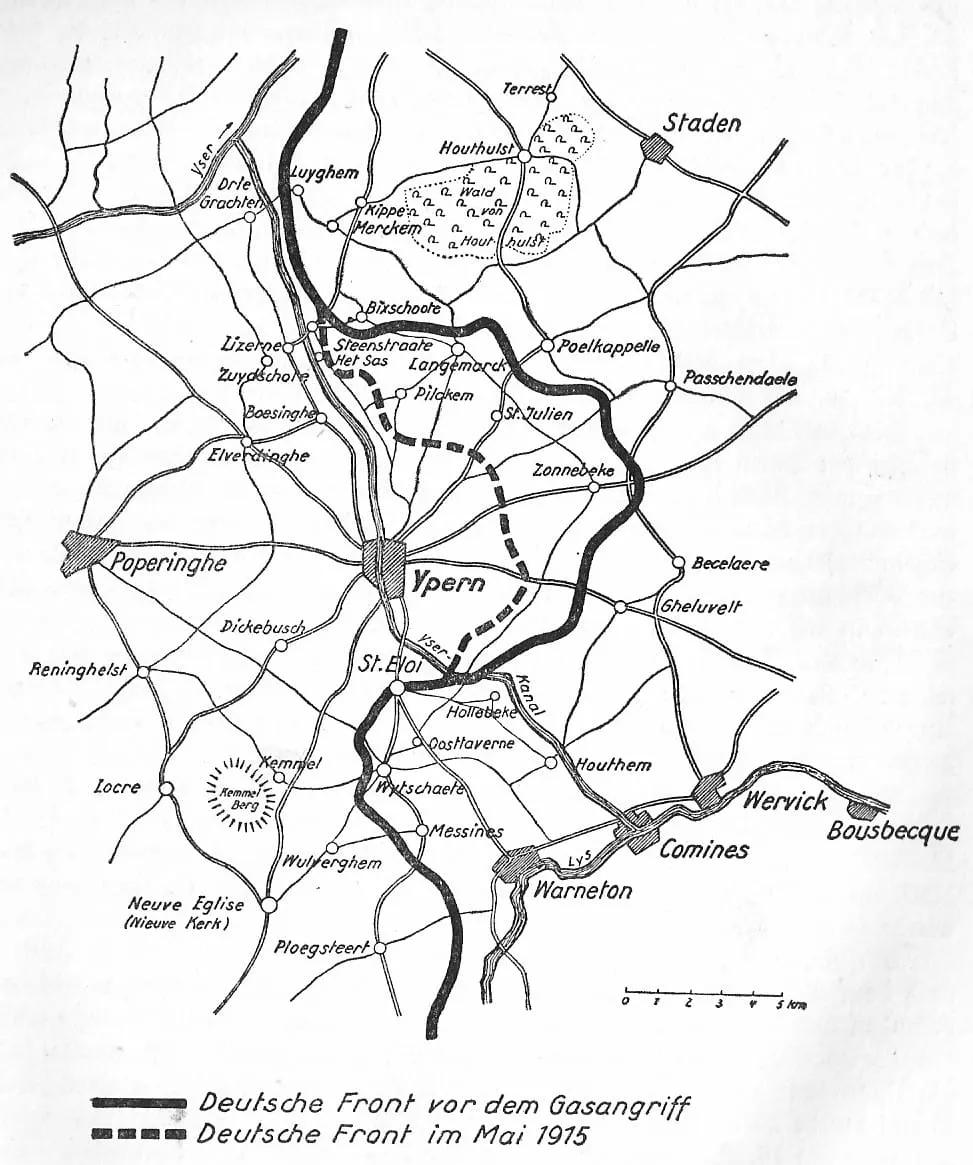
The Battle of Bellewaarde Ridge, fought on 24 and 25 May 1915 east and north-east of Ypres, was the final stage of the Second Battle of Ypres. It began at dawn with a German chlorine attack which, according to the British official history, was the largest the British had yet experienced. It covered almost the whole sector of the British V Corps. The British already had simple respirators and were not taken by surprise, but many units, made up largely of half-trained recruits, were almost entirely destroyed. The Germans tore two gaps in the British line: at Bellewaarde Lake and Ridge, and at Mouse Trap Farm. Night counter-attacks did not close them, but the Germans no longer had the strength to go further. On the evening of 24 May their command halted the attack, and on 25 May the fighting died down.
Name and dates
The name of the battle and the dates 24–25 May were fixed after the war by the British Battles Nomenclature Committee, which divided the fighting at Ypres in the spring of 1915 into four battles. Bellewaarde Ridge was the last of them, after the Battle of Gravenstafel Ridge, the Battle of St. Julien and the Battle of Frezenberg Ridge. The committee’s report used the spelling “Bellewaerde”, which can still be found in the literature and in the name of a nearby amusement park. The British official history noted, however, that this spelling had not been officially adopted, and the regiments received the battle honour “Bellewaarde”, in keeping with the Flemish name of the place.
Bellewaarde is a low ridge with a lake and a former château about 4 kilometres east of Ypres, north of the village of Hooge and the Menin road. The name of the battle, like the names of the earlier stages, only partly reflects the course of the fighting. The attack covered the whole front of V Corps, and some of the heaviest fighting took place several kilometres further north, at Mouse Trap Farm near Wieltje. 25 May itself passed almost without fighting, but it was on that day that the committee ended this battle, and with it the whole Second Battle of Ypres. The Germans did not treat this fighting as a separate battle and did not claim any major success in it.
Background
After the Battle of Frezenberg Ridge, which ended on 13 May, the front at Ypres fell quiet for nine days. The British even concluded that the Second Battle of Ypres was over. After the departure of General Smith-Dorrien, the Second Army was commanded by General Herbert Plumer, and his former V Corps was taken over by General Edmund Allenby. The lull was used to improve the trenches and build rear lines. The soldiers now had simple respirators of cotton waste or cloth soaked in a chemical solution, and hand sprayers for neutralising the remnants of gas were sent to the trenches. The first flannel hoods with eyepieces, forerunners of the later masks, were available only at sixteen per battalion, for the machine-gun crews. The battalions worn down in April and May were filled with recruits, who were often at the front for the first time. In mid-May the French, on the left of the British, drove the Germans off the west bank of the canal at Steenstrate.
The German Fourth Army of Duke Albrecht of Württemberg was also exhausted, and from 9 May some of its ammunition and units had been taken away for the Sixth Army, which was defending itself in Artois against the French and British offensive. The main German forces were fighting in the east, where the pursuit of the Russians after the breakthrough at Gorlice was under way. Even so, the Germans prepared one more gas attack at Ypres. The day before, on 23 May, Italy had declared war on Austria-Hungary, which was greeted with joy in the British trenches.
Forces
The V Corps sector, about 9 kilometres long, ran from near Hill 60 in the south to Turco Farm in the north, where it met the French. On the Menin road, east of Hooge, stood two brigades of the 1st Cavalry Division, dismounted and fighting as infantry. Further north, across the railway and the road to Zonnebeke, the front was held by the 85th Brigade of the 28th Division, and from Wieltje to Mouse Trap Farm and Turco Farm by the 10th and 12th Brigades of the 4th Division. Battalions of the Territorial 50th (Northumbrian) Division were attached to the front-line units for instruction. In reserve were the 84th Brigade, the 2nd Cavalry Division, the 11th and 13th Brigades, and further west the 27th Division and the 3rd Cavalry Division.
According to a German account quoted by the British official history, the 39th Division of XV Corps attacked opposite Hooge, the 53rd and 54th Reserve Divisions of XXVII Reserve Corps between Bellewaarde and Wieltje, and further to the north-west the 51st Reserve Division of XXVI Reserve Corps. If these figures are accurate, four German divisions struck four British brigades.
Course of the fighting
24 May: the gas attack. It was Whit Monday, a warm, fine day. After the rain of the previous days the trenches were full of mud. At about 2.45 a.m., as dawn was breaking, red rockets went up over the German lines. Immediately afterwards artillery, machine guns and infantry opened fire, and the Germans released chlorine on a front of about 7 kilometres, from Hooge to Turco Farm. In places the trenches were so close together that the hiss of gas escaping from the cylinders could be heard. In the light wind the dense cloud, a dozen or more metres high, drifted very slowly. The soldiers were standing to and expected an attack, but the cylinders were so close that many had no time to put on their respirators. This time the German infantry advanced almost immediately behind the cloud. The bombardment, partly with tear-gas shells, went on at full strength for four and a half hours. It cut all the telephone lines, and messages were carried by runners, many of whom were killed.
The first assault was repulsed with heavy German losses almost everywhere except at Mouse Trap Farm. This moated farm near Wieltje, earlier called Shell Trap Farm by the British, was already a heap of rubble and mud, and the trenches of the two sides were only about 30 metres apart there. The Germans took it in their first rush. In the sector of the 85th Brigade, however, between Bellewaarde Lake and the Zonnebeke road, two companies of the 8th Middlesex and a company of the 2nd East Surrey practically ceased to exist within two hours, after a stubborn defence. At about 8 a.m. the remnants of the 3rd Royal Fusiliers, who had lost all their officers, were also driven from the trenches south of the railway. The survivors rallied in the third line behind Railway Wood. At Hooge the cloud enveloped the positions of the 2nd Cavalry Brigade. The gas felled its commander and the brigade staff officer, and command was taken over by General W. H. Greenly of the 9th Cavalry Brigade. At about 10 a.m. the Germans broke through the front of the 18th Hussars between Hooge and Bellewaarde. A gap thus opened in the British line on both sides of Bellewaarde Lake. The Germans, however, went no further than the trenches they had captured.
On the northern flank the 2nd Royal Dublin Fusiliers and the 2nd Royal Irish Regiment held a sharp angle of the front at Mouse Trap Farm. From the captured farm the Germans worked their way along the trenches, bombing them with grenades. The reserves counter-attacked several times and at moments recovered the lost trenches, but the Germans quickly retook them. At about noon the organised defence of the Dublins ceased. The battalion’s commander, Lieutenant-Colonel Arthur Loveband, and several other officers were killed. Soon the Germans also took all the trenches of the Royal Irish. The whole angle of the front at Mouse Trap Farm was lost. To the left of the gap two battalions of the 12th Brigade, supported by French batteries of 75 mm guns from the west bank of the canal, beat off every attack.
Counter-attacks. At noon the commander of the 28th Division sent his reserve, the 84th Brigade, to counter-attack at Bellewaarde. It was badly weakened after the fighting of 8–13 May, and its ranks were filled mostly with recruits who had joined in the last ten days. The battalions set off without a midday meal, marched under fire south of Ypres and attacked from the so-called GHQ Line only at 5 p.m. They retook Witte Poort Farm and the nearby rise, but did not reach the lost trenches. At about 11 p.m., in bright moonlight, a joint attack by the 84th Brigade and the 80th Brigade of the 27th Division went in. The troops came within a few metres of the German trenches, but rifle and machine-gun fire at close range threw them back to the road at Witte Poort Farm, where they dug in. Only at Hooge did a company of the 1st York and Lancaster drive the Germans out of the houses along the Menin road after dark.
At Mouse Trap Farm the brigade commanders of the 4th Division decided that they did not have the strength to retake so wide a gap. In the evening it turned out that the French battalions that were to help them could be used only as support. At 8 p.m. the division’s chief of staff, Lieutenant-Colonel Archibald Montgomery, therefore ordered the abandonment of a salient about a kilometre deep, almost impossible to hold in the marshy ground, and the withdrawal of the troops to the rear line running from Wieltje to Turco Farm. The withdrawal was carried out during the night without interference from the Germans. That same evening the command of the German Fourth Army issued an order not to undertake any further major operations. The German battalions were as exhausted as the British.
25 May. The day passed without German attacks and with light shelling. During the night of 25–26 May the 80th Brigade dug a trench from the Menin road to Zouave Wood, linking up with the cavalry, and the front was continuous again. The British artillery had almost run out of ammunition: by the end of the fighting on 25 May little was left but a few shrapnel shells. With this the Second Battle of Ypres came to an end.
Casualties
The British official history does not give losses for the two days alone. In the period from 21 to 30 May, in which the fighting took place mainly on 24 May, V and II Corps together lost 358 officers and 10,107 other ranks killed, wounded and missing. Some battalions ceased to exist. The 2nd Royal Dublin Fusiliers went into the trenches with 17 officers and 651 other ranks, and after the fighting only 21 men withdrew across the canal: one officer and 20 soldiers. The 3rd Royal Fusiliers lost 16 officers and 536 men. The 84th Brigade lost about 60 per cent of its strength in the counter-attack, and the 80th Brigade 16 officers and 490 men. Among those killed on 24 May was Private John Condon of the 2nd Royal Irish Regiment, from Waterford. His headstone states that he was 14, and for decades he was regarded as the youngest British soldier killed in the war. More recent research, however, indicates that he was older, and the identification of his remains is also in doubt.
German losses for these days were not given separately. The British official history estimated that the German battalions had lost almost as many men as the British.
Significance
The Germans moved the front forward by several hundred metres, in places by about a kilometre. They took Mouse Trap Farm, which they held until 31 July 1917, and part of Bellewaarde Ridge, from which they had an even better view into the already shallow Ypres salient. They did not, however, manage to break through the front, and after 24 May they gave up further attacks. The British official history wrote that both sides were exhausted after more than a month of fighting, carried on mainly by the same divisions, which were thrown into battle again and again until they almost ceased to exist.
The battle also exposed the disastrous shortage of ammunition in the British army. On 27 May Field Marshal John French informed the War Office that he would have to suspend offensive operations until stocks were rebuilt. The official historian praised the decision to withdraw the 4th Division instead of launching another hasty counter-attack. He noted that French officers had long judged hasty British counter-attacks without artillery support in the words of a French general of the Crimean War: it is magnificent, but it is not war.
Bellewaarde Ridge remained one of the most contested places in the Ypres salient. The British attacked it again on 16 June and 25 September 1915, each time without significant gains.
Spotted a mistake?Report an error