Key event
German gas attack at Bellewaarde
- Category:
- Military operations
- Front:
- Western Front
- Date:
- 24 May 1915
- Author:
- Natalia
- Battle:
- Battle of Bellewaarde Ridge
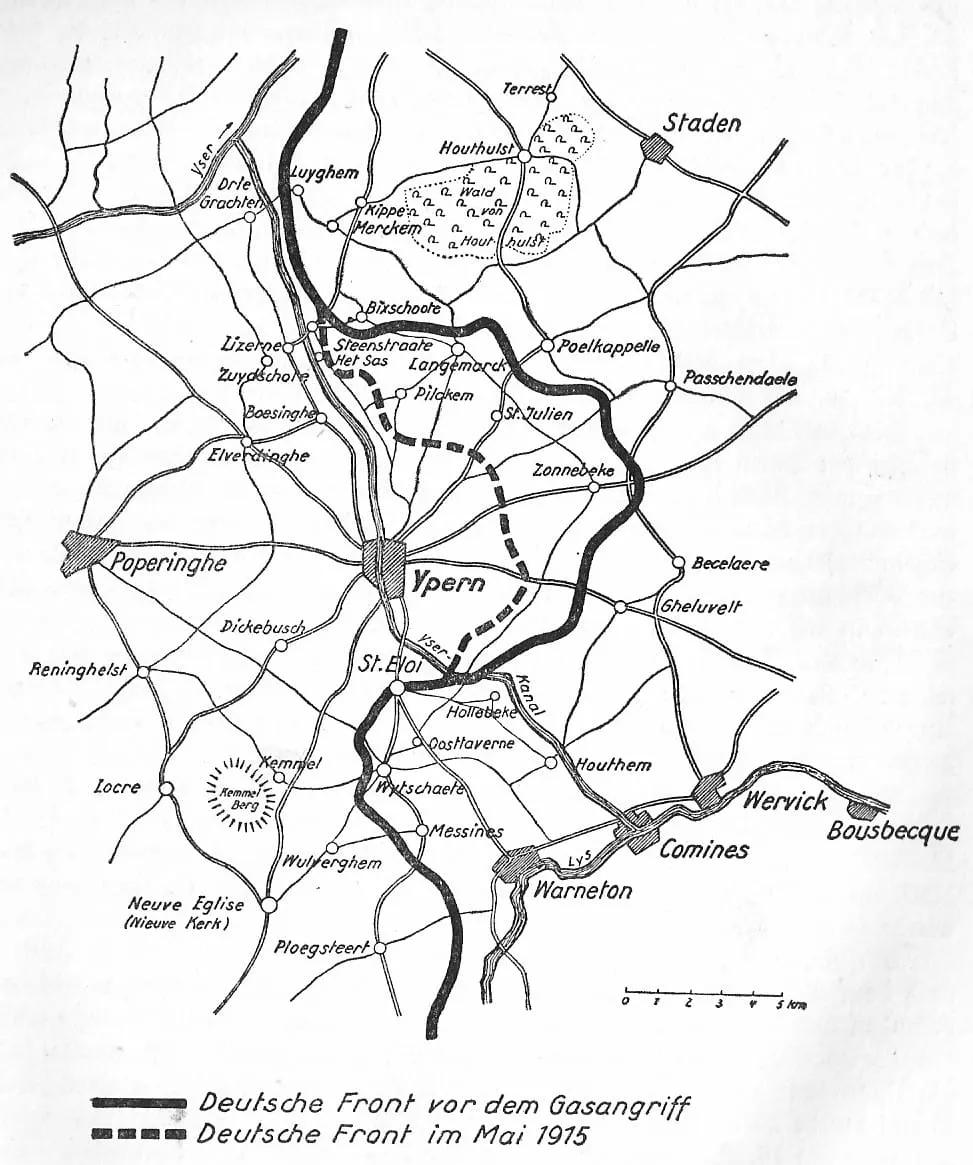
On 24 May 1915, Whit Monday, the Germans struck the Ypres salient for the last time that spring. At dawn they released chlorine from cylinders on a front about 7 kilometres long, from the village of Hooge in the east to Turco Farm north of the town. According to the British official history it was the largest gas attack the British had yet experienced. This time it fell not on surprised French troops, as on 22 April, but on British units that were expecting an attack and had simple respirators. Even so, the day brought them some of the heaviest losses of the entire Second Battle of Ypres.
A cloud at dawn
Since the end of the fighting for Frezenberg Ridge on 13 May, relative calm had reigned at Ypres. The British had managed to improve their trenches and had received their first means of protection: pads of cotton wool or cloth soaked in a chemical solution and hand sprayers for neutralising the remnants of the gas. The day before, news had reached the front that Italy had declared war on Austria-Hungary. The ranks of many battalions, thinned out in April and early May, were filled, however, with recruits who were at the front for the first time.
At about 2.45 a.m., as dawn was breaking, red rockets rose above the German trenches. Immediately afterwards guns, machine guns and rifles opened up, and gas began to escape from the cylinders. In places the trenches were so close to each other that the defenders could hear its hiss. In the light wind the dense cloud, more than ten metres high, drifted very slowly and hung over the trenches for a long time. The men stood ready, but many did not manage to put on their respirators in time. The German infantry advanced almost immediately behind the gas. For four and a half hours the heavy artillery rained shells, some of them containing tear gas, on the British lines and cut every telephone line. Reports and orders were carried by runners, many of whom never reached their destination.
Two gaps in the front
The British beat off the first assault almost everywhere. The Germans, however, immediately took Mouse Trap Farm, a ruined farmstead near Wieltje, north-east of Ypres, where the trenches of the two sides were only about 30 metres apart. A few kilometres further east, by Bellewaarde Lake, companies of the British 28th Division north and south of the railway line were broken within a few hours, and at about 10 a.m. the Germans also broke through the line of dismounted cavalry between Hooge and Bellewaarde. In this way the first gap in the British front opened on Bellewaarde Ridge.
Some of the heaviest fighting took place at Mouse Trap Farm. The sharp angle of the front here was held by two Irish battalions: the 2nd Battalion, Royal Dublin Fusiliers and the 2nd Battalion, Royal Irish Regiment. From the captured farm the Germans worked their way along their trenches, bombing them with grenades. The reserves counter-attacked several times, but at about midday the Dubliners’ defence collapsed. Their commanding officer, Lieutenant Colonel Arthur Loveband, and several other officers were killed. Soon the Royal Irish trenches fell too, and with them the whole angle of the front. Of the roughly 670 Dubliners who had been in the trenches that morning, only 21 withdrew across the canal after the fighting. Among the Royal Irish dead was Private John Condon, who for decades was thought to be the youngest British soldier killed in this war. His headstone says he was 14, though more recent research suggests he was older.
Counter-attacks and withdrawal
At noon the headquarters of the 28th Division threw its reserve, the 84th Brigade, made up mostly of fresh recruits, into a counter-attack at Bellewaarde. The brigade reached its starting positions only in the afternoon and attacked at 5 p.m. It retook Witte Poort Farm but did not recover the lost trenches. At about 11 p.m., by moonlight, it renewed the attack together with the 80th Brigade of the 27th Division. The men got within a few metres of the German trenches, but close-range fire threw them back with heavy losses.
At Mouse Trap Farm the commanders of the 4th Division concluded that they did not have the strength to retake the lost ground. In the evening, when it became clear that the French battalions could only support them, the decision was taken to give up a wedge of the front about a kilometre deep and to withdraw during the night to the rear line from Wieltje to Turco Farm. The Germans did not interfere. Their 4th Army was just as exhausted and that same evening received orders not to undertake any more major operations. Gas and shelling cost the British thousands of killed, wounded, gassed and captured that day. The Germans moved the front forward by a few hundred metres, but they did not break through it and did not reach Ypres.
Remember the articles you have read? Only in this browser; nothing is sent anywhere.How it works
Read ·
A voice from the front
“In a day or two the soldiers may leave off twitching and shuddering as they breathe, and may be able to draw a breath fairly, but an hour or two after they have inhaled the deadly German gas is an awful time to see one's men. […] Sleep comes to these tired soldiers like a death. […] even in sleep they twitch and shudder, and their sides heave like those of spent horses.”
Spotted a mistake?Report an error
Meanwhile
(04)Elsewhere in the same days.
- 24 May 1915 · Eastern FrontBattle of the Stryj beginsOn 24 May 1915 the South Army began shelling Russian positions before Stryj. Linsingen massed his forces for one blow, but the infantry stuck in the wire.
- 24 May 1915 · Italian FrontItalians cross the Austrian borderOn 24 May 1915 Italian troops crossed the border of Austria-Hungary along almost its whole length. The Austrians fell back behind the Soča, blowing up bridges.
- 24 May 1915 · DiplomacyGermany breaks off relations with ItalyOn 24 May 1915 Germany broke off diplomatic relations with Italy, which had declared war on Austria-Hungary. Yet Berlin and Rome did not go to war.
- 24 May 1915 · Middle EastRussians retake UrmiaOn 24 May 1915 the Russians returned to Urmia, left a few days earlier by the Turks and Kurds. An occupation tragic for the Christians was over.
Related events
(04)The same battle, people or subject.
- 25 May 1915 · Western FrontEnd of the Second Battle of YpresOn 25 May 1915 the Second Battle of Ypres died down. After five weeks of fighting and gas attacks the Germans had shrunk the salient but not taken Ypres.
- 24 April 1915 · Western FrontBattle of St Julien beginsOn 24 April 1915 the Germans struck the Canadians at Ypres with chlorine. The 1st Canadian Division's front gave way, and in the afternoon St Julien fell.
- 22 April 1915 · Western FrontBattle of Gravenstafel Ridge beginsOn the night of 22–23 April 1915 Canadians counter-attacked at Ypres to close the gas-attack gap. Of 1,500 men who charged the wood, under 500 were left.
- 25 September 1915 · Western FrontBattle of Loos beginsOn 25 September 1915 the British attacked at Loos behind chlorine gas, taking the village, Hill 70 and the Hohenzollern Redoubt, but reserves were too far back.