1915: The Second Battle of Ypres
Battle of St. Julien
- Dates:
- 24 April – 4 May 1915
- Front:
- Western Front
- Location:
- Around the village of Sint-Juliaan (St. Julien), Keerselare, Gravenstafel Ridge and Wieltje north-east of Ypres, West Flanders (Belgium)On the battle map →
- Sides:
- United Kingdom, Canada and British IndiaJohn French, Horace Smith-Dorrien, Herbert Plumer, Edwin Alderson, Arthur CurrieFranceFerdinand Foch, Henri PutzGerman EmpireAlbrecht, Duke of Württemberg, Otto von Hügel
- Result:
- Inconclusive. The Germans took St. Julien and forced the Allies to shorten their front, but did not break through the defence or take Ypres.
- Author:
- Natalia
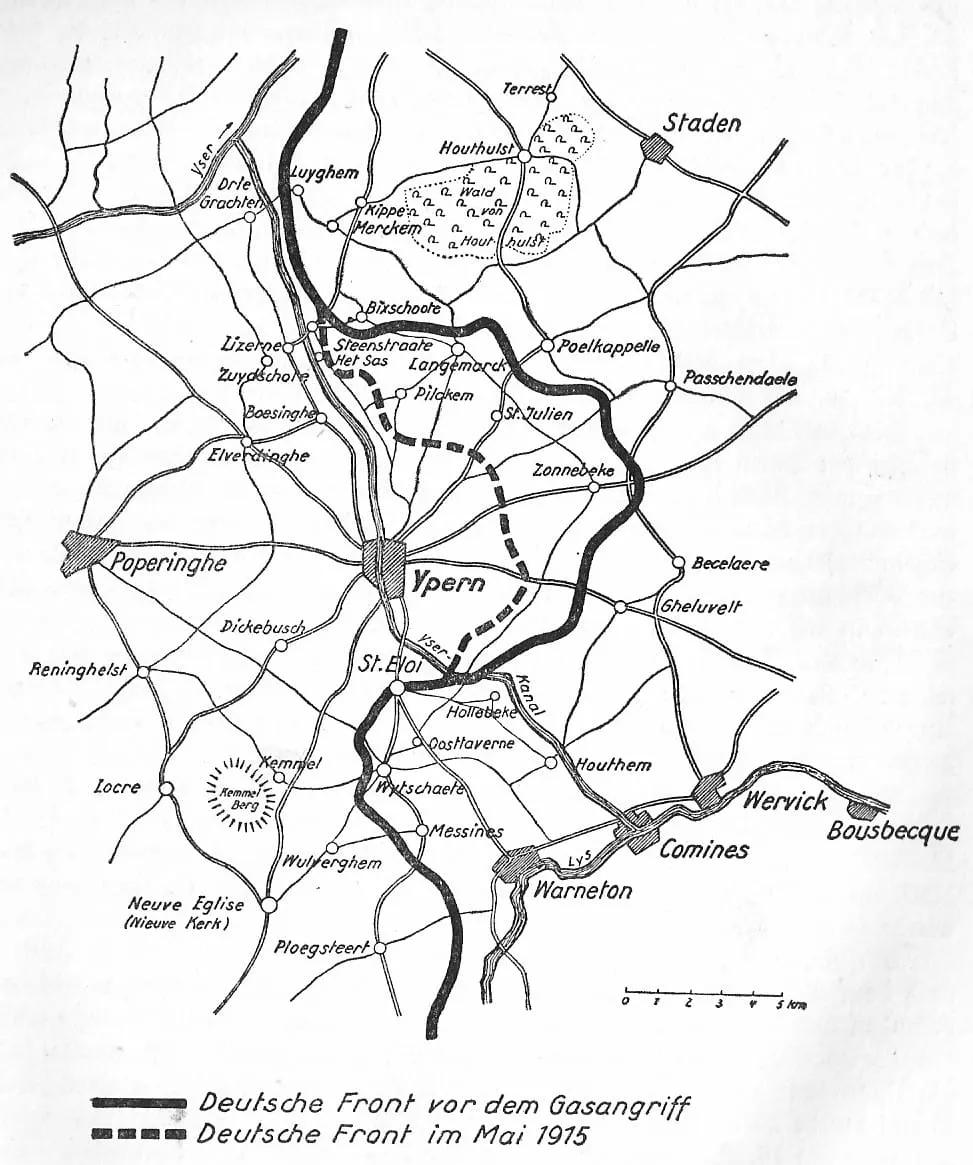
The Battle of St. Julien was the second stage of the Second Battle of Ypres. It began at dawn on 24 April 1915, when the Germans released a cloud of chlorine on the trenches of the 1st Canadian Division at the apex of the salient north-east of Ypres. The Canadians fell back, and in the afternoon they lost the village of Sint-Juliaan, called St. Julien by the British. Over the following days the British, Indians and French counter-attacked again and again to recover the lost ground. The attacks, made in haste, across open fields and with weak artillery support, broke down with heavy losses. At the beginning of May the Allies withdrew to a shorter line, closer to Ypres. The Germans, however, did not break through, and the town remained in Allied hands.
Name and dates
The name and dates of the battle were fixed after the war by the British Battles Nomenclature Committee. It divided the fighting at Ypres from 22 April to 25 May 1915 into four battles: Gravenstafel Ridge (22–23 April), St. Julien (24 April – 4 May), Frezenberg (8–13 May) and Bellewaarde (24–25 May). The Battle of St. Julien covered the second German gas attack, the fall of the village, the Allied counter-attacks in the last days of April and the withdrawal of the British troops to a new line on 1–4 May. Some studies, including the English Wikipedia, end it on 5 May. The Germans themselves treated the whole fighting as one battle, which they called the Second Battle of Flanders.
The village of Sint-Juliaan now lies in the municipality of Langemark-Poelkapelle. Before the battle it lay behind the Canadian sector; after 22 April it found itself just behind the front line.
Background
On 22 April the Germans, for the first time on the Western Front, released a cloud of chlorine on two French divisions on the northern edge of the Ypres salient. The French broke, and a gap several kilometres wide opened in the Allied front. Through the night and the following day the Canadians counter-attacked and, together with British battalions rushed up in haste, built a new, thin line from their old front to the Ypres–Yser canal. The front of General Edwin Alderson’s 1st Canadian Division now bent into a sharp wedge. Its apex lay at the crossroads at Keerselare, on the road from Sint-Juliaan to Poelkapelle. To the east of it, towards Gravenstafel Ridge, stood General Arthur Currie’s 2nd Brigade, and to the west, towards Sint-Juliaan, General Richard Turner’s depleted 3rd Brigade.
The German 4th Army under Albrecht, Duke of Württemberg decided to exploit its success and eliminate the salient. General Otto von Hügel’s XXVI Reserve Corps, with the 51st and 52nd Reserve Divisions, was assigned to the attack on the Canadians. Engineers placed gas cylinders opposite the Canadian apex.
Course of the fighting
24 April. At about 4 a.m., after a short artillery bombardment, the Germans opened the cylinders on a front a few hundred metres wide, at the junction of the two Canadian brigades. The Canadians had no masks and covered their faces with handkerchiefs soaked in water or urine. The 15th Battalion of the 3rd Brigade suffered worst, losing 647 men that day, the most of any Canadian battalion in a single battle of the war. The neighbouring 8th Battalion under Lieutenant-Colonel Louis Lipsett held most of its trenches. Through the morning the front of the 3rd Brigade fell back towards Sint-Juliaan. Turner, having misunderstood his orders, withdrew the remnants of his brigade to the GHQ Line, a chain of fortified points in the rear, and exposed Currie’s left flank. Small groups of Canadian soldiers, cut off from their own side, fought on until their ammunition ran out. In the afternoon the Germans took the village. The 2nd Brigade held on to Gravenstafel Ridge, and in front of the GHQ Line the German attack was stopped by British reinforcements. In the evening General Charles Hull, commander of the newly arrived 10th Brigade of the 4th Division, was ordered to retake Sint-Juliaan. Ten additional battalions were placed under his command.
25 April. Hull’s attack was postponed because of the difficulty of assembling the troops in the dark and went in only after dawn. The battalions of the 10th Brigade advanced across open fields without reconnaissance and without proper artillery preparation, and German machine guns in and around Sint-Juliaan inflicted enormous losses on them. The brigade lost nearly 2,500 men. The York and Durham Brigades of the British 50th (Northumbrian) Division, a Territorial division that had only just arrived at the front, failed to take their objectives but established a new line closer to the village. The Canadian 2nd Brigade, whose flank was exposed, withdrew from Gravenstafel Ridge that day. The Canadian medical officer Francis Scrimger carried wounded men that day out of a dressing station under fire and shielded one of them with his own body, for which he received the Victoria Cross. Over the following days most of the Canadian battalions were relieved.
26 April. General Ferdinand Foch was preparing a French counter-attack and pressed for British support. Field Marshal John French therefore threw into the attack the Lahore Division of the Indian Corps, which had only just reached Ypres after a long, exhausting march. At 2.05 p.m., after a bombardment of only forty minutes, the Ferozepore and Jullundur Brigades advanced north of Wieltje, alongside French North African troops. At about 2.30 p.m. the Germans released gas on them. The two brigades lost almost 2,000 men, and the 47th Sikhs 348 of their 444 men. The same day the Northumberland Brigade of the 50th Division, the first brigade of the British Territorial Force thrown into an attack in this war, struck straight at Sint-Juliaan. It broke into the edge of the village but had to fall back, losing 1,954 men, among them its commander, General James Riddell.
27–30 April. On 27 April the Sirhind and Ferozepore Brigades of the Lahore Division renewed the attack together with the French, but came up against untouched wire. The same day the commander of the Second Army, General Horace Smith-Dorrien, proposed in a letter to the chief of staff of the British Expeditionary Force a withdrawal of the troops from the salient to a shorter line. French, irritated by his pessimism, took away his command of the troops in the salient and gave it to General Herbert Plumer, commander of V Corps. Plumer soon proposed an almost identical withdrawal. French delayed his decision because Foch was promising further French counter-attacks, which, however, changed little. The French lost nearly 4,000 men between 26 and 29 April.
1–4 May. When the French attacks failed, French agreed to the withdrawal. On 1 May guns, stores and wounded began to be moved out of the salient, and on the night of 3/4 May the infantry left its old positions. The new line ran from Hill 60 east of Hooge, across Frezenberg Ridge to Mouse Trap Farm, and from there westwards to the canal as before. The front thus moved several kilometres closer to Ypres.
Casualties
The exact losses of the Battle of St. Julien alone cannot be separated from those of the whole Second Battle of Ypres. The 1st Canadian Division lost 5,975 men between 22 April and 3 May, including about a thousand killed, 3,058 of them on a single day, 24 April. The British 10th Brigade lost nearly 2,500 men on 25 April, and the Northumberland Brigade 1,954 on 26 April. The Lahore Division lost 3,889 men between 24 April and 1 May, about 30 per cent of the soldiers sent into action. German losses were also heavy, but they cannot be established for the Battle of St. Julien alone.
Significance
The Battle of St. Julien was the Canadians’ first great test on the Western Front. The division, made up mostly of volunteers who a few months earlier had been civilians, paid an enormous price for it, but earned a reputation as troops who would not give way even in the worst situation. The battle also exposed weaknesses in Canadian command and equipment, above all the Ross rifle, which jammed in mud and in rapid fire. Many soldiers exchanged it for British Lee-Enfield rifles taken from the dead.
For the British the battle was a string of costly, badly prepared counter-attacks which, instead of recovering ground, only added to the losses. One of its consequences was the removal of Smith-Dorrien, whom French finally relieved of command of the Second Army on 6 May. Gas, used for the second time on 24 April, did not bring the Germans a breakthrough. The Allies hurriedly introduced the first improvised respirators, and the effect of surprise weakened with each attack.
At the crossroads at Keerselare, where the gas struck the Canadians on 24 April, there has stood since 1923 a memorial with the figure of a pensive soldier, known as the Brooding Soldier. These battles also gave rise to one of the best-known war poems. The Canadian army doctor John McCrae, who served at Ypres with the Canadian artillery, wrote the poem In Flanders Fields at the beginning of May, after the death of a friend; it was published in December 1915.
Spotted a mistake?Report an error