Key event
Battle of Caporetto begins
- Category:
- Military operations
- Front:
- Italian Front
- Date:
- 24 October 1917
- Author:
- Łukasz Skowroń
- Battle:
- Twelfth Battle of the Isonzo
- Tags:
- Italy, Germany, Austria-Hungary, chemical weapons
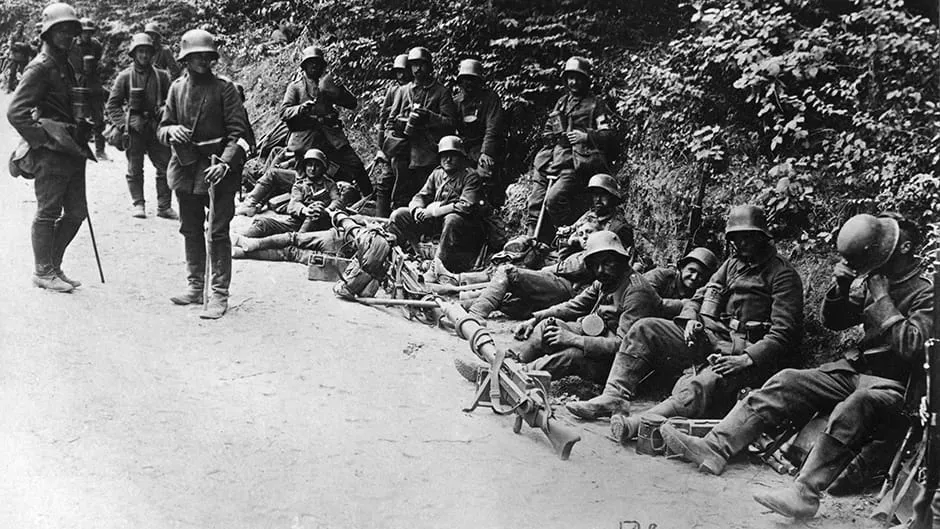
At two in the morning on 24 October 1917 hundreds of guns opened fire on the front along the upper Isonzo, from Rombon above Bovec to the Bainsizza plateau. The joint offensive of Germany and Austria-Hungary against Italy had begun, called the Twelfth Battle of the Isonzo and known in Italy and around the world as the Battle of Caporetto. After several hours of bombardment, in rain and fog, the infantry of the new German 14th Army under General Otto von Below went over to the assault. By evening the Italian front had been torn open over a length of more than 30 kilometres, and a German division advancing along the floor of the Isonzo valley had taken the small town of Caporetto, today Slovenian Kobarid, and stood on the old Italian-Austrian frontier.
Before the storm
The decision on the offensive was taken in September, when the Austrians, exhausted by the Eleventh Battle of the Isonzo, obtained German help. For several weeks infantry, guns and ammunition were moved by night into the valleys around Tolmin and Bovec. According to the Austrian official history, the 14th Army, made up of seven German and eight Austro-Hungarian divisions, had 1,678 guns and 44 trench-mortar batteries on the day of the attack. Because of heavy rain, which delayed the concentration, the date of the attack was put back by two days.
The Italians knew that something was in preparation. On 20 and 21 October three Austro-Hungarian officers who had deserted, a Czech and two Romanians, revealed details of the plan to them, including the place of the attack and the announcement of a gas bombardment. General Luigi Cadorna toured the two threatened corps on 22 October and moved one division to Kobarid, but he did not believe that the enemy could develop a major offensive in such difficult mountains. General Luigi Capello, commanding the 2nd Army, was ill, and his troops, deployed for attack after the summer offensive, were still largely beyond the Isonzo, on the Bainsizza plateau.
Gas and fog
The weather that day was dreadful: in the night it drizzled, then came downpours, and on the peaks snowstorms. Fog filled the valleys. Punctually at 2 a.m. the Central Powers’ artillery opened fire with gas shells on the Italian batteries and the front line. At Bovec, in Italian Plezzo, the German 35th Pioneer Battalion electrically fired 894 projectors buried in the ground, modelled on the British Livens projectors. Their bombs filled with phosgene a ravine behind the Italian front line in which men of the 87th Infantry Regiment of the Friuli Brigade were sheltering. When the German pioneers entered the ravine in the morning, they found, according to their accounts, between 500 and 800 dead, only a few of whom had managed to put on their masks. The gas also silenced some of the Italian batteries that were to have shelled the crowded German and Austrian assembly positions.
After a two-hour pause, at 6.30 a.m., a violent destructive bombardment fell on the Italian trenches, command posts, depots and roads, and half an hour later the trench mortars joined in. The fog in the valleys prevented the Italians from using the machine guns and guns hidden in rock caverns on the slopes. The artillery of General Pietro Badoglio’s XXVII Corps, its telephone lines cut by the bombardment, hardly replied, which later became the subject of years of controversy.
The breakthrough
At 8 a.m. at Tolmin and at 9 a.m. at Bovec the infantry went over to the assault. The German 12th Silesian Division of General Arnold Lequis got furthest. Without climbing the slopes, it advanced along the floor of the Isonzo valley on both banks of the river, was in Idrsko at about 1 p.m., and at 4 p.m. its leading regiment burst into Caporetto, taking 2,000 prisoners. In the town further Italian units falling back from the mountains fell into German hands, among them the commander of the 43rd Division. The division pressed on, and before midnight its advance guard stood at Robič on the old frontier, 23 kilometres from where it had set out in the morning. The Austrian official history regarded this march deep into the Italian positions, without regard for flanks and rear, as one of the boldest feats of the whole war.
On the ridges above the valley the fighting went more slowly. The Austro-Hungarian 50th Division took the village of Krn and rolled up the Italian positions on Mrzli vrh, taking, according to the Austrian official history, 7,000 prisoners. Bavarians of the Alpine Corps at 5.30 p.m. took the heavily fortified Hill 1114, one of the two key points of the Italian defence on the Kolovrat ridge, and the German 200th Division took the second, Ježa hill, in the evening. The Austro-Hungarian 1st Division crossed two lines of trenches south of Tolmin. At Bovec the Austro-Hungarian 22nd Rifle Division took the ruins of the town and broke through the second line, but the attack on Rombon collapsed in a snowstorm, and the neighbouring 55th Division took only the forward trenches on Mount Vršič. In the south, on the Bainsizza plateau, the attack by General Kosak’s group was repulsed.
Evening in Udine
In the evening ever worse news reached the Italian headquarters in Udine. General Alberto Cavaciocchi’s Italian IV Corps had been shattered, and its units in the Krn massif cut off. At 9.30 p.m. Cadorna ordered the troops withdrawn from the Bainsizza plateau to the Globočak–Vrh–Monte Santo line, and before midnight he laid down further lines on which the 2nd Army was to make a stand on the mountains in front of the plain. He also sent reserves to the threatened sector. According to the estimates of the Italian historian Mario Silvestri, the Germans and Austrians took about 35,000 prisoners and hundreds of guns that day.
The headquarters of the 14th Army at Krainburg (today Kranj) did not even know by the evening how far its divisions had got. It did know, however, that the attack was everywhere proceeding according to plan. The next day its troops pushed on into the mountains above the Natisone valley, and behind them the road to the Friuli plain was opening.
Remember the articles you have read? Only in this browser; nothing is sent anywhere.How it works
Read ·
A voice from the front
“Soon the fire-mouths of more than 1,000 guns flash on both sides of Tolmein. In the enemy’s ground there is an unbroken bursting and crashing. Mighty as the heaviest thunderstorm, it echoes back from the mountains. In amazement we watch and listen to the tremendous event. In vain Italian searchlights try to pierce the rain.”
Translated · Original (de)
Bald zucken die Feuerschlünde von über 1000 Geschützen beiderseits Tolmein. Im Feindgelände dröhnt ein ununterbrochenes Bersten und Krachen. — Mächtig, wie schwerstes Gewitter, hallt es von den Bergen wieder. Staunend sehen und hören wir das ungeheuere Geschehen. Vergebens versuchen italienische Scheinwerfer durch den Regen zu dringen.
Spotted a mistake?Report an error
Meanwhile
(04)Elsewhere in the same days.
- 23 October 1917 · Western FrontBattle of La Malmaison beginsAt 5.15 a.m. on 23 October 1917 the French Sixth Army attacked the western end of the Chemin des Dames. Zouaves took Fort La Malmaison; Chavignon fell too.
- 26 October 1917 · DiplomacyBrazil declares war on GermanyOn 26 October 1917 the Brazilian Congress recognised that Germany had imposed a state of war on Brazil. The immediate cause was the sinking of the Macau.
- 26 October 1917 · Western FrontStart of the Second Battle of PasschendaeleOn 26 October 1917 the Canadians attacked the Passchendaele ridge in rain. After hard fighting they took the Bellevue spur, where the New Zealanders had failed.
- 21 October 1917 · Middle EastTurks repulsed at PetraOn 21 October 1917 Turks from Ma'an attacked Arab regulars in Wadi Musa near Petra. They broke into the first line, but in the evening had to withdraw.
Related events
(04)The same battle, people or subject.
- 28 October 1917 · Italian FrontFall of Gorizia and UdineOn 28 October 1917 the Austrians retook Gorizia and the Germans took Udine, the Italian headquarters. The Italian army fell back behind the Tagliamento.
- 9 November 1917 · Italian FrontItalians withdraw behind the PiaveOn 9 November 1917 the last Italian rearguards crossed the Piave and blew the bridges. The retreat from Caporetto was over, and the enemy stood on the river.
- 12 September 1917 · Italian FrontEnd of the Eleventh Battle of the IsonzoOn 12 September 1917 the last great Italian assault on Monte San Gabriele failed. That day the Austrians got orders for a joint offensive with the Germans.
- 11 November 1917 · Italian FrontCentral Powers on the PiaveOn 10–11 November 1917 the Austrians and Germans reached the Piave from sea to mountains, and Conrad attacked at Asiago. The fight for a new line began.