1917: The Western Front
Battle of Hill 70
- Dates:
- 15–25 August 1917
- Front:
- Western Front
- Location:
- Hill 70 north of Lens, between Loos-en-Gohelle and the mining settlements of the town's northern suburbs (Cité St. Édouard, St. Laurent, St. Émile, Ste. Élisabeth and St. Auguste), and the western suburbs of Lens, Pas-de-Calais department (France)On the battle map →
- Sides:
- Canada and the United KingdomDouglas Haig, Henry Horne, Arthur CurrieGerman EmpireRupprecht, Crown Prince of Bavaria, Otto von Below
- Result:
- Canadian victory. The Canadians took and held Hill 70, inflicting heavy losses on the Germans and tying down their reserves, but did not take Lens, which remained in German hands until the autumn of 1918.
- Author:
- Natalia
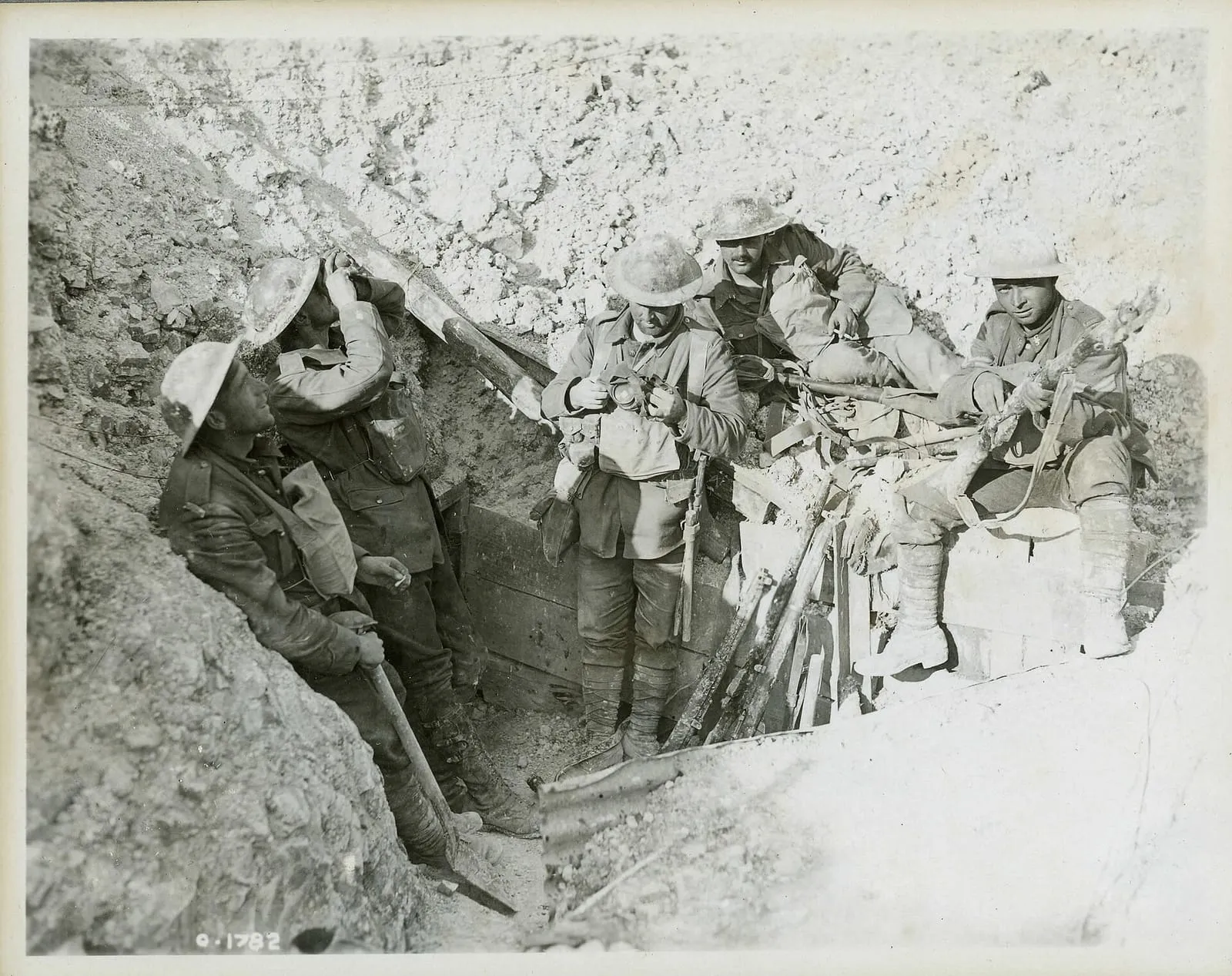
The Battle of Hill 70 was the first battle of the Canadian Corps under a Canadian commander, General Arthur Currie. It was meant to draw German attention and reserves away from Flanders, where the Third Battle of Ypres had been under way since 31 July. The headquarters of the British First Army wanted the Canadians to strike straight at the ruined mining town of Lens. Currie persuaded his superiors that Hill 70, which dominated the town from the north, mattered more: the Germans would not tolerate the loss of so valuable an observation point and would have to retake it, and then the Canadian artillery would inflict losses on them such as no attack could. At dawn on 15 August 1917 two Canadian divisions took the summit within a few dozen minutes, and over the next three days, by Currie’s count, beat off 21 German counter-attacks, some of them delivered with flamethrowers and under cover of a new gas, mustard gas. The plan worked. Things went worse on 21–25 August, when the Canadians tried to break into Lens itself: the attacks in the ruins of the town brought heavy losses and little ground. In eleven days of fighting the Canadian Corps lost more than 8,500 men, and the Germans, by various estimates, between 10,000 and 20,000.
Name and dates
The name “Battle of Hill 70” and the dates 15–25 August 1917 were fixed after the war by the British Battles Nomenclature Committee. They cover the capture of the hill on 15 August, the repulse of counter-attacks until 18 August and the attacks on the western suburbs of Lens from 21 to 25 August, which ended with the capture of Aloof Trench. The Canadian official history (G.W.L. Nicholson, Canadian Expeditionary Force 1914–1919), on which this page is mainly based, dates the battle the same way. The German official history says that the fighting continued intermittently until 24 August. The hill, called cote 70 by the French, took its name from the height of 70 metres marked on the maps. Times are given in British time.
Background
Lens, the centre of the most densely built-up coalfield in France, had been in German hands since October 1914. After the capture of Vimy Ridge in April 1917 the Germans fell back onto the plain, and the town found itself in a projecting salient of their front, under the fire of British artillery, which reduced it to ruins. The British already knew Hill 70, a treeless chalk hump in the northern suburbs: in September 1915, in the Battle of Loos, the Scottish 15th Division had crossed its summit but had been unable to hold it. From the hill one could see the whole of Lens and the Douai plain far behind the German lines.
In the spring of 1917, after the failure of the French offensive on the Aisne, the British commander-in-chief, Douglas Haig, was preparing a great offensive in Flanders. The other armies were meanwhile to tie down the Germans on their own sectors. General Henry Horne’s First Army planned an attack on Lens with three corps on a front from Gavrelle to Hill 70, but as the heavy artillery left for the north it had to scale down its intentions. In June the Canadians and the British I Corps fought on both sides of the little Souchez river south-west of Lens and took most of the village of Avion, but the attack on Hill 70, which I Corps was to carry out, was postponed for lack of guns.
Meanwhile, on 9 June, Currie took command of the Canadian Corps; he had previously commanded the 1st Division. On 7 July the First Army passed Haig’s order on to him: take Lens, so as to threaten an advance on Lille from the south. The Canadians were to break through Méricourt Trench south of the town and reach the railway line beyond it. From 10 July the corps took over from I Corps the front facing Lens and Hill 70, and by 16 July the 1st and 2nd Canadian Divisions held about five kilometres of line from Souchez northwards to the Bois Hugo wood north-east of Loos.
Currie’s plan
Currie considered the order mistaken. Lens was dominated from the north by Hill 70 and from the south-east by the high ground at Sallaumines. If the Canadians took the town itself while the Germans stayed on the hills, the attackers would find themselves lower down and in a worse position than before. At a conference of corps commanders on 10 July he persuaded Horne to make Hill 70 the main, immediate objective. He reckoned that the Germans would not accept its loss, because from the summit Canadian observers would see deep into their rear. They would counter-attack, and counter-attacks delivered in full view of artillery observers could be broken up by fire. As the Canadian plans put it, the hill was to be a place of “killing by artillery”.
Currie wanted to attack on 30 July, but torrential rain delayed the attack until mid-August. In the meantime the Canadians carried out raids, and the Canadian artillery cut the wire and shelled the German batteries. Special companies of British Royal Engineers fired drums of gas onto Lens from Livens projectors: by 15 August more than 3,500 such drums and 900 gas shells had fallen on the town. According to Nicholson, the artillery had by then neutralised about 40 of the 102 identified German batteries. For the first time Canadian guns were registered while keeping wireless contact with observers on the ground. On 9 August airmen of the Royal Flying Corps shot down six German observation balloons over Lens. The preparations could not be hidden, and the Germans expected an attack and even learned its date. It was only possible to mislead them about the place and the hour: on 14 August the British I Corps staged a feint attack with dummy tanks west of Lens.
The attack was to be carried out by General Archibald Macdonell’s 1st Division on the left and General Henry Burstall’s 2nd Division on the right, each with two brigades in the first wave, ten battalions in all. General David Watson’s 4th Division was to feint an attack on Lens from the west. The objective was set in three stages: the first German trenches, the Blue Line on the crest of the hill, and the Green Line, the old German third line on the rear, eastern slope, about 1.4 kilometres from the starting positions. Immediately after taking its objective each brigade was to dig in 48 Vickers machine guns, each of which became the core of a strongpoint held by at least 25 infantrymen. The attack was supported by nine field artillery brigades, with 102 18-pounder guns per division, and by 160 machine guns firing over the heads of the infantry. Heavy guns, however, were few: after many batteries had left for Flanders the corps was left with 164, many of them badly worn. The battalions rehearsed the attack on ground resembling the battlefield, using methods tried out in May at Fresnoy.
German defences
The sector belonged to the German Sixth Army of General Otto von Below, part of the army group of Crown Prince Rupprecht of Bavaria. Hill 70 was held by the 7th Infantry Division of Group “Loos” (the staff of IV Corps), and Lens itself by the 11th Reserve Division. Expecting an attack, the Germans brought two reserve divisions into the vicinity, the 4th Guard Division and the 220th Division, which practised counter-attacks together with the front-line divisions. Under the new principles of defence in depth the Germans were to accept the loss of the thinly held forward zone, defend themselves from machine-gun nests and shell holes further back, and with immediate counter-strokes by fresh troops throw the attackers out before they had time to dig in. The rubble of the mining settlements around the hill, with their deep cellars, gave the defenders good cover.
Course: 15 August
During the night of 14–15 August the Germans, expecting an attack, moved their reserve battalions closer to the front, and at 3 a.m. they detected the Canadian infantry assembling. At 4.25 a.m., as day broke, the Canadian barrage opened. The engineers fired drums of burning oil onto the settlement of Cité Ste. Élisabeth and other targets to add to the fire and lay a smoke screen. The German artillery replied after three minutes, but the Canadian guns quickly neutralised it. In the smoke the Canadians advanced quickly. The 2nd Division passed through the ruins of the St. Édouard and St. Laurent settlements, and within twenty minutes both divisions stood on the Blue Line, on the crest of the hill. By 6 a.m. the Green Line was in Canadian hands everywhere except on the sector of the 2nd Canadian Brigade in the centre. There, after the pause laid down in the timetable, the smoke cleared, and machine-gun fire from the St. Auguste settlement and from a large chalk quarry stopped the 7th and 8th Battalions. Only part of the 7th Battalion broke into the quarry and held on there until the afternoon.
The first German counter-attacks came between 7 and 9 a.m. The Canadians had already dug in their machine guns, and the artillery observers on the summit could see the enemy’s preparations as clear as day. Every attack was broken up before it had properly begun. Around noon and in the afternoon seven battalions of the 4th Guard Division and the 185th Division entered the fight. Instead of a coordinated counter-stroke it was a series of disjointed attacks. Waves of German infantry advanced across open ground under the fire of heavy guns, shrapnel and machine guns and were destroyed before they reached the Canadian trenches. Airmen directed artillery fire onto troop concentrations in the rear and strafed them with machine guns. The Germans broke only into Chicory Trench on the right flank, from which they were driven out in the evening. At one point all the guns of the Canadian Corps and of the neighbouring I Corps were firing simultaneously in front of three Canadian divisions. On the first day the Canadians lost 1,056 killed, 2,432 wounded and 39 prisoners, and by the evening had taken about 350 prisoners.
Course: counter-attacks, 16–18 August
On 16 August at 4 p.m. the fresh 5th and 10th Battalions took the rest of the Green Line within an hour, including the quarry, where the 10th Battalion killed about a hundred Germans and took 130 prisoners. The 5th Battalion, which had run out of ammunition, had, however, to fall back in part. Private Harry Brown of the 10th Battalion, a runner, carried an urgent message through the barrage with a shattered arm and died of his wounds. He was awarded the Victoria Cross posthumously. The same decoration went to a stretcher-bearer of the 7th Battalion, Private Michael O’Rourke, who from 15 to 17 August carried out the wounded under fire. By the evening of 16 August the number of prisoners had risen to 970.
The Germans did not let up. During the night of 17–18 August they began a new series of attacks, mainly on the quarry, and tried to exhaust the Canadian artillery with false SOS signals. At the same time they shelled the Canadian batteries with shells containing a new gas, marked with a yellow cross, namely mustard gas, which they had first used in July at Ypres. Mustard gas burned the skin and eyes, and its effects often appeared only many hours later. Gunners whose mask goggles misted over from droplets of gas took them off in order to aim accurately and fell victim to the gas. By 21 August two field artillery brigades alone had lost 183 men to gas. Early on 18 August the Germans attacked Chicory Trench and the positions by the Bois Hugo wood, where they used flamethrowers. Sergeant Frederick Hobson of the 20th Battalion, when a Lewis gun jammed, charged the Germans alone with the bayonet and was killed, while Major Okill Learmonth of the 2nd Battalion, badly wounded, stood on the parapet, threw back German grenades and directed the defence, and when he could no longer fight, gave instructions to the junior officers. He died of his wounds. Both were awarded the Victoria Cross posthumously. All the attacks were beaten off. Currie wrote in his diary that it was “the hardest battle in which the Corps has participated”, with 21 counter-attacks, and estimated German losses at nearly 20,000.
Course: the attack on Lens, 21–25 August
On 18 August Currie decided to improve his position on the southern slope of the hill, in front of Lens. On 21 August at 4.35 a.m., while it was still dark, the 6th Brigade of the 2nd Division and the 10th Brigade of the 4th Division were to take about 2.7 kilometres of German trenches from Eleu-dit-Leauvette in the south-west to the St. Émile settlement. The Germans seemed to have anticipated the attack: just before zero hour a battalion of the 4th Guard Division attacked on its own, and the two sides clashed with the bayonet in no man’s land. The Canadians took only some of their objectives. Company Sergeant-Major Robert Hanna of the 29th Battalion, when all the officers had fallen, led an attack on a German machine-gun nest and took it, for which he was awarded the Victoria Cross. In the ruins and cellars of Lens the defenders had the advantage, and it was hard to dig in among the rubble. In the afternoon counter-attacks by the Guard forced the 27th and 29th Battalions back to their starting positions. On the right flank the 47th Battalion reached the Lens–Arras road after a day of fighting. Corporal Filip Konowal of that battalion, a Ukrainian who before the war had been a bayonet-fighting instructor in the Russian army, knocked out several German machine-gun nests in the following days of fighting for Lens and received the sixth Victoria Cross of the battle. 21 August cost the Canadians 1,154 men.
During the night of 22–23 August the 44th Battalion attacked the Green Crassier, a large mine spoil heap between the station in Lens and the canal. Its capture was meant to envelop the town on three sides, but the wedge driven into the German positions had exposed flanks. At 3 a.m. the leading company climbed onto the heap, but the neighbouring Fosse St. Louis mine, supposedly empty, was full of Germans emerging from underground tunnels. Throughout 23 August the mine changed hands repeatedly, and on 24 August the Canadians on the heap were cut off, and by late afternoon all had been killed or taken prisoner. The 44th Battalion lost 257 men. On 25 August at 2 a.m. the 50th Battalion, supported by mortars and rifle grenades, took Aloof Trench, losing only a few wounded. With that the fighting at Lens practically came to an end. As early as 23 August the 3rd Division had relieved the 1st and 2nd Divisions on the hill.
Losses
The Canadian official history states that the fighting from 15 to 25 August cost the Canadians 9,198 men. Later researchers, among them Tim Cook, have pointed out that this figure also includes losses away from the battlefield, and give 8,677 killed, wounded and missing at Hill 70 and Lens. The British official history gives 8,418 men for 15–23 August. The bloodiest day was the first, with 3,527 casualties, and the attacks on Lens from 21 August cost nearly 4,000 men. Many of these were caused by gas.
German losses cannot be determined exactly, because, as the German official history admits, full figures have not survived. Currie estimated them on 18 August at nearly 20,000, First Army intelligence around 22 August at 12,000–15,000, and the British historian Robert Foley at about 10,000. Older works give as many as 25,000. The 7th Division alone lost about 2,000 men before it was withdrawn on 17 August. According to various sources the Canadians took between 1,100 and nearly 1,400 prisoners. Canadian historians point out that even the lowest estimates of German losses exceed those of the attackers, which rarely happened on the Western Front.
Significance
The capture of Hill 70 was a model of the limited-objective attack. The Canadians quickly seized ground that let them see the enemy’s positions and let the Germans bleed themselves white in counter-attacks. Haig noted that the attack had gone “very well”, and Horne called it “an unqualified success”. The Canadian historian Tim Cook judged the battle the most one-sided German defeat alongside Messines. The attacks on Lens on 21–23 August, by contrast, were hasty and badly prepared and showed that Currie was still learning to command a corps.
The aim of the diversion was achieved. The Germans regarded the fighting at Lens as an attempt to draw their forces away from Flanders and ordered the Sixth Army to defend itself with its own reserves. It had, however, to use up divisions that could have relieved exhausted units in Flanders: from 15 to 25 August it did not send a single one there, and the plan to exchange worn-out divisions for fresh ones was thwarted. As a German historian quoted by Nicholson wrote, the Canadians achieved their aim, and Rupprecht gave up retaking the hill because it would have required new, strong forces. Hill 70 did not change hands again until the end of the war. The Germans abandoned Lens, ruined to its foundations, only in October 1918.
The First Army still planned to encircle Lens with an attack on the high ground at Sallaumines, but lacked the strength. In October the Canadian Corps was moved to Flanders, where it fought the last phase of the Battle of Passchendaele. The Battle of Hill 70 long remained in the shadow of Vimy and Passchendaele. Only in the 21st century, on the occasion of the centenary, was a Canadian memorial park dedicated to it laid out in Loos-en-Gohelle.
Spotted a mistake?Report an error