France · The Entente
François Anthoine
Commander of the Fourth and First Armies (1917), chief of staff to the commander-in-chief of the French armies (1917–1918)
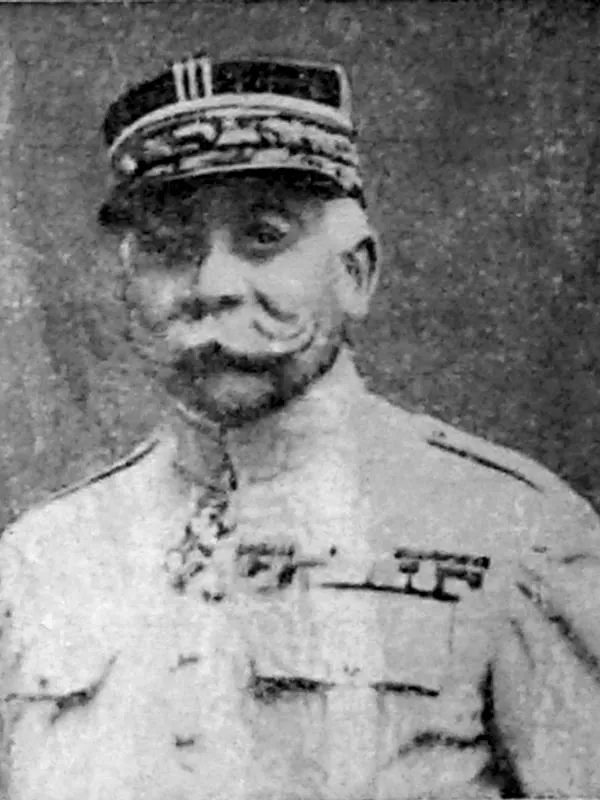
- Born:
- 28 February 1860, Le Mans (France)
- Died:
- 25 December 1944, Paris
- Author:
- Łukasz Skowroń
- Photo:
- G.Garitan, CC BY-SA 4.0, Wikimedia Commons

General François Paul Anthoine is almost forgotten today, although in 1917 he was one of the most important French commanders. In the spring his Fourth Army took the Moronvilliers heights in Champagne, the only sector of the Nivelle offensive in which the French had any real success. In the summer and autumn his First Army fought in Flanders on the left flank of the British, in the only great battle of the war in which a French army operated under the general direction of a British commander. Then, as chief of staff to General Philippe Pétain, he lived through the worst months of 1918 at headquarters. He paid for them with his post, because he was considered a pessimist, and he was given no further command for the rest of the war.
Before the war
He was born on 28 February 1860 in Le Mans, the son of a teacher of rhetoric at the lycée in Nantes. In 1879 he entered the École polytechnique in Paris, which trained, among others, artillery officers, and became a gunner. From 1885 to 1887 he served in Tonkin. In 1898, as a captain, he testified in the Dreyfus affair that on the day of Alfred Dreyfus’s degradation another officer had repeated to him the condemned man’s alleged confession of treason. This account, in time judged doubtful, was part of the so-called legend of Dreyfus’s confession, which his opponents exploited. Anthoine’s career did not suffer from it. According to the notes of General Louis André, minister of war from 1900 to 1904, the minister did not want to promote this “reactionary”, yet Anthoine nevertheless became a major in 1901.
Anthoine was then aide-de-camp to General Brugère; from 1909 to 1911 he commanded the 48th Field Artillery Regiment, and in 1911 he joined the Technical Committee of the General Staff. At the end of 1913 he became a brigadier-general.
1914–1916: Lorraine, Artois, the Somme
In August 1914 he became chief of staff of the Second Army under General Noël de Castelnau. With him he went through the failed offensive in Lorraine and the defeat at Morhange on 20 August, when General Ferdinand Foch’s XX Corps attacked even though the army had ordered a halt the day before. The Second Army then repulsed the Germans on the Mortagne and on the heights of the Grand Couronné in front of Nancy. At the end of September Castelnau and his whole staff moved north, where a new Second Army tried to outflank the German wing in Picardy.
At the beginning of October, when the Germans threatened Arras and Castelnau was thinking of retreat, Joffre sent Foch north as his deputy. Foch imposed his will on the Second Army and brought about the removal of its chief of staff. Anthoine was replaced by General Duchêne, until then chief of staff of XX Corps. Anthoine was not shelved, however: on 8 October he took over the 20th Infantry Division, and a day later he was promoted to major-general. His division belonged to X Corps, which through the winter and spring of 1915 held the front in Artois near Arras, and in May fought in the Second Battle of Artois at Saint-Laurent-Blangy.
On 10 September 1915 Anthoine took over X Corps. The corps was then in the Argonne, where during the Second Battle of Champagne it fought only in a subsidiary role, and afterwards waged underground mine warfare. In the summer of 1916 it was moved to the Somme, south of the river, where in September, October and November it attacked as part of the Tenth Army at Chaulnes, Chilly and Ablaincourt, on the less well-known wing of the Battle of the Somme. In March 1917, when the Germans withdrew to the Hindenburg Line, Anthoine’s corps followed them and took Ham.
1917: Champagne
At the end of March 1917 Anthoine took over the Fourth Army in Champagne, in Pétain’s army group. The commander-in-chief, General Robert Nivelle, gave it a subsidiary attack in his offensive east of Reims, against the Moronvilliers massif, from which the Germans overlooked the whole plain around Châlons. At dawn on 17 April, in sleet, Anthoine’s divisions advanced behind a creeping barrage. In the first days they broke onto most of the summits, but the Germans held out in concrete shelters and tunnels dug into the chalk, and their counter-attacks won back part of the gains. The Third Battle of Champagne lasted until 20 May, when the French took Mont Cornillet. By that day Anthoine’s old corps, X Corps, was also fighting there. The battle brought no breakthrough, but against the background of the defeat on the Aisne it was the only part of the offensive that produced a clear gain. Already in the first days, however, signs of the mutinies that spread through the army in May and June appeared on the hills of Champagne.
1917: Flanders
In June Anthoine was given an exceptional task. General Douglas Haig was preparing a great offensive in Flanders, and Pétain, who after the mutinies could not attack himself, promised him the support of six divisions. On 1 June it was agreed that they would form the French First Army and that its commander would receive general directions from Haig in the same way as a British army commander. On 15 June Anthoine took command of this army. At the beginning of July his divisions relieved the Belgians on the Yser Canal at Boezinge, on the left flank of General Hubert Gough’s British Fifth Army.
Anthoine, as befitted a gunner, did not want to attack before the artillery preparation was complete. The date of the attack was put back twice, at his request and Gough’s, from 25 to 28 and then to 31 July. When the Third Battle of Ypres finally began, the French waded across the flooded ground north of Bikschote and reached their objectives at small cost. It was the same on 16 August at Langemarck, when they took the Drie Grachten bridgehead, and on 9 October at Poelcappelle, when the French 2nd Division reached the edge of Houthulst Forest. At the end of October the French and Belgians cleared the flooded Merkem peninsula. In Flanders the French army was a covering flank rather than a striking force, and according to the British historian Cyril Falls it lost about 8,500 men in the whole battle, a fraction of the British losses.
Cooperation with the British went well. When in September Foch demanded that a hundred heavy guns of the French First Army be sent to Italy, Haig first defended them, pointing out that they covered the British left flank and supported the Belgians, and then agreed to give them up on condition that Pétain replaced them with others. As late as 1918 Gough called Anthoine an old friend from the days of Passchendaele. In the second half of November and early December 1917 the First Army was withdrawn from Flanders.
1918: headquarters and dismissal
On 23 December 1917 Pétain appointed Anthoine his chief of staff, that is major-general of the Armies of the North and North-East. The two men were close: cautious, defensively minded and intent on sparing men until the Americans arrived. When on 21 March 1918 the Germans struck the British, Pétain thought above all of covering Paris and was slow to send reserves north, which threatened to separate the Allied armies. The crisis was ended by the Doullens conference, at which the coordination of operations was entrusted to Foch.
The real blow came on 27 May, when the Germans broke through on the Aisne and within a few days stood on the Marne. Pétain wanted to shorten the front and rebuild reserves; Foch demanded attacks and moved divisions according to his own plan. Pétain’s headquarters were regarded as pessimists, and Anthoine, according to the historian Elizabeth Greenhalgh, as a particularly gloomy one. According to French accounts, when Pétain would not sacrifice him, the war committee of Georges Clemenceau’s government on 22 June took away Pétain’s right to appeal to the government against Foch’s decisions. At the turn of June and July 1918 Anthoine was removed and his place was taken by General Edmond Buat, who was considered more open to Foch’s plans. French sources give different dates here, 30 June or 5 July. Some historians see the change as part of a wider purge of headquarters that Clemenceau carried out after the defeat on the Aisne.
Anthoine was placed at the disposal of the ministry. On 31 October 1918 he became inspector-general of works in the zone of the armies.
After the war
From March 1919 to April 1920 he commanded the prisoner-of-war formations working on the reconstruction of the devastated regions of France. In 1921 he passed to the reserve. In 1934 he received the Grand Cross of the Legion of Honour. He died in Paris on 25 December 1944, a few months after the liberation of the city.
Assessment
Anthoine has never had a biography, and his image consists mainly of remarks in other men’s memoirs and in the official histories. What emerges from them is a solid, methodical gunner who took care over artillery preparation and did not throw infantry into an attack without support. At Moronvilliers and in Flanders his armies reached their objectives at lower cost than their neighbours, although they never stood on the main axis. Gough, his British neighbour in Flanders, remembered him kindly.
His role at Pétain’s headquarters is less clear. Critics, among them men from Foch’s circle, saw him as one of those who in the spring of 1918 confirmed Pétain in his dark forecasts and his inclination towards the defensive. Historians of the French army point out, however, that the caution of Pétain’s staff had solid grounds: the army was exhausted and its reserves thin. In this view Anthoine’s dismissal was not so much a judgement of his competence as a signal that in the dispute between Foch and Pétain the government had taken Foch’s side.
Sources
Spotted a mistake?Report an error
Commanded in battles
(06)- 16 April – 9 May 1917Nivelle OffensiveWestern Front
- 17 April – 20 May 1917Third Battle of ChampagneWestern Front
- 31 July – 2 August 1917Battle of Pilckem RidgeWestern Front
- 31 July – 10 November 1917Third Battle of YpresWestern Front
- 16–18 August 1917Battle of Langemarck (1917)Western Front
- 9 October 1917Battle of PoelcappelleWestern Front
Mentioned in battles
(01)Often appears with
People who appear in the same events.