1917: Flanders
Battle of Pilckem Ridge
- Dates:
- 31 July – 2 August 1917
- Front:
- Western Front
- Location:
- The Ypres (Ieper) salient, from the river Lys at Warneton to the Ypres–IJzer canal at Steenstraat, with Pilckem Ridge, the Steenbeek valley and the western edge of the Gheluvelt plateau, West Flanders (Belgium)On the battle map →
- Sides:
- United Kingdom and New ZealandDouglas Haig, Hubert Gough, Herbert PlumerFranceFrançois AnthoineGerman EmpireRupprecht, Crown Prince of Bavaria, Friedrich Sixt von Armin, Hermann von Stein
- Result:
- Partial Allied success. In the north Pilckem Ridge and the Steenbeek line were taken, but on the Gheluvelt plateau the attack stalled, and German counter-attacks retook part of the gains in the centre.
- Author:
- Natalia
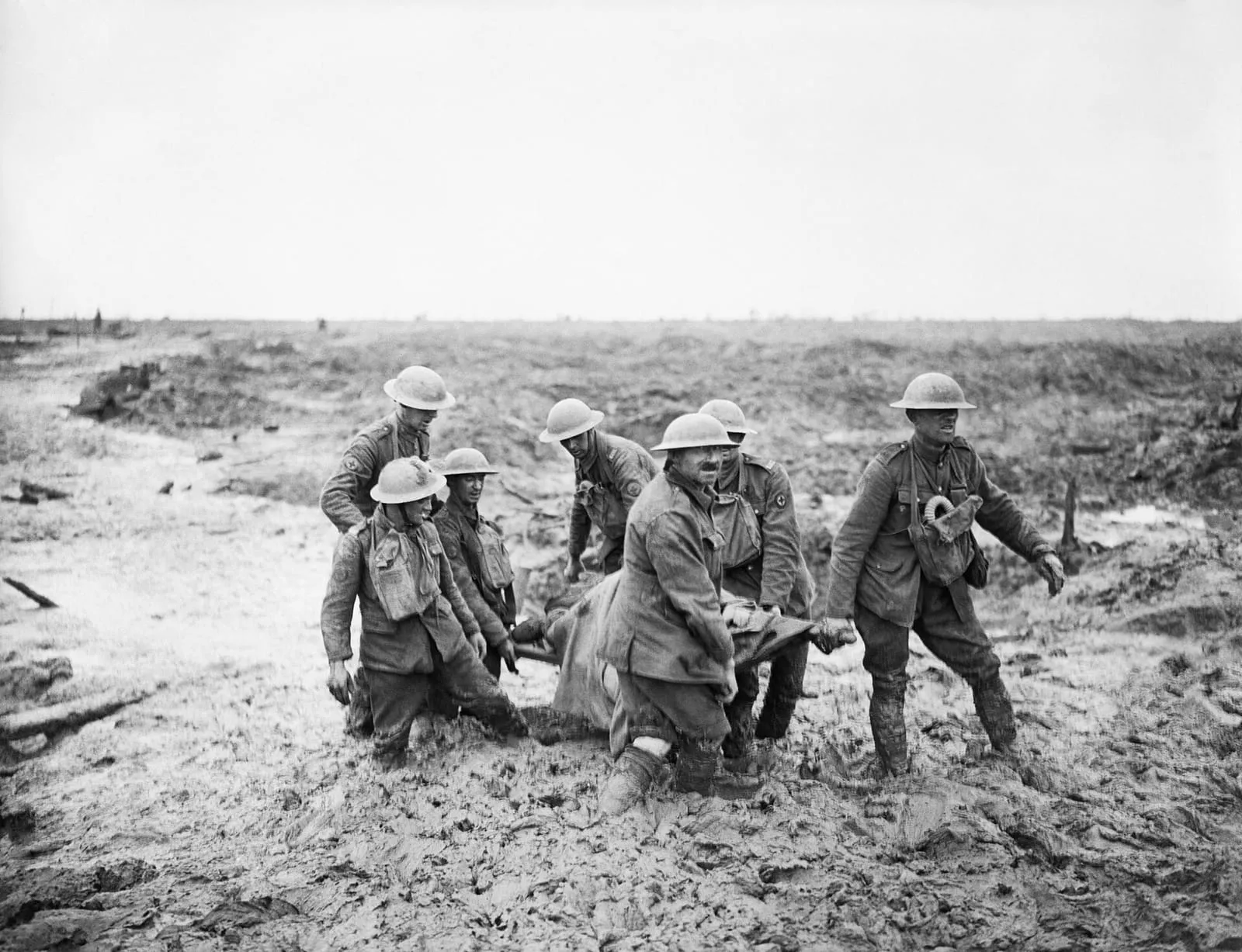
The Battle of Pilckem Ridge was the opening attack of the Third Battle of Ypres. At 3.50 a.m. on 31 July 1917, after roughly two weeks of bombardment, nine divisions of General Hubert Gough’s British Fifth Army went forward from the salient around Ypres, covered in the south by the Second Army and in the north by two divisions of the French First Army. On the northern flank the Allies took the low Pilckem Ridge within a few hours, from which the Germans had been watching the canal at Boezinge since 1915, and came up to the Steenbeek stream. In the centre some brigades broke in to a depth of more than three kilometres, but in the afternoon, as the rain began, German counter-attack divisions drove them back. On the most important sector, the Gheluvelt plateau by the road from Ypres to Menin, the British advanced only a few hundred metres. The rain then fell for four days and turned the battlefield into mud.
Name and dates
The name and the dates 31 July – 2 August 1917 were fixed after the war by the British Battles Nomenclature Committee, which counted this attack as the first of eight battles at Ypres in 1917. The British official history counts its casualties from 31 July to 3 August. The Germans include these days in the first period of the Battle of Flanders, which lasted until 9 August. The ridge takes its name from the hamlet of Pilckem (today Pilkem, part of Boezinge), which lies on it by the road from Ypres to Langemarck.
Background
Haig had entrusted the main attack in Flanders to Gough as early as the end of April, and on 10 June, after the victory at Messines, the Fifth Army took over the front from Observatory Ridge to Boezinge. Gough greatly enlarged the plan drawn up by Haig’s staff. For the first day he set no fewer than three lines of objectives: the blue (the German front line), the black (the Albrecht line) and the green (the Wilhelm line), lying about one, two and three kilometres from the starting trenches, and beyond them a red line, to which fresh troops could push on by themselves if the defence collapsed. The head of operations on Haig’s staff, General John Davidson, warned that so deep a bound would disperse the artillery and proposed an advance of a kilometre and a half. Plumer and Rawlinson had earlier planned similarly cautious bounds. Gough replied that in the first, most carefully prepared attack everything the enemy left undefended had to be taken. Haig endorsed his plan at the end of June, but ordered that the greatest weight be directed at the Gheluvelt plateau.
The plateau was the key to the battlefield. The highest ground east of Ypres, with the ruins of Sanctuary Wood, Shrewsbury Forest and Glencorse Wood, it gave the Germans a view over the whole salient, and the batteries behind it could enfilade any attack further north. II Corps under General Claud Jacob, which was to attack it, received five divisions instead of four and more than 40 per cent of the army’s artillery, but also the hardest task: opposite it the Germans had concentrated the most guns and counter-attack divisions.
On the German side the salient was defended by the Fourth Army of General Friedrich Sixt von Armin, and the sector from Pilckem to the Menin road by Group “Ypern” under General Hermann von Stein (III Bavarian Corps). Behind the forward lines stood concrete shelters and machine-gun nests, and beyond the Passchendaele ridge the counter-attack divisions were waiting.
Preparations
The bombardment began in mid-July, and more than 3,000 guns and mortars were assembled for the attack: the Fifth Army had over 750 heavy and over 1,400 field guns, and the French nearly 900 guns and mortars on seven kilometres of front. The date of the attack was postponed twice, because the French had not managed to emplace their batteries and the British guns were losing time in duels with the German artillery in bad weather. In the last days of July the Allied air forces fought great air battles with German fighters over the salient. On 27 July airmen reported that the Germans had abandoned their front line opposite Boezinge. The British Guards Division and the French then crossed the canal and occupied the abandoned trenches on a front of about three kilometres, and during the night threw more than a dozen bridges across the canal. This lifted from the infantry the most difficult obstacle on the northern flank. The last days before the attack were overcast, and on 29 July it rained heavily.
Course of the battle
31 July, morning. Zero hour was set at 3.50 a.m. so that the British, attacking from the west, could see about 200 metres while the Germans looked into darkness. Low cloud, however, meant that it was still dark and aircraft could hardly fly. Behind a creeping barrage that moved forward about 90 metres every four minutes, the infantry passed easily through the shattered German front line. On the northern flank the 38th (Welsh) Division and the Guards Division of Lord Cavan’s XIV Corps took the village of Pilckem, breaking a battalion of the Prussian Guard, and reached the Steenbeek, an advance of about three kilometres. In the 15th Battalion of the Royal Welsh Fusiliers, Private Ellis Evans, the Welsh poet known as Hedd Wyn, went into the attack. In the first hours of the assault, on the way to the defences at the hamlet of Hagebos, he was hit by a shell and soon died. To their right, XVIII Corps under General Ivor Maxse, with the 51st (Highland) Division and the 39th Division, took Sint-Juliaan (St. Julien) and before eleven o’clock had consolidated on the Steenbeek. Tanks helped to capture several fortified farms.
The French I Corps under General Paul Lacapelle, with the 1st and 51st Divisions, attacked on a narrow strip of land between the canal and the flooded meadows. The artillery preparation had destroyed almost all the German shelters, and the French advanced to schedule, losing few men. At about 10.30 a.m. their patrols entered Bikschote (PL), and in the afternoon they repulsed a counter-attack from Houthulst Forest. In this way they recovered most of the ground they had lost during the German gas attack of 22 April 1915.
In the centre XIX Corps, with the 15th (Scottish) Division and the 55th (West Lancashire) Division, took Frezenberg and the Pommern Redoubt. After a pause on the black line its reserve brigades moved on towards the green line. The 164th Brigade of the 55th Division passed through the Wilhelm line and took Hill 35, an advance of nearly four kilometres. Its patrols reached the Gravenstafel ridge.
On the Gheluvelt plateau it was a different story. The 24th Division on the right flank of II Corps was held up in front of German shelters. The 30th Division struggled through the shattered Sanctuary Wood, lost the barrage and in the darkness veered north: one of its battalions mistook Château Wood for Glencorse Wood and reported that it had taken its objective. The brigade of the 18th Division that was to pass through it only discovered at about nine o’clock that it had to capture for itself ground believed to be taken. The British took Stirling Castle and Bellewaarde Ridge, and the 8th Division reached Westhoek ridge, but under enfilade fire from Glencorse Wood and Nonne Bosschen it had to dig in there. The green line on the plateau was not taken until 20 September.
On the southern flank, in the Second Army, the New Zealand Division took La Basse-Ville on the Lys after street fighting, and the 41st Division captured Hollebeke and Klein Zillebeke.
31 July, afternoon. Around noon the German counter-attack divisions of Group “Ypern”, the 221st Division and the 50th Reserve Division, came down from the Passchendaele ridge on the advanced brigades of XIX Corps. News from the front reached the headquarters with great delay, because mist made signalling impossible and runners got stuck in the mud. Soon after 1 p.m. it began to rain, and the artillery observers lost sight of their own infantry. At 2 p.m. waves of infantry, supported by aircraft, advanced behind a German barrage. The 39th Division was pushed back to Sint-Juliaan, exposing the flank of the 55th Division, and the reserve brigades of the 55th and 15th Divisions, scattered and out of touch with the artillery, were broken up or fell back to the black line, losing up to 70 per cent of their men. The Germans retook Sint-Juliaan. Their advance was stopped only at six in the evening, above the flooded Steenbeek valley, by artillery and machine-gun fire. Counter-attacks on the flanks, at Bikschote, on Westhoek ridge, at La Basse-Ville and Klein Zillebeke, were repulsed. In the evening the rain set in properly, and it did not stop for the next four days.
1–2 August. In the downpour both sides tried to improve their positions. On 1 August the Germans pushed the 8th Division back somewhat south of the railway to Roeselare, but in the evening it recovered the ground. On 2 August their attacks on the XIX Corps sector at the Pommern Redoubt were repulsed. North of Ypres the British reoccupied Sint-Juliaan and pushed posts across the Steenbeek. Gough planned to resume the attack on the plateau quickly, but mud and rain forced him to keep postponing it until 10 August, and the second great attack did not begin until 16 August.
Among the wounded of those days was the medical officer of the Liverpool Scottish battalion of the 55th Division, Captain Noel Chavasse. Despite his wounds he tended soldiers near Wieltje for two days. He died on 4 August, and for those days he was posthumously awarded a second Victoria Cross. He is one of only three men in history to have received it twice.
Casualties
According to the British official history the Fifth Army lost 27,001 killed, wounded and missing from 31 July to 3 August, of whom 3,697 were killed, and the Second Army 4,819 from 31 July to 2 August, including 769 killed. On 4 August Haig reported a total of 31,850 casualties to the Cabinet, pointing out that on the first day of the Battle of the Somme the army had lost nearly 60,000 men. The French, according to their official history, lost about 1,300 men, including 180 killed. Most of the British casualties were suffered not in the morning attack but later, under artillery fire and in the German counter-attacks. Of roughly 140 tanks, half got stuck or were destroyed.
The German Fourth Army lost about 30,000 men in the ten-day period from 21 to 31 July. Haig reported that more than 6,100 prisoners and 25 guns had been taken, and Gough spoke of 5,626 prisoners on 31 July alone. Several German divisions that had held the front line had to be relieved at once.
Significance
The attack of 31 July was a greater success than the first day on the Somme. The Fifth Army gained about 45 square kilometres, deprived the Germans of observation from Pilckem Ridge and Bellewaarde Ridge and inflicted losses close to its own. In the view of the historians Robin Prior and Trevor Wilson it was “a considerable achievement”. Yet the green line was reached only in the north, and the halt on the Gheluvelt plateau exposed the flank of the troops attacking in the centre. Gough was criticised for over-ambitious objectives, which led the infantry away from its own artillery and left it a prey to the counter-attacks. The German defence in depth passed the test: the counter-attack divisions retook part of the gains, and the plateau remained in German hands.
The worst, however, was brought by the weather. The downpours of 31 July and the following days, and then an exceptionally wet August, turned the shell-torn valleys of the Steenbeek, the Hanebeek and the Bassevillebeek into swamps. The offensive lost momentum, the Germans gained time to bring up reserves, and fighting for Pilckem Ridge and Langemarck went on throughout August. Haig, convinced that the German army was weakening, told the Cabinet that further attacks would follow.
Hedd Wyn was buried in Artillery Wood Cemetery near Boezinge, beside the Irish poet Francis Ledwidge, who was killed on the same day by a shell while building a road behind the front line. On 6 September 1917, at the National Eisteddfod in Birkenhead, in the presence of the Prime Minister, David Lloyd George, it was announced that the chief prize, the bardic chair, had been won by a poem submitted under the pseudonym “Fleur de Lys”. When the author did not answer the threefold call, the Archdruid announced that he had fallen six weeks earlier. The chair was draped in a black sheet. As the “Black Chair” it became in Wales a symbol of the sacrifice of the generation that died in that war. Since 2014 a Welsh memorial has stood on Pilckem Ridge, not far from the place where the poet fell.
Spotted a mistake?Report an error