Russian Empire · The Entente
Nikolai Yudenich
Commander of the Caucasus Army (1915–1917) and the Caucasus Front (1917), general of infantry
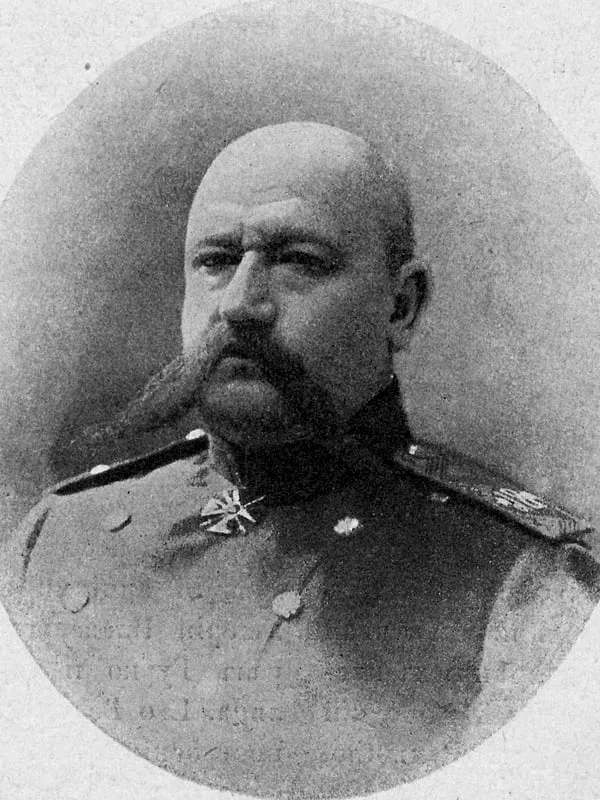
- Born:
- 30 July 1862, Moscow (Russian Empire)
- Died:
- 5 October 1933, Saint-Laurent-du-Var (France)
- Author:
- Natalia
- Photo:
- Сканирование: Владимир Васильев, domena publiczna, Wikimedia Commons

General Nikolai Yudenich is regarded as one of the ablest Russian commanders of the war, and under his direction the Caucasus front was the only one on which Russia kept winning right up to the revolution. As chief of staff of the Caucasus Army in the winter of 1914 he stopped the Turks at Sarikamish, and as its commander in 1916 he took Erzurum, Trebizond and Erzincan, smashing the Ottoman Third Army. His victories relieved the British in Mesopotamia and at the Dardanelles, and at the beginning of 1917 the Russians controlled most of Turkish Armenia. The revolution cut his career short. In the Civil War he led the Whites in north-western Russia, and in the autumn of 1919 his troops came right up to Petrograd.
Before the war
He was born on 30 July 1862 (18 July in the Julian calendar) in Moscow, into the family of an official descended from the Minsk nobility. He graduated from the Alexander Military School and, in 1887, from the Nicholas General Staff Academy. He spent several years in Turkestan, where in 1894 he commanded one of the detachments of the expedition to the Pamirs. In the Russo-Japanese War he led a rifle regiment, was twice wounded, was promoted to major-general in 1905 and received the golden weapon for bravery.
From 1907, with a short break, he served in the Caucasus, first as quartermaster-general and from 1913 as chief of staff of the Caucasus Military District. He came to know this difficult, mountainous theatre of operations well and gathered around him a group of able staff officers. Short and stocky, with a long moustache, he spoke briefly and firmly. He was regarded as a calm man who did not give way to panic and was not afraid to take responsibility.
Sarikamish
When the war broke out he became chief of staff of the Caucasus Army. Its nominal commander was the aged Viceroy of the Caucasus, Count Illarion Vorontsov-Dashkov, and his deputy was General Alexander Myshlayevsky. When in November 1914 General Bergmann’s offensive towards Erzurum ended in retreat, Yudenich went to the front and judged its conduct critically.
In December the War Minister Enver Pasha led the Third Army on a winter march across the mountains into the Russian rear at Sarikamish. Myshlayevsky concluded that the troops on the Aras would be encircled, ordered a retreat towards Kars and left the front, which caused panic as far as Tiflis. Yudenich stayed where he was, decided to fight and took control of the troops. The frozen Ottoman corps failed to take Sarikamish, and at the beginning of January 1915 the Russians went over to the counter-attack. On 4 January IX Corps surrendered, and on 6 January Yudenich took command of all troops in the field. Of Enver’s army of about 90,000 men, some ten to twenty thousand remained fit to fight. Recognised as the victor, at the beginning of 1915 Yudenich was promoted to general of infantry and became commander of the Caucasus Army.
1915
In 1915 Yudenich’s army had to give up some of its divisions to the German front, and the main Caucasus front stood still. The fighting took place on the flanks. In the south, around Lake Van, in May the Russians came to the relief of the Armenians defending Van, and Yudenich approved an Armenian administration of the city. In July, however, the Turks defeated the Russian IV Caucasus Corps at Malazgirt and Van had to be abandoned, and tens of thousands of Armenians fled to the Caucasus with the army. Yudenich did not send reinforcements to the beaten units in small packets; instead he gathered his reserves and at the beginning of August struck from a distant flank at the wing of the advancing Turks near Karakilise. The counter-manoeuvre forced them to retreat and restored the front.
In September 1915 Grand Duke Nicholas Nikolaevich, removed by the Tsar from command of the whole army, became Viceroy of the Caucasus and commander-in-chief there. The Grand Duke dealt mainly with administration and with Persia, where in the autumn he sent Baratov’s corps, while Yudenich continued to command the army in the field. Their cooperation was not always easy, because Yudenich was reluctant to give up troops to secondary directions.
Erzurum, Trebizond, Erzincan
After the evacuation of Gallipoli Yudenich calculated that the Turks would move the freed divisions to the Caucasus within a few months and attack in the spring. He decided to forestall them with a winter attack, when the enemy expected quiet. The Grand Duke had doubts but agreed, and the plan was also backed by the Tsar’s chief of staff, General Mikhail Alekseyev. In January 1916 Yudenich began the Erzurum offensive. At Köprüköy he broke through the Ottoman lines at a spot the Turks considered impassable, and then forced his way across snow-covered ridges into the ring of forts of Erzurum. When before the assault his commanders asked for a delay, he cut the discussion short: “Very well. We attack on the eleventh.” On 16 February 1916 the fortress fell, and Yudenich received the Order of St George 2nd class, the last recipient in the history of the empire.
In the spring his troops advanced along the Black Sea coast, supported by the fleet and by landings, and on 18 April took Trebizond, the most important port of northern Anatolia. During this operation Yudenich fell out with the commander of the Black Sea Fleet, Admiral Andrei Eberhardt, and moved some of the troops himself without the cover of warships. In the summer the Turks, reinforced by divisions from the Dardanelles, prepared a counter-offensive with two armies. Yudenich struck first, defeated the Ottoman Third Army at Bayburt and on 25 July took Erzincan. When in August the Ottoman Second Army moved forward, with one of its corps commanded by Mustafa Kemal, the Russians lost Muş and Bitlis, but Yudenich moved up his reserves and stopped the advance. According to W. E. D. Allen and Paul Muratoff, the operations from June to September 1916 cost the Caucasus Army about 50,000 men, including the sick in Persia.
Revolution
After the February Revolution the Caucasus Army was renamed the Caucasus Front in April 1917, and Yudenich became its commander-in-chief. Soon, however, the collapse of discipline and the soldiers’ committees paralysed the army, and supplies were breaking down. Yudenich concluded that the front could now only defend itself. At the turn of May and June he lost his post. According to Allen and Muratoff, he resigned the command himself, unable to bear the committees’ interference; according to other sources he was dismissed by the War Minister Alexander Kerensky, who accused him of opposing the government’s instructions. He went to Petrograd and sympathised with General Kornilov. After the Bolshevik coup he went into hiding in the capital.
Civil War and emigration
At the turn of 1918 and 1919 he made his way to Finland on false papers. The Russian émigrés in Helsinki recognised him as leader of the Whites in the north-west, and in June 1919 Admiral Alexander Kolchak appointed him commander-in-chief of the forces on that front. Yudenich sought Finland’s help, but its condition was recognition of Finnish independence, which neither Kolchak nor his foreign minister Sergei Sazonov would accept. Under British pressure a North-Western Government was formed in August, which recognised Estonia’s independence, and Yudenich became its war minister.
In October 1919 his North-Western Army, numbering some ten to twenty thousand men and supported by British tanks and the fleet, advanced on Petrograd. It took Yamburg, Gatchina and Tsarskoye Selo and came up to the Pulkovo Heights on the approaches to the city. It failed, however, to cut the railway to Moscow, along which the Bolsheviks brought up reinforcements, and the Finns and Estonians did not support the attack. At the end of October the Red Army went over to the counter-offensive and pushed the Whites back into Estonia, where they were interned. In January 1920 Yudenich disbanded the army. Men of Stanisław Bułak-Bałachowicz detained him briefly in Estonia, but after the intervention of the Allied missions he was released.
He settled in France, near Nice, and withdrew from émigré politics. He devoted himself to the history of the wars in the Caucasus and to charitable work. He died of tuberculosis on 5 October 1933 in Saint-Laurent-du-Var, although some sources give Cannes. He was buried in the Russian cemetery in Nice.
Assessment
Historians of the wars in the Caucasus, led by Allen and Muratoff, rate Yudenich very highly. They stress his coolness at Sarikamish and Malazgirt, his ability to surprise the enemy in terrain considered impassable, and his care for supplies, roads and field railways, without which none of his winter operations would have been possible. The Russian historian Aleksei Oleynikov called him a “master of improvisation”. Critics point out that his staff had poor intelligence, which several times, among others before Malazgirt, before the capture of Trebizond and before the Turkish success at Mamahatun in 1916, misjudged the enemy’s strength, and that pursuits after victories set off late and did not allow the Third Army to be encircled. Some contemporaries also thought that his role at Sarikamish had been exaggerated.
Yudenich’s victories were largely squandered. Russia was unable to turn them into lasting gains, and after the army disintegrated in 1918 the Turks recovered all the lands they had lost. In the Civil War he proved a weaker politician than commander. His attachment to the principle of an indivisible Russia hampered an alliance with Finland and Estonia, without which the march on Petrograd had no chance of success.
Sources
Spotted a mistake?Report an error
Commanded in battles
(03)Mentioned in battles
(02)Often appears with
People who appear in the same events.