Armenia · The Entente
Andranik Ozanian
Commander of the 1st Armenian Volunteer Unit in the Russian army (1914–1916), major general, commander of the Western Armenian Division (1918)
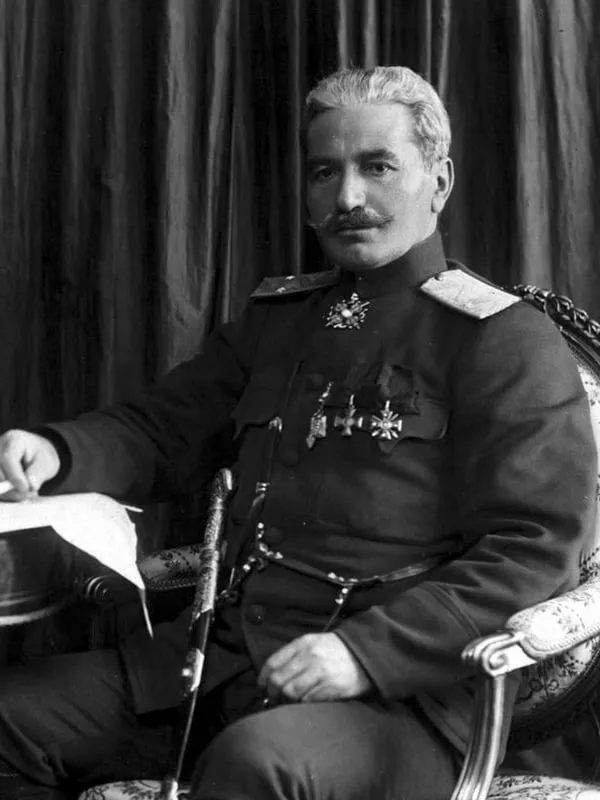
- Born:
- 25 February 1865, Şebinkarahisar (Ottoman Empire)
- Died:
- 31 August 1927, Richardson Springs (California, United States)
- Author:
- Natalia
- Photo:
- autor nieznany, domena publiczna, Wikimedia Commons

Andranik Ozanian, known simply as Andranik or General (Armenian: zoravar) Andranik, was the most famous Armenian guerrilla of the turn of the 19th and 20th centuries and one of the most legendary figures in the history of his nation. For more than a decade he fought Ottoman and Kurdish forces in the mountains of Turkish Armenia, in the Balkan War he fought on the side of Bulgaria, and during the Great War he commanded a unit of Armenian volunteers in the Russian army. In 1918, when the Russian army fell apart and the Turks advanced into Transcaucasia, he defended Erzurum, and then, refusing to recognise the peace concluded by the young Republic of Armenia, he fought on his own account in Nakhichevan and Zangezur. For Armenians he is a national hero. Azerbaijani historians, and some Western ones, hold his units responsible for violence against the Muslim population.
Before the war
He was born on 25 February 1865 in Şebinkarahisar in the Sivas vilayet. Some sources and the inscription on his former grave give the year 1866. The name Andranik means “firstborn” in Armenian. His mother died when he was one year old. He worked as a carpenter in his father’s workshop, married early and was widowed early. As a young man he beat up a Turkish gendarme who was abusing Armenians, and escaped from prison. At the end of the 1880s he began revolutionary activity, and in 1892 he joined the newly founded Armenian Revolutionary Federation, the Dashnak party.
During the Hamidian massacres of 1894–1896 he defended villages around Muş and in the mountains of Sasun together with other fedayi (Armenian guerrillas), and after the death of the famous leader Aghbiur Serob in 1899 he took command of the local bands. He won fame with his escape in 1901 from the Monastery of the Holy Apostles near Muş, which was besieged by the army. In 1904 he led the uprising in Sasun, bloodily suppressed by the Ottoman army. He crossed Persia to the Caucasus and then left for Europe. In 1907 he broke with the Dashnaks when they decided to co-operate with the Young Turks against the Sultan. He never returned to the party, and this aversion weighed on his later relations with the authorities of Armenia.
He settled in Bulgaria. In the First Balkan War, together with Garegin Nzhdeh, he commanded a company of about 230 Armenian volunteers in the Macedonian-Adrianopolitan Corps of the Bulgarian army. He was described at the time by Leon Trotsky, then a war correspondent. Andranik received a Bulgarian order for bravery, but when Bulgaria went to war with its former allies he disbanded the company and settled in a village near Varna.
1914–1916: the volunteer unit
In the summer of 1914 he sailed to Russia and in August reported to the Caucasus command in Tiflis. The Russians, preparing for war with Turkey, agreed to the formation of Armenian volunteer units and entrusted Andranik with the first of them, about 1,200 men strong, mostly volunteers from Turkish Armenia. The unit fought in Persian Azerbaijan as part of the detachment of General Fyodor Chernozubov. In April 1915, according to most accounts, it took part in the Battle of Dilman, in which General Tovmas Nazarbekian (Nazarbekov) defeated Halil’s corps. When in May the Russian forces moved to relieve besieged Van, Andranik marched with Nazarbekian’s column and in the second half of May entered the city, liberated by its defenders and the Russian vanguard. In June his volunteers cleared the Turks from the southern shore of Lake Van.
Meanwhile, deep in Anatolia, the Armenian genocide was under way. Many of Andranik’s volunteers came from those lands and could no longer find their families. At the beginning of March 1916 the unit took part in the capture of Bitlis. According to the Russian historian Maslovsky, the volunteers entered the city without orders and broke into the hospital of the American mission to take revenge on the Turkish families sheltering there. Only a sotnia of Cossacks put an end to it. For bravery in 1915–1916 Andranik received the Crosses of St George and the orders of St Stanislaus and St Vladimir, and Russian commanders praised him as a brave and experienced leader.
In 1916 the Russian authorities decided to convert the units into regular rifle battalions. The Armenians read this as a sign that Russia wanted to take Turkish Armenia for itself and that the volunteers were no longer needed. Andranik resigned his command and left the front in the summer. In Tiflis he devoted himself to helping refugees and founded the non-party newspaper Hayastan.
1918: Erzurum
After the revolution and the armistice concluded at Erzincan in December 1917, the Russian soldiers left the front. They were to be replaced by a newly formed Armenian corps under Nazarbekian, numbering at most a dozen or so thousand men. Andranik, promoted to major general by the front command, took over its Western Armenian Division. In February 1918 the Ottoman Third Army of Vehip Pasha went on the offensive, and Andranik became commander of the defence of Erzurum. He had about 3,000 infantry, a few hundred cavalry and eight guns. Soldiers from the Caucasus refused to fight on Turkish soil and deserted. After fighting near Ilıca, Andranik abandoned the city during the night of 11–12 March. Thousands of Armenian inhabitants fled with him.
The fall of Erzurum and the whole retreat were accompanied by violence against civilians. Historians including Anahide Ter Minassian and Mark Levene write that Armenian irregulars, seeking revenge for the genocide, murdered Muslims and burned their villages, and according to Levene Andranik’s units were particularly cruel around Kars. Andranik’s biographer, Antranig Chalabian, rejects the accusations against the general himself. Ottoman soldiers and Kurds in turn murdered Christians who had not managed to flee.
In May, when the Turks took Alexandropol, Andranik with two volunteer regiments covered the road to Tiflis. According to W. E. D. Allen and Paul Muratoff this was a sound idea, but his forces were too weak for regular fighting. Pushed back by the Turkish 5th Caucasian Division, he withdrew through Vorontsovka and Jalaloghly to Dsegh and then to Dilijan. That is why he took no part in the Battle of Sardarabad or at Karakilisa.
Nakhichevan and Zangezur
On 28 May 1918 the Armenian National Council took power, which is regarded as the beginning of the First Republic of Armenia, and on 4 June it concluded the Treaty of Batum with Turkey. Andranik recognised neither the armistice nor the treaty, which left the Turks all of Turkish Armenia and a large part of Russian Armenia, and he called the state ruled by the Dashnaks a plaything in the hands of Turkey. With several thousand soldiers and thousands of refugees he crossed by Lake Sevan into Nakhichevan. He tried to break through to Khoy in Persia, where refugees from Van were crowded, and further on to meet the British, but in the summer he fought the Turks around Salmas and Khoy and had to turn back. On 14 July he telegraphed the Bolshevik leader of Baku, Stepan Shaumian, that Nakhichevan considered itself part of the Soviet republic and that he and his detachment placed themselves at the disposal of Lenin’s government. A few days later the Turks occupied Nakhichevan, and Andranik with about 30,000 refugees withdrew into the mountains of Zangezur.
In Zangezur, the key corridor between Turkey and Azerbaijan, his units had taken control of most of the district by the autumn. Judgements of these months differ sharply. The historians Donald Bloxham and Jörg Baberowski write that Andranik destroyed Muslim villages in order to make Zangezur a homogeneously Armenian land, and the government of Azerbaijan accused him of massacres. Chalabian and Armenian historians maintain that his presence alone saved some 60,000 Armenians of Zangezur from annihilation. After the Armistice of Mudros, at the end of November, Andranik advanced on Shusha, the capital of Nagorno-Karabakh. At the beginning of December he was about 40 kilometres from the town when he received a message from the British commander in Baku, General William Thomson, ordering him to halt operations because the disputes were to be settled by the peace conference. Andranik trusted the British and turned back. The historian Christopher Walker believes that this is precisely why Karabakh later remained with Azerbaijan.
After the war
In winter Zangezur, cut off by snow, suffered famine and epidemics. In March 1919 Andranik led the remnant of his division across the mountains to the Ararat plain. On 13 April at Etchmiadzin he disbanded the detachment, by then only about 1,350 men strong, and handed over its weapons to the Catholicos. He would not even enter Erivan. He left via Tiflis for Europe and never returned to Armenia. In Paris and London he lobbied for the Allies to occupy Turkish Armenia, and in the United States he raised money for refugees. In 1922 he married and settled in Fresno, California, where many Armenians lived. He died on 31 August 1927 at the spa of Richardson Springs. The Soviet authorities would not allow his body to be brought to Armenia, so in 1928 he was buried in the Père Lachaise cemetery in Paris. In 2000 his remains were moved to Yerevan, to the Yerablur military cemetery.
Assessment
In Armenia Andranik is the hero of songs, novels and monuments, a symbol of the resistance of a nation that almost ceased to exist during the war years. Allen and Muratoff valued him as one of the best Armenian guerrilla leaders and believed that in 1918 the Armenians ought to have waged precisely a guerrilla war in the mountains, but in regular battles his units were too weak. His break with the government after the Treaty of Batum divided an already fragile state. Walker stresses that many Armenians from Turkish Armenia thought as he did: the republic on the Araxes was for them only a scrap of land without the homeland for which they had fought for forty years. In Azerbaijan and Turkey he is remembered above all as a perpetrator of violence against Muslims. Western scholars see in him a figure typical of those years in the Caucasus, when after the collapse of the empires all sides fought for survival and land, and the victims were above all civilians.
Sources
Spotted a mistake?Report an error
Mentioned in battles
(01)Often appears with
People who appear in the same events.