Ottoman Empire · The Central Powers
Vehip Pasha
Commander of the Southern Group at Gallipoli (1915) and of the Ottoman Third Army in the Caucasus (1916–1918)
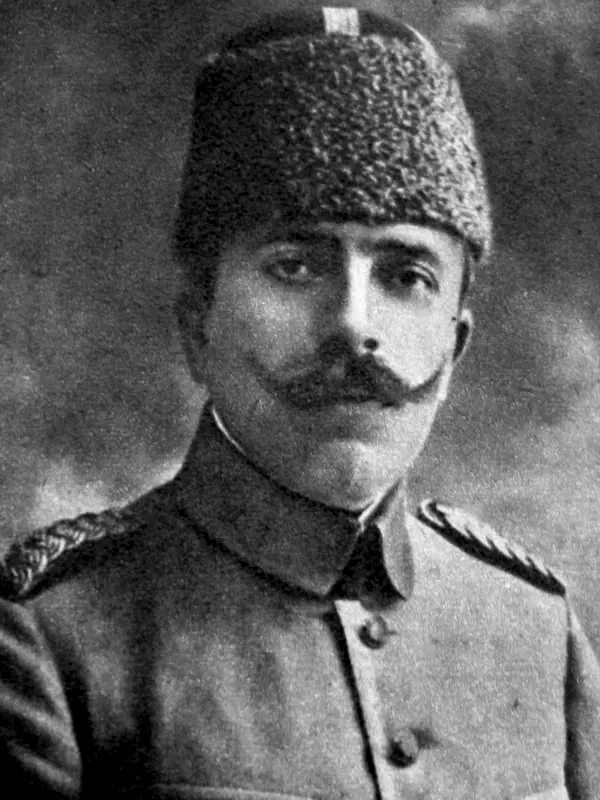
- Born:
- 1877, Janina (Ottoman Empire, now Greece)
- Died:
- 13 June 1940, Istanbul (Turkey)
- Author:
- Łukasz Skowroń
- Photo:
- autor nieznany, domena publiczna, Wikimedia Commons

Mehmed Vehip, known as Vehip Pasha (Turkish: Vehip Paşa), and after surnames were introduced in Turkey Mehmet Vehip Kaçı, was one of the ablest Ottoman generals of the Great War and at the same time one of the most forgotten. In the summer of 1915 he commanded the defence of the southern tip of the Gallipoli peninsula. From the spring of 1916 he headed the Third Army in the Caucasus, which the Russians shattered that same summer, and in 1918 he led it on a victorious march that restored Erzurum, Kars and Batumi to Turkey. The Germans then came to regard him as an obstacle, and Enver Pasha sent him back to the capital. After the war he gave testimony that remains to this day one of the most frequently cited Ottoman accounts of the Armenian genocide. He spent most of the rest of his life in exile.
Before the war
He was born in Janina in Epirus, into a wealthy family. His father, Mehmed Emin Efendi, was the town’s mayor. Most works give the year 1877; his Turkish biographer Yüksel Nizamoğlu writes of 1875. His elder brother, Esat Pasha, also became a general.
Vehip graduated from the military engineering school and, in 1900, top of his year from the general staff college. He served in the Fourth Army in Yemen, then on a divisional staff in Diyarbakır. During this time he drew close to the Young Turks. On 23 July 1908 in Monastir (Bitola) he read out to the crowds the proclamation restoring the constitution, which made him known throughout the empire. After the counter-revolution of 1909 was suppressed, the minister of war Mahmud Şevket entrusted him, while still a major, with command of the military school in Constantinople.
In the First Balkan War he defended his home town as commandant of the fortress under the orders of his brother, commander of the Janina corps. The siege lasted from October 1912 to early March 1913, and Vehip personally negotiated the terms of surrender with the Greeks. He then spent about nine months as a prisoner in Athens. On his return, by now a colonel, he became a divisional commander and governor of the Hejaz. The Committee of Union and Progress sent him there with the aim of curbing the independence of the Sharif of Mecca, Hussein. Vehip, a hard officer disinclined to compromise, soon fell out with him, and according to Turkish historians sent telegrams to the capital demanding the sharif’s removal. Constantinople, however, preferred not to provoke Hussein.
1915: Gallipoli
When the Ottoman Empire entered the war, Vehip was ordered to join the expedition against the Suez Canal with two regiments from the Hejaz, but he did not arrive in time. He was promoted to general (mirliva) and, after briefly commanding IX Corps, took over the Second Army, which covered Constantinople and Thrace.
On the Gallipoli peninsula the front was divided into the Northern Group, commanded by his brother Esat, and the Southern Group at Cape Helles. The south was commanded by the German general Erich Weber. After the bloody fighting for Gully Ravine, General Otto Liman von Sanders removed Weber, and Enver Pasha sent Vehip in his place together with fresh divisions of the Second Army. According to Turkish accounts, Vehip made it a condition that he would be subordinate directly to Enver rather than to Liman, and so it was. He took command on 8 or 9 July 1915.
A few days later, on 12 and 13 July, the British and French attacked along the Kereves Dere stream. They gained little, and it was the last great Allied attack at Helles. Turkish historians also credit Vehip with complaining to Enver about the costly counter-attacks that Liman ordered every time reinforcements arrived, and with having these attacks curtailed. When in August the British landed at Suvla Bay and attacked Sari Bair, Vehip repulsed the diversionary attacks at Helles and sent some of his divisions north. Liman von Sanders later praised both brothers for sparing him the quarrels so common among Turkish commanders. Vehip commanded at Helles until October, when the Second Army was withdrawn from the peninsula.
1916: defeat on the Kara Su
On 16 February 1916 the Russians took Erzurum. Enver dismissed the commander of the Third Army, Mahmud Kâmil Pasha, and at the beginning of March entrusted it to Vehip, whom W. E. D. Allen and Paul Muratoff, historians of the Caucasian wars, describe as a commander with an “excellent reputation” earned at the Dardanelles. Vehip arrived at headquarters in Erzincan on 6 March. He found the army shattered and could not prevent the loss of Trebizond in April. Under Enver’s plan, the newly formed Second Army of Ahmed İzzet Pasha was to come to his aid in the summer.
At the end of May Vehip secretly brought up several divisions and retook Mamahatun, coming within a few dozen kilometres of Erzurum. Allen and Muratoff call this an undoubted tactical success. Soon, however, Enver, alarmed by Russian reinforcements being shipped by sea to Trebizond, ordered him to shift the weight of operations to the Black Sea. The attack on the coastal flank failed, and at the beginning of July General Nikolai Yudenich struck first. In less than four weeks he shattered the Third Army at Bayburt and on the Dumanlı Dağ massif, and on 25 July took Erzincan, which Vehip no longer tried to defend. According to Allen and Muratoff, he lost control of his retreating corps, and the Second Army began its offensive too late to help him. His Turkish biographer also blames the defeat on the poor relations between Vehip and İzzet.
By the autumn fewer than 30,000 soldiers remained in the ranks of the Third Army, while at least 50,000 deserters wandered behind the front. Throughout 1917, as the Russian army disintegrated after the revolution, this front was quiet.
1918: from Erzincan to Batumi
On 18 December 1917 Vehip concluded an armistice at Erzincan with the commander of the Russian Caucasus Front, General Mikhail Przhevalsky. The Russian soldiers went home, and the front was taken over by weak Armenian and Georgian units. The government in Constantinople, despite defeats in Palestine and Mesopotamia, kept the Third Army in reserve for the Caucasus. According to Allen and Muratoff, Vehip had 45,000–50,000 men and 160 guns. He bombarded the Russians with protests against looting and massacres of Muslims, of which he accused the Armenian units, and on 12 February 1918 his divisions moved forward. The corps were commanded by Kâzım Karabekir and Vehip’s schoolfellow Yakup Şevki.
The Turks took Erzincan, Trebizond on 24 February and Erzurum on 12 March, which had been defended to the last night by the Armenian volunteers of Andranik Ozanian. At the end of March they crossed the 1878 border, on 14 April took Batumi and on 25 April Kars, surrendered by the Armenians on the orders of the Transcaucasian authorities. In these weeks Vehip was not only a commander but also a diplomat. It was his telegram of 10 March, demanding the evacuation of the districts of Kars, Ardahan and Batumi, that opened the negotiations with Transcaucasia at Trebizond. At the Batumi conference in May he demanded on Turkey’s behalf more than the Treaty of Brest-Litovsk gave it, including the Alexandropol district and the railway across Armenia to Persia. On 15 May his troops took Alexandropol. The march on Erivan was stopped by the Armenians at the battle of Sardarabad and in the Bash Abaran gorge, although the Turks won at Karakilisa. On 4 June peace with the three Transcaucasian republics was concluded at Batumi.
His victories brought him into conflict with the Germans, who had taken Georgia under their protection and wanted to keep the Caucasian oil and manganese ore for themselves. Vehip, whom Allen and Muratoff call an obstinate man, ordered a march on Tiflis, and on 10 June his 9th Caucasian Division clashed at Vorontsovka with a German-Georgian detachment and took prisoners. The German Supreme Army Command threatened to withdraw all its troops and officials from Turkey. Enver gave way, abandoned the march on Tiflis and in mid-June recalled Vehip to Constantinople, entrusting further expansion towards Baku and into Persia to the new Ninth Army and the Caucasian Army of Islam. His biographer writes that Enver simply sacrificed him for the sake of harmony with the Germans.
Witness to the genocide
Vehip took over the Third Army in March 1916, when most of the deportations and massacres of Armenians in eastern Anatolia had already taken place. As he himself testified, in 1916 he learned that a gendarmerie detachment had murdered a labour battalion of about two thousand Armenian soldiers in an area under his command. He had the gendarmes’ commander Kör Nuri and the band leader Çerkez Kadir court-martialled and hanged, and tried to bring those responsible for the order to account, but without success.
After the Armistice of Mudros and the flight of the Young Turk leaders, he submitted written testimony to a commission of inquiry investigating wartime crimes. In it he wrote that the deportations of the Armenians had been carried out in a manner “wholly unworthy of humanity, civilisation and government”, that the massacres and plunder were the result of decisions of the Central Committee of Union and Progress, and that the murderers operating behind the lines of the Third Army had been recruited and directed by Dr Bahaeddin Şakir. The testimony was read out in 1919 during the courts-martial in Istanbul. Historians of the genocide, among them Vahakn Dadrian and Taner Akçam, regard it as one of the most important pieces of evidence of the intent to exterminate. Nizamoğlu, for his part, stresses that Vehip arrived in the Caucasus after the main wave of deportations, so that to a large extent he repeated what he had heard from others, and that in the same testimony he also described crimes committed by Armenian units against Muslims.
After the war
The government that held the Young Turks to account after the war also charged Vehip, among other things with financial abuses in Batumi. On 10 March 1919 he was arrested and held in the Bekirağa prison in Istanbul. In 1920 he escaped abroad. He took no part in the War of Independence and made no secret of his contempt for Mustafa Kemal. He lived in Italy, Germany, Romania, Greece and Egypt, was watched by Turkish intelligence, and at the end of the 1920s was stripped of his citizenship. In 1935–1936, as chief of staff of the Ethiopian forces on the southern front, he fought against the Italians in the Italo-Abyssinian War. Thanks to President İsmet İnönü, his former staff officer, he regained his citizenship and in October 1939 returned to Turkey. He died in Istanbul in June 1940. He was buried in the Karacaahmet cemetery.
Assessment
In Turkey Vehip long remained in the shadows: as an opponent of Atatürk and an émigré he did not fit the national story of Gallipoli and the War of Independence. His Turkish biographer called his life a road “from heroism to exile”. Allen and Muratoff, though critical of Enver’s plans, grant him boldness: his May attack in 1916 was a genuine success, and they attribute the July defeat largely to the weakness of his forces, poor coordination with the neighbouring army and orders from Constantinople. The Third Army he rebuilt carried out in 1918 the most successful Turkish offensive in the Caucasus of the whole war, though against an enemy that, after the collapse of the Russian army, could not resist it. For the Armenians he was the commander of an army whose march in 1918 threatened the remnants of their nation with annihilation, and at the same time one of the few senior Ottoman officers who, under oath, called the genocide by its name.
Sources
Spotted a mistake?Report an error
Commanded in battles
(02)Mentioned in battles
(01)Often appears with
People who appear in the same events.