1918: Palestine, Syria and Persia
Battle of Sardarabad
- Dates:
- 21–29 May 1918
- Front:
- Middle East
- Location:
- The Ararat plain west of Erivan, between Etchmiadzin (Vagharshapat), the station and village of Sardarabad (today Armavir) and the Araks and Karaburun stations at the foot of Aragats; accompanying fighting in the Bash Abaran gorge (Aparan) and at Karakilisa (Vanadzor), Erivan GovernorateOn the battle map →
- Sides:
- Armenia (Armenian National Council)Tovmas Nazarbekian, Movses Silikian, Daniel Bek-Pirumian, Drastamat KanayanOttoman EmpireVehip Pasha, Kâzım Karabekir
- Result:
- Armenian victory. At Sardarabad and Bash Abaran the Turks were thrown back and the road to Erivan closed. At Karakilisa the Turks won. On 4 June the two sides made peace at Batum.
- Author:
- Łukasz Skowroń
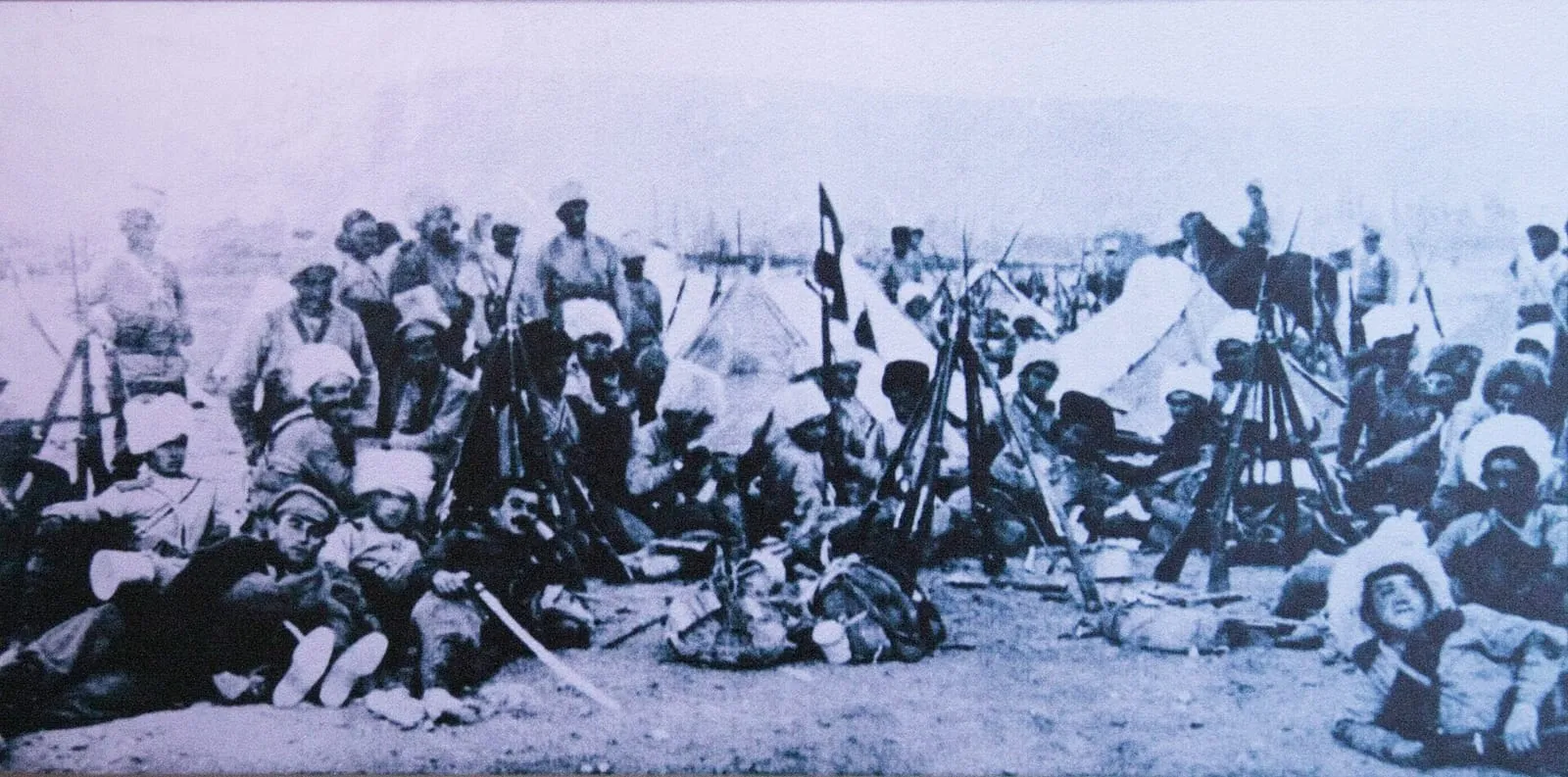
The Battle of Sardarabad was the most important engagement of the short Turkish–Armenian war of spring 1918. After taking Alexandropol on 15 May, Ottoman troops advanced into Russian Armenia. One column went along the railway towards Erivan across the Ararat plain, a second through the Bash Abaran gorge, a third on Karakilisa. On 21 May the Turks took the station and village of Sardarabad, a little over 20 kilometres from Etchmiadzin, the seat of the head of the Armenian Church. The Armenians, who since February had been retreating almost without a fight, this time struck back. Within a week they threw the Turks back from Sardarabad several dozen kilometres to the north, and Dro’s detachment defended the Bash Abaran gorge. At Karakilisa General Nazarbekian’s troops were beaten, but the Turkish march on Erivan came to a halt. In Armenian memory these engagements, known together as the “heroic battles of May”, became the beginning of revived statehood.
Name and dates
In Polish studies the form “bitwa pod Sardarapatem” (Battle of Sardarapat) is also found, matching the Armenian name of the place. The village and station of Sardarabad lay within the present-day town of Armavir. Under the name of the battle we include the fighting on the Ararat plain, and in separate parts we describe two engagements fought on the same days: the defence of the Bash Abaran gorge (today Aparan) and the battle of Karakilisa (today Vanadzor). This is how Armenian historiography treats them.
We adopt the dates 21–29 May 1918, given by most studies, from the Turkish capture of Sardarabad to the end of the fighting before the armistice. The sources differ in the details, however. According to Armenian studies the decisive counter-attack at Sardarabad came on 22 May, and the deciding advance on 27 and 28 May. The British historians of the Caucasian wars W.E.D. Allen and Paul Muratoff, the main source of this page alongside Armenian works, write of General Silikian’s counter-attacks on 23 and 24 May. Some Polish and English online accounts end the battle as early as 24 May. All dates are given according to the Gregorian calendar.
Background
After the disintegration of the Russian army the Caucasus front was taken over by weak Armenian forces. In February 1918 the Ottoman Third Army of Vehip Pasha moved forward, recovered Erzurum, and in April entered Russian territory. On 25 April the Armenians, on the orders of the authorities in Tiflis, handed Kars over to the Turks. At the Batum conference, opened on 11 May, the Turks demanded more than the Treaty of Brest-Litovsk gave them: the Alexandropol district and the railway running through Armenia to the Persian border. On the night of 14/15 May they presented an ultimatum and, without waiting for an answer, took Alexandropol.
For the Armenians it was a matter of life and death. On a scrap of land around Erivan and Lake Sevan hundreds of thousands of refugees were crowded, among them survivors of the Armenian genocide of 1915–1916. On 18 May the Erivan city council resolved that the town would be surrendered without a fight and the population evacuated to the mountains. That decision was overturned by the authority exercised in Erivan since the spring by the Dashnak Aram Manukian. The historian Richard Hovannisian calls it a “popular dictatorship”. According to Armenian studies Manukian organised the recruitment of volunteers, fortifications around the town and supplies for the army, and Catholicos Gevorg V refused to leave Etchmiadzin. A later legend tells of church bells that for six days called people to the defence.
The defence of Erivan was commanded by General Movses Silikian, subordinate to the commander of the Armenian corps, General Tovmas Nazarbekian. According to Allen and Muratoff, in mid-May Silikian had 6,000 to 7,000 men and 28 guns in the area of Etchmiadzin and Sardarabad. Armenian studies speak of 9,000–10,000 soldiers and volunteers, some of whom had to be sent to Bash Abaran. Alongside the rifle regiments they included regiments of volunteers from western Armenia, among others from Van, as well as Yazidi cavalry. On this axis, according to Allen and Muratoff, the Turks were not much more numerous than the Armenians. Two regiments of the 11th Caucasian Division advanced on Sardarabad, and south of the Araks stood the 12th Division, which nevertheless remained idle throughout the battle.
Course
Sardarabad
On 21 May a Turkish column advancing from Alexandropol along the railway pushed back the Armenian advance guard and in the evening took the station and village of Sardarabad. The Armenians fell back to a line through the villages of Kurakanlu, Kiorpalu and Zeyva, a few kilometres west of Etchmiadzin. According to Armenian studies, early on the morning of 22 May the troops of Colonel Daniel Bek-Pirumian, Silikian’s deputy, attacked along the whole line and with artillery support recaptured Sardarabad, advancing 15–20 kilometres. The following days brought regrouping and unsuccessful attacks on the hills by the Araks station, where the Turks had dug in.
The decision came on 27 May. When a detachment coming from the direction of Aragats turned the Turkish left flank and came out behind the hills, the main forces took them by storm. In the evening the Armenians took the Araks station and Mastara, and on 28 May the Karaburun station and the area of Talin. On 29 May the Turks, strengthened by reinforcements, counter-attacked at the Aragats station. According to Allen and Muratoff the Armenians threw the enemy back as far as the Ani station and Mastara, about 50 kilometres north of Sardarabad. Silikian wanted to go further, on Alexandropol, but received orders to halt operations. According to Armenian studies the troops were already short of ammunition, and reinforcements were reaching the Turks.
Bash Abaran
After the fall of Alexandropol the Turks could also advance on Erivan by the road from Hamamlu station (today Spitak), through the passes between Aragats and the Pambak mountains. According to Allen and Muratoff, Silikian sent there about a thousand picked riflemen with machine guns and four guns under the command of the well-known partisan Drastamat Kanayan, known as Dro. They took up positions in the Bash Abaran gorge. Around 24 May a regiment of the 11th Caucasian Division arrived there. Reinforced with cavalry and then infantry, Dro counter-attacked on 25 May, fought on 26 and 28 May, and on 29 May threw the Turks back north of Bash Abaran and held the gorge.
Karakilisa
Things went differently for Nazarbekian’s main forces in the north. On 21 and 22 May the 36th Caucasian Division with part of the 9th Division pushed them back from Hamamlu without difficulty. Nazarbekian decided to make a stand at Karakilisa, while the 5th Caucasian Division meanwhile pushed back the detachments of Andranik Ozanian covering the road to Tiflis. Between 25 and 28 May, according to Allen and Muratoff, the heaviest fighting of the whole war took place at Karakilisa. The Armenian rifle regiments fought fiercely, and Garegin Nzhdeh also fought there, but the Turks turned both flanks and cut the road to Dilijan. Nazarbekian with difficulty led his main forces out by mountain paths. On 29 May they took up positions covering Dilijan, now numbering only about 5,000 men fit to fight. Armenian sources write that in captured Karakilisa the Turks massacred thousands of inhabitants.
Losses
No exact figures exist. Armenian studies estimate Turkish losses at Sardarabad at about 3,500 men, and in the fighting of 22–26 May alone at as many as 5,500 killed. Armenian losses were in their view much smaller, but they were not counted. At Karakilisa, according to some sources, the Armenians lost about a thousand killed and captured.
Significance
Allen and Muratoff, writing drily and without sentiment, regarded Sardarabad and Bash Abaran as the Armenians’ only real, if modest, successes in this war, won against equal forces. In their view Armenian resistance did not seriously delay Turkish plans in Transcaucasia. These were damaged more by the political manoeuvres of the Georgians, who on 26 May declared independence under German protection. Armenian historians and some Western ones, such as Christopher Walker, see Sardarabad as the battle that saved the nation. Had the Turks taken Etchmiadzin and Erivan, the Armenian population and the refugees on the Ararat plain might have suffered the same fate as the Armenians of Anatolia in 1915.
The fighting was still going on when on 28 May the Armenian National Council in Tiflis assumed power over the Armenian lands, which is regarded as the beginning of the First Republic of Armenia. On 4 June its delegates signed a peace with the Ottoman Empire at Batum. The Armenians had to give up most of the Alexandropol district and a large part of the Erivan Governorate. The Turks occupied the railway through Sardarabad and Etchmiadzin, but did not enter Erivan. According to Hovannisian, news of the Armenian victories led them to make a small adjustment of the border in Armenia’s favour. The state at first covered a little over 10,000 square kilometres, but it survived until the autumn, when the Ottoman Empire capitulated to the Entente.
In Soviet Armenia, where the Dashnak government was condemned, the battle was for a long time hardly mentioned. Only after the commemoration of the 50th anniversary of the genocide in 1965 did the authorities agree to commemorate the victory. In 1968 the great Sardarapat Memorial was unveiled near Armavir. Every year on 28 May, Republic Day, the President of Armenia pays tribute there to the fallen.
Spotted a mistake?Report an error