1916: The relief of Kut and the Erzurum Offensive
Erzurum offensive
- Dates:
- 10 January – 16 February 1916
- Front:
- Middle East
- Location:
- The Armenian Highlands in eastern Anatolia, from Lake Tortum and the Çakırbaba ridge through the Pasin valley on the upper Aras (Köprüköy, Hasankale) to the ring of Erzurum forts, Ottoman EmpireOn the battle map →
- Sides:
- Russian EmpireNikolai Yudenich, Mikhail Przhevalsky, Pyotr KalitinOttoman EmpireMahmud Kâmil Pasha, Abdul Kerim Pasha
- Result:
- Decisive Russian victory. The Ottoman 3rd Army was broken at Köprüköy, and on 16 February 1916 the Russians took the fortress of Erzurum, capturing more than 300 guns.
- Author:
- Natalia
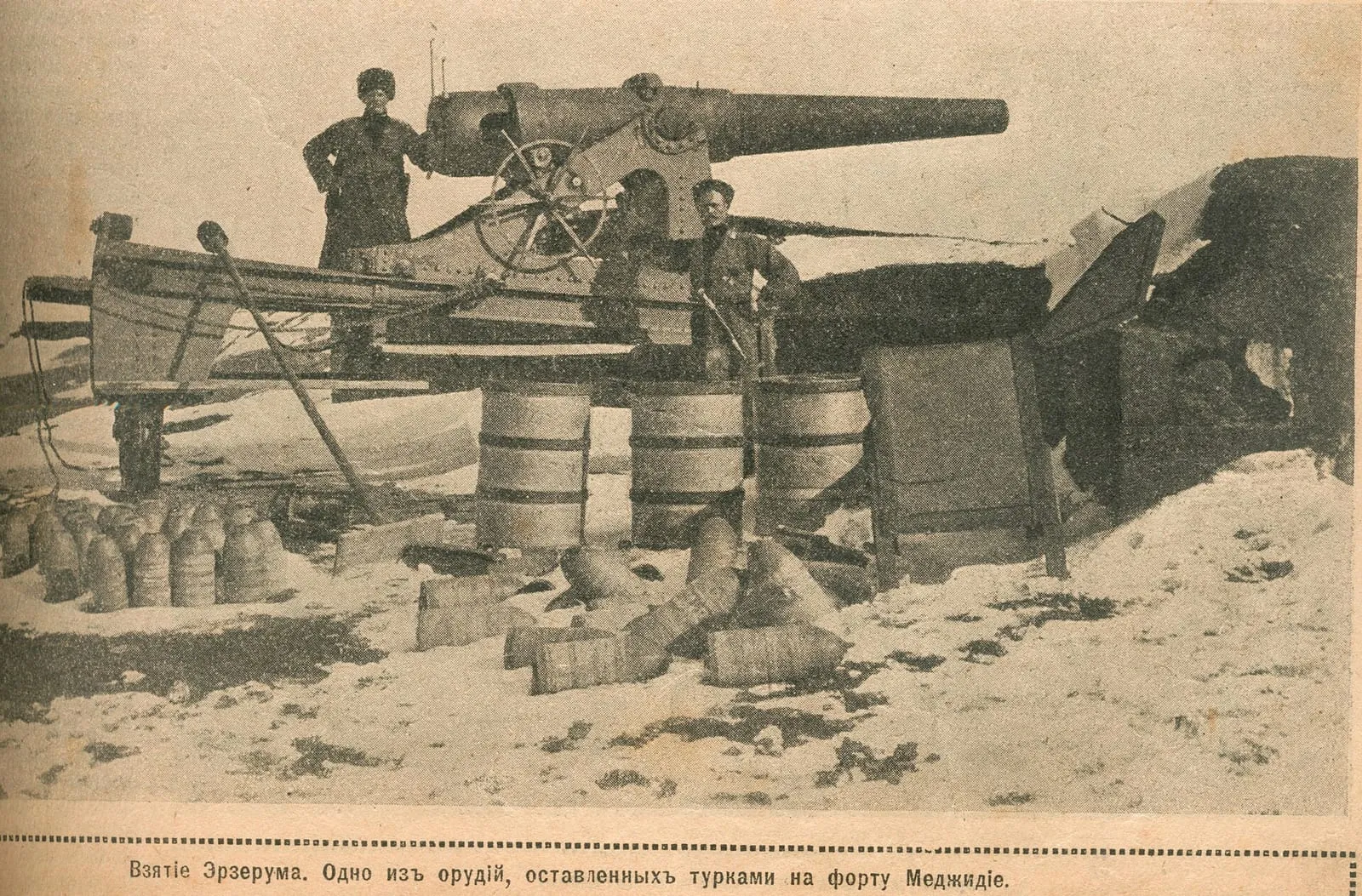
The Erzurum offensive was the greatest victory of the Russian Caucasus Army in the First World War. In the depths of winter, when deep snow lay in the mountains of the Armenian Highlands and the Turks expected calm until spring, General Nikolai Yudenich attacked the Ottoman 3rd Army. In the Battle of Köprüköy, from 10 to 19 January 1916, he broke through its fortified lines and threw it back behind the forts of Erzurum. After three weeks of preparation, on 11 February, the Russians struck at the fortress itself, which was considered impregnable. On the morning of 16 February Cossacks rode into the city. The defeat opened the way for the Russians into the interior of Anatolia, towards Trebizond and Erzincan.
Name and dates
Russian literature speaks of the Erzurum operation, Turkish literature of the Battle or Offensive of Erzurum (Erzurum Muharebesi, Erzurum Taarruzu). The British history of the Caucasian wars by W.E.D. Allen and Paul Muratoff, the main source for this page, divides it into the Battle of Köprüköy (10–19 January 1916) and the assault on Erzurum (11–16 February 1916), and between them describes the preparations for the assault.
All dates on this page are given according to the Gregorian calendar, used in Western Europe and by the Turks in military correspondence. Russia then used the Julian calendar, 13 days behind. In Russian documents and some Russian studies the offensive therefore began on 28 December 1915, and Erzurum fell on 3 February 1916. The mixing of the two calendars in later publications, including online ones, means that the same events are sometimes dated differently. The British chronology of the war on which our timeline is based records the start of the offensive under 11 January, the capture of Köprüköy under 17 January and the occupation of Erzurum under 16 February. We adopt the dates 10 January – 16 February 1916: from the first attack to the Russian entry into Erzurum. The pursuit of the broken army went on for several more weeks, and Allen and Muratoff consider that the operation ended only in mid-March.
Background
After the Battle of Sarikamish at the turn of 1914 and 1915 the Ottoman 3rd Army took a long time to recover. Throughout 1915 the main front in the Caucasus, between the Aras valley and Erzurum, stood still, and the fighting took place mainly on the flanks, around Lake Van and in Persia. In the autumn Grand Duke Nicholas took command in the Caucasus as viceroy, but the army in the field was still commanded by Yudenich.
At the end of 1915 the situation began to turn against the Russians. After the evacuation of the Entente troops from Gallipoli the Turks had a dozen or so experienced divisions free. The Minister of War, Enver Pasha, decided to transfer them to Asia: two to Mesopotamia, where the Turks were besieging the British at Kut, two to Syria, two to the Alexandretta area and seven to the Caucasus front. The transports set off in the first half of January, but the capacity of the Turkish railways was so small that most units were due to arrive only in March.
Yudenich foresaw this move. He calculated that transferring the divisions from the Dardanelles to Erzurum would take about three months, and that the Turks, if they were planning an offensive, would carry it out in spring. He therefore decided to strike first and by mid-January to break the 3rd Army so that even after the arrival of reinforcements it would be incapable of attacking. The plan was approved by the Grand Duke, although he had doubts. He was persuaded by a telegram from the Tsar’s chief of staff, General Mikhail Alekseyev, who was considering taking some troops from the Caucasus to the Western Front if they were going to stand idle there.
Forces and plan
According to Allen and Muratoff, in January 1916 the 3rd Army numbered about 70,000–75,000 men and 120 guns, of which about 65,000 infantry with a hundred guns stood on the front covering Erzurum, known as the “Köprüköy fortified lines”. Its commander, Mahmud Kâmil Pasha, was on leave in Constantinople, and its German chief of staff, Major Felix Guse, was being treated for typhus in Germany. The army was commanded in their stead by the commander of XI Corps, Abdul Kerim Pasha. On this sector the Russians had about 75,000–80,000 infantry, about 20 Cossack regiments and 230 guns, but in the mountains their superiority in cavalry and artillery counted for little. Soviet and Russian studies give much higher figures for both sides, because they include whole armies with their rear services.
The Turkish front, about 120 kilometres long, was divided by mountains into three sectors. The most strongly fortified was the Pasin valley on the upper Aras, through which ran the main road from Kars to Erzurum, with a stone bridge at Köprüköy. It was here, in November 1914, that the Russians had tried in vain to break through. Yudenich chose another place: the mountainous Çakırbaba ridge at the junction of the Turkish X and XI Corps, which the Turks considered inaccessible. First General Mikhail Przhevalsky’s II Turkestan Corps was to attack in the north for two days to draw the Turkish reserves there. Then General Pyotr Kalitin’s I Caucasian Corps was to strike on both banks of the Aras. Only on the fifth day was General Vorobyov’s 4th Caucasian Rifle Division, hidden in the mountains, to break the front at the Çakırbaba ridge and descend on the Turkish rear at Köprüköy.
Preparations were made in the greatest secrecy. Ammunition and food were brought up gradually, explained as preparations for wintering. The soldiers received sheepskin coats, padded trousers, felt boots and warm caps, and each was to carry two logs so as to be able to light a fire on the bare slopes. Regiments sent officers to Tiflis to shop for Christmas, which according to the Julian calendar fell on 7 January. A rumour was spread of a transfer of troops to Persia, and one regiment was sent by rail towards the Persian border with much publicity. Even brigade commanders did not know the plan, and Vorobyov learnt of his task two weeks before the battle.
Course: the Battle of Köprüköy
10–13 January. On 10 January, during the Russian holidays, II Turkestan Corps attacked on the northern sector. The assaults on Mount Karadağ, defended from trenches cut into the rock, broke down in terrible frost. One battalion lost 300 men killed and frozen. The Turks were convinced that they had repulsed the main attack. On 12 January I Caucasian Corps went into the attack in the Aras valley. The 153rd Baku Infantry Regiment took the first Turkish trenches on the plain at Azap in bloody fighting, and in the south the Derbent Regiment beat off one counter-attack after another. On 13 January Abdul Kerim, concluding that the main blow was falling on the Aras, threw in his only reserve there, the 17th Division. Five of his nine divisions thus found themselves far from the place where the real attack was to come.
14–16 January. On 14 January, the Orthodox New Year, the breakthrough began. Columns of Don Cossack infantry and Turkestan regiments struggled along the Çakırbaba ridge in a blizzard, through snow up to one and a half metres deep, clearing their way with shovels, and by 11 a.m. Vorobyov’s division had taken the Turkish positions on a narrow sector. The next day the Russians took the fortified summit of Kozıçan and began to descend on the rear of the Turkish positions in the Pasin valley. On 16 January their columns split the Ottoman army in two: X Corps with the 34th Division in the north and five divisions of IX and XI Corps in the south. During the night of 16–17 January Abdul Kerim ordered a general retreat.
17–19 January. The Turks withdrew so efficiently that the Russian units on the Aras noticed only in the morning. On the evening of 17 January Vorobyov entered Köprüköy, and Yudenich angrily telegraphed Kalitin that his corps had let the enemy escape. On 18 January Siberian Cossacks reached Hasankale (today Pasinler), and on the morning of 19 January they routed the Turkish rearguard there, taking, according to Allen and Muratoff, 1,500 prisoners and four guns. The same day their horse battery fired the first shots at the Erzurum forts on the Deveboynu ridge.
Preparations for the assault
The success at Köprüköy set off a wave of optimism in the army, but in Tiflis the advice was to be content with the ground gained. Colonel Yevgeny Maslovsky, whom Yudenich had sent to reconnoitre, reported that Erzurum was not ready for defence. Russian scouts also discovered that the high, rocky Kargapazar ridge, rising to about 3,000 metres between the Aras valley and the Erzurum plain, was neither manned nor included in the system of forts. The Turks considered it impassable. On 23 January the Grand Duke agreed to the assault, although Yudenich took the responsibility on himself. The Russians cobbled together a makeshift siege train from the guns of the Kars fortress, extended the narrow-gauge railway, set up motor columns and for the first time on this front used aircraft for reconnaissance.
On the flanks Yudenich attacked so that the Turks could not bring reinforcements to Erzurum. On 26 January IV Caucasian Corps took Hınıs, an important road junction south of Erzurum, and the troops from Van advanced along the shores of the lake. On 25 January a rifle battalion seized the Kargapazar plateau after a short fight, and from 31 January the whole of Vorobyov’s division held it. In frost, and in snow reaching a horseman’s head, the soldiers relieved one another every few hours and built paths along which the guns were hauled up.
Erzurum was a fortress rebuilt after the Russo-Turkish War of 1877–1878 to plans first by British and then by German engineers. Two rings of forts on the Deveboynu ridge (“Camel’s Neck”) covered the city from the east, and groups of forts in the Gürcübogaz gorge to the north and on the Palandöken ridge to the south protected the flanks. According to Allen and Muratoff, however, the forts were not adapted to defence against modern artillery, only some of the guns were modern, and the garrison was short of men. Mahmud Kâmil Pasha, who returned to the army at the end of January, had at most 50,000 soldiers, many of them untrained recruits, instead of the roughly 75,000 needed to man the whole fortress. The Turks nevertheless still believed that the fortress would hold out until the spring reinforcements arrived.
Course: the assault on Erzurum
11–12 February. On 8 February Yudenich invited his commanders to dinner. When after the meal he announced an attack for 10 February, some of them began asking for a delay. Yudenich cut the discussion short: “Very well. We attack on the eleventh.” On 11 February at 2 p.m. the Russian artillery opened fire on the Çobandede and Dalangöz forts. During the night one and a half battalions of the 153rd Baku Regiment under Colonel Pirumov, an Armenian, approached Fort Dalangöz in silence and broke in. Bayonet fighting went on until dawn. On 12 February the Turks counter-attacked eight times, and by evening Pirumov had 300 men fit for combat left out of 1,400. But they held the fort. The same day Przhevalsky’s Turkestan regiments, outflanking the Gürcübogaz gorge through the mountains, forced the Turks to abandon Fort Karagöbek. A column that was to cross the Palandöken ridge lost its way on the plateau at night, and more than 600 soldiers suffered severe frostbite.
13–14 February. The Turkish X Corps put up stiff resistance in the Gürcübogaz gorge. Meanwhile Vorobyov’s division descended from Kargapazar almost unhindered, and the Don Cossack infantry, which had lost a whole frozen battalion in the blizzard, reached the rear of Fort Tafet on the evening of 13 February. On 14 February the fort, attacked from three sides, fell, and the Russians took 1,500 prisoners and 20 guns. By evening they were already standing on the edge of the Kara Su (upper Euphrates) plain, behind the backs of the defenders of the Deveboynu ridge.
15–16 February. On the morning of 15 February Russian airmen reported the movement of baggage trains in the streets of Erzurum and on the roads to the west. Mahmud Kâmil Pasha ordered a retreat. By the afternoon the Turks had abandoned all the forts of the outer ring, including Çobandede, where the Russians captured 42 guns. Turkish rearguards held out during the night at Fort Sivişli. At 7 a.m. on 16 February a regiment of Terek Cossacks rode into Erzurum, followed by the infantry. At noon Yudenich entered the fortress.
Losses
According to Allen and Muratoff, at Köprüköy the 3rd Army lost nearly 15,000 killed, wounded and frozen, about 5,000 prisoners and as many deserters. Of 65,000 soldiers, about 40,000 took refuge behind the Erzurum forts. During the assault the Turks lost at least 10,000 killed and wounded and about 5,000 prisoners, and thousands more in the pursuit. In Erzurum itself the Russians captured 327 guns. Soviet studies estimated Turkish losses in the whole operation at about 66,000 men, including 13,000 prisoners.
According to Allen and Muratoff, the Russians lost about 10,000 killed and wounded and 2,000 severely frostbitten at Köprüköy, and in the assault on Erzurum a thousand killed, 4,000 wounded and as many frostbitten. The whole operation cost them about 17,000 men. Russian figures speak of 2,339 killed and 14,796 wounded.
Significance
The Erzurum offensive was a model of a carefully prepared winter operation in high mountains and Yudenich’s greatest success. The Russians twice achieved complete surprise, striking where the enemy considered the terrain impassable. They did not, however, manage to encircle the 3rd Army: the breakthrough at Köprüköy came on too narrow a sector, and after the fall of Erzurum the pursuit set off late. Even so, the Ottoman army in the Caucasus was broken. According to Allen and Muratoff, no more than 25,000 men with a few dozen guns remained of Mahmud Kâmil Pasha’s forces.
The fall of the fortress, regarded as the key to eastern Anatolia, caused a wide stir. In the Entente countries it was greeted with joy after the defeat at Gallipoli and at a time when the British were trying in vain to relieve Kut. On the same day as Erzurum the Russians took Muş to the south, at the beginning of March Bitlis, in April Trebizond and in the summer Erzincan. Erzurum remained in Russian hands until the disintegration of the Russian army after the revolution. The Turks retook it in March 1918.
Spotted a mistake?Report an error