1914: The Ottoman Empire enters the war
Battle of Sarikamish
- Dates:
- 22 December 1914 – 17 January 1915
- Front:
- Middle East
- Location:
- The Russo-Turkish border in the Caucasus, from Ardahan and Oltu to Sarikamish and the Aras valley, including the Allahuekber MountainsOn the battle map →
- Sides:
- Ottoman EmpireEnver Pasha, Hafız Hakkı Pasha, İhsan PashaRussian EmpireIllarion Vorontsov-Dashkov, Alexander Myshlayevsky, Nikolai Yudenich, Georgy Berkhman
- Result:
- Decisive Russian victory. The Ottoman 3rd Army lost most of its soldiers, largely to frost and disease. IX Corps was captured, and the Turks long lost the capacity to attack in the Caucasus.
- Author:
- Łukasz Skowroń
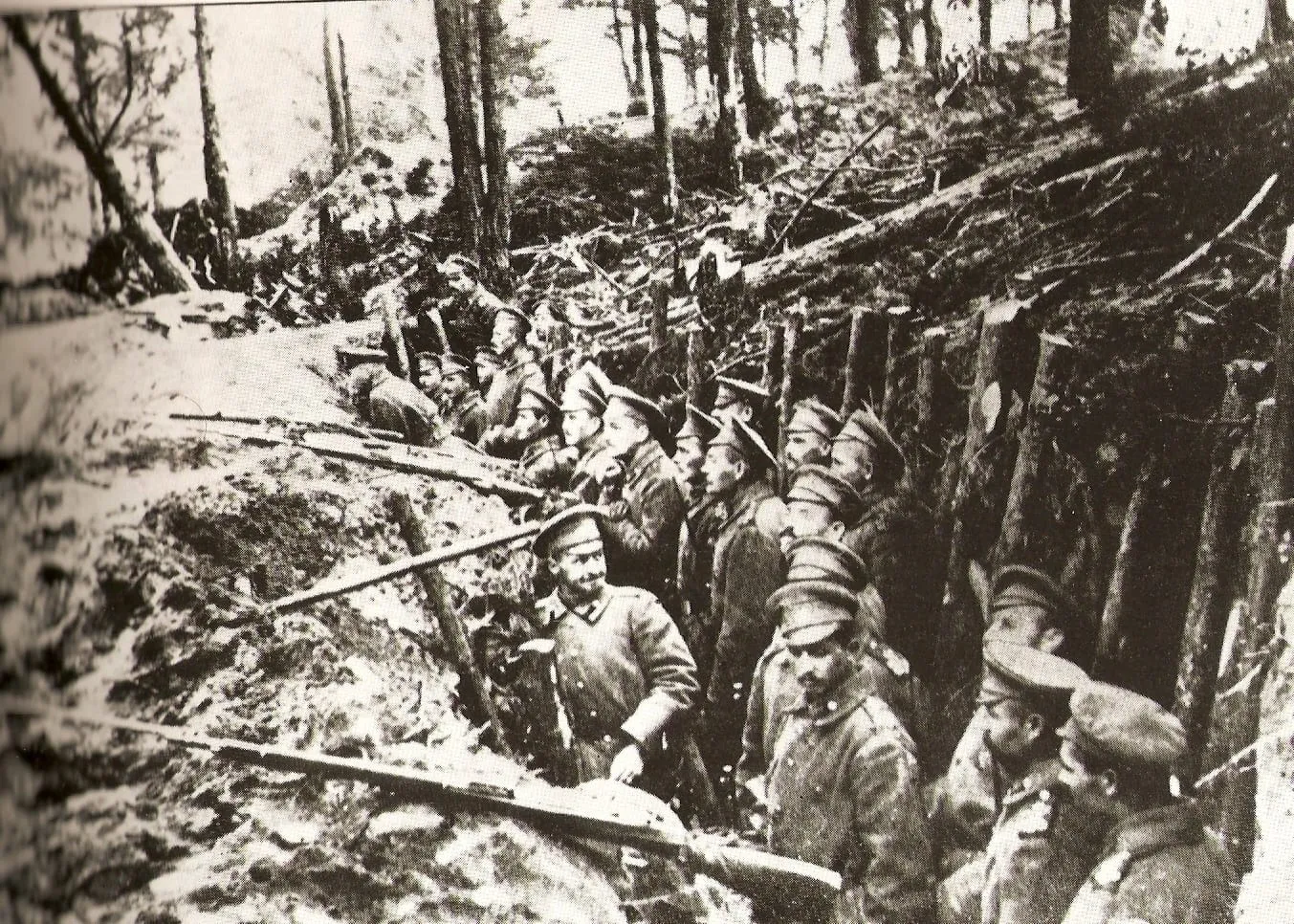
The Battle of Sarikamish (Turkish: Sarıkamış) was the first great battle on the Caucasus front and one of the greatest defeats in the history of the Ottoman army. At the turn of 1914 and 1915 the Minister of War, Enver Pasha, led the Ottoman 3rd Army on a winter march through the mountains to outflank the Russian troops on the border and take Sarikamish, a railway station on the road to the fortress of Kars. The plan was bold, but it took no account of conditions. Soldiers without winter uniforms or supplies marched over passes in deep snow and frost, freezing to death by the thousand along the way. When they reached Sarikamish there were too few of them to break the defence. A Russian counter-attack encircled the remnants of two corps, and of an army numbering some 90,000 men in December only some fifteen thousand fit for combat remained after a few weeks.
Name and dates
Polish literature uses the name Battle of Sarykamysz or, following Russian historiography, the Sarykamysz operation. The small town, today in Turkey, belonged to Russia in 1914. On the Polish edition of this site we use the Polonised form Sarykamysz and give its Turkish name, Sarıkamış, at first mention. The Polish Wikipedia has no separate article on this battle.
On this page we adopt the dates 22 December 1914 – 17 January 1915. On 22 December the Ottoman corps went over to the attack. The end date, 17 January, is given by most English-language studies, which include in the battle the last fighting of the Ottoman XI Corps in the Aras valley. Russian studies end the operation a day later, on 18 January, and Turkish ones much earlier, on 4 or 5 January, when the remnants of IX Corps capitulated and X Corps began its retreat. The British chronology of the war on which this site is based records the start of the battle only under 29 December. Those were the days of the heaviest fighting for the town itself.
Background
At the beginning of November 1914 the Russians entered Turkey and advanced towards Erzurum, but a counter-attack by the 3rd Army pushed them almost back to the border. The Bergmann Offensive ended in the first Turkish victory of this war. Enver Pasha concluded that the Russian Caucasus Army was weak, because its best corps were fighting the Germans and Austrians. He decided to destroy it with a single blow and recover the lands Turkey had lost after the war with Russia of 1877–1878, including Kars, Ardahan and Batumi. He also counted on a victory rousing the Muslims of the Caucasus and opening the way to Persia and Central Asia.
At the beginning of December Enver left Constantinople for the front together with his chief of staff, the German general Friedrich Bronsart von Schellendorf. According to Turkish studies he reached the 3rd Army headquarters at Köprüköy in the middle of the month. Its commander, General Hasan İzzet Pasha, considered a winter offensive in the mountains impracticable, because his soldiers had no warm clothing, food supplies or experience of such conditions. On the night of 18–19 December he resigned, and Enver took command of the army himself.
Plan and forces
Enver’s plan envisaged a great enveloping manoeuvre. XI Corps, supported by cavalry, was to pin down the main Russian forces, which stood in the Aras valley a few dozen kilometres beyond the border. Meanwhile IX and X Corps were to outflank them from the north along mountain paths, come out in their rear at Sarikamish and cut the only railway linking the front with Kars. Further north a small detachment under a German officer, Major Stange, was to strike at Ardahan. The plan required the infantry to march through mountains rising to more than 2,500 metres, in winter, to a strict timetable.
According to the most often cited figures the 3rd Army numbered about 90,000 soldiers, although estimates range from 75,000 to more than 110,000. IX Corps was commanded by İhsan Pasha, and X Corps by Colonel Hafız Hakkı, a young and ambitious officer from Enver’s circle, promoted to general during the operation. On the Russian side the nominal commander of the Caucasus Army was the Viceroy of the Caucasus, Count Illarion Vorontsov-Dashkov. He sent his deputy, General Alexander Myshlayevsky, to the front, and with him the chief of staff, General Nikolai Yudenich. The main Russian forces on the Aras, numbering several tens of thousands of men, were still led by General Georgy Berkhman. Sarikamish itself was almost defenceless.
Course
22–26 December. XI Corps attacked the Russians on the Aras, and IX and X Corps set off to the north and north-east. Instead of turning towards Sarikamish, Hafız Hakkı’s X Corps went for Oltu, where on 23 December it drove out General Istomin’s Russian detachment. At Oltu two Ottoman divisions, each taking the other for Russians, fired on each other for several hours. Hafız Hakkı then led two divisions across the Allahuekber ridge to make up for lost time. The march through the snowbound mountains lasted some fifteen hours. According to Turkish sources about 10,000 soldiers froze to death in them, and the divisions arrived near Sarikamish with a small fraction of their original strength. IX Corps too was losing hundreds of men to exposure, spending nights in the snow and in forests without fires.
26–31 December. On 26 December the first units of IX Corps attacked Sarikamish. The town was defended by a makeshift garrison of a few battalions, militia and armed railwaymen, directed by Colonel Nikolai Bukretov. Over the following days the Russians brought up reinforcements by rail and by road from the Aras valley, and General Mikhail Przhevalsky took command of the defence. Meanwhile Myshlayevsky, convinced that the troops on the Aras would be encircled, ordered a retreat towards Kars and left the front. Some sources date his departure to 28 December, others to the last days of December. His behaviour caused panic in the rear, as far as Tiflis. Yudenich stayed put and decided to defend himself. At the same time Stange’s detachment occupied Ardahan, and the Turks cut the railway to Kars for a time. On 29 December, the day of the heaviest assaults, an Ottoman regiment broke into Sarikamish but was driven out. The exhausted, frozen and hungry units no longer had the strength to take the town.
1–5 January 1915. Yudenich concentrated his forces and went over to the counter-attack. The Russians retook Ardahan and closed the ring around the remnants of IX Corps on the wooded hills near Sarikamish. On 4 January İhsan Pasha capitulated together with his staff and divisional commanders. Only a few hundred men remained of the corps, according to Turkish figures barely more than a hundred soldiers and a hundred officers. On the night of 4–5 January Hafız Hakkı withdrew the remnants of X Corps across the mountains. Enver, who had himself nearly been captured, left the army at the beginning of January and returned to Constantinople.
6–17 January. The Russians turned against XI Corps, which was still holding positions on the Aras. In mid-January, in the fighting at Kara Urgan, they pushed it back towards Köprüköy. With that Enver’s offensive finally came to an end. Hafız Hakkı took command of the 3rd Army, but on 12 February 1915 he died of typhus, which was raging in the overcrowded hospitals of Erzurum.
Losses
Ottoman losses are among the most disputed figures of this war. The Turkish General Staff estimated that by mid-February 1915 the 3rd Army had lost about 60,000 men. Other estimates speak of 70,000–90,000, including those killed, frozen to death, dead of typhus in hospitals, prisoners and deserters. Most of them did not die in combat but of frost, hunger and disease. According to various sources between several thousand and more than ten thousand soldiers were taken prisoner by the Russians. At the beginning of January, by Turkish reckoning, about 16,000 soldiers were left in the whole army, although some of the scattered and those who had fled later returned to the ranks.
The Russians also lost many men. The most often cited figure is about 20,000–30,000 killed, wounded and sick, including several thousand with frostbite.
The Armenians
On the Russian side fought Armenian volunteer units, made up largely of Armenians from the Caucasus but also of refugees from the Turkish side of the border. Their part was small on the scale of the battle, although the volunteers distinguished themselves in several engagements, and the Armenian inhabitants of the borderland supplied the Russians with information about Ottoman troop movements. At the same time thousands of Armenians, Ottoman subjects, served in the ranks of the 3rd Army. According to Armenian accounts one of them saved Enver from capture, and Enver himself, after his return, praised the conduct of Armenian soldiers in a letter to the Armenian bishop of Konya.
Nevertheless the Ottoman authorities quickly shifted part of the blame for the defeat onto the Armenians, accusing them of treason, desertion and aiding the enemy. In February 1915 the War Ministry ordered Armenian soldiers to be disarmed and transferred to labour battalions, in which many of them were later murdered. Historians agree that the defeat at Sarikamish and the search for scapegoats among the Armenians formed part of the immediate background to the Armenian genocide, which began in the spring of 1915.
Significance
Sarikamish decided the fate of the Caucasus front for more than a year. The 3rd Army never regained its former strength, and the Russians, though weakened themselves, were able to go over to an offensive that in 1916 brought them the capture of Erzurum and Trebizond. Yudenich, acknowledged as the victor, soon became commander of the Caucasus Army, and Myshlayevsky was removed from command.
The battle also had consequences far from the Caucasus. In the most difficult days, when alarming reports were coming in from Tiflis, the Russian commander-in-chief, Grand Duke Nicholas Nikolaevich, asked the British for a demonstration against Turkey that would relieve the Caucasus front. Although the Russians soon defeated Enver on their own, this request became in London one of the impulses for the attack on the Dardanelles and, in consequence, for the Gallipoli campaign.
Spotted a mistake?Report an error