Russia · The Entente
Stepan Shaumian
Extraordinary Commissar for the Caucasus (1917–1918), chairman of the Baku Council of People's Commissars (1918)
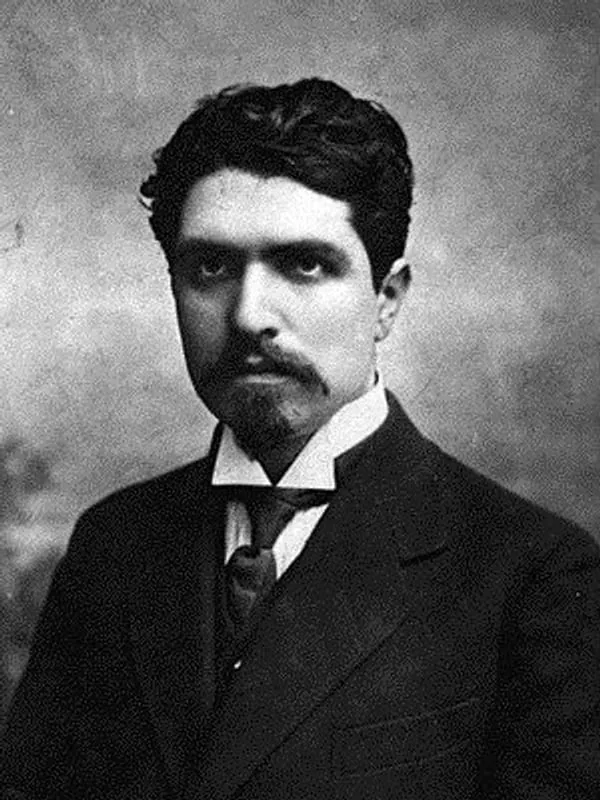
- Born:
- 13 October 1878, Tiflis (Georgia)
- Died:
- 20 September 1918, Near Krasnovodsk (Transcaspia, now Turkmenistan)
- Author:
- Łukasz Skowroń
- Photo:
- autor nieznany, domena publiczna, Wikimedia Commons

Stepan Shaumian was the most important Bolshevik in the Caucasus and one of the few whom Vladimir Lenin trusted without reservation. An Armenian from Tiflis, educated in Riga and Berlin, a journalist and organiser of the workers of the Baku oilfields, he spent most of the war in prison and in exile. After the revolution Lenin appointed him Extraordinary Commissar for the Caucasus. In the spring of 1918 Shaumian became head of the Bolshevik Baku Commune, which ruled the largest oil centre in the world of its day, while the whole of the South Caucasus was breaking away from Russia and the Turkish army was approaching from the west. His rule began with bloody fighting against the Muslims of Baku and ended three months later, when the city council, against the Bolsheviks’ wishes, called in the British for help. In September 1918 Shaumian was shot together with other Baku commissars and became one of the foremost martyrs of the Soviet pantheon. In this war the Bolsheviks took Russia out of the Entente camp, but on the Caspian Sea Shaumian fought to the end against the same enemy as the British, although he refused to cooperate with the British themselves.
Before the war
He was born on 13 October 1878 (1 October in the Julian calendar) in Tiflis, into the family of an Armenian shop clerk. After the Realschule in Tiflis he studied at the Polytechnic Institute in Riga, from which he was expelled in 1902 for revolutionary activity. In 1899 he founded the first Marxist circle in Armenia, in Jalaloghly, now Stepanavan, which bears his name, and in 1902 he was one of the founders of the Union of Armenian Social Democrats. He completed his philosophy studies in Berlin in 1905. In emigration he met Lenin and sided with the Bolsheviks.
After returning to the Caucasus he was a teacher, journalist and underground activist. From 1907 he led the Bolsheviks in Baku, where the young Joseph Stalin was also active. Their relations were strained: when Shaumian was arrested in 1909, some comrades suspected Stalin of informing on him, which was never proved. In 1912 he was elected in absentia a candidate member of the Central Committee. Lenin corresponded with him on the national question, and Shaumian, himself an Armenian, was regarded as a committed internationalist. Exiled to Astrakhan, he returned to Baku in the spring of 1914 and in the summer led the great general strike of the oil workers, which was cut short by the outbreak of war.
War, prison and exile
During the war Shaumian led the underground Bolshevik organisation in Baku and throughout the Caucasus. In October 1915 he chaired an illegal conference of Caucasian Bolsheviks in Baku, which adopted Lenin’s anti-war slogans and elected him head of the party’s Caucasian Bureau. He also wrote for the Armenian socialist press, in which he condemned the massacres of Armenians in the Ottoman Empire. On 7 March 1916 the police arrested him in Grozny. The head of the provincial gendarmerie in Baku reported to Petrograd that he was one of the most experienced party activists in the Caucasus, a convinced Bolshevik and follower of Lenin, and that his removal from the region would bring calm to the whole area. In December he was exiled to Saratov.
He was freed by the February Revolution. In March 1917 he returned to Baku, where, while he was still on his way, he was elected in absentia chairman of the soviet of workers’ deputies, although the Bolsheviks were a clear minority in it. According to the memoirs of Anastas Mikoyan, it was his personal authority that decided the matter. In the summer he met Lenin in Petrograd, and at the Sixth Party Congress he was elected in absentia to the Central Committee. In October he led a congress of Caucasian Bolsheviks in Tiflis, at which he proposed dividing the South Caucasus into three autonomous national regions, federally linked to Russia. Most delegates did not support him.
Commissar for the Caucasus
After the October coup the Bolsheviks had almost no power in the South Caucasus. Tiflis and most of the region were controlled by the Georgian Mensheviks, the Armenian Dashnaks and the Azerbaijani Musavatists, who soon formed the Transcaucasian Commissariat and did not recognise Lenin’s government. The exception was Baku with its Russian and Armenian proletariat. At the end of 1917 the city soviet under Shaumian’s chairmanship took power in the city, and in December Lenin appointed him Extraordinary Commissar for the Caucasus. Shaumian was also entrusted with carrying out the decree on “Turkish Armenia” of the turn of 1917 and 1918, in which the Soviet government promised the Armenians of the Ottoman lands occupied by Russia the right to self-determination.
Reality quickly put an end to these plans. The Russian army was abandoning the Caucasus front, and the Treaty of Brest-Litovsk gave Kars, Ardahan and Batum to Turkey. In Baku tension grew between the soviet, which rested on Russian workers, Armenian soldiers and the Dashnaks, and the Muslim majority of the province’s inhabitants. At the end of March 1918 a dispute over disarming Muslim soldiers turned into street fighting, known as the March Days. The soviet’s troops and Dashnak units crushed the Musavatists, and the fighting turned into a massacre of the Muslim population of Baku. Estimates of the victims range from 3,000 to 12,000. In a report to Moscow Shaumian admitted that the Bolsheviks had deliberately used the opportunity to deal with their opponents and that the participation of the Dashnaks had given the civil war to some extent the character of an ethnic massacre, “but it could not be avoided”. Historians such as Firuz Kazemzadeh believe that the soviet provoked the fighting in order to get rid of its most dangerous rival. For the Azerbaijani leaders it was the final argument for seeking help from the Turks.
The Baku Commune
On 25 April 1918 the Baku Council of People’s Commissars was set up, in which Shaumian was chairman and commissar for foreign affairs. The Commune nationalised the oil industry, the Caspian fleet and the banks and tried to spread Soviet power in the surrounding districts. Lenin wrote to him in May that in Moscow they were delighted with his “firm and resolute policy”, and advised him to combine it with “the most careful diplomacy”. When Azerbaijan’s independence was proclaimed in Tiflis on 28 May, Baku was in Bolshevik hands, and the Azerbaijani government in Ganja was counting on Nuri Pasha’s Caucasus Army of Islam.
The Commune decided to forestall the Turks. At the beginning of June its troops, mostly Armenian, marched west and took Kurdamir, but at the end of the month they were routed at Göyçay. Help from Russia was negligible: Moscow, absorbed by the civil war, sent only small detachments, and Shaumian sent telegrams asking for troops to Lenin and to Stalin, who was then organising supplies in Tsaritsyn. At the beginning of July the Commune accepted the help of the Cossacks of Lazar Bicherakhov, who was paid by the British, and handed him command at the front, but on 10 July the Turks took Kurdamir and the Commune’s troops fell back to the city itself.
The sharpest dispute concerned British help. It was offered from Enzeli in Persia by General Lionel Dunsterville, and in the city the British vice-consul Ranald MacDonell argued for it. Shaumian had an explicit ban from Moscow on accepting it, and did not himself believe that a British general and a Bolshevik commissar could become allies. Moscow was counting rather on the Germans, who wanted to keep the Turks away from Baku and to lay their own hands on Baku’s oil. The Dashnaks, the Socialist Revolutionaries and the Mensheviks were in favour of calling in the British. On 25 July, at a stormy session, the soviet adopted their motion by a small majority. Shaumian announced that the commissars were giving up power, and according to accounts cited by historians he said that they were leaving “with pain in our hearts and curses on our lips”. On 31 July the Commune formally stepped down, and power passed to the Centrocaspian Dictatorship, which called in the British.
Death
The Bolsheviks tried to sail to Astrakhan with troops and Soviet property, but ships of the Caspian flotilla turned their vessels back. In mid-August, at another attempt, they were stopped at sea, and Shaumian and his comrades were accused of abandoning the city in its hour of danger and put in prison. They were released in the chaos of the last night of the defence of Baku, 14/15 September. The steamer they boarded put in not at Astrakhan but at Krasnovodsk, where the anti-Bolshevik Transcaspian government held power. Before dawn on 20 September, in the desert by the Transcaspian Railway, 26 men connected with the Commune were shot, Shaumian among them. The order was given by the Socialist Revolutionary leaders of the government in Ashkhabad. Soviet historiography blamed the British, which Britain denied, and historians working in the British archives generally believe that the British did not give the order, although their liaison officer might perhaps have been able to prevent the execution.
After the Red Army occupied Azerbaijan, the remains of the commissars were buried in Baku. Towns, streets and ships were named after them, and Shaumian was commemorated by, among others, Stepanakert in Nagorno-Karabakh and Stepanavan in Armenia. In 2009 the Azerbaijani authorities demolished the commissars’ mausoleum, and Shaumian’s body was not found among the exhumed remains.
Assessment
In the USSR Shaumian was “the Caucasian Lenin”, a model Bolshevik and a martyr of the revolution, and for decades his death weighed on Soviet–British relations. Western historians, from Firuz Kazemzadeh to Ronald Suny, see him as a man of principle, more inclined to compromise than many of his comrades, who nevertheless ruled Baku only thanks to armed Armenians and whose Commune is remembered for the March Days. For Azerbaijani historians he is above all jointly responsible for the massacre of Muslims in March 1918. The Socialist Revolutionary Mikhail Ter-Pogosyan, who knew him in those months, recalled that he was at once a Bolshevik and an Armenian nationalist. The dispute over which of these faces was the real one continues to this day, as does the dispute over who was to blame for his death.
Sources
Spotted a mistake?Report an error
Mentioned in battles
(01)Often appears with
People who appear in the same events.