Russia · The Entente
Lazar Bicherakhov
Commander of the Terek partisan detachment in Persia (1916–1918), commander of the troops on the Baku front (1918), White Army major general
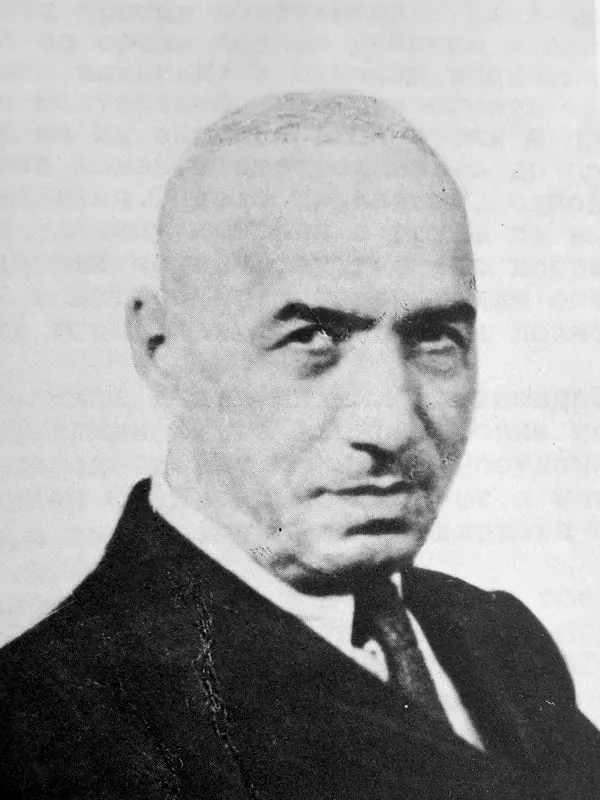
- Born:
- 15 November 1882, Petersburg (Russia)
- Died:
- 22 June 1952, Dornstadt near Ulm (Germany)
- Author:
- Natalia
- Photo:
- autor nieznany, domena publiczna, Wikimedia Commons

Lazar Bicherakhov was one of the few Russian officers who did not lay down their arms after the Bolshevik coup and fought the Central Powers to the end of the war. An Ossetian from the Terek Cossacks and commander of a small but hard-fighting detachment of “partisans” in Persia, at the turn of 1917 and 1918 he and his men went into British pay. He then became the main armed force of the mission of General Lionel Dunsterville, which was making its way through Persia to the Caspian Sea. In 1918 he routed the Persian Jangalis at Manjil, for a time commanded the troops of the Bolshevik Baku Commune against the Turks, and then took control of the Dagestan coast. The British saw him as a hero, the Bolsheviks as a traitor. The Whites recognised him as one of their generals, although he did not submit to Anton Denikin. He acted in the history of the war in the Caucasus with great freedom, often on his own initiative, and to this day he provokes extreme judgements.
Before the war
According to Russian biographies, he was born on 15 November 1882 in Petersburg, into a family of Ossetians from the Cossack stanitsa of Novoosetinskaya in the Terek Oblast. His father, Fyodor, was a wachmistr (sergeant major) in the Tsar’s personal escort. Lazar completed a real school in Petersburg and the Alexeyev Military School in Moscow. He served in the 1st Gorsko-Mozdok Regiment of the Terek Cossacks, stationed at Olty on the Turkish border, as a sotnik in 1912. His elder brother Georgy was a Cossack activist on the Terek.
Galicia, the Carpathians and Persia
At the beginning of August 1914 Bicherakhov, then a podesaul, was discharged from the service on grounds of illness, but the outbreak of war brought him back into the army. In the newly formed 2nd Gorsko-Mozdok Regiment he commanded a sotnia and fought in Galicia and the Carpathians. For distinguishing himself in action he was promoted in 1915 to esaul and then to voyskovoy starshina, that is, lieutenant colonel, and received several orders. For a time he was attached to Grand Duke Michael Alexandrovich, the Tsar’s brother.
He became best known in Persia, where from 1916 he fought in the expeditionary corps of General Nikolai Baratov. There he commanded a detachment of volunteers from the Cossack regiments, known as the partisan detachment, which carried out deep mounted raids into the Turkish rear. According to Allen and Muratoff, authors of a Cambridge-published history of the wars in the Caucasus, in the summer of 1916 his sotnias covered Baratov’s left wing in the area of Nahavand. In the spring of 1917, when the Russians were moving towards Mesopotamia after the British capture of Baghdad, only his partisans managed to cross the border and make contact with the British cavalry near Mandali. Dunsterville, who met him later, described him as a slim man of about forty, of commanding bearing, wounded many times and adored by his soldiers.
In British pay
In the autumn of 1917 Baratov’s corps was disintegrating. Bicherakhov’s detachment, about a thousand men, intercepted broken units of the Persian gendarmerie at Qasr-e Shirin, and then, cut off from the main force and without food, with Baratov’s consent passed temporarily under the orders of the British commander in Mesopotamia, General Frederick Maude. According to Russian sources, Bicherakhov then wrote to Baratov that he was staying at the front, would go on fighting, would not join the armistice and regarded all negotiations with the enemy as treason, and that he would answer to Russia himself for this decision. In December his men fought beside the British in the Jabal Hamrin hills.
At the beginning of January 1918, at Baratov’s request, he set out from Qasr-e Shirin for Kermanshah to gather Russian soldiers willing to go on fighting. Almost no one came forward, but his detachment held together. In February his Cossacks covered the withdrawal of the Russian troops, and in March, after the departure of the last regular Russian units from Hamadan, Bicherakhov made an agreement with Dunsterville: the British paid his detachment, and he undertook to cooperate with them in Persia and then in the Caucasus. British liaison officers and armoured cars were attached to the detachment. For several months his roughly 1,200 Cossacks were the only serious armed force in northern Persia for Dunsterville, who himself had only a few dozen soldiers. On 23 March it was they who reached Qazvin at the last moment, against which the Jangalis of Mirza Kuchik Khan were preparing to move.
On 12 June Bicherakhov, supported by a squadron of British hussars, two armoured cars and two aircraft, came up against Jangalis led by German officers at the bridge at Manjil. After a failed attempt at negotiation he routed them with ease and opened the road to Rasht and Enzeli on the Caspian Sea. The British official history of the Mesopotamian campaign records that at about this time Bicherakhov decided to “go over to the Bolsheviks”, since this was the only way to the Caucasus, and accepted from them the post of commander of the Red Army in the Caucasus. Dunsterville agreed to this tactical cooperation: only the Bolsheviks could ship the Cossacks across the sea. In London not everyone shared his trust in the Russian.
At Baku
On 5 July Bicherakhov’s detachment, according to Allen and Muratoff 1,200 Cossacks with six guns, landed at the port of Alat south of Baku. Bicherakhov preferred not to enter the city itself, so as not to become dependent on its quarrelling authorities. In Baku his arrival set off a wave of hope. The Bolsheviks of Stepan Shaumian and the Armenian nationalists gave him command of the Agsu–Kurdamir sector, where the troops of the Baku Commune (PL) were falling back before the Caucasus Army of Islam. He intended to strike with his Cossacks and a thousand picked soldiers from Baku into the gap between the Turkish columns, but the Turks forestalled him and took Kurdamir on 10 July. According to Allen and Muratoff, in mid-July Bicherakhov concluded that the Commune’s troops would not stand up in the field to regular infantry and artillery, and ordered a retreat towards Baku, covered by the Cossacks. They were subordinate to him in name only: Grigory Petrov’s Red Guard detachment did not obey his orders at all, and the Bolsheviks trusted him less and less.
At the end of July the Commune fell, and the new authorities, according to Moberly, gave Bicherakhov supreme command. In those same days the sudden appearance of his Cossacks on the left flank and in the rear of the Turks, who had come right up to the city, caused panic and a retreat among them. But then Bicherakhov unexpectedly, without explanation, left the front. He withdrew by rail northwards to Dagestan, and about a thousand soldiers of the Baku garrison went with him. He wrote to his brother that he did not want to command “an army of deserters and cowards”. Dunsterville, who arrived in Baku a few weeks later, considered this departure a mistake that largely sealed the city’s fate. Allen and Muratoff note, however, that the Briton understood his motives: an officer who could not stand soldiers’ committees and meetings before every battle feared being shut up in besieged Baku and cut off from the road home to the North Caucasus.
Dagestan and the Caspian
On 12 August Bicherakhov took Derbent, and on 2 September, after fighting with the Dagestani Bolsheviks, Petrovsk, today’s Makhachkala. He announced that he would bring reinforcements from the North Caucasus to help Baku. Some of the Baku Armenians who had left with him returned by sea from Derbent and on the last day of the Battle of Baku, 14 September, counter-attacked together with the British. After the fall of the city it was in Petrovsk that the Caspian Flotilla and opponents of the Bolsheviks from the whole coast sought support. In September Bicherakhov became head of the government of the Caucasian-Caspian Union, which brought together representatives of the Terek Cossacks, the Transcaspian government, the Russian settlers of Mugan, Petrovsk, Derbent and the Armenian National Council. He proclaimed the restoration of Russian statehood and the continuation of the fight against the Germans and Turks alongside the Allies. He recognised the Provisional All-Russian Government, which made him a major general. He also aided the rising of the Terek Cossacks, led by his brother Georgy.
In the autumn Petrovsk was attacked by Turkish and Azerbaijani troops, supported by Dagestani highlanders. In November, after the Armistice of Mudros, Bicherakhov accepted the British proposal to occupy Baku together with them, since the presence of Russians was meant to reassure the inhabitants about British intentions. On 17 November his soldiers sailed into Baku together with the troops of General William Thomson, and the Turks had to leave the city.
After the war
The end of the war with the Central Powers meant the end of British money. Bicherakhov had to disband most of his troops, and the authorities of Azerbaijan treated him with hostility. In January 1919 he resigned his command, and his units passed to Denikin’s Armed Forces of South Russia. A general known for his republican views, he was given no post by Denikin and left for Great Britain, where he sought in vain help for the fight against the Bolsheviks; he then lived in Paris and from 1928 in Germany. Towards the end of the Second World War, according to some sources, he was associated with collaborationist organisations of émigrés from the North Caucasus. After the war the Americans detained him but did not hand him over to the Soviet Union. He died on 22 June 1952 in Dornstadt near Ulm.
Assessment
For the British he was above all a loyal ally. Dunsterville called him “a truly heroic figure” and stressed that his Cossacks, although they had not escaped the influence of revolutionary ideas, had resolved to be faithful to his person unto death. The British official history sees his detachment as the only really effective obstacle to the Turks on the road to Baku in the summer of 1918. At the same time, the British judged his departure from Baku at the critical moment to be a heavy blow to the city’s defence.
In Soviet historiography “Bicherakhovshchina” meant counter-revolution and treason: a commander who had accepted a post from the Bolsheviks then turned against them and aided foreign intervention. Modern Russian historians, especially Aleksei Bezugolny, the author of his biography, see him rather as a Russian patriot who did not accept the Peace of Brest-Litovsk, sought allies wherever he could, and at the price of flexibility towards successive authorities tried to maintain a Russian presence on the Caspian Sea. His last years, spent among Caucasian émigrés in Nazi Germany, remain the most poorly documented and most disputed part of his life.
Sources
Spotted a mistake?Report an error
Mentioned in battles
(01)Often appears with
People who appear in the same events.