1918: Palestine, Syria and Persia
Battle of Baku
- Dates:
- 26 August – 15 September 1918
- Front:
- Middle East
- Location:
- The western and northern approaches to Baku on the Absheron Peninsula, from Bibi-Heybat and the Wolf's Gate pass through Biləcəri station to Binəqədi, Digah and the oilfields; Baku Governorate (now Azerbaijan)On the battle map →
- Sides:
- Ottoman Empire and AzerbaijanNuri Pasha, Mürsel Pasha, Süleyman İzzetCentro-Caspian Dictatorship and United KingdomGeorgy Dokuchayev, Hakob Bagratuni, Lionel Dunsterville
- Result:
- Turkish and Azerbaijani victory. The British evacuated on the night of 14–15 September and the Caucasian Army of Islam occupied Baku. The capture of the city was accompanied by a massacre of Armenians.
- Author:
- Natalia
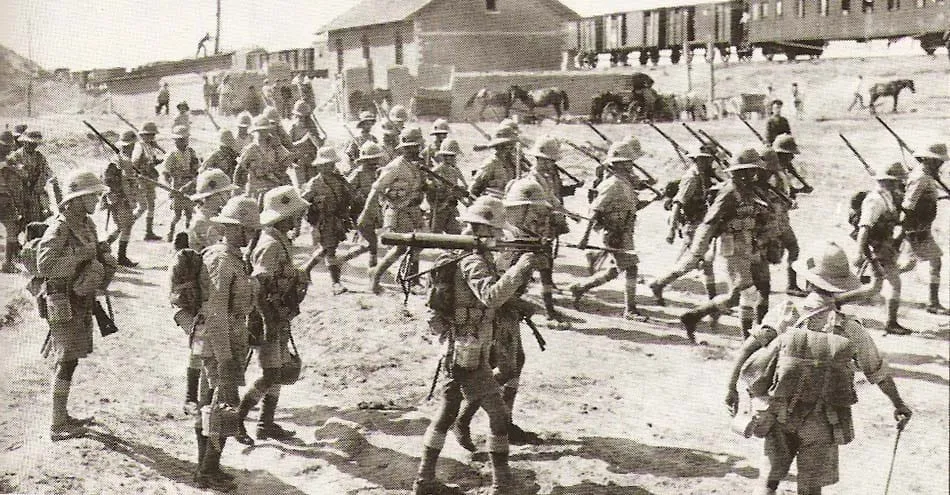
The Battle of Baku was the final act of the Turkish march to the Caspian Sea in 1918. The city, with its oilfields and the largest port on the Caspian, was defended by the troops of the Centro-Caspian Dictatorship, mostly Armenian, and by the small British force of Major-General Lionel Dunsterville, little more than a thousand infantrymen of the English 39th Infantry Brigade. Against them stood Nuri Pasha’s Caucasian Army of Islam; Nuri was the brother of the war minister Enver Pasha, and his army consisted of Turkish divisions and Azerbaijani volunteers. After three weeks of fighting on the approaches, on 14 September, the Turks broke through the defences. During the night the British sailed away to Persia, and the next day the Army of Islam occupied the city. This was accompanied by the massacre of thousands of Armenians.
Name and dates
The fighting for Baku went on intermittently from the end of July to the middle of September 1918, and different authors divide it differently. Many works date the battle to 26 August – 14 September. We also adopt this starting date: on that day the Turks, three weeks after their first, repulsed assault, began a methodical advance on the positions held by the British. The earlier fighting at the turn of July and August, including the assault of 5 August, is described as background. We take 15 September as the end of the battle, when the Turks and Azerbaijanis entered the city, abandoned during the night by the British. Allen and Muratoff, authors of the classic British work on the wars in the Caucasus, write that regular Turkish troops entered Baku only on the morning of 16 September.
The main sources of this page are the British official history of the Mesopotamian campaign by F.J. Moberly (volume IV), Dunsterville’s memoir “The Adventures of Dunsterforce” (1920) and the work of W.E.D. Allen and Paul Muratoff. Dates are given according to the Gregorian calendar, which all the sides fighting at Baku used.
Background
After the disintegration of the Russian army the Turks advanced deep into the South Caucasus. In spring 1918 Enver formed the Caucasian Army of Islam from the 5th Caucasian Division and local volunteers. Formally it was to help the new Azerbaijan Democratic Republic, whose government sat in Ganja, to recover its capital. Baku was held by the Bolshevik Baku Commune (PL), supported by the Armenian Dashnaks. In March, during the March Days, Bolshevik and Dashnak units killed thousands of Muslims in the city, by some estimates about 12,000. The Germans, Turkey’s allies, wanted Baku’s oil for themselves and pressed Enver to halt the march. He officially forbade his brother to advance on Baku, but according to Turkish research secretly encouraged him to do so.
The Commune’s June offensive westwards ended in defeat at Göyçay and the loss of Kurdamir on 10 July. By the end of July the Turks were already standing on the heights above the city. The Baku soviet then voted to call in the British, the Bolsheviks gave up power and on 1 August the Centro-Caspian Dictatorship took over, a coalition of Socialist Revolutionaries, Mensheviks and Dashnaks, supported by the sailors of the Caspian Flotilla. The city’s forces were commanded by the former tsarist generals Georgy Dokuchayev and the Armenian Hakob Bagratuni. Colonel Lazar Bicherakhov, however, left the front with his Cossacks, the most efficient unit of the defence. At the end of July he departed northwards by rail and on 12 August took Derbent.
The British had been trying to reach the Caspian Sea since the beginning of the year. Dunsterville’s mission, sent from Baghdad in January, was stuck at Enzeli in February, and only after the Jangalis were defeated at Rasht did the route through Persia become safe. At the invitation of the new authorities Dunsterville sent Lieutenant-Colonel Stokes to Baku with a handful of soldiers. They arrived on 4 August, and the next day the defenders, inspired by the sight of them, repulsed the first Turkish assault on the Wolf’s Gate pass. The Turks, however, kept the heights west of the railway, from which they could see the whole city.
The defence line
Baku lay in a basin open to the sea. To the west it was shielded by a wall of cliffs, below which the railway from Tiflis ran along a valley. In the south, near Bibi-Heybat, the road to the city led through a pass called the Wolf’s Gate. A few kilometres to the north the cliffs turned east and petered out on flat ground near Biləcəri station, beyond which stretched the oilfields and villages of the Absheron Peninsula. This way, from the north, the whole defence could most easily be outflanked. Lieutenant-Colonel Keyworth, commander of the British troops in the city, wrote of a defence line of about 20 kilometres, Dunsterville of more than 30. In mid-August there was a gap on its right flank, through which Turkish and Azerbaijani units infiltrated into the Tatar, that is Azeri, villages in the rear.
British reinforcements arrived from Enzeli in small groups. Dunsterville himself arrived on 17 August. By 24 August there were in Baku: the 7th Battalion of the North Staffordshire Regiment (fewer than 550 men), the 9th Battalion of the Royal Warwickshire Regiment (fewer than 450), a company of the 9th Battalion of the Worcestershire Regiment and a platoon of the Hampshire Regiment, as well as armoured cars, machine guns, the 8th Field Battery and two Martinsyde aircraft. The British took the left flank by the sea and the most threatened sector near Biləcəri. The rest of the line was held by 6,000 to 8,000 local soldiers, mainly Armenians. Moberly and Dunsterville describe them very harshly: they lacked officers, discipline and training, soldiers’ committees decided whether orders were carried out, and units left their positions for the city whenever they liked. Dunsterville added that it was hard to blame the “underfed factory hand” who had been given a rifle without training or commanders, and that there was no lack of individual examples of courage among the Armenians.
Course of the battle
26 August: Mud Volcano
On 26 August at about 10.30 a.m. about a thousand Turks, two battalions according to Allen and Muratoff, with artillery, attacked a mud volcano north of Biləcəri, a hill the British called the Mud Volcano or Dirty Volcano. It was defended by Captain Sparrow with 140 officers and men of the North Staffordshire. Four attacks were repulsed, but the fifth outflanked the hill from the north and at about 1.30 p.m. the Turks took it. All the company’s officers fell, and only 58 men of the whole company got away. Two Armenian battalions that were to support the hill never appeared at their positions at all. The same day another North Staffordshire company retook a hill near Binəqədi that an Armenian battalion had abandoned, and it was named Stafford Hill. The new line ran from it through the Warwick Castle height to Biləcəri station.
31 August – 1 September: Stafford Hill and Digah
At dawn on 31 August about 500 Turkish infantry, supported by about a dozen guns, attacked Stafford Hill, which was defended by 80 men of the North Staffordshire. Local units abandoned the trench at the south-western corner of the hill, and two battalions from the reserve at Binəqədi moved too late to counter-attack. At about 8 a.m. the British, having lost about 40% of their strength, fell back to Warwick Castle, and at about 11 they had to abandon that height too, when the Armenian battalion on their flank left without a fight. During the night the defence fell back to the railway embankment. That day the British lost 44 men. The next morning the Turks attacked Digah with cavalry. The Russians and Armenians held out for an hour, and two companies of the Royal Warwickshire fell back fighting for several kilometres and lost 71 missing.
On the afternoon of 1 September Dunsterville told the assembled committees that the city could not be defended, that he was withdrawing his troops and advised them to come to terms with the Turks quickly. The committees deliberated for hours without result, and the Dictatorship demanded that the British leave only together with its troops and after the civilian population had been evacuated. The flotilla, without which there was no way to sail away, could sink their ships. Dunsterville stayed. Meanwhile the command in Baghdad, alarmed by the Turkish march from Tabriz through Persia, held back reinforcements and ordered him to evacuate.
Preparations for the assault
For almost two weeks the Turks confined themselves to shelling the city and port. They were waiting for reinforcements: on 8 September Süleyman İzzet’s 15th Infantry Division arrived, and according to Allen and Muratoff the assault was delayed by the slow concentration of the 36th Caucasian Division. On 10 September Nuri Pasha himself arrived with the troops. According to Allen and Muratoff, by 12 September the Army of Islam had 7,000–8,000 Turkish soldiers and 6,000–7,000 Azerbaijani irregulars before Baku, while the defenders able or willing to fight numbered fewer than 8,000. On the night of 12–13 September an Arab officer from the Turkish army came over to the British and warned that the general assault would take place the next day.
14 September: the last assault
The assault began in darkness and mist early on the morning of 14 September. The main blow of Mürsel Pasha’s 5th Caucasian Division fell on the cliffs north of the Wolf’s Gate, held by Armenians. The Turks broke through the line about a kilometre and a half north of the pass and came out onto the ridge above the city. The North Staffordshire companies had to turn to face north, and Major Ley with the reserve stopped the Turks on the cemetery heights just above Baku. At the same time the Turks attacked Biləcəri, where companies of the Worcestershire and Royal Warwickshire were fighting. Local units fell back time after time, exposing the British flanks, and Major Havelock was killed in the fighting near Biləcəri. By evening the whole line had fallen back to the suburbs. Turkish artillery shelled the city and port. At about 3 p.m. Keyworth concluded that if the British did not want to be killed or taken prisoner, they had to leave. Major Ley was to hold the positions until 8.30 p.m.
The Turks, however, were also exhausted and made no serious attacks from the afternoon onwards. Moberly states that the British lost about 125 men that day, Dunsterville 180, about a fifth of those fighting. Faviell estimated Turkish losses at 2,000.
Evacuation and the fall of the city
Since the beginning of August Dunsterville had kept three steamers in hand, the President Kruger, the Kursk and the Argo. On the evening of 14 September the wounded, the soldiers, the guns and the ammunition were loaded onto them. When everyone was on board at about 10 p.m., two dictators arrived at the quay with an order to return to the front and the threat that the fleet would sink the ships. Dunsterville refused. Shortly after midnight the President Kruger slipped past the guardship, which opened fire but missed. All the ships with troops reached Enzeli on 15 September.
During the night and the next day thousands of Armenians fled Baku. According to Allen and Muratoff, by the morning of 15 September about 8,000 soldiers and civilians had left the port. That night armed Azeris from the city began murdering and looting the Armenian inhabitants. On 15 September units of the Army of Islam entered Baku. The massacre, which the Armenians call the September Days, lasted according to Allen and Muratoff throughout 15 September and the following night, until regular Turkish troops restored order. A commission of the Armenian National Council counted 8,988 killed, and other estimates reach 10,000 and even 30,000 victims. According to figures cited in Russian and Azerbaijani literature, 36 officers and 1,651 soldiers were taken prisoner, including four British.
Losses
The exact losses of the whole battle cannot be given. The British lost several hundred men: according to Moberly about 80 on 26 August, 44 on 31 August, 71 missing on 1 September and about 125 on 14 September, not counting individual casualties from shelling. The losses of the Centro-Caspian Dictatorship’s units were not counted. Turkish losses were high: according to the Military History Department of the Turkish General Staff, 1,130 soldiers, including 30 officers, were killed in August alone, and the 15th Division lost 84 killed, more than 350 wounded and 73 missing on 14–15 September.
Significance
The capture of Baku was one of the last successes of the Ottoman Empire in this war. On 16 September Halil Pasha, commander of Army Group East, took a parade in the city, and on 17 September the government of Azerbaijan, for which Baku became the capital, moved there. The Turks marched on northwards along the coast and in October took Petrovsk. They achieved this against the wishes of their German ally, which was itself preparing an expedition to Baku in Georgia. The success proved short-lived. After the defeat in Palestine and Syria Turkey signed the Armistice of Mudros on 30 October, undertook to withdraw from the Caucasus, and in November the British returned to Baku.
For the British the expedition to Baku was a failure, although a skilful evacuation saved their troops. They managed neither to hold the city, nor to destroy the oilfields, nor to take over the Caspian flotilla. They did, however, delay the capture of Baku by several weeks. Dunsterville, who was recalled soon afterwards and whose mission was dissolved, stressed that his soldiers had held back an enemy many times more numerous for six weeks. The fall of the city also had a tragic epilogue for the Bolsheviks. The commissars of the Baku Commune, imprisoned by the Dictatorship and led by Stepan Shaumian, managed to sail from Baku in the chaos of the last night, but in Krasnovodsk they were arrested by the anti-Bolshevik authorities of Transcaspia, and a few days later 26 of them were shot.
Spotted a mistake?Report an error