1916: The Battle of the Somme
Battle of Thiepval Ridge
- Dates:
- 26–28 September 1916
- Front:
- Western Front
- Location:
- The Thiepval ridge from Courcelette westwards to the village of Thiepval and the Ancre valley, with Mouquet Farm and the Zollern, Stuff and Schwaben redoubts, north of Pozières, Somme department (France)On the battle map →
- Sides:
- United Kingdom and CanadaDouglas Haig, Hubert Gough, Julian Byng, Claud Jacob, Ivor MaxseGerman EmpireRupprecht, Crown Prince of Bavaria, Fritz von Below
- Result:
- British victory, but an incomplete one. The British and Canadians took Thiepval, Mouquet Farm, the Zollern Redoubt and parts of the Stuff and Schwaben redoubts, but the Germans held the northern edge of the ridge until mid-October.
- Author:
- Łukasz Skowroń
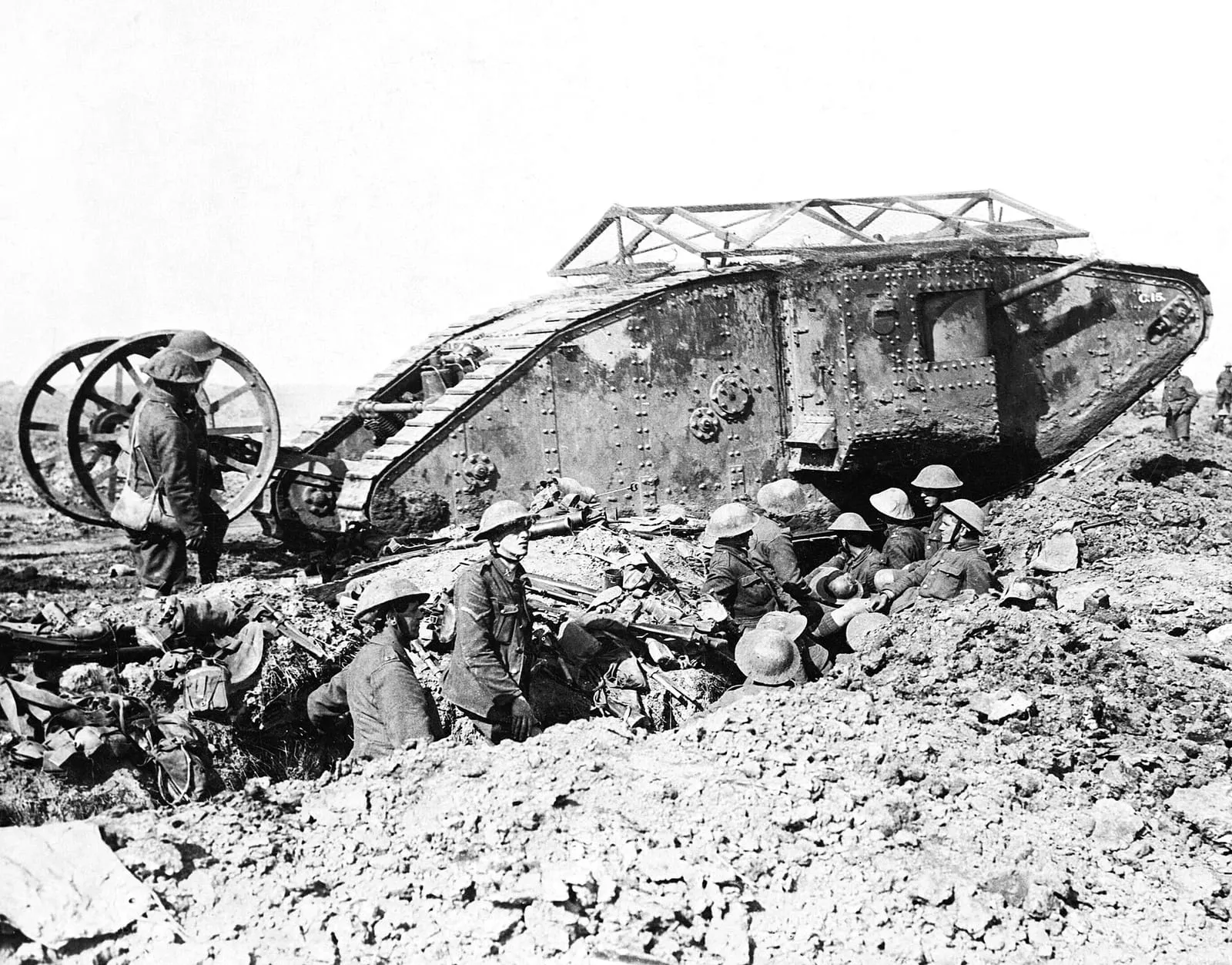
The Battle of Thiepval Ridge was the first major attack by General Hubert Gough’s Reserve Army in the Battle of the Somme. Its objective was the last stretch of the high ridge north of the Albert–Bapaume road that the Germans still held: from Courcelette in the east to the ruins of the village of Thiepval and the great Schwaben Redoubt above the Ancre valley in the west. Thiepval had been one of the objectives of the first day of the battle. On 1 July 1916 thousands of British soldiers fell below its château and in the Schwaben Redoubt, and in the following weeks further attacks from the west and the south achieved nothing. On 26 September, the day after the Fourth Army had opened the Battle of Morval, Gough attacked with two corps on a front about five and a half kilometres long. The Canadians advanced onto the high ground beyond Courcelette, the British 11th Division at last took Mouquet Farm, and General Ivor Maxse’s 18th Division captured Thiepval in a single afternoon and the following morning, a village held for two years by a Württemberg infantry regiment. On the crest of the ridge, however, in the Stuff and Schwaben redoubts and in the trench the Canadians called Regina, the Germans defended themselves fiercely. The fighting for these positions went on for more than two weeks.
Name and dates
The name “Battle of Thiepval Ridge” and the dates 26–28 September 1916 were fixed after the war by the British Battles Nomenclature Committee. It covers the Reserve Army’s attack on the sector from the Albert–Bapaume road to Serre. The British official history (Miles, Military Operations France and Belgium 1916, volume II) notes, however, that fighting continued without a break in the following days as well, and carries its account of this battle up to 30 September. From 1 October British nomenclature counts the same fighting as part of the Battle of the Ancre Heights. The Germans did not treat it as a separate battle and regarded it as part of the Battle of the Somme. On this page we keep to the official dates, and describe the fighting of 29 and 30 September and of October briefly as its continuation.
Times are given according to the British official history, in British time. In German sources they are an hour different. The main sources for this page are Miles’s volume, the despatches of Douglas Haig, the history of the 18th Division (G.H.F. Nichols, 1922) and the Canadian official history (Nicholson, 1962).
Background
The Thiepval ridge runs west from Courcelette, past Mouquet Farm, to the point where it falls steeply to the Ancre near Saint-Pierre-Divion. Whoever held it could see, on one side, the British rear as far as the town of Albert, and on the other the valley of the upper Ancre. The village of Thiepval itself lay on a spur of the hill jutting out to the south, almost at the very top. Before the war it had been a sleepy village with a château, a church and red roofs, where the people of Albert went for Sunday walks. By September 1916 not a single house was left standing. Under the rubble of the château and along the road to the cemetery, however, lay deep cellars and dugouts linked by tunnels. A German map captured later marked 144 deep dugouts along the front line alone west of the village. The village was covered by redoubts: Zollern to the east, Stuff on the crest of the ridge and Schwaben north of Thiepval, above the slope running down to the Ancre. The British gave them their own names, often mangling the German ones: the Staufen Redoubt became the Stuff Redoubt to them.
North of the Bapaume road the British had advanced very slowly all summer. Between 23 July and 3 September three Australian divisions took Pozières and the windmill ridge, and then pushed forward in a narrow wedge towards Mouquet Farm, from which the Germans kept driving them back. At the beginning of September the Australians were relieved by General Julian Byng’s Canadian Corps. On 15 September, in the Battle of Flers–Courcelette, the Canadians took Courcelette, and the Fourth Army on their right advanced about two kilometres. After this attack Haig concluded that the German reserves were almost exhausted and that the time had come for Gough to strike hard on the left wing. The Fourth Army, whose progress depended on the pace of the French, was to keep attacking towards Morval and Lesbœufs, while the Reserve Army at the same time drove the Germans off the Thiepval ridge. Haig was already thinking of the next step: an attack with tanks on Serre and on the Ancre valley at Beaumont-Hamel. On 24 September he discussed this plan with Gough and with the commander of the Third Army, General Allenby.
On the German side the front from Courcelette to Thiepval was held by three divisions of General Fritz von Below’s First Army, which since the end of August had come under the army group of the Crown Prince of Bavaria, Rupprecht. Facing the Canadians was the 7th Division, from the Zollern Redoubt to the eastern edge of Thiepval the 8th Division, and the village itself was held by the 26th Reserve Division, which had been on this sector since the autumn of 1914. Thiepval was defended by the 180th Infantry Regiment from Württemberg, reinforced by part of the 77th Reserve Infantry Regiment of the 2nd Guard Reserve Division, and the Schwaben Redoubt and the old trenches down to the Ancre by the 66th Infantry Regiment. The Württembergers knew every metre of their sector. Instead of rotating along the front like other regiments, they arranged their own company reliefs and rested in Bapaume. According to the history of the 18th Division, many soldiers of the pre-war regular army were still serving in Thiepval, proud that for two years no one had driven them out.
Plan and preparations
The Reserve Army’s operation order was issued on 22 September. The attack was set for 26 September, the day after the Fourth Army’s attack at Morval, so that the Germans would have no time to recover. The front of attack, from the eastern edge of Courcelette to the old German front line south of Thiepval, was divided in half between Byng’s Canadian Corps and General Claud Jacob’s II Corps. Each corps had two divisions in line. The attack was to proceed in three stages, with a ten-minute pause on the first objective and an hour’s pause on the second. The Canadians, covering the right flank, were to take the trenches on the high ground north-west of Courcelette, with Regina Trench as the final objective. The 11th Division on the right of II Corps was to take Mouquet Farm, the Zollern Redoubt and the Stuff Redoubt, and the 18th Division on the left the village of Thiepval and the Schwaben Redoubt. The order stated clearly that the Germans had to be driven off the whole line of the ridge, so that they would lose their view over the British rear and the British would gain a view over the valley of the upper Ancre.
The preparatory bombardment began on 23 September. It was fired by about 230 heavy guns, howitzers and mortars and 570 field guns and howitzers, which according to the official history was roughly the same amount of artillery per metre of front as the Fourth Army had had on 15 September. On the afternoon of 24 September a Special Company of the Royal Engineers fired 500 tear gas shells into Thiepval, and the German trench mortars, which until then had been a great nuisance to the British, fell silent by five in the afternoon. That same evening a company of the 6th Battalion, York and Lancaster Regiment, tried to take Mouquet Farm before the main attack. It broke into the rubble, but a German counter-attack with grenades forced it to withdraw. Of the twenty serviceable Mark I tanks the British then had on the Somme, Rawlinson kept twelve for the Battle of Morval. Gough received eight, six of which he allotted to II Corps.
The 18th Division prepared with particular care. Maxse was one of the best trainers in the British Army and liked to repeat that without proper preparation the bravest troops fail and their heroism is wasted. On its way from Flanders his division went through three weeks of battle training. Company, battalion and brigade commanders toured the whole sector by car and bus, and the chief of staff of II Corps, Brigadier-General Philip Howell, gave them a lecture on local conditions and the experience of recent fighting. Sappers, pioneers and two infantry battalions dug about 2,300 metres of assembly and communication trenches, and screened the road from Authuille to Thiepval from German observers with brushwood. Maxse also devised a way of dealing with the German barrage, which usually fell on the British jumping-off line a few minutes after an attack began. The first waves were to leave their trenches before zero hour, and the reserves were to wait further back instead of immediately occupying the vacated trenches. He also chose an unusual hour for the attack: 12.35 p.m. He believed the infantry should have no more than two or three hours of daylight on the final objective, and should do the rest of the consolidation in darkness, out of reach of observed fire. On the evening of 25 September his short message went round the division: “The 180th Regiment of Württembergers has withstood attacks on Thiepval for two years, but the 18th Division will take it tomorrow.”
That same night, at 11.25 p.m., Gough announced that in the event of great success both corps were to push on, because “it is quite possible that the enemy’s resistance will completely collapse”. The Germans expected an attack. On 22 September their First Army had warned its subordinate units, and the Württembergers in Thiepval could see the British digging assembly trenches. They simply did not know when the blow would fall.
26 September: the Canadians at Courcelette
The fine autumn morning after a rainy night passed quietly. The infantry, who had occupied the assembly trenches before dawn, lay motionless in them for several hours. At 12.35 p.m. the British barrage came down, with bursts of massed machine-gun fire passing over it. Almost at once the German artillery opened fire on the Canadian lines and the ruins of Courcelette.
On the right wing the 2nd Canadian Division was to take the German front line east and north-east of Courcelette. Both tanks allotted to it failed: one got stuck on the way, the other was hit just behind the Canadian line by a shell that set off all its ammunition. The 29th Battalion from Vancouver took its stretch of German trench in ten minutes, most of its defenders having fled. The neighbouring 31st Battalion from Alberta came under machine-gun fire from the front and the left and was held up. When late in the evening, at 10.50 p.m., it renewed the attack with a company of a Winnipeg battalion, it took the trench up to the Miraumont road.
The main Canadian attack was made by General Arthur Currie’s 1st Canadian Division, on the high ground north-west of Courcelette. Its final objective was Regina Trench, called Staufen Riegel by the Germans, running along the reverse slope of the ridge. It was not certain whether the artillery had cut the wire in front of it, so Byng ordered the infantry to halt on the second objective and to go on only after patrols had reconnoitred. The Montreal 14th Battalion of the 3rd Brigade crossed about 360 metres under fire, took the first objective, and at about 2.40 p.m. reported that it was consolidating in Kenora Trench on the crest of the hill. Next to it the Scottish 15th Battalion (48th Highlanders) ran into unexpectedly strong resistance from a forward German post, overcame it in heavy fighting and dug in a little below the ridge. On the left the 2nd Brigade took Zollern Trench and Hessian Trench on the highest part of the ridge, but its left flank was in the air, because its neighbours from the 11th Division had not come up. Machine-gun fire from the II Corps sector forced the Canadians to give up part of Hessian Trench and dig a defensive flank. In the evening Byng reported to Gough that the situation was “on the whole” good.
26 September: Mouquet Farm and Thiepval
The 11th Division attacked with two brigades. On the right the 34th Brigade was to take, in turn, Mouquet Farm, the Zollern Redoubt and the Stuff Redoubt. Thirty seconds before zero hour a party of bombers of the 9th Battalion, Lancashire Fusiliers, occupied the known exits from the farm’s cellars, and two battalions of fusiliers reached the first objective. Beyond it, under accurate fire from the Zollern Redoubt, Hessian Trench and the Stuff Redoubt, the attack fell apart. The Northumberland Fusiliers lost almost all their officers in the fight for the dugouts of the old German second position, and of a platoon that advanced along the sunken road from Pozières to Grandcourt to keep in touch with the Canadians, five men survived. The smoke of the German bombardment hid the battlefield, and over-optimistic reports reached the headquarters. When the commanders of both battalions went forward themselves to see what was happening, they found scattered groups of soldiers on an “empty battlefield”.
Meanwhile, in the ruins of Mouquet Farm a confused fight for the cellar entrances went on. Both tanks allotted there got stuck on the way, but the crew of one of them came forward on foot and joined the fight with their machine guns. They were helped by men of the Dorset and Manchester battalions and by pioneers of the 6th Battalion, East Yorkshire Regiment. At about 5.30 p.m. the British threw smoke candles into the cellars and the last defenders, according to the official history an officer and 55 men of the 165th Infantry Regiment, surrendered. Haig in his despatch gives the time as 6 p.m. and credits the pioneers, who acted on their own initiative. The farm, fought over since August by Australians, British and Canadians, had at last been taken. To the left of the 34th Brigade, the 33rd Brigade had an easier task. Its battalions took Schwaben Trench between the farm and Thiepval, then Zollern Trench, capturing almost two hundred prisoners in the dugouts, and before 4 p.m. part of Hessian Trench on the ridge.
The 18th Division attacked with two brigades. The right one, the 53rd Brigade, set off from the valley the British called Nab Valley. Its Suffolk and Essex battalions left their trenches before the British barrage lifted and escaped the German fire, which a few minutes later fell on the empty assembly trenches. Many Germans ran towards them unarmed to surrender. After twelve minutes the first objective was taken, and at 1.15 p.m. the battalions stood in Zollern Trench, in touch with the 11th Division on their right. The third stage, up the slope towards the ridge, broke down under fire from the front and the flanks.
The hardest task fell to the 54th Brigade: the western part of the village and the old German trench system west of it. Lieutenant-Colonel Frank Maxwell’s 12th Middlesex went through the village itself, while companies of the 11th Battalion, Royal Fusiliers, mopped up the trenches and dugouts. Below the ruins of the château on the southern edge of the village the attack was stopped by machine guns until a tank came up and crushed the resistance. German accounts confirm that its appearance had an immediate effect. Soon it too got stuck in the ruins. From then on the fighting broke up into dozens of clashes in rubble, shell holes and intact dugouts, in which the defenders held out to the end. The commander of the 1st Battalion of the 180th Regiment, according to a German account, was last seen by the church in the middle of the village, where he and his men refused to surrender. At 6.30 p.m. a carrier pigeon reached the headquarters of the 26th Reserve Division with a message that eighteen men were left in the battalion’s dugout. Private Frederick Edwards of the 12th Middlesex rushed alone at a machine gun that threatened to break the attack and bombed it out with grenades. Private Robert Ryder of the same battalion cleared a German trench with the fire of his Lewis gun. Both received the Victoria Cross. Towards evening the commander of the 6th Northamptonshire, coming up in support, was mortally wounded, and Maxwell, the only surviving battalion commander, gathered the remnants of three battalions and organised a line on the northern edge of the ruins. The north-western corner of the village and the old trenches west of it remained in German hands. The three battalions of the 54th Brigade lost 840 of their 2,290 men that day.
27 September: the end of the fight for Thiepval
During the night the 18th Division relieved its exhausted battalions. The 7th Bedfordshire took over, in darkness, under fire and on unfamiliar ground, the whole sector of the three battalions, and at 5.45 a.m. two of its companies attacked the north-western corner of the village with grenades and the bayonet, without artillery preparation. The right wing was held up by a machine gun until Second Lieutenant Tom Adlam, famous for his grenade throwing, led an attack across open ground. Wounded in the leg, he fought on, and received the Victoria Cross for it. According to Haig the whole village was in British hands by 8.30 a.m.; according to the history of the 18th Division the action was over by 11 a.m. The Bedfords took about 70 prisoners. Maxse called their night relief the finest example of battle discipline his division had yet given.
On the Canadian side the Germans withdrew during the night from Courcelette to Regina Trench and the Le Sars line, because they lacked the strength to counter-attack. The 2nd Canadian Division occupied the rest of its objective without a fight and sent patrols towards Le Sars. The 1st Canadian Division twice lost and regained Kenora Trench. In the 11th Division it turned out at dawn that the Germans had abandoned the Zollern Redoubt during the night. The attack on the Stuff Redoubt at 10 a.m. was stopped by machine-gun fire. In the afternoon a West Yorkshire battalion, which had not received word that the attack had been postponed, went forward on its own and broke into the southern part of the redoubt, and a Green Howards battalion surprised the Germans in Hessian Trench west of it and took 80 prisoners. By evening the 11th Division and the Canadians held most of Hessian Trench. Maxse judged that an attack on the Schwaben Redoubt had no chance as long as the Germans held the Stuff Redoubt, and with Gough’s consent postponed it to the following day. From the afternoon it rained.
28 September: the Schwaben Redoubt
At 1 p.m. the 53rd Brigade attacked the Schwaben Redoubt from the south, and the Bedfordshire companies of the 54th Brigade its western edge and the old trenches between the redoubt and the Ancre valley. Bulgar Trench fell quickly. The Suffolk battalion fought its way through the stubbornly defended Midway Trench and at 2.30 p.m. was approaching the eastern end of the redoubt. The 7th Queen’s, attached from the 55th Brigade and new to the ground, veered too far to the left, but broke into the southern face of the redoubt and by 5 p.m. had taken all of it. To its left the Bedfords and the 1/5th West Yorkshire, in heavy fighting for the strongpoints of the old German line, had cleared the western face of the redoubt by 8 p.m. Counter-attacks by the 66th Regiment and by companies of other regiments hurriedly brought up failed to dislodge them, but the northern part of the redoubt remained in German hands. To the right of the 18th Division, a group of Yorkshiremen in the Stuff Redoubt under Captain Archie White of the Green Howards took most of the northern face of the redoubt in the evening. They lacked the men and the grenades to hold it, however. White later received the Victoria Cross for his defence of the Stuff Redoubt over several days, as did Adlam, who was wounded for the second time on 28 September.
The Canadians attacked Regina Trench all day in rain and mud. A New Brunswick battalion attacked three times, in the morning, the afternoon and the evening, each time without success, losing about 200 men. The wire in front of the trench was uncut, and the German artillery fired without pause. At 1 p.m. the Reserve Army ordered that the Stuff and Schwaben redoubts be taken by 29 September, and Stuff Trench, the western extension of Regina Trench, by 1 October.
Fighting after 28 September
The fighting did not stop with the end of the battle’s official dates. On 29 and 30 September the 11th Division, with the help of the Canadians, took the rest of Hessian Trench, and White’s men beat off several counter-attacks in the Stuff Redoubt. On 30 September an East Surrey battalion took the northern face of the Schwaben Redoubt, but an evening counter-attack again pushed it partly back. On the western face of the redoubt the Germans held on despite repeated attacks. The official history ends its account of this fighting by stating that on both sides the soldiers fought in trenches calf-deep in mud until utterly exhausted, and that in the chaos of trenches, shell holes and dugouts the artillery often could no longer support the infantry effectively. The author also notes that the later attacks lacked coordination along the whole front.
The battle’s final objectives were taken only in the Battle of the Ancre Heights. On 9 October a Cheshire battalion of the 25th Division stormed the northern face of the Stuff Redoubt, and on 14 October the 39th Division took the rest of the Schwaben Redoubt. On 21 October the 39th and 25th Divisions captured Stuff Trench and the 18th Division a stretch of Regina Trench; the Canadians completed the capture of Regina Trench only on 11 November.
Losses
The full losses of both sides in this battle have never been compiled. According to the British official history the 11th Division lost 3,615 men between 26 and 30 September, about 70 per cent of them wounded, and the 18th Division 3,344 from 26 September to 5 October. The fight for Thiepval alone cost the 18th Division, according to its history, 1,456 killed and wounded, and the Schwaben Redoubt another 1,990. The 1st Canadian Division lost 6,254 men in the whole of September, including the fighting for Courcelette, and its 3rd Brigade more than 1,100 in this battle alone. To these must be added the losses of the 2nd and 3rd Canadian Divisions.
The Germans lost a great many men, but their losses are even harder to establish. The regiments defending Thiepval and Mouquet Farm were largely destroyed. According to German regimental accounts cited by the British official history, the 153rd Regiment lost a battalion and a half, and according to more recent studies the Thiepval garrison lost about three quarters of its men. Haig stated that about 2,300 prisoners were taken on the Thiepval ridge in these and the following days, and almost 10,000 in the whole attack from 14 to 30 September. The 18th Division counted in its prisoner cages 610 Germans taken at Thiepval, and Maxse estimated that more than 3,000 of the enemy had been put out of action in the fight for the village. September itself was the bloodiest month of the whole Battle of the Somme for the Germans.
Significance
Haig called the attack of 26 September “a splendid success”. After three months the British had taken Thiepval, one of the strongest fortresses of the German defence on the Somme, which on 1 July had cost them so much blood. Together with the Fourth Army’s gains at Morval, the attack gave the British almost the whole ridge between the Péronne–Bapaume road and the Ancre. The Germans lost their view over the British rear around Albert, and the British gained a view over the Ancre valley between Miraumont and Hamel and the slopes beyond the river. The capture of the ridge prepared the ground for the Battle of the Ancre in November, the final chord of the Battle of the Somme. For the German command the loss of Thiepval was a shock. The Supreme Army Command, “without attributing blame to anyone”, demanded a detailed inquiry into the causes of the recent defeats, and Rupprecht noted that the soldiers and their commanders were losing heart and complained constantly of the infantry’s helplessness against tanks.
The battle also showed the limits of British capabilities. The first day went well where the attack had been carefully prepared and the infantry followed close behind a good barrage. When the fighting moved into the labyrinth of trenches and dugouts on the crest of the ridge, further attacks broke down as narrow, poorly coordinated assaults, in rain and mud, against defenders ready to pay any price. The ridge that Gough was to have taken in a day took three weeks to capture.
The capture of Thiepval brought fame to the 18th Division and its commander. French soldiers counted it among the most important feats of 1916, and Maxse’s methods, from meticulous training to the choice of the hour of attack, became a model for other divisions. In 1918 Maxse became Inspector-General of Training of the British Army. At home, however, the credit was long given to the Canadians. Maxse used to tell how, when he mentioned this to a young staff officer of a neighbouring Canadian division, he heard: “But you don’t understand, it’s propaganda. We are colonials. We have to get the credit for everything.” Today, next to the rebuilt village, stands a memorial designed by Edwin Lutyens, bearing the names of more than 72,000 British and South African soldiers who fell on the Somme and have no known grave.
Spotted a mistake?Report an error