1916: The Battle of the Somme
Battle of the Transloy Ridges
- Dates:
- 1–18 October 1916
- Front:
- Western Front
- Location:
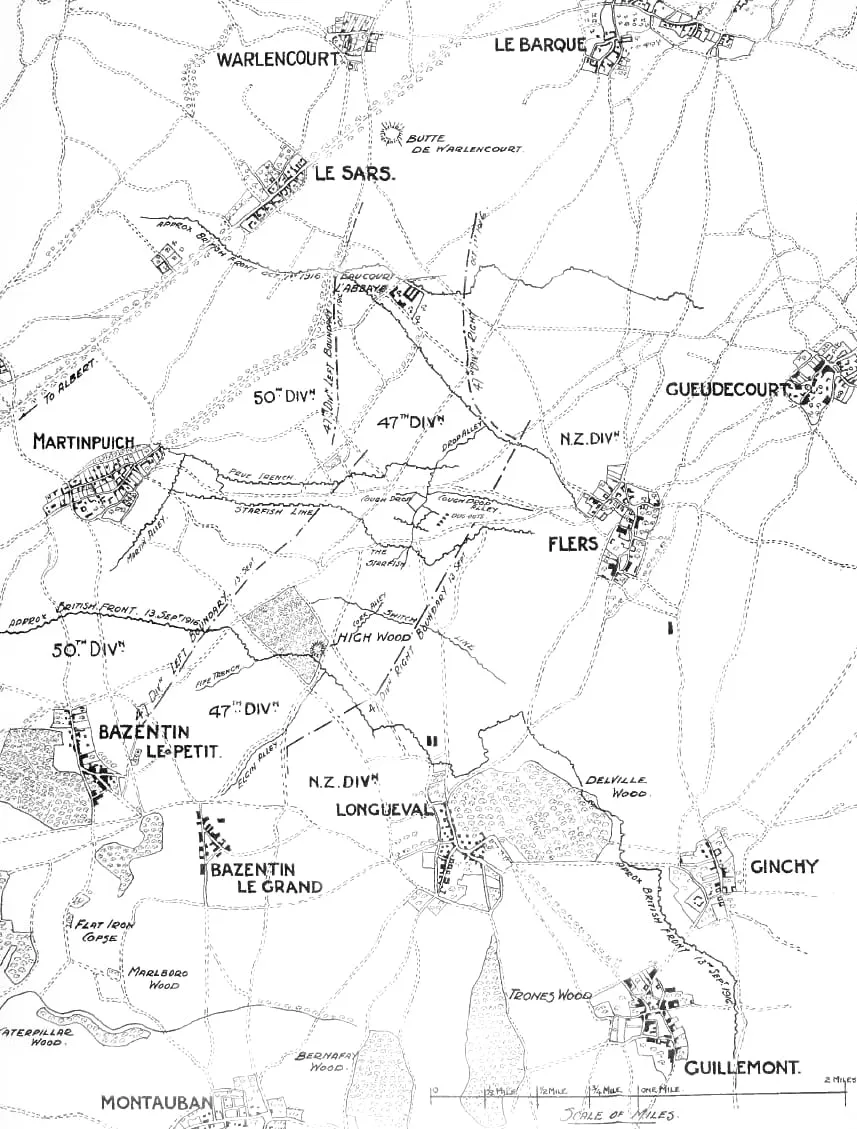
- Low ridges and valleys between Lesbœufs, Gueudecourt and Le Sars and Le Transloy, Beaulencourt and the Butte de Warlencourt, on the border of the Somme and Pas-de-Calais departments (France)On the battle map →
- Sides:
- United Kingdom, New Zealand, Union of South Africa, Newfoundland and FranceDouglas Haig, Henry Rawlinson, Ferdinand Foch, Émile FayolleGerman EmpireRupprecht, Crown Prince of Bavaria, Fritz von Below
- Result:
- Inconclusive. The British took Eaucourt l’Abbaye and Le Sars and the French broke into Sailly-Saillisel, but the attacks on the positions before Le Transloy and the Butte de Warlencourt collapsed in rain, mud and German machine-gun fire.
- Author:
- Łukasz Skowroń
The Battle of the Transloy Ridges was the last major attack of the British Fourth Army in the Battle of the Somme. After the September successes at Flers, Morval and Gueudecourt the main ridge above the Somme was in Allied hands, and before the army of General Henry Rawlinson opened a wide, shallow valley with lower ridges, behind which lay the village of Le Transloy and the small town of Bapaume. Douglas Haig hoped that a combined blow by three armies would still break the German defence in October. On 1 October the British took the abbey of Eaucourt l’Abbaye, and on 7 October the village of Le Sars on the road to Bapaume. Then came the rains. In the mud, under low clouds that blinded the airmen and the artillery, the successive attacks of 7, 12 and 18 October on the German trenches before Le Transloy and on the chalk mound of the Butte de Warlencourt ended in a gain of a few hundred metres or nothing at all. The French on the right flank broke into Sailly-Saillisel in the middle of the month. The Germans, reinforced with fresh divisions, artillery and aircraft, changed their method of defence and held their positions.
Name and dates
The name “Battle of the Transloy Ridges” was given after the war by the British Battles Nomenclature Committee. It covers the operations of the Fourth Army from 1 to 18 October 1916, although the British official history (the volume by Captain Wilfrid Miles of 1938) notes that on the III Corps front the fighting for Snag Trench before the Butte de Warlencourt went on without a break until 20 October, and describes it accordingly in a single chapter. The parallel fighting of the Reserve Army for the Stuff and Schwaben redoubts and Regina Trench, west of the Albert–Bapaume road, counts as a separate battle, the Battle of the Ancre Heights. The French did not use this division. For them the October attacks of the Sixth Army on Sailly-Saillisel and of the Tenth Army south of the Somme were another stage of the autumn offensive. From the night of 30 September to 1 October both sides switched from summer to winter time. Times in the text are given in British time, following Miles.
Background
At the end of September Haig decided that, after the capture of Morval, Lesbœufs, Gueudecourt and the Thiepval ridge, the time had come for another great attack. In a letter of 29 September GHQ ordered the armies to prepare an attack and to make every effort to launch it by 12 October. The Fourth Army was to take Le Transloy, Beaulencourt and the ridge beyond the Thilloy–Warlencourt valley as far as Loupart Wood, the Reserve Army of General Hubert Gough was to strike north towards Irles and Miraumont and east of Beaumont-Hamel, and the Third Army was to cover its left flank. Haig believed that in normal autumn weather these tasks were not beyond the strength of his armies. According to Miles it was precisely the weather that caused the plan to be successively postponed, cut down and finally abandoned.
The British had grounds for optimism. September had been the bloodiest month of the battle for the German army, its soldiers were surrendering more readily than before, and the new positions the Germans were digging before Le Transloy and Bapaume could not compare with the lines already captured. In a report of 7 October Haig estimated that the Germans had already used 70 divisions on the Somme and lost about 370,000 men. The British divisions, however, were exhausted. The New Zealand Division, which had been fighting since 15 September, had lost nearly 7,000 men, and hardly any battalion of the Fourth Army could put more than 400 men into an attack in October, many of them poorly trained recruits. At the beginning of the month General Henry Horne took command of the First Army, and XV Corps was taken over by General J. P. Du Cane, who had never before commanded in the field. To the right of the British stood the French Sixth Army of General Émile Fayolle, which at the end of September had taken over Morval from them in order to strike at Sailly-Saillisel and on towards Rocquigny.
On the other side the commander was the Crown Prince of Bavaria, Rupprecht, and the sector north of the Somme was held by the First Army of General Fritz von Below. The Germans were digging further lines of defence behind the front: the first from Sailly-Saillisel through Le Transloy to Loupart Wood, the second just outside Bapaume. In front of them, on the slopes falling towards the British, new trenches were appearing, which the British named after the weather and the sky: Rainbow, Cloudy, Misty, Zenith, Dewdrop, Spectrum. Between the end of September and 13 October six German divisions on the sector from Le Transloy to the Ancre were replaced by seven fresh ones, and two of these were soon replaced in turn. On 5 October the Supreme Army Command ordered every unnecessary trench at Verdun to be abandoned in order to free troops for the Somme. Between 15 September and 8 October the First Army received 23 new heavy batteries.
Course: 1–6 October
The first attack was meant to straighten the left flank of the Fourth Army. III Corps and the New Zealand Division were to take the buildings of the abbey of Eaucourt l’Abbaye (today in the commune of Warlencourt-Eaucourt) and a stretch of the German third position, known as the Flers Line, as far as Le Sars. 1 October was a fine autumn day. The bombardment went on from seven in the morning, and at 3.15 p.m. the infantry went into the attack. The New Zealanders, preceded by a cloud of fire and smoke from barrels of burning oil, took their objective and some 250 prisoners. In the 47th (London) Division two Mark I tanks drove along the German trenches and helped two battalions through Eaucourt l’Abbaye, but then got stuck and burnt out. In the 50th Division Lieutenant-Colonel Roland Bradford led two battalions under fire in a renewed attack on Flers Trench, for which he received the Victoria Cross. The 23rd Division occupied the Flers Line as far as the junction with the Canadians, but its patrols were driven back by fire from the houses of Le Sars. According to Bavarian accounts the Germans regarded Eaucourt l’Abbaye as lost by the afternoon of 1 October.
On 2 October at about eleven o’clock rain began to fall, and with short breaks it went on for the next two days. A renewed attack by a battalion of the 47th Division to the left of the abbey failed, but on 3 October its patrols found that few Germans were left in the trenches before Eaucourt l’Abbaye and occupied them almost without a fight. The day before, the 47th Division had been taken over by General George Gorringe, who had come straight from Mesopotamia, where in April he had led the last attempt to relieve Kut. The downpour forced Rawlinson to postpone the next attack, set for 5 October, to 7 October, because the ammunition could not be brought up. Fayolle readily moved his attack to the same day, so that, as Miles writes, it was in effect the bad weather that brought about the coordination of the two armies’ attacks. From 4 October it rained less, but a strong wind blew and low clouds hampered the airmen. Nobody knew exactly where the new German trenches before Le Transloy ran, or even where their own front line was.
Course: 7–8 October
On 7 October at 1.45 p.m., after twenty-four hours of bombardment, the whole Fourth Army attacked. On the right flank of Lord Cavan’s XIV Corps the 56th Division ran into machine-gun fire from German artillery positions and from Dewdrop and Spectrum trenches north-east of Lesbœufs. Its gains had to be given up during the night. The 20th Division did better east of Gueudecourt. Its battalions took Rainbow Trench, as the Germans had no wish to defend it, and pushed on to Misty and Cloudy trenches. An evening counter-attack from the direction of Beaulencourt was broken up by rifle fire. In XV Corps the 12th and 41st Divisions failed to take Bayonet Trench. Their battalions were stopped by fire from machine guns that the British bombardment had not destroyed, and by the evening the whole 124th Brigade numbered fewer men than a single battalion. The 47th Division failed to reach Snag Trench, halfway to the Butte de Warlencourt.
The only clear success of the day was achieved by the 23rd Division of General J. M. Babington. Battalions of the Durham Light Infantry and the Green Howards, supported by a tank that was destroyed by a shell, broke into Le Sars after fierce fighting, cleared the village and took two trenches of the Flers Line beyond it. The commander of one of the battalions wanted to strike at once at the Butte de Warlencourt from the west and asked for two fresh companies and a tank, but none were to hand. The Butte, a chalk mound about 18 metres high, dominated the whole area: from it one could see both the British positions and the German batteries near Bapaume. Both sides knew its value perfectly well. On 8 October the 23rd Division cleared the Flers Line as far as the army boundary. In two days of fighting it lost fewer than 750 men and took over 520 prisoners from the German 4th Ersatz Division, some of whom it caught in the middle of a relief. The same day a night attack by the 47th Division on Snag Trench and an afternoon attack by the 56th Division near Lesbœufs achieved nothing.
Course: 12 October
The next attack was set for 12 October, “rather optimistically” according to Miles. Between 8 and 11 October no fewer than six exhausted divisions had to be relieved in the mud. The newcomers had no time to get to know the ground or to dig jumping-off trenches, and the commander of the 9th (Scottish) Division asked in vain for a delay of two days. Because of the bad light the airmen were unable to photograph the new German trenches. At 2.05 p.m., on a day of passing showers, four divisions went into the attack. The Germans, by now used to afternoon attacks and warned by the bombardment, were waiting ready. Their machine guns now stood further back, dispersed and hidden, out of range of the British barrage, and swept the whole zone of the attack with fire. According to a British report they were “scattered all over the country”.
On the right flank the 4th Division advanced only at the junction with the French, by less than half a kilometre. The 6th Division took the rest of Rainbow Trench and part of the road to Beaulencourt. North of Gueudecourt the Newfoundland Regiment’s battalion of the 88th Brigade, the same one that had bled to death at Beaumont-Hamel on the first day of the battle, took and held a stretch of Hilt Trench and, together with a neighbouring battalion, took nearly 150 prisoners. Elsewhere the attacks of the 12th and 30th Divisions broke down on uncut wire and machine-gun fire. The Scots of the 9th Division and the South African Brigade, blinded by smoke drifting from the Butte, gained about 200 metres and halted halfway to Snag Trench. German accounts spoke of heavy fighting and companies reduced to 35 men. Lord Cavan explained to Haig that the main cause of the failures was the machine guns hidden in depth. He proposed that the barrage should only begin beyond each objective and wanted to blind the German observers with smoke shells, but the British artillery had none throughout the Battle of the Somme.
Course: 13–18 October
Rawlinson concluded that the delays caused by the weather had given the Germans time to recover and that their resistance had to be broken by methodical bombardment. An order issued late on 13 October set the new attack for 18 October, ordered jumping-off trenches to be dug parallel to the objectives and the bombardment to begin at once. First, in night raids, several trenches that spoiled the start line had to be taken. This succeeded only in part. On the evening of 14 October the South Africans took the Pimple, a knoll at the western end of Snag Trench. After several overcast days 16 October was fine, but on the evening of 17 October it began to rain again.
The attack began on 18 October at 3.40 a.m., almost two hours before dawn. In the darkness, as the moon was hidden by rain clouds, the soldiers struggled through a maze of flooded shell holes and trenches, slipping and falling into mud that clogged their rifles and Lewis guns, so that they were soon left with only grenades and bayonets. The 6th Division took part of Mild Trench and the 12th Division Grease Trench north-east of Gueudecourt. The attacks of the 4th and 30th Divisions gained a few dozen metres or nothing. In the morning a single tank reached Gird Trench on its own, fired for twenty minutes at fleeing Germans and drove along the trench, but the exhausted infantry, which had lost most of its officers, was unable to follow it. The Scots and South Africans of the 9th Division took the greater part of Snag Trench. In the following days the Germans counter-attacked there with flamethrowers, and the fighting for a junction of trenches that the British called the Nose went on until 20 October. According to the history of the regiment defending the trench, that evening the Germans withdrew from it of their own accord, in line with a new principle of not losing men in forward positions of no tactical importance.
The French at Sailly-Saillisel
The French Sixth Army fought its heaviest battles of this offensive in October, on a narrow sector, roughly four kilometres wide, between Saint-Pierre-Vaast Wood and the boundary with the British. On 7 October I Corps of General Adolphe Guillaumat advanced about 1,200 metres up the slope west of Sailly-Saillisel. This was the best attack north of the Somme that day, though far from its objective of Rocquigny. On 12 October an attack by XXXII Corps on Sailly-Saillisel was smothered by German artillery fire. At the request of Ferdinand Foch the attack was renewed on the evening of 15 October, and after a night of fighting most of the village was in French hands. On 17 October the French repulsed five German counter-attacks, and on 18 October improved their position in the northern part of the village. They took the eastern part, Saillisel, only in November. The attacks of IX Corps on the German trenches before Le Transloy broke down under machine-gun fire. South of the Somme the Tenth Army took trenches and woods near Chaulnes from 10 October, but its commander, General Alfred Micheler, lacking sufficient reserves, complained that he had been “reduced to the role of a watchdog for Fayolle”.
The German defence
According to the German official history, which Miles cites, the great crisis of the defence on the Somme lasted until the middle of October. Below reported that the Allied heavy artillery was destroying the fortifications, inflicting the most casualties, paralysing movement in the rear and giving the soldiers no rest. His soldiers in the trenches near Eaucourt l’Abbaye and Le Sars ate cold rations, suffered from diarrhoea and had no way of burying their dead, and some of their losses were caused by their own guns firing short. Some Bavarian regiments lost over a thousand men each in a week and a half of fighting.
The Germans, however, changed their method of defence. Instead of keeping as many soldiers as possible in the front line, they held it thinly and placed their main forces and machine guns in depth, on reverse slopes and in shell holes, from which they could open fire by surprise and counter-attack quickly. Trenches served mainly as shelter and lines of approach. By 20 October, as Miles writes, the measures of the new Supreme Army Command of Hindenburg and Ludendorff were also beginning to take effect: the artillery was much stronger, the infantry could be relieved regularly, and new air squadrons, with Albatros D.I fighters, made it possible to direct counter-battery fire and took away the Allies’ superiority in the air. “The infantry began to trust our airmen again”, it was noted on the German side. The Germans also had untouched ground behind them, and their supplies did not have to toil through kilometres of churned-up earth.
Conditions
By the middle of October, as Miles wrote, conditions on the battlefield and behind it were so bad that mere survival was a severe test of body and spirit. The chalky subsoil and earth turned into a yellowish-grey, sticky mud that coated men up to the knees, clogged weapons and turned shell holes into quicksand. According to the historians Robin Prior and Trevor Wilson, supplies came along a single road from Longueval to Flers, which was shelled by the German artillery. The mud smothered the bursts of shells, many guns had been firing without a break for over two months and were too worn to shoot accurately, and observation from the air was impossible on most days. The Scots of the 9th Division, returning from Snag Trench, abandoned on the way their soaked, mud-caked kilts, which they no longer had the strength to carry. At the end of October cases of trench foot began to increase in the British army.
Casualties
The losses of the Battle of the Transloy Ridges alone were not given. The divisions usually reported them for longer periods: the 50th Division 4,072 men for 10 September – 3 October, the 21st Division 4,152 for 16 September – 1 October, the 9th Division 3,255 for 12–24 October, and the 30th Division 2,650 for 11–22 October. According to figures cited in the literature, the British Fourth Army and Reserve Army together lost about 57,700 men in the whole of October, the French Sixth and Tenth Armies about 37,600, and the German First and Second Armies, according to various calculations, from about 78,000 to 85,000. The Germans thus lost far fewer than in September, when according to the same figures they lost about 135,000 men, and gave up much less ground.
Significance
The Battle of the Transloy Ridges showed that the Somme offensive had reached its limits. The capture of Eaucourt l’Abbaye, Le Sars and most of Sailly-Saillisel was the only clear progress of October. Prior and Wilson point out that September had been exceptionally dry, while autumn on the Somme is usually wet, and that the British army was now attacking into a valley from which it would have had to advance several kilometres to reach open ground. Surprise, observation and fresh troops were lacking, and the German defence had revived. After 18 October Haig, Foch and Rawlinson limited their aims to local attacks. Further attacks by the Fourth Army near Le Transloy on 23 October and at the beginning of November, in even worse mud, also ended in failure, and the Butte de Warlencourt remained in German hands until February 1917. Haig continued the fighting partly under pressure from the French commander-in-chief Joseph Joffre and in the conviction that wearing down the German army was producing results. The Germans generalised the experience of October, with a dispersed defence in depth and machine guns hidden out of range of the barrage, in a winter manual on the defensive battle, which became the basis of their defence in 1917.
Spotted a mistake?Report an error