Key event
Start of the Battle of the Transloy Ridges
- Category:
- Military operations
- Front:
- Western Front
- Date:
- 1 October 1916
- Author:
- Natalia
- Battle:
- Battle of the Transloy Ridges
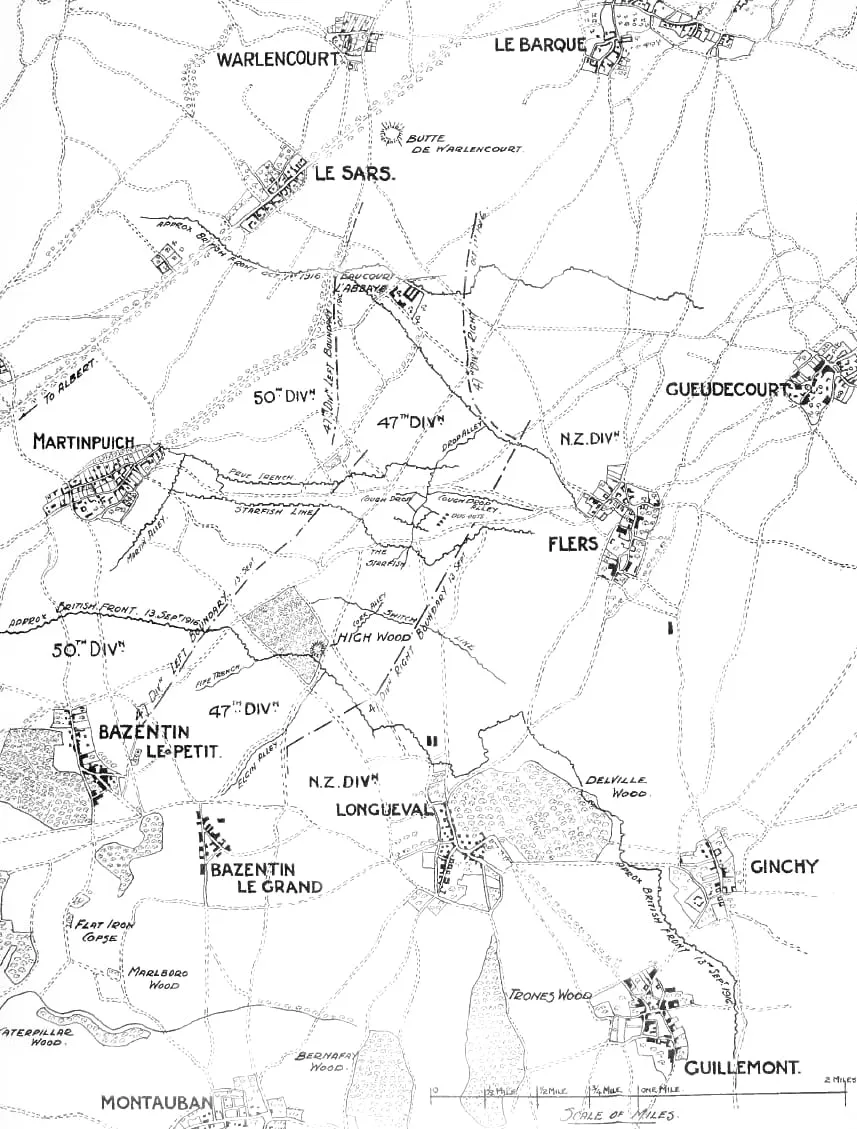
On 1 October 1916, on a fine autumn afternoon, the British Fourth Army of General Henry Rawlinson opened a new phase of the Battle of the Somme. At 3.15 p.m. the infantry of III Corps and the New Zealand Division left their trenches to take the buildings of the former abbey of Eaucourt l’Abbaye and the stretch of the German third position known as the Flers Line, which ran as far as the village of Le Sars. The New Zealanders, preceded by a wall of fire from drums of burning oil, quickly took their objective. Two tanks led the Londoners across the line of German trenches and through the ruins of the abbey, then stuck fast and were burnt. Lieutenant-Colonel Roland Bradford, who under fire rallied a broken attack and led it forward again, won the Victoria Cross that day. By evening the British held almost the whole Flers Line. It was a good start to the fighting that the British later called the Battle of the Transloy Ridges. The next day, however, the rain began, and the autumn downpours turned it into an exhausting struggle in the mud.
The plan for October
After the capture of Morval, Lesbœufs and Gueudecourt and the Thiepval Ridge in September, Douglas Haig was preparing another great attack. In a letter of 29 September General Headquarters ordered that a combined attack by the Fourth Army, the Reserve Army and the Third Army should be launched by 12 October. In it the Fourth Army was to take Le Transloy, Beaulencourt and the ridge beyond the Thilloy–Warlencourt valley, and on the way to that objective to get as close as possible to the German positions. Rawlinson had already issued his order on 28 September. His first step was to straighten the army’s left wing, which had fallen behind after the September fighting. Here the Germans still held the Flers Line, a double trench running from Flers through Eaucourt l’Abbaye towards Le Sars, from which they could enfilade any attack to the north.
Eaucourt l’Abbaye (today part of the commune of Warlencourt-Eaucourt) consisted of two large farms within a common enclosure, built on the site of a former Augustinian abbey. The Germans had installed themselves in its old cellars, several of which had survived the shelling in good condition. The attack was to be made by III Corps with three divisions: the 47th (London), the 50th (Northumbrian) and the 23rd. The New Zealand Division of XV Corps was to swing its left wing forward, pivoting on a point in Gird Trench about 1,400 metres east of the abbey. On the front of XIV Corps and the right wing of XV Corps only heavy shelling and minor advances were planned.
In the last days of September the British prepared their jumping-off position. On 29 September at dawn a company of the 8th Battalion, York and Lancaster Regiment, took the buildings of Destremont Farm by the Bapaume road, and a London battalion began bombing the Germans back along Flers Trench. Morale was good, but the divisions were exhausted. The New Zealand Division had been fighting without a break since 15 September, and the two battalions that were to attack on 1 October together numbered fewer than 850 rifles. At midnight on 30 September/1 October both sides put their clocks back from summer time to winter time.
On the other side, the Flers Line at Eaucourt l’Abbaye had been held since 26 September by the 6th Bavarian Reserve Division, which from the first days had suffered heavy losses from British artillery. West of the Bapaume road, at Le Sars, the exhausted 7th Division was holding out. The German command was just beginning to replace its worn-out divisions with fresh ones brought from Verdun, Lorraine and Flanders. September had been the bloodiest month of the battle for the Germans, and their new positions behind the Flers Line, dug in haste, could not compare with the lines the Allies had already taken. At Haig’s headquarters there was moderate optimism. September, however, had been relatively dry, with only a few downpours, and autumn on the Somme usually brings long rains.
Bombardment and burning oil
At seven in the morning of 1 October a methodical bombardment began along the whole front of the Fourth Army, kept up at a steady rate until zero hour. On the right wing of the attack, in the already captured part of Gird Trench, sappers of the Special Brigade, Royal Engineers, had set up 36 projectors, which a minute before the attack fired drums of oil onto the German positions. Thirty of them burst as planned, and most of the New Zealanders’ objective was shrouded in a red wall of flame and thick black smoke. Prisoners later complained bitterly about this way of waging war, and the history of the Bavarian regiment defending this sector wrote that the “incendiary bombs” had caused great havoc.
Even so, the Canterbury and Otago battalions of the 2nd New Zealand Brigade were met by machine-gun fire that inflicted heavy losses on them before they got through the German positions. Sergeant Donald Forrester Brown of the Otago battalion, who had already distinguished himself on 15 September in an attack on German machine-gun nests, single-handedly rushed a machine gun that was holding up the advance and captured it. He was killed soon afterwards. For both deeds he was awarded the Victoria Cross posthumously. The Canterbury battalion quickly took Gird Trench and part of Circus Trench, and the Otago battalion went far beyond its wrecked objective and past the abandoned German redoubt called The Circus. Reinforced by part of the Wellington battalion, the New Zealanders dug in by the Le Barque road, in touch with the Londoners. According to the official history, they owed their rapid success to an excellent field-artillery barrage and the dash of the infantry. They suffered heavy losses, but took about 250 prisoners. The Bavarian regiment facing them lost the staffs of two battalions, and its attempts to counter-attack failed.
Tanks at Eaucourt l’Abbaye
In the 47th Division, temporarily commanded by Brigadier-General W. H. Greenly, the 141st Brigade attacked with three battalions and two Mark I tanks. Two weeks earlier the division had bled itself white in High Wood, and its previous commander had lost his post. The tanks assembled at the German Starfish redoubt and were to drive along the trenches of the Flers Line to the abbey. The right-hand battalion, the 1/19th London, was stopped by machine-gun fire fifty metres short of the German trenches. The men waited in shell holes for the tanks, and when the machines drove along the trenches from right to left, they moved forward easily. The rear waves began to consolidate the captured trench, while the leading waves passed Eaucourt l’Abbaye and joined the New Zealanders by the Le Barque road. The centre battalion, the 1/20th London, followed the tanks across the trenches of the Flers Line and swept through the abbey buildings without clearing them of Germans.
On the brigade’s left wing things went worse. The 1/17th London was stopped by uncut wire and surviving machine guns. Meanwhile both tanks, which had helped the two battalions, became stuck in the trenches west of the abbey. When the Bavarians counter-attacked along the trenches, the immobilised and unsupported machines were set on fire, and their crews withdrew. In the ruins of the abbey and in the trenches to its left the Germans held out, but according to Bavarian accounts they already considered Eaucourt l’Abbaye lost by the afternoon of 1 October.
Bradford and the Flers Line
In the centre of the attack the 151st Brigade of the 50th Division advanced. Its right-hand battalion, the 1/6th Battalion, Durham Light Infantry, had its flank exposed after the Londoners’ failure and under German machine-gun fire managed to seize only a scrap of Flers Trench. Its commander had been wounded even before the attack. Then the commander of the neighbouring 1/9th Battalion, which was in reserve, came over under heavy fire: the 24-year-old Lieutenant-Colonel Roland Bradford. He took command of both battalions, rallied the men and led them in a new attack, which took Flers Trench at about 9.30 p.m. By dawn he had also driven the Germans out of the second trench of the line, barricaded the exposed right flank and repulsed successive attacks with bombs and Stokes mortar fire. For his courage and skilful leadership he received the Victoria Cross. A year later, as a 25-year-old brigadier-general, the youngest general in the British Army, he was killed in the Battle of Cambrai.
The other battalions of the 151st Brigade took the Flers Line in the centre and on the left without much difficulty, because the Germans had not had time to organise effective resistance. An observer from No. 3 Squadron of the Royal Flying Corps described the British barrage seen from the air as “a rigid wall of fire”, and in his account the infantry of the 50th Division advanced in perfect order only fifty metres behind it. On the corps’ left wing the 23rd Division took both trenches of the Flers Line and, after hard fighting beyond the Bapaume road, linked up with the Canadians. Its patrols, which tried to enter Le Sars, were driven back by fire from the houses of the village.
The rest of the front
On the army’s right wing, on the front of XIV Corps and part of XV Corps, the hour-long bombardment at 3.15 p.m. brought only small gains of ground. South-east of Morval the French Sixth Army of General Émile Fayolle attacked that day without much success. The German machine guns in the Bois de la Haie proved the most dangerous. At the same time, west of the Albert–Bapaume road, General Hubert Gough’s Reserve Army went into the attack, fighting for Regina Trench and the redoubts on the northern edge of the Thiepval Ridge.
The night and the next day
The situation became clear at divisional and corps headquarters only the next morning. The 47th Division, however, knew of the failure on its left wing and during the night sent a fresh battalion to repeat the attack over the same ground. The tired and much weakened battalion went forward at 6.45 a.m. and, after losing about 170 men, mainly to machine-gun fire, was withdrawn. That day command of the 47th Division was taken over by General George Gorringe, who had come straight from Mesopotamia. On the German side, the Bavarian regiment from Eaucourt l’Abbaye assembled by the Le Sars road, and the defence of the village itself was taken over by units of the fresh 4th Ersatz Division, brought from Flanders.
On 2 October at about eleven o’clock rain began to fall, and with short breaks it poured for the next two days. At noon on 3 October patrols found that few Germans remained in the trenches in front of Eaucourt l’Abbaye, and the Londoners occupied them almost without a fight. The attack of 1 October had thus achieved almost all its objectives, and the German line fell back towards Le Sars and the Butte de Warlencourt, a chalk mound by the Bapaume road. The downpour, however, forced Rawlinson to postpone the next attack from 5 to 7 October. The divisions of the Fourth Army were now to attack down into a valley, in rain, mist and ever deeper mud, against new German trenches whose positions nobody knew exactly.
Remember the articles you have read? Only in this browser; nothing is sent anywhere.How it works
Read ·
Voices from the front
“We shall probably be fighting before you get this, but one has a far better chance of getting through now than in July. I shall be very glad if we do have a scrap, as we have been resting quite long enough. Of course one always has to face possibilities on such occasions; but we have faced them in advance, haven't we? I believe with all my soul that whatever will be will be the best.”
“News came through on this day of heavy rain and wind of our losses in the attack. Very heavy. B....., L....., and Bl....., all killed; B....., a good blighty; G....., dangerously wounded. I never felt more utterly sick and miserable than to-day. […] They were very glorious when they came, but arrived at the sand-pits near M..... a very tired crowd.”
Spotted a mistake?Report an error
Meanwhile
(02)Elsewhere in the same days.
- 29 September 1916 · Balkan FrontEnd of the Battle of HermannstadtOn 29 September 1916 the last units of the Romanian I Corps retreated across the mountains from Hermannstadt. They escaped but lost 3,000 prisoners and 13 guns.
- 3 October 1916 · Balkan FrontResignation of the Kalogeropoulos governmentOn 3 October 1916 Kalogeropoulos's ministers resigned; next day the king accepted the resignation of the whole cabinet, which the Entente refused to recognise.
Related events
(04)The same battle, people or subject.
- 15 September 1916 · Western FrontStart of the Battle of Flers-CourceletteOn 15 September 1916 tanks went into battle for the first time, on the Somme. The British took Flers, Martinpuich and High Wood; the Canadians took Courcelette.
- 28 September 1916 · Western FrontEnd of the Battle of MorvalOn 28 September 1916 the Battle of Morval died down. The British held the villages taken and handed part of the front to the French, but could not go on.
- 25 September 1916 · Western FrontStart of the Battle of MorvalOn 25 September 1916 the British Fourth Army attacked on the Somme at noon and took Morval and Lesbœufs in three hours. At Gueudecourt the attack failed.
- 3 September 1916 · Western FrontBattle of Guillemont beginsOn 3 September 1916 British and Irish troops took Guillemont on the Somme in under three hours, after it had been fought for in vain since late July.