Key event
Battle of Guillemont begins
- Category:
- Military operations
- Front:
- Western Front
- Date:
- 3 September 1916
- Author:
- Natalia
- Battle:
- Battle of Guillemont
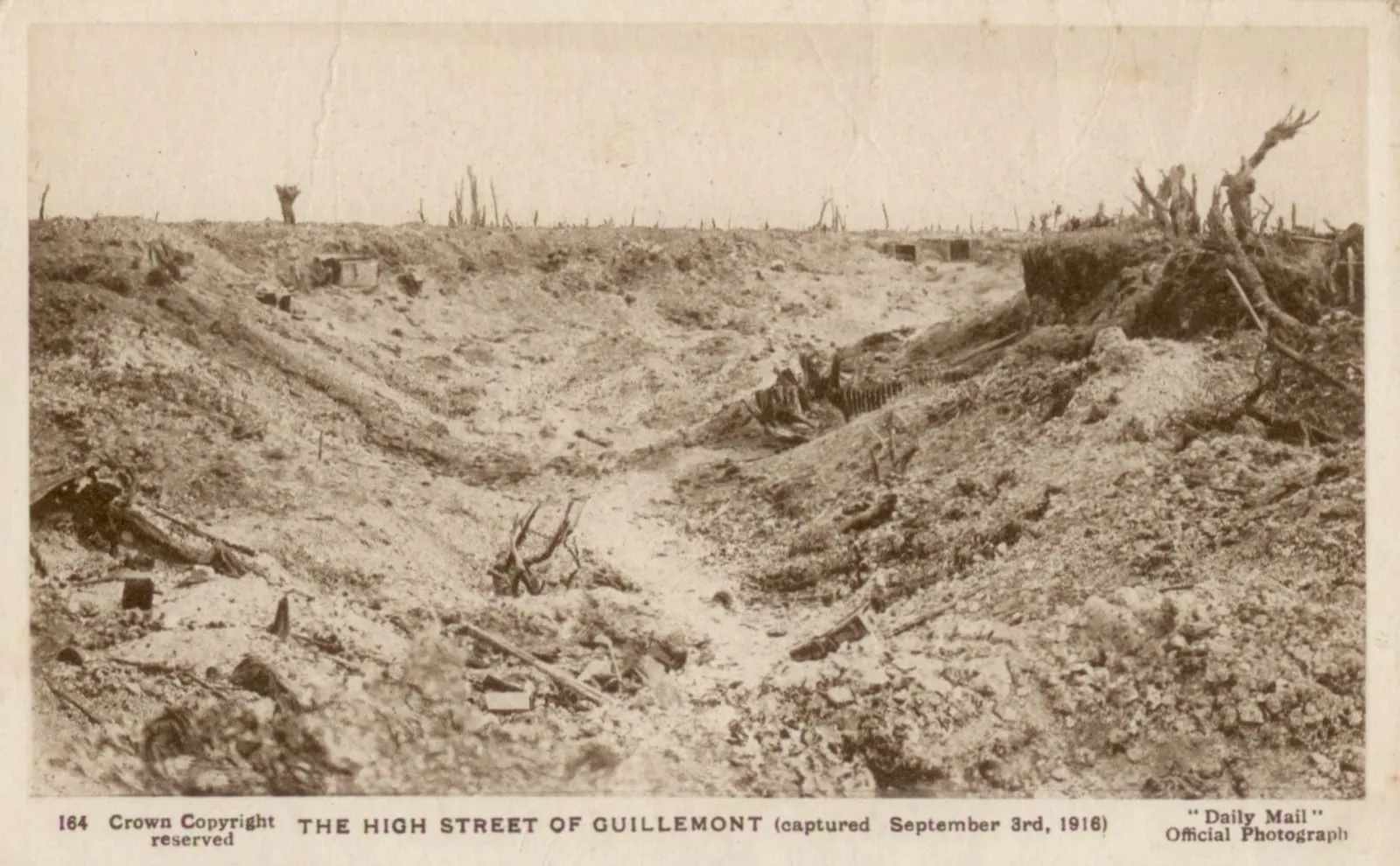
On Sunday 3 September 1916 the British Fourth Army and the French Sixth Army attacked together on the front from Delville Wood to the Somme. The main British objective was the ruined village of Guillemont on the right wing of their front on the Somme. For more than five weeks of the Battle of the Somme one division after another had broken into it and perished in its rubble. This time the 20th (Light) Division and the Irish 47th Brigade of the 16th Division set off at noon. Less than three hours later they were already beyond the village. That same day, however, the attack on the neighbouring Falfemont Farm ended in failure, and the 7th Division, which had broken into Ginchy, was driven out of it. The capture of Guillemont and the breaking of the second position south of the village were the only British successes on the Somme that Sunday.
The village that could not be taken
Guillemont lay on the ridge along which the German second position ran, on the road from Longueval to Combles. By September nothing was left of the village. An aerial photograph of the southern part of Guillemont taken on 29 August showed, as the British official history puts it, “a sea of craters”. Beneath the rubble, however, many deep dugouts had survived, and underground passages connected all the wells in the village. The defenders could therefore sit out a bombardment and come up to the surface as soon as it stopped. The approaches were covered from the flanks by Falfemont Farm with Wedge Wood to the south and by Ginchy to the north.
The British attacked Guillemont on 23 and 30 July and on 8, 16, 18 and 21 August. Several times their battalions reached the middle, and even the far end, of the village, but they were always cut off there. General Douglas Haig was losing patience. At the end of August he reminded the commander of the Fourth Army, General Henry Rawlinson, that Ginchy, Guillemont and Falfemont Farm had to be taken without delay. He was planning a great offensive for mid-September, in which tanks were to take part for the first time, and wanted to launch it from the ridge beyond these villages. The attack was set for 29 August, but torrential rain turned the chalky ground into mud and the French asked for more time, so the date was postponed three times.
Final preparations
From 30 August there was no rain, and 3 September promised to be a fine day. On the morning of 2 September the preparatory bombardment began. The Germans replied mainly with fire on the 7th Division’s trenches near Ginchy. Meanwhile a relief was under way on the German side. In the last days of August the sector from Guillemont to Falfemont was taken over by the 111th Division of General Fritz von Below’s 1st Army. One of its officers was a 21-year-old second lieutenant of the Hanoverian 73rd Fusilier Regiment, Ernst Jünger. At the end of August he spent several days in the line at Guillemont, and after a short rest his company was placed in reserve in the cellars of Combles. There, as he described after the war in his book In Stahlgewittern (Storm of Steel), on the evening before the battle a shrapnel fragment hit him in the leg. Jünger went to hospital, and the next day his company returned to the line. After a bombardment lasting many hours it was attacked from all sides. Almost all his comrades were killed, and no one came back to Combles.
On the British side Guillemont was to be taken by Major-General William Douglas Smith’s 20th (Light) Division. Its 59th Brigade had been so bled white that it numbered only 1,650 rifles, so two battalions from other brigades were attached to it. The northern part of the village was to be attacked by the Irish 47th Brigade, lent from the 16th Division, which was in corps reserve. Its battalions – the 6th Connaught Rangers, 7th Leinsters, 8th Royal Munster Fusiliers and 6th Royal Irish – had been recruited mainly in the south and west of Ireland. To the right of the 20th Division, on the ridge above the ravine near Combles, waited the 5th Division. Its task was to take Falfemont Farm and the German second position as far as Wedge Wood, and finally to reach Leuze Wood.
Failure at Falfemont
The 5th Division moved first. Falfemont Farm, less than 400 metres from its trenches, was to be taken before the main attack, together with the French. At 8.50 a.m. the 2nd King’s Own Scottish Borderers left their trenches “in perfect order”, as the British official history recorded. Everything, however, went wrong. The French 127th Infantry Regiment in the ravine near Combles could not move under machine-gun fire, and the barrage of French field guns that was to cover the Scots never appeared at all. Without warning their allies, the French had turned these guns against a German counter-attack further south. Fired on from the front and the flank, the battalion lost nearly three hundred men. Some observers reported that the attack had succeeded, because no one was coming back. In reality no one was coming back because everyone lay dead or wounded.
At noon two Royal Warwickshire battalions tried again, but the Germans once more fired from the flank. They managed only to occupy an old battery position and a stretch of trench by Wedge Wood. A third attack, at 6.30 p.m., took Wedge Wood itself. Falfemont Farm remained in the hands of the German 164th Infantry Regiment until evening.
Noon: the assault on Guillemont
At 8.15 a.m. the British artillery carried out a so-called “Chinese attack”: a series of sudden bursts of fire meant to simulate preparation for an assault and deceive the Germans. It then shelled the ground north-east of Guillemont for half an hour. Not everything worked. Opposite Arrow Head Copse neither a special mine nor a flamethrower destroyed the German strongpoint. A Rifle Brigade battalion took it only in the first assault, killing many of the defenders.
At 12 noon the whole line went forward. On the left wing of the 59th Brigade the 10th King’s Royal Rifle Corps left its trenches even before zero hour. It suffered losses from its own shells as a result, but it took the Germans by surprise. The Irish of the Connaught Rangers beside it did not want to be left behind and did the same. The 7th Leinsters struck from the direction of the railway station and, as the official history writes, “swept everything before them”. Within twenty minutes the first objective – the road to Hardecourt and the line beyond it to the north – had been taken. By 12.30 p.m. divisional headquarters already knew this from the reports of Royal Flying Corps airmen, who circled over the battlefield watching for the flares lit by the infantry in the captured positions.
At 12.50 p.m. the brigades moved on, under artillery and machine-gun fire but without stopping. By 1.15 p.m. they were digging in beyond the middle of the village. At 2.50 p.m. the last bound began, to the road from Wedge Wood to Ginchy. German resistance had by then largely been broken. The commander of the 59th Brigade telegraphed to division that there was “nothing” in front of him and that fresh troops should be brought in. Before 3.30 p.m. Guillemont was in British hands, and sappers and pioneers of a Durham Light Infantry battalion were consolidating the captured ground. On the right wing the 95th Brigade of the 5th Division broke through the second position south of the village and reached the road to Ginchy, taking about 150 prisoners.
The Irish at Guillemont
For the 47th Brigade it was the first great day of the Battle of the Somme. The British official history, usually restrained, writes of the “impetuous Irish”, who rushed forward without clearing all the German positions behind them. A rifle battalion of the 59th Brigade had to detach a whole company to winkle Germans out of hiding places around the quarry on the Connaught Rangers’ sector. The 6th Royal Irish went into the last attack to the sound of the regimental pipers, and after them ran the Munsters, who, as was recorded, “could not be restrained”.
Three soldiers of the 20th Division and the 47th Brigade received the Victoria Cross for that day. Private Thomas Hughes of the Connaught Rangers was wounded but returned to the fight, single-handedly put a German machine-gun crew out of action and, though wounded again, brought back several prisoners. Lieutenant John Vincent Holland of the Leinster Regiment led the battalion bombers through the British barrage and bombed the surprised Germans in their dugouts. Sergeant David Jones of the 12th Battalion King’s (Liverpool) commanded a platoon which held an advanced position on the edge of Ginchy until 5 September, beating off repeated counter-attacks. The price was high. The 59th Brigade with its attached battalions lost nearly 1,400 men, and the 47th Brigade more than a thousand. Among the dead was the commander of the Connaught Rangers, Lieutenant-Colonel John Lenox-Conyngham.
On the German side Guillemont was defended by a battalion of the 76th Infantry Regiment and a machine-gun company. According to that regiment’s history, the battalion was largely destroyed by the bombardment and the assault. At about 2.30 p.m. a few wounded men reached the rear with the report: “Guillemont is English!” The British barrage prevented the reserve battalion from moving to counter-attack. South of the village a surprised battalion of the 73rd Fusilier Regiment was almost wiped out. That day the British took more than 700 Germans prisoner.
Ginchy: in and out
To the left of Guillemont the day went differently. The 7th Division of XV Corps was to take Ginchy, a village lying higher than Guillemont, from which the Germans could see the whole area. At noon the 20th Manchesters went through the southern part of the village so quickly that they disappeared from the observers’ view, and began to dig in on its eastern edge. The battalion on their left, however, was stopped by fire from German trenches by Delville Wood, whose eastern corner the British had not managed to clear beforehand. The Germans, who had held the northern part of Ginchy, counter-attacked from the north and drove the Manchesters out. At about 5.15 p.m. word reached 20th Division headquarters that the 7th Division had withdrawn from Ginchy. General Douglas Smith forbade any further advance towards Leuze Wood and ordered the left flank to be covered. At 5.30 and 6.30 p.m. German counter-attacks from the direction of Ginchy broke down under the fire of rifles and Lewis light machine guns. In the evening the Germans, after fierce fighting with scattered groups of British soldiers, again took the whole of Ginchy.
The French and the rest of the front
General Émile Fayolle’s French Sixth Army attacked at noon along its whole front north of the Somme. According to the British official history it achieved “considerable success”: it took most of the village of Cléry, most of the German trenches along the road from Cléry to Le Forest, and Le Forest itself. Its left wing, however, did not help the British at Falfemont Farm. Elsewhere the attacks failed. The 1st Division did not take the trenches by High Wood, the Australians in their last attack on the Somme did not take Mouquet Farm, and the attack of the Reserve Army on both sides of the Ancre ended with heavy losses. For the German high command, led for a few days by Hindenburg and Ludendorff, the loss of Guillemont and Cléry on a single day was a painful blow.
The day’s balance
In the evening German aircraft flew over the captured ground, and then the German artillery opened heavy and accurate fire. After dark it began to rain. The new British line ran from the south-western edge of Ginchy to the south-east, along the road to Wedge Wood. At about 8 p.m. patrols of a Somerset Light Infantry battalion went towards Leuze Wood and met no Germans there. At 11 p.m. Rawlinson ordered the attack to be resumed the following afternoon.
The British official history states that the breaking of the second position by the 5th Division and the capture of Guillemont by the 20th Division were the only gains of that Sunday. But they were important gains. The village that had blocked the British right wing all summer and separated them from the French had finally fallen. An attack prepared on a wider front, close behind a creeping barrage, with well-organised reinforcements and communications, achieved in less than three hours what all the earlier attempts had failed to do. Falfemont Farm, Leuze Wood and Ginchy remained to be taken, and the fighting for them was to last for several more days.
Remember the articles you have read? Only in this browser; nothing is sent anywhere.How it works
Read ·
A voice from the front
“What I have seen and lived through here since then far surpasses all the horrors of the previous, second year of the war. […] Recently a whole gun crew, a corporal and three men, fell to a direct hit during the barrage fire. Since no one would fire the gun covered with the dead any more, I did it myself together with our ensign.”
Translated · Original (de)
Was ich seit dieser Zeit hier gesehen und erlebt habe, übersteigt bei weitem alles Schauerliche des vorangegangenen zweiten Kriegsjahres. [...] Neulich fiel eine ganze Bedienung von einem Unteroffizier und drei Mann durch Volltreffer während des Sperrfeuers. Da niemand mehr an dem von Toten bedeckten Geschütz schießen wollte, so tat ich's mit unserem Fähnrich zusammen.
Spotted a mistake?Report an error
Meanwhile
(04)Elsewhere in the same days.
- 2 September 1916 · Balkan FrontCentral Powers enter DobrujaOn the night of 1–2 September 1916 Toshev's Bulgarian 3rd Army crossed the Dobruja border along its whole length and split the Romanian garrisons apart.
- 4 September 1916 · AfricaBritish occupy Dar es SalaamOn 4 September 1916 Dar es Salaam, capital of German East Africa, surrendered without a fight to a British squadron and to columns that had come from Bagamoyo.
- 4 September 1916 · Balkan FrontRomanians take OrsovaOn 4 September 1916 the Austrians left the west bank of the Cerna and Dragalina's Romanian 1st Division took Orsova, having broken through on 1 September.
- 1 September 1916 · DiplomacyBulgaria declares war on RomaniaOn 1 September 1916 Bulgaria declared war on Romania to regain the Dobruja lost in 1913. Tsar Ferdinand called for a fight against the "treacherous neighbour".
Related events
(04)The same battle, people or subject.
- 6 September 1916 · Western FrontEnd of the Battle of GuillemontThe Battle of Guillemont ended on 6 September 1916. The British took Falfemont Farm and Leuze Wood and linked up with the French, but did not take Ginchy.
- 14 July 1916 · Western FrontBattle of Bazentin Ridge beginsAt dawn on 14 July 1916, after a night approach and five minutes of shelling, the British took the German second position from Longueval to Bazentin-le-Petit.
- 25 September 1916 · Western FrontStart of the Battle of MorvalOn 25 September 1916 the British Fourth Army attacked on the Somme at noon and took Morval and Lesbœufs in three hours. At Gueudecourt the attack failed.
- 1 October 1916 · Western FrontStart of the Battle of the Transloy RidgesOn 1 October 1916 the British Fourth Army attacked on the Somme at Eaucourt l’Abbaye and the Flers Line, aided by tanks and New Zealanders. Next day it rained.