1916: The Battle of the Somme
Battle of Guillemont
- Dates:
- 3–6 September 1916
- Front:
- Western Front
- Location:
- The village of Guillemont and the ridge to its south-east (Falfemont Farm, Wedge Wood and Leuze Wood), between Longueval, Ginchy and Combles, about 13 km east of Albert, Somme department (France)On the battle map →
- Sides:
- United Kingdom (with Ireland) and FranceDouglas Haig, Henry Rawlinson, Lord Cavan, Émile FayolleGerman EmpireFritz von Below, Max von Gallwitz
- Result:
- British victory. The British took Guillemont, Falfemont Farm and Leuze Wood, eliminated the salient at Delville Wood and closed up to Ginchy, which they did not, however, take in those days.
- Author:
- Łukasz Skowroń
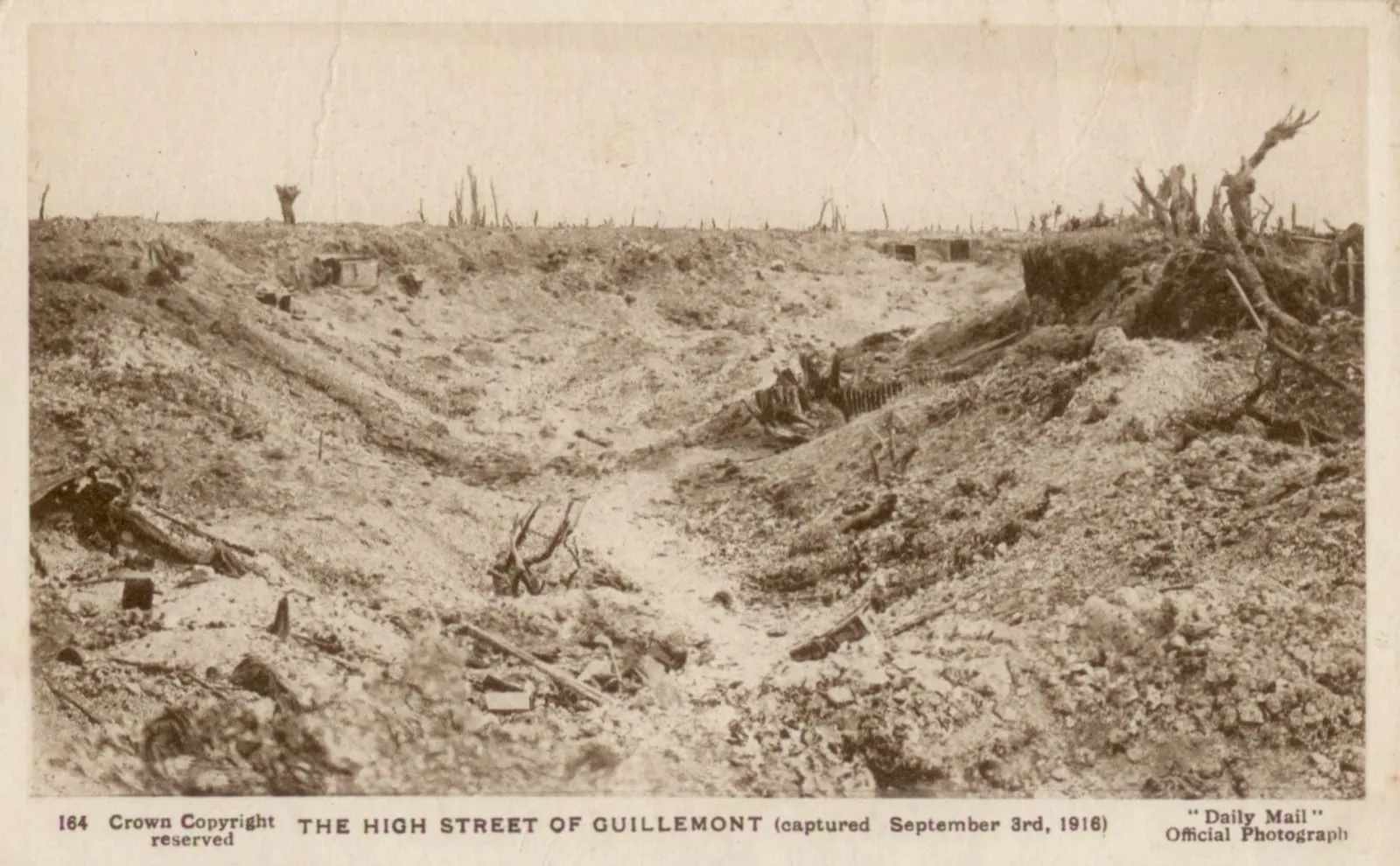
The Battle of Guillemont ended one of the most frustrating chapters of the Battle of the Somme. The village of Guillemont, on the right wing of the British front where it joined the French, had beaten off one attack after another for more than five weeks. From 23 July to the end of August British battalions several times broke into its ruins and each time were thrown out of them or perished there cut off. Only on 3 September 1916 did the 20th (Light) Division, reinforced by the Irish 47th Brigade of the 16th Division, take the village in less than three hours. On its right the 5th Division broke through the German second position, but for two days it could not take Falfemont Farm, which was swept by flanking fire because the French had failed to clear the neighbouring ravine in time. The farm fell on 5 September and the British entered Leuze Wood above Combles. On the left the 7th Division several times broke into Ginchy and each time had to withdraw from it.
Name and dates
The name “Battle of Guillemont” and the dates 3–6 September 1916 were fixed after the war by the British Battles Nomenclature Committee. According to the British official history (Wilfrid Miles, Military Operations, France and Belgium, 1916, vol. II) it covers the whole sector from the ravine at Combles to Longueval, so not only the capture of Guillemont, Falfemont Farm and Leuze Wood by XIV Corps but also the failed attacks of XV Corps on Ginchy and the fighting on the eastern edge of Delville Wood. The earlier attacks on the village, from 23 July to the end of August, do not fall within the name, though in practice they formed one whole with it. Ginchy was taken only on 9 September, in a separate battle. Times are given in British summer time, one hour behind German time.
Background
Guillemont was a small village on the road from Longueval to Combles, on the ridge along which the German second position ran. From 14 July, when the British took Trônes Wood, the village lay just in front of their line. The Germans turned it into a fortress. The houses had long since been reduced to rubble, but beneath them deep cellars and dugouts remained, and according to the British official history underground passages linked all the wells in the village. The village was covered from the south by Falfemont Farm and Wedge Wood on the second position, and from the north by Ginchy. British troops attacking Guillemont from the west advanced across open ground under fire from both. The trouble was made worse by the division of the front: Guillemont belonged to the British, while the neighbouring ravine at Combles and Maurepas belonged to the French 6th Army of General Émile Fayolle. Fayolle would not advance until the village was in British hands, and the British could not hold it without French progress.
The first large attack on the village was made at dawn on 23 July by the 30th Division, on the same night in which the Australians took Pozières. The 19th Manchesters broke through uncut wire into the village but, without support, were cut off and destroyed. On 30 July, in thick fog, the same division attacked together with the French. The Scots of the 2nd Battalion Royal Scots Fusiliers went right through the village, but they too were surrounded, and the fog prevented the airmen from giving any help at all. On 8 August the attack of the 55th (West Lancashire) Division and the 2nd Division ended the same way: two Liverpool battalions that got into Guillemont were cut off there and wiped out. Further attempts on 16, 18 and 21 August gained only scraps of ground. The most, the railway station north-west of the village, was taken by the 24th Division on 18 August. An attack planned for 24 August was cancelled because the exhausted divisions were not ready.
These attacks were very costly. According to the British official history the 2nd Division lost more than 4,900 men from 24 July to 11 August, the 55th Division more than 4,100 in August alone, and the 24th Division more than 3,500 in August. Historians, among them Robin Prior and Trevor Wilson, later criticised General Henry Rawlinson, commander of the 4th Army, for attacking the village again and again on a narrow front, with one or two brigades, under fire from untaken neighbouring positions. Douglas Haig himself came to a similar conclusion in August. At the end of the month he urged Rawlinson to take Ginchy, Guillemont and Falfemont Farm without delay, but by a carefully prepared attack on a wider front, in agreement with the French. Haig was in a hurry: for the middle of September he was planning a great offensive using a new weapon, tanks, and wanted to launch it from the line of Leuze Wood, Ginchy and High Wood.
Plan
In mid-August the right wing of the 4th Army was taken over by XIV Corps under Lieutenant-General Lord Cavan. He was given two divisions for the attack. The 5th Division of Major-General Reginald Stephens was to take the German second position from Falfemont Farm to Wedge Wood and then reach Leuze Wood above the ravine at Combles. The 20th (Light) Division of Major-General William Douglas Smith was to take Guillemont itself and reach the road from Wedge Wood to Ginchy. Its 59th Brigade was so weakened that it numbered only 1,650 rifles, so it was reinforced with two battalions from other brigades. The exhausted 60th Brigade was replaced by the 47th Brigade of the 16th (Irish) Division, made up of battalions of the Connaught Rangers, the Leinster Regiment, the Royal Munster Fusiliers and the Royal Irish Regiment. To the left of XIV Corps the 7th Division of XV Corps was to take Ginchy, and further still the 1st Division the trenches by High Wood. The French 6th Army was to attack at the same time along its whole front north of the Somme, from Combles to Cléry.
The attack was first set for 29 August, but from 25 August it rained and the chalky soil turned into sticky mud, in which digging jumping-off trenches and bringing up ammunition went very slowly. The date was put back to 30 August, then to 1 September and finally, at the request of the French, to 3 September. The rain stopped on 30 August. On 31 August the Germans made their biggest counter-attack since the start of the battle at Delville Wood and drove the British out of part of the trenches they had taken. On the morning of 2 September the preliminary bombardment began. The infantry was to follow close behind a creeping barrage that moved through Guillemont at a rate of 100 yards (about 90 metres) every four minutes.
The village and its surroundings were defended by the German 111th Division, part of the 1st Army of General Fritz von Below. In Guillemont itself stood a battalion of the 76th Infantry Regiment with a machine-gun company, south of the village the Hanoverian 73rd Fusilier Regiment, and Falfemont Farm was held by the 164th Infantry Regiment. Further south-east stood the 2nd Guards Division. Serving in the 73rd Regiment was Leutnant Ernst Jünger, who in his war diary, published after the war as In Stahlgewittern (Storm of Steel), described Guillemont at the end of August as a field of craters, in which the village differed from the rest of the ground only in that the craters were paler, from the stone of the houses ground to dust.
Course
3 September: Falfemont. The day began with a defeat. At 8.50 a.m. the 2nd King’s Own Scottish Borderers of the 5th Division advanced in perfect order on Falfemont Farm, less than 400 metres away. The attack was to be supported by French infantry from the ravine at Combles and by a barrage of French field guns. The French 127th Infantry Regiment, however, could not move under machine-gun fire, and the French guns, without warning the British, were switched to repelling a German counter-attack further south. The Scots, fired on from the front and the flank, lost nearly three hundred men. No one fell back, because all of them lay dead or wounded. A further attempt at noon and a third at 6.30 p.m. also failed. Only Wedge Wood was taken.
3 September: Guillemont. At 12 noon the main attack went in. The 95th Brigade of the 5th Division took the trenches on the ridge south of Guillemont and then the German second position up to the edge of the village. A battalion of the Duke of Cornwall’s Light Infantry picked off German machine-gunners with accurate rifle fire, which the British official history singles out as unusual at a time when soldiers relied mainly on grenades. Two brigades of the 20th Division struck the village itself. On the left of the 59th Brigade the 10th King’s Royal Rifle Corps set off even before zero hour, taking losses from its own artillery but surprising the Germans. The Irish of the 6th Battalion Connaught Rangers next to them did the same. The 7th Leinsters attacked from the direction of the station. Within twenty minutes the whole first objective had been taken. At 12.50 p.m. the attack moved on, and by 1.15 p.m. the men were already digging in beyond the middle of the village. At 2.50 p.m. both brigades reached the road from Wedge Wood to Ginchy. German resistance collapsed. The commander of the 59th Brigade reported that there was “nothing” in front of him and that fresh troops should be put in. Private Thomas Hughes of the Connaught Rangers and Lieutenant John Vincent Holland of the Leinster Regiment were awarded the Victoria Cross for that day. The commander of the Connaught Rangers, Lieutenant-Colonel John Lenox-Conyngham, was killed. According to the history of the German 76th Regiment, its battalion in Guillemont was for the most part destroyed during the bombardment and the assault, and the few wounded who reached the rear at about 2.30 p.m. brought the news: “Guillemont is English!”
3 September: Ginchy. On the left the success was not complete. The 20th Manchesters of the 7th Division broke into Ginchy at noon and crossed to its eastern edge, but the battalion on their left was stopped by fire from the trenches by Delville Wood. A German counter-attack from the north drove the British out of the village in the afternoon, and in the evening the Germans occupied it again. The commander of the 20th Division therefore forbade any further advance towards Leuze Wood and ordered the left flank to be covered. Sergeant David Jones of the 12th Battalion King’s (Liverpool Regiment) held an advanced position on the southern edge of Ginchy with his platoon until 5 September and was also awarded the Victoria Cross. The capture of Guillemont and the 5th Division’s break-in to the second position were the only gains of the day. The attacks of the 1st Division at High Wood, of the Australians at Mouquet Farm and of the Reserve Army on the Ancre failed. The French, on the other hand, took most of the villages of Cléry and Le Forest, but their left wing did not advance along the ravine at Combles.
4 September. The night and the following day were windy and wet. The 5th Division again attacked Falfemont Farm, and again the French neighbours did not move. The 1st Bedfordshires, advancing from Wedge Wood along a German trench, took more than 180 prisoners and occupied the northern and western corners of the farm, but frontal attacks still broke down. To its left two companies of the 1st Devonshires entered Leuze Wood in the evening, where there were few Germans. The 20th Division, unsure what was happening in Ginchy, sent forward only patrols, and the 7th Division in the morning once more got into Ginchy and was once more driven out.
5–6 September. German resistance was weakening. By three in the morning of 5 September the 1st Norfolks had occupied Falfemont Farm, and by 7.30 a.m. the whole stretch of the second position. Battalion commanders reported that the Germans were broken and inclined to retreat. Rawlinson therefore ordered Leuze Wood and the high ground between it and Ginchy to be boldly occupied. In the afternoon the Devonshires occupied the German trench in Leuze Wood, and contact was made with the French left wing in the ravine at Combles. The attacks of the 7th Royal Irish Fusiliers on Combles Trench, however, broke down on wire hidden in the corn. That day the 16th (Irish) Division of General William Hickie took over the front in place of the 20th Division. On 6 September, a fine autumn day, an Irish battalion entered the neighbouring Bouleaux Wood but lost touch with its neighbours. In the evening in Leuze Wood the London Scottish of the 56th Division, relieving the 5th Division, beat off a German counter-attack. The 7th Division attacked Ginchy twice more, in the morning and in the afternoon of 6 September. Men of the Gordon Highlanders and Devonshire battalions broke into the village in the afternoon and sent prisoners to the rear, but at 4.30 p.m. a counter-attack drove them out again. General Herbert Watts reported that his division could do nothing more.
Casualties
The British official history does not give total losses for the battle, only figures from divisional returns over longer periods. The 59th Brigade with its three attached battalions lost nearly 1,400 men on 3 September, and the Irish 47th Brigade more than a thousand. The whole 20th Division lost 2,950 officers and men from 22 August to 8 September, the 5th Division 4,233 from 26 August to 7 September, and the 7th Division, which fought for Ginchy, 3,800 from 23 August. The battalions of the 5th Division, averaging 700 men each before the attack, lost about 40 per cent of their strength, mostly wounded. On 3 September alone the British took more than 700 Germans prisoner, and the battlefield was covered with German dead. Full German losses are not known. The regimental histories cited by Miles speak of the near-total destruction of the battalions defending Guillemont and the trenches south of the village.
Significance
After six weeks of failed attacks the British had at last taken the village that was blocking their right wing. They eliminated the salient at Delville Wood, which all summer had been shelled from three sides, occupied the German second position from Ginchy to the ravine at Combles and joined up with the French. Ginchy was exposed from the south and fell on 9 September. Among historians the battle is regarded as proof that the British army had learned something over the summer. An attack on a wider front, carefully prepared, close behind a creeping barrage and in agreement with the French, achieved in three hours what the earlier attempts had failed to achieve all summer. The failed attacks on Falfemont Farm and Ginchy showed, however, how much every success depended on securing the flanks. Nor did the British manage to take the strongpoint known as the Quadrilateral east of Ginchy, which was to prove one of the obstacles in the attack of 15 September. For the 16th (Irish) Division, made up largely of volunteers from John Redmond’s nationalist movement, Guillemont and, a few days later, Ginchy became the most important places of remembrance of this war.
Spotted a mistake?Report an error