1916: The Battle of the Somme
Battle of Ginchy
- Dates:
- 9 September 1916
- Front:
- Western Front
- Location:
- The village of Ginchy on the ridge between Delville Wood and Combles, about a kilometre north-east of Guillemont and 12 km east of Albert, Somme department (France)On the battle map →
- Sides:
- United KingdomDouglas Haig, Henry Rawlinson, Thomas Morland, William HickieGerman EmpireRupprecht, Crown Prince of Bavaria, Fritz von Below
- Result:
- British victory. The 16th (Irish) Division took Ginchy and held it against German counter-attacks, but the attacks on the neighbouring sectors achieved little and the Quadrilateral redoubt remained in German hands.
- Author:
- Natalia
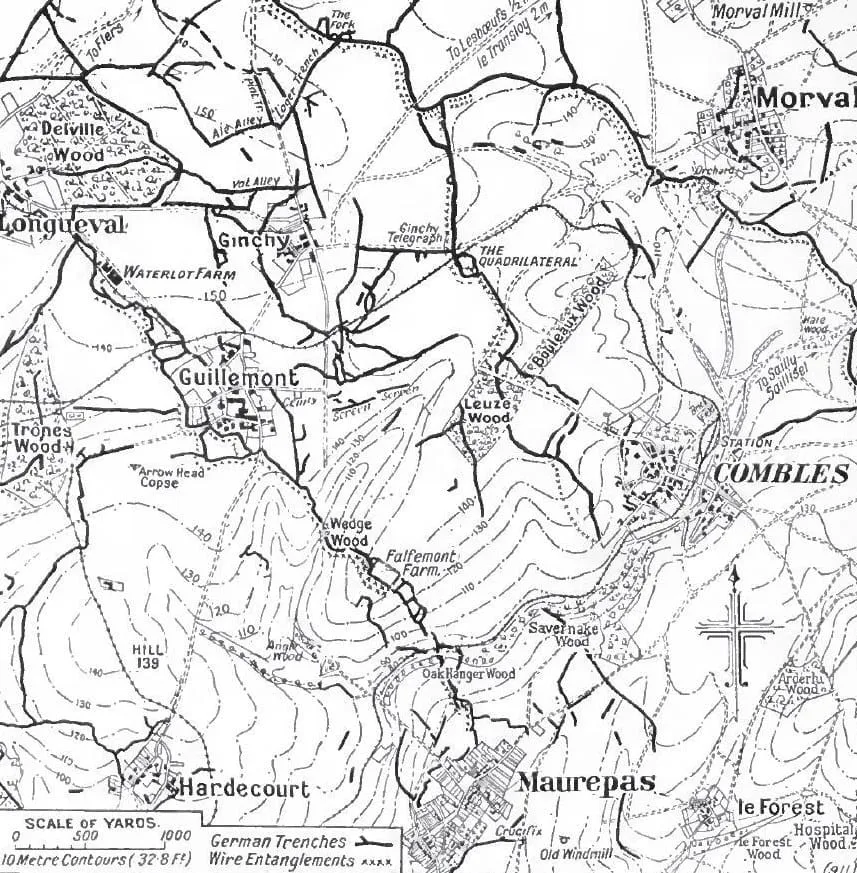
The Battle of Ginchy was a short, one-day attack by the British Fourth Army during the Battle of the Somme. The village of Ginchy stood at the highest point of the ridge the British had been fighting for since mid-July, and it dominated the surrounding country. From 3 September the British 7th Division had broken into its ruins three times and been driven out three times. On 9 September at 4.45 p.m. the 16th (Irish) Division, made up of volunteers from Irish nationalist circles, attacked on a broad front from Leuze Wood to Delville Wood, with the London 56th Division beside it. The Irish brigade that attacked the village itself took it that same evening, captured about two hundred prisoners and beat off German counter-attacks during the night. Elsewhere the attack failed. The capture of Ginchy gave the British the whole ridge from Leuze Wood to Delville Wood and a good base for the great attack of 15 September.
Name and dates
The name “Battle of Ginchy” was given after the war by the British Battles Nomenclature Committee. According to the British official history it covers only the operations of 9 September 1916 on the sector from the ravine near Combles to Longueval. The committee assigned the earlier attacks of the 7th Division on Ginchy on 3–6 September to the Battle of Guillemont (3–6 September) and the Battle of Delville Wood, while the fighting for Ginchy Telegraph and the Quadrilateral redoubt on 10–14 September has no name of its own. This page uses the official date of 9 September, but also describes the background and the aftermath. Times are given in British summer time, an hour earlier than German time.
Background
Ginchy stood on a ridge that ran south-east from Delville Wood and Longueval towards Leuze and Bouleaux Woods above Combles. East of the village, at the highest point of the area, there had once been an optical telegraph station from the time of the Revolutionary Wars. It no longer existed in 1916, but the spot was still called Ginchy Telegraph. South-east of the village, by the sunken road to Morval, the Germans had built a four-sided redoubt which the British called the Quadrilateral. Whoever held Ginchy looked down on the German third defensive position and, beyond it, the road to Morval and Lesbœufs.
After the Battle of Bazentin Ridge in mid-July, the right wing of General Henry Rawlinson’s British Fourth Army was stuck in front of Guillemont and Ginchy. Throughout August the British attacked these villages with small forces and suffered heavy losses each time. The commander of the British Expeditionary Force, General Douglas Haig, was preparing a great attack for mid-September and wanted to take the ridge from Guillemont to Delville Wood before it. Co-operation with the French, who were attacking to the right of the British on the north bank of the Somme, also depended on this.
On 3 September the British finally took Guillemont. At noon that same day the 22nd Brigade of the 7th Division attacked Ginchy from the west. The 20th Battalion of the Manchester Regiment went through the village and began to dig in on its eastern edge, but the battalion on its left was stopped by machine-gun fire from the trenches near Delville Wood, and Germans who had remained in the northern part of the ruins took the British in the flank. In the afternoon and evening units of the German 35th Fusilier Regiment and 88th Infantry Regiment counter-attacked and retook the village, according to the regimental history in hand-to-hand fighting with spades and axes. On 4 September the 9th Battalion of the Devonshire Regiment broke into Ginchy and was driven out after an hour. On 6 September the 2nd Battalion Gordon Highlanders and a Devonshire battalion again entered the village and took prisoners, but at about 4.30 p.m. a German counter-attack forced them to withdraw. The divisional commander reported that his men could do no more. According to the official history, between 23 August and its relief on 7 September the 7th Division lost 174 officers and 3,626 other ranks.
The historians Robin Prior and Trevor Wilson write that Ginchy was attacked with forces that were too weak, because the 7th Division was being saved for the great attack. Battalions attacked two at a time, nobody cleared the captured cellars in which Germans were hiding, and the artillery did not silence the machine guns firing from the flanks. The British official history adds that German positions on the eastern edge of Delville Wood, in trenches called Hop Alley and Ale Alley, enfiladed every attack on the village from the west. The fall of Guillemont now made it possible to strike at Ginchy from the south.
Forces
The attack of 9 September was carried out by XIV Corps, commanded since 17 August, in place of the sick Lord Cavan, by General Thomas Morland. On the right wing, from Leuze Wood, attacked General Charles Hull’s 56th (London) Division, made up of London Territorial Force battalions. On the left wing, facing Ginchy, stood General William Hickie’s 16th (Irish) Division. This was a New Army division formed from volunteers from all over Ireland, mainly Catholics and nationalists. Many of them had come from the ranks of the National Volunteers, the part of the Irish Volunteers which in 1914 had followed the nationalist leader John Redmond and supported taking part in the war in return for the promise of home rule. Since the beginning of September its brigades had fought at Guillemont and Leuze Wood as part of other divisions, and for 9 September they returned to Hickie’s command. They were weakened and very tired. General F. W. Ramsay, commander of the 48th Brigade, which was to take the village, stipulated that his men would have to be relieved immediately after taking Ginchy, and was given that assurance.
North of the Irish the attack was supported by XV Corps (the 55th Division at Delville Wood) and, further on, by III Corps at High Wood. The French Sixth Army was also to attack on 9 September, but on 8 September General Ferdinand Foch asked for more time to prepare and the French attacked only on 12 September.
On the German side, the Somme front north of the river belonged to General Fritz von Below’s 1st Army, which since the end of August, together with General Max von Gallwitz’s 2nd Army south of the river, had formed part of the new army group of the Bavarian Crown Prince Rupprecht. On the night of 7/8 September the 5th Bavarian Division relieved the exhausted German 56th Division at Ginchy, and the Bavarian 19th Infantry Regiment took over the defence of the village itself. The relief took place amid confusion. The Bavarians did not even know whether the British had already taken the village, which according to the regimental history had, after many bombardments, “completely vanished from the face of the earth”. South of Ginchy, by the Quadrilateral redoubt and in Leuze and Bouleaux Woods, the fresh 185th Division took up position on the night of 7/8 September. The boundary between the two divisions ran right next to the village.
Course of the battle
The Fourth Army’s order of 6 September provided for an attack along the whole right wing: XIV Corps was to take the road from Combles to Leuze Wood, the Quadrilateral redoubt and Ginchy, XV Corps the Hop Alley and Ale Alley trenches near Delville Wood, and III Corps Wood Lane trench and the eastern corner of High Wood. The bombardment began at 7 a.m. on 9 September and continued all day at a steady rate, without the usual intensification of fire before the assault. Zero hour was set for 4.45 p.m., so that the Germans would not have time to organise a counter-attack before dark.
Right wing. On the 56th Division’s sector, the London Rifle Brigade set out from the south-eastern edge of Leuze Wood against Loop Trench above the Combles ravine and had to fall back under artillery and machine-gun fire. By 6.15 p.m. the 9th Battalion of the London Regiment had taken the German line in Bouleaux Wood and further north-west, as far as the road to Morval. To its left the 4th Battalion of the London Regiment followed the barrage up to a trench south-east of the Quadrilateral redoubt, but the neighbouring Rangers battalion was held up by fire from the trenches near Ginchy. As the sun set a thick mist rose that made air observation impossible. The staffs did not know what was happening in front of them. The London Scottish, sent forward after dark in the belief that the Quadrilateral had already been taken, lost their direction in the darkness, and the redoubt remained in German hands.
Centre. On the right wing of the 16th Division, next to the Londoners, attacked the 47th Brigade: the 6th Battalion Royal Irish Regiment and the 8th Battalion Royal Munster Fusiliers, supported by a detachment of the 6th Battalion Connaught Rangers. The brigade received a belated order to wait two minutes after zero hour for a final bombardment. The 48th Brigade beside it, however, set off on time and drew the German barrage on itself. When the men of the 47th Brigade left their trenches they were stopped at close range by machine-gun fire: the British artillery had been pounding mainly the second German line, and the first remained almost untouched. Further attempts, including one by the 7th Battalion Royal Inniskilling Fusiliers, were unsuccessful.
Ginchy. Ginchy was attacked by the 48th Brigade with two battalions of the 49th Brigade. The right-hand 1st Battalion Royal Munster Fusiliers came under fire from the same positions that had stopped the 47th Brigade, but it wheeled towards them, overwhelmed the nearest Germans and went on. To its left, beyond the road from Guillemont, the 7th Battalion Royal Irish Rifles, followed closely by the 7th Battalion Royal Irish Fusiliers, met only weak resistance and before 5 p.m. reached the first objective on a line cutting across the village. At 5.25 p.m. the 8th Battalion Royal Dublin Fusiliers, following the Munsters, went through the village, with the 8th Battalion Royal Inniskilling Fusiliers beside it. Meanwhile the 9th Battalion Royal Dublin Fusiliers, with some of the men of the Royal Irish Rifles and Royal Irish Fusiliers, was clearing the western part of the ruins. Some of the Germans surrendered, others fled towards Flers and Lesbœufs, and the Irish, carried away by their momentum, had to be called back from the pursuit so that they could dig in in the orchards on the northern edge of the ruins. Sappers of the 156th Field Company built strongpoints on both flanks, by the roads to Delville Wood and to Lesbœufs.
On the German side Ginchy and the trenches east of Delville Wood were held by the I Battalion of the Bavarian 19th Regiment, with the II Battalion in reserve. According to the regimental history its left company south-east of the village held its ground, but the company in the village itself was rolled up from the flank (“we reached the bitter end”), and the Irish attack also swept away part of the reserve battalion. Counter-attacks by the II Battalion from the north of the village at 6.20 p.m. and 9 p.m. (German time) failed, and the second time the men lost their way in the darkness. Rupprecht later wrote that the confusion arose because two divisions were responsible for defending the village: a British battalion passed in small groups through the gap at their junction and outflanked the Bavarians.
Left wing. At Delville Wood the Germans did abandon the eastern tip of the wood, but the 164th Brigade of the 55th Division failed to take the Hop Alley and Ale Alley trenches. Its men entered Hop Alley and were driven out of it by artillery and machine-gun fire. Further west the 1st Division of III Corps took Wood Lane trench with heavy losses, but in High Wood the attack broke down, and the crater of a mine blown under a German strongpoint at the eastern corner of the wood was retaken by the Germans after an hour and a half of bombing fighting.
The night and 10 September. Ginchy now formed an awkward wedge driven into the German lines. In the evening the Germans tried several times to get back into the village, and the sappers particularly distinguished themselves in beating off these attempts. On the night of 9/10 September the 1st Battalion Welsh Guards of the 3rd Guards Brigade took over Ginchy from the 48th Brigade. This did not happen without fighting, since groups of Germans were still hiding in the ruins, and some Irish units were relieved only on the evening of 10 September. On the morning of 10 September the III Battalion of the Bavarian 19th Regiment attacked in the mist along the road to Lesbœufs and for a time broke into the village. Further attacks, at about 11 a.m. and in the afternoon, were beaten off by the Guardsmen in heavy fighting. According to the German regimental histories, of a battalion of the Bavarian 14th Regiment thrown into the attack later, few of those who reached Ginchy managed to get back.
Losses
According to the British official history, the 16th (Irish) Division lost 240 officers and 4,090 other ranks on 1–10 September, that is at Guillemont and at Ginchy, out of 435 officers and 10,410 other ranks, or about 40 per cent of its strength. The losses of the six battalions that took Ginchy were very heavy, especially among officers. Those killed included the commander of the 8th Battalion Royal Inniskilling Fusiliers, Lt-Col H. P. Dalzell-Walton, and Captain W. J. Murphy, commanding the 9th Battalion Royal Dublin Fusiliers. On the night of 9/10 September a shell killed the commander of the 6th Battalion Royal Irish Regiment, Lt-Col FitzRoy Curzon. In the 9th Battalion Royal Dublin Fusiliers Lieutenant Tom Kettle was killed, an economist, poet and former MP of the nationalist Irish Parliamentary Party. The official history gives the 56th Division’s losses that day only for individual battalions. The British took about two hundred prisoners at Ginchy. According to the historian Christopher Duffy, the Bavarian 19th Infantry Regiment lost 884 men on 7–12 September.
Significance
The capture of Ginchy ended two months of fighting for the ridge on the British right wing. According to Duffy, the British thereby gained another 2.7 km of the ridge, from Leuze Wood to Delville Wood, from which they could see the German third position. The headquarters of the German 4th Bavarian Division at Flers reported that the loss of Ginchy had exposed the whole sector from Flers to Martinpuich. Prior and Wilson explain the success by the fact that after the fall of Guillemont it was possible to attack from the south, and that six battalions attacked instead of two, with twice as strong field artillery support. The defenders were also not helped by the unfortunate junction of two divisions. The failure on the flanks, however, had its price: the Quadrilateral redoubt, fought for in vain again on 13 September, stopped the attack of the 6th Division on 15 September and fell only on 18 September.
The Guards Division based itself on Ginchy when on 15 September it set out from there towards Lesbœufs in the first battle involving tanks. For Ireland the battle became, alongside the first day on the Somme, when the unionist 36th (Ulster) Division fought at Thiepval, one of the most important places of memory of the First World War. Ginchy and Guillemont were taken by soldiers from the nationalist part of the island only a few months after the Easter Rising. After the war, in independent Ireland, their memory was long pushed to the margins. Today the Celtic cross of the 16th Division at Guillemont commemorates them.
Spotted a mistake?Report an error