Key event
Capture of Ginchy
- Category:
- Military operations
- Front:
- Western Front
- Date:
- 9 September 1916
- Author:
- Łukasz Skowroń
- Battle:
- Battle of Ginchy
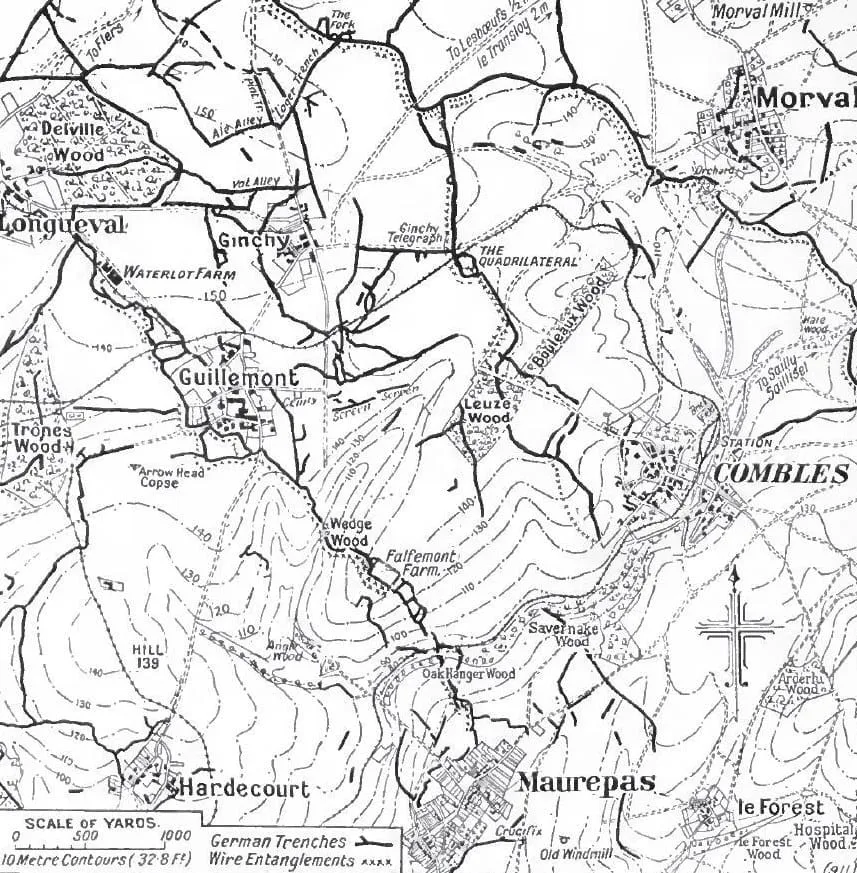
Towards evening on 9 September 1916 the Irish 16th Division took the ruins of the village of Ginchy, the highest point of the ridge on the British right wing on the Somme. During the previous week the British 7th Division had three times broken into the village and three times been driven out of it. This time six Irish battalions went over to the assault at 4.45 p.m. and, according to the historians Robin Prior and Trevor Wilson, took the village in about two hours. They captured about two hundred prisoners and beat off German counter-attacks until morning. The victory came at a high price, and on the neighbouring sectors the attack failed. Among those killed that day was Lieutenant Tom Kettle of the 9th Battalion Royal Dublin Fusiliers, an economist, poet and one of the best-known Irish politicians of his generation.
The Irish before Ginchy
The 16th (Irish) Division of General William Hickie was a division of volunteers, mostly Catholics and nationalists. Many of its soldiers and officers had gone to war at the call of John Redmond, leader of the Irish Parliamentary Party, who hoped that loyalty to Britain during the war would secure Ireland the promised self-government, that is home rule. After the Easter Rising and the execution of its leaders in the spring of 1916 more and more people in Ireland regarded this policy with dislike, and the soldiers in British uniform knew that at home not everyone would consider them heroes.
In the summer the division came from Loos to the Somme. At the beginning of September its brigades, lent to other divisions, fought in the Battle of Guillemont, and then for several days held the line between Guillemont and Leuze Wood under constant shelling. For 9 September they returned to Hickie’s command, but they were exhausted and depleted. General F. W. Ramsay, whose 48th Brigade was to take the village, warned his superiors that his men would have to be relieved immediately after Ginchy was taken. He was assured that this would happen.
By then Ginchy had in effect ceased to exist. According to the history of the Bavarian 19th Infantry Regiment, which had taken over the defence of the village two days earlier, after repeated bombardments it had “completely vanished from the face of the earth”, and only remnants of walls and corners of hedges showed that a human settlement had once stood there. The Bavarians did not even know exactly where the front ran. On their left, by the redoubt the British called the Quadrilateral, stood the newly arrived 185th Division, and the junction of the two divisions fell right next to the village.
A long day of waiting
The British artillery opened fire at 7 a.m. on 9 September and kept firing all day at a steady rate, without intensifying before the assault. The attack was set only for 4.45 p.m., so that the Germans would have no time before dark to organise a counter-attack. The whole right wing of General Henry Rawlinson’s 4th Army was to attack: the London 56th Division from Leuze Wood towards Combles, the 16th Division on Ginchy, and further left units at Delville Wood and High Wood. The French, who originally were also to attack that day, postponed their attack to 12 September.
For many hours the Irish waited in shallow trenches, in mud left by the rains of early September. The 47th Brigade, on the division’s right, received an order at the last moment to go over two minutes after the appointed time, because the artillery was to fire one last violent burst. The order arrived late and only to that brigade. The 48th Brigade opposite the village set off on time.
The assault
At 4.45 p.m. the battalions of the 48th Brigade left their trenches and at once drew the German barrage on themselves. When the 47th Brigade set off two minutes later, the 6th Battalion Royal Irish Regiment and the 8th Battalion Royal Munster Fusiliers came under close-range machine-gun fire. The British shells had fallen mainly on the second German line, and the first had survived. The brigade attacked several times, committed a battalion from reserve and gained nothing.
The same fire struck the 1st Battalion Royal Munster Fusiliers, the right wing of the 48th Brigade. The Munsters, however, wheeled towards the German positions, overwhelmed the nearest defenders and went on. To their left, on the other side of the road from Guillemont, the 7th Battalion Royal Irish Rifles and the 7th Battalion Royal Irish Fusiliers close behind it met weak resistance. Before 5 p.m. they stood on the first objective, a line running along the road the British called Hans Crescent and on through the village. At 5.25 p.m. the 8th Battalion Royal Dublin Fusiliers passed through the ruins, and the 8th Battalion Royal Inniskilling Fusiliers came into action on its right. The 9th Battalion Royal Dublin Fusiliers, with some of the men who had not stopped at the first objective, cleared the western part of the village.
On the German side the company of the Bavarian 19th Regiment that held Ginchy was rolled up from the flank. “We had reached the bitter end,” the regimental history recorded. The Irish attack also swept away part of the reserve battalion behind the village. Some of the Germans surrendered, others fled towards Flers and Lesbœufs. The Irish rushed after them in pursuit, and the officers had to turn them back so that the captured village could be consolidated at all. The new line was set up in the overgrown orchards on the northern edge of the ruins.
The death of Tom Kettle
Tom Kettle was 36. He was the son of Andrew Kettle, one of the leaders of the Irish Land League, a nationalist MP for East Tyrone in 1906–1910 and from 1908 professor of national economics at University College Dublin. He belonged to the Irish Volunteers. In the summer of 1914 he went to Belgium on their behalf to buy arms, and when war broke out he became the correspondent there of the London Daily News. What he saw during the German invasion convinced him that the Irish had a moral duty to fight Germany. He campaigned for recruitment and, despite poor health, secured a posting to the front himself. After the Easter Rising he reportedly predicted that its leaders would go down in history as heroes and martyrs, and he, if at all, as a “bloody British officer”.
On 4 September, in the trenches near Guillemont, Kettle wrote the sonnet “To My Daughter Betty, the Gift of God”. He ended it with the words that he and his comrades had died “not for flag, nor King, nor Emperor”, but for a dream born in a herdsman’s shed and for the secret Scripture of the poor. In a letter to a friend, the MP Joseph Devlin, he wrote that rest in France, which he loved, would not be a bad fate, and that by passing into silence he would in this way help Irish reconciliation.
On 9 September Kettle led B Company of the 9th Battalion Royal Dublin Fusiliers into the attack. Accounts of his death differ. According to one he was hit, tried to get up and was struck again, this time fatally. An officer of his battalion wrote to his widow that he was shot through the heart while taking cover in a shell hole. Eighteen-year-old Second Lieutenant Emmet Dalton, the son of a friend of Kettle’s, wrote from a field hospital that he was just behind him when a bullet struck him above his body armour, straight in the heart. Dalton was awarded the Military Cross for his conduct at Ginchy. Kettle’s body was buried on the battlefield by soldiers of the Welsh Guards, but the grave was lost. His name is on the memorial to the missing at Thiepval. The Irish poet George William Russell later wrote a poem in which he set Kettle’s sacrifice beside that of the leaders of the Easter Rising.
Night in Ginchy
The captured village formed a projecting wedge, exposed to fire from three sides. Sappers of the 156th Field Company built strongpoints by the roads to Delville Wood and Lesbœufs, and when the Germans tried several times in the evening to get back into Ginchy, the sappers fought in the front line and distinguished themselves in repelling these attempts. The Bavarians counter-attacked from the north of the village twice, the second time in total darkness, and each time without success.
On the neighbouring sectors the day ended badly. On the right the Londoners took the German line in Bouleaux Wood but did not take the Quadrilateral redoubt or Loop Trench above Combles, and thick mist that rose at sunset blinded the airmen and the staffs. On the left the 55th Division failed to take the trenches by Delville Wood from which every attack on Ginchy had been raked for a week, and at High Wood the attack broke down.
During the night the Guards Division began to take the place of the Irish. The 1st Battalion Welsh Guards took over Ginchy from the 48th Brigade while fighting groups of Germans still hiding in the ruins. That night a shell killed the commander of the 6th Battalion Royal Irish Regiment, Lieutenant-Colonel FitzRoy Curzon. Some Irish units were relieved only on the evening of 10 September, when the Guardsmen were already beating off further Bavarian counter-attacks.
The price of victory
The British official history states that from 1 to 10 September, at Guillemont and Ginchy, the 16th Division lost 240 officers and 4,090 men, roughly two-fifths of its strength. Among those killed from the six battalions that took Ginchy were the commander of the 8th Battalion Royal Inniskilling Fusiliers and the captain commanding the 9th Battalion Royal Dublin Fusiliers. The division soon left the Somme and moved to Flanders.
The capture of Ginchy gave the British the whole ridge from Leuze Wood to Delville Wood, with a view of the German third position. Six days later the Guards Division set off from here towards Lesbœufs in the great attack in which tanks were used for the first time in history. In Ireland the memory of Ginchy and Guillemont, taken by nationalist volunteers a few months after the Easter Rising, was quickly overshadowed by events at home. For decades it was pushed to the margins, and only at the end of the 20th century did it begin to be restored.
Remember the articles you have read? Only in this browser; nothing is sent anywhere.How it works
Read ·
A voice from the front
“I am calm and happy but desperately anxious to live. . . . The big guns are coughing and smacking their shells, which sound for all the world like overhead express trains, at anything from 10 to 100 per minute on this sector; the men are grubbing and an odd one is writing home. Somewhere the Choosers of the Slain are touching, as in our Norse story they used to touch, with invisible wands those who are to die.”
Spotted a mistake?Report an error
Meanwhile
(04)Elsewhere in the same days.
- 7 September 1916 · AfricaAction at KisakiOn 7–8 September 1916 two of Smuts's columns attacked the Germans separately at Kisaki, south of the Uluguru Mountains. Both were repulsed; the pursuit stalled.
- 11 September 1916 · Balkan FrontZaimis resignsOn 11 September 1916 the Greek prime minister Alexandros Zaimis resigned. Talks on entering the war had stalled, and French pressure on Athens kept growing.
- 11 September 1916 · Balkan FrontSurrender of the Greek IV Corps at KavalaOn 11 September 1916 the Greek IV Corps, trapped in Kavala, gave itself up to the Germans to avoid Bulgarian captivity. The Bulgarians took the town next day.
- 6 September 1916 · Balkan FrontThe Bulgarians take TutrakanOn 6 September 1916 the Romanian fortress of Turtucaia (Tutrakan) capitulated. Its commandant fled across the Danube, and about 28,000 soldiers were captured.
Related events
(04)The same battle, people or subject.
- 3 September 1916 · Western FrontBattle of Guillemont beginsOn 3 September 1916 British and Irish troops took Guillemont on the Somme in under three hours, after it had been fought for in vain since late July.
- 23 July 1916 · Western FrontBattle of Pozières Ridge beginsOn the night of 23 July 1916 the 1st Australian Division took most of Pozières on the Somme, the only success of the great British attack that night.
- 17 July 1916 · Western FrontBattle of Bazentin Ridge endsOn 17 July 1916 the Battle of Bazentin Ridge ended. The British held the German second position but lost High Wood and failed to take all of Longueval.
- 15 July 1916 · Western FrontBattle of Delville Wood beginsOn 15 July 1916 Lukin's South Africans broke into Delville Wood near Longueval. By afternoon they held almost all of it, and the Germans counter-attacked.