1917: Arras and the Nivelle Offensive
Second Battle of the Scarpe (1917)
- Dates:
- 23–24 April 1917
- Front:
- Western Front
- Location:
- A front of about 15 km east of Arras, from Croisilles and the Sensée valley through Guémappe, Monchy-le-Preux and Rœux on the Scarpe to Gavrelle on the Douai road, Pas-de-Calais department (France)On the battle map →
- Sides:
- United KingdomDouglas Haig, Edmund Allenby, Henry HorneGerman EmpireRupprecht, Crown Prince of Bavaria, Ludwig von Falkenhausen, Otto von Below, Fritz von Loßberg
- Result:
- Inconclusive. The British advanced from a few hundred metres to 2 km, took Guémappe and Gavrelle and captured more than 2,700 prisoners, but Rœux and the chemical works remained in German hands.
- Author:
- Łukasz Skowroń
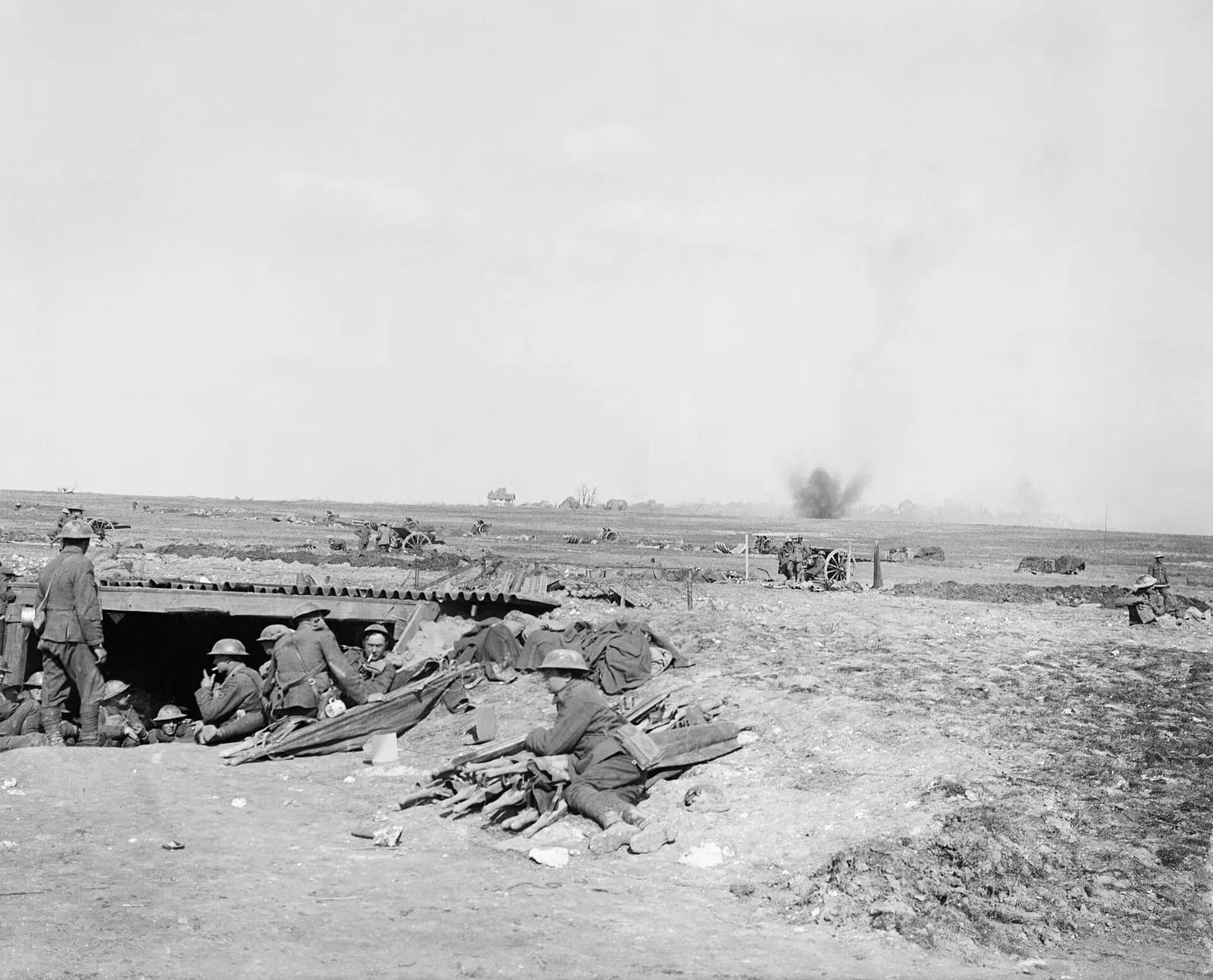
The Second Battle of the Scarpe was the second great British attack in the Battle of Arras. After an eight-day pause, on St George’s Day, the feast of England’s patron saint, nine divisions of General Edmund Allenby’s Third Army and General Henry Horne’s First Army attacked on both sides of the river Scarpe, from Croisilles to Gavrelle. This time there was no question of surprise, and the Germans already had a new, deep defensive system based on strong counter-attacks. Many of those who took part called it the hardest day they had lived through since the start of the war. After two days the British had taken Guémappe, Gavrelle and the ridge above the Cojeul valley, but Rœux and the chemical works on the Scarpe remained in German hands, and losses were high. The attack was renewed mainly because the French offensive on the Aisne, which had not brought the promised breakthrough, had to be supported.
Name and dates
The name “Second Battle of the Scarpe” and the dates 23–24 April 1917 were fixed after the war by the British Battles Nomenclature Committee. It is one of several phases into which the British divide the Battle of Arras: after the First Battle of the Scarpe and the Battle of Vimy Ridge (9–14 April), and before the Battle of Arleux (28–29 April), the Third Battle of the Scarpe (3–4 May) and the Battle of Bullecourt (3–17 May). Formally it was an operation of the Third Army, joined only by the right wing of the First Army at Gavrelle. The British official history, written by Cyril Falls, also describes under this heading the unsuccessful attack on La Coulotte near Lens. Some of the fighting, for example for the buildings of Cavalry Farm on the Cambrai road and at Monchy, went on until 25 and 26 April.
Background
The first week of the Battle of Arras brought the British their greatest success since the start of trench warfare. On 9 April they took Vimy Ridge and advanced along the Scarpe as far as Fampoux, and on 11 April they captured the hill with the village of Monchy-le-Preux. Then the attack lost momentum. Exhausted divisions attacked in snow and mud, separately and without adequate support from the artillery, which had not managed to get across the churned-up ground. On 15 April three divisional commanders of VI Corps, in the unusual form of a joint “resolution”, spoke out against further isolated attacks, and Douglas Haig ordered a pause to prepare a coordinated attack on a broader front.
On 16 April Haig gathered the commanders of the First, Third and Fifth Armies at Saint-Pol. The new attack was to start on 20 April, but because of bad weather and insufficiently cut wire it was postponed to 23 April. Horne declared that his First Army could not yet storm the whole line at Oppy, and its task was limited to taking Gavrelle and a local attack north of Vimy Ridge. General Hubert Gough’s Fifth Army was only to support its neighbours with artillery fire. At the same time, on 16 April, General Robert Nivelle’s French offensive on the Aisne began, for which the attack at Arras had been only a preparation. Its results fell far short of the promises, and the French government began to waver. Haig believed that the Germans must not be given time to recover and that the British had to tie down their reserves as long as the French were fighting.
The Germans did not waste this pause. After the defeat of 9 April Colonel Fritz von Loßberg, the best German expert in defensive fighting, became chief of staff of the Sixth Army. In front of the Drocourt–Quéant line (Wotanstellung) he had a new position built, Rouvroy–Fresnes–Boiry, in front of it a forward zone 1.5–2 km deep, and behind it divisions intended solely for counter-attacks (Eingreifdivisionen), one for every two front-line divisions. The front line now often ran a few hundred metres behind the crest, where it was hard to locate. The commander of the Sixth Army, General Ludwig von Falkenhausen, who was blamed for keeping the reserves too far back on 9 April, was recalled and appointed governor-general of Belgium. He was succeeded by General Otto von Below. According to some sources he took command on 23 April itself, and according to the Canadian official history only on 28 April.
Plan and forces
The objectives were modest, at least when measured in distance. The first line (Blue Line) was a belt running from the Hindenburg Line beyond the Sensée stream, across the ridge above Chérisy and the western part of Hill 100, known as Infantry Hill, east of Monchy, to Rœux and the chemical works on the Scarpe and the centre of the village of Gavrelle. The second (Red Line) included the Bois du Sart wood, the village of Pelves, Greenland Hill and the whole of Gavrelle. South of the Scarpe the attack was made by General Thomas Snow’s VII Corps (33rd, 30th and 50th Divisions) and General Aylmer Haldane’s VI Corps (15th (Scottish), 29th and 17th Divisions); north of the river by General Charles Fergusson’s XVII Corps (51st (Highland) and 37th Divisions) and, from the First Army, General Walter Congreve’s XIII Corps with the 63rd (Royal Naval) Division.
For two nights before the attack the artillery shelled German batteries, dugouts and ravines with gas shells. The creeping barrage was fired by 18-pounder field guns alone, one for every 18 metres of front, and moved forward 90 metres every four minutes. About twenty tanks could be assembled from those that had survived the first days of the battle. The largest number, five, went to the 51st Division, which was to take Rœux. The situation, however, was quite different from 9 April. The German artillery on the battle front was now more numerous than before the battle began (according to Falls the number of field guns had risen from 419 to 548, and of medium howitzers from 148 to 244) and much less well reconnoitred. The German divisions were fresher than the British ones, four of which had already fought on 9 April.
Course
23 April, morning. The attack went in at 4.45 a.m. along the whole front. A thick mist, thickened by smoke from the shells, lasted until about eight, after which came a bright, almost hot day. The German barrage came down almost immediately, and in many places it was the artillery, not the machine guns, that inflicted the heaviest losses. On the right flank the 33rd Division advanced along the trenches of the Hindenburg Line, and one of its battalions, supported by a tank that destroyed concrete machine-gun nests one after another, went forward almost 2 km and took hundreds of prisoners. Before noon, however, German counter-attacks cut off the forward companies, and a detachment that had crossed the Sensée was driven back. The 30th Division reached the German front line and was decimated there. The 50th (Northumbrian) Division took its first objective at Wancourt Tower and more than 600 prisoners, but a counter-attack at about 11 a.m. drove it back to its starting positions.
To its north the 15th (Scottish) Division, after two hours of fighting for every trench, drove the Germans out of Guémappe. When a counter-attack threw back its neighbour, the battalions of the Seaforth Highlanders had to withdraw from the village, but their outposts to the north and east of it held on, and the Germans never returned to Guémappe. The 29th Division east of Monchy reached almost all of its first objective on the slope of Infantry Hill and beat off the morning counter-attack. Things went worse for the 17th Division between Monchy and the Scarpe. A hidden outpost of the German 26th Division, one of the best in the army, spotted its troops assembling in the Lone Copse valley half an hour before the attack, and the assault collapsed under fire.
The heaviest fighting took place by the river itself. The 51st (Highland) Division attacked Rœux, where the village, the château, the railway station and the chemical works formed one great fortress. It was helped by tank C.7 of Second Lieutenant Victor Smith, which drove into the village with the infantry and fired 200 rounds from its 6-pounder guns into the windows of houses held by the Germans. The Scots cleared Rœux, although every officer of one of the battalions was killed or wounded, and at 11.05 a.m. a Seaforth battalion took the chemical works. German counter-attacks, however, pushed them out of most of the village, and after sunset a battalion of the reserve 208th Division retook the works and the station. To the left of the Scots the 37th Division reached the Rœux–Gavrelle road, and its 111th Brigade even the Plouvain–Gavrelle road, advancing 1.4–1.8 km.
On the First Army’s flank the 63rd (Royal Naval) Division, made up partly of sailors fighting as infantry, attacked Gavrelle, although during the night it had turned out that the wire was not well cut. The Drake and Nelson Battalions passed through the few gaps in the wire, and the Hood Battalion, commanded by Commander Arthur Asquith, son of the former prime minister Herbert Henry Asquith, moved off close behind them to avoid the German barrage. After street fighting the division took the whole village and reached its eastern edge, but could not take the windmill on the hill beyond Gavrelle, which the Germans considered more important than the village itself. By evening it had beaten off several strong counter-attacks.
23 April, afternoon and evening. At about 2.25 p.m. Allenby ordered the first objective to be taken that same day “at all costs”. At 4 p.m. the Germans struck in strength at the 29th Division at Monchy and partly pushed back its right flank. The evening attack at about 6 p.m. succeeded in only one place: rested battalions of the 50th Division, together with the remnants of the morning’s attackers, retook the hill at Wancourt Tower, and the exhausted Germans surrendered in groups. One battalion of the 15th Division went through its own barrage and reached the first objective on the Cambrai road, but had to fall back. The 17th Division, now under fire also from Rœux across the river, did not gain a single metre.
24 April. At dawn it turned out that the Germans had withdrawn in the Hindenburg Line sector. The 33rd, 30th and 50th Divisions occupied the first objective, advancing about 1.4 km, and in the centre as much as 1.6 km. They were joined by the companies cut off the previous day, which had held out surrounded all night. The 15th Division came almost up to Cavalry Farm, and the 3rd Division, which had relieved the 29th during the night, approached the first objective at Monchy. At Gavrelle the Germans bombarded the village all through midday, and at 3.30 p.m. about three battalions, including fresh ones from the 1st Guard Reserve Division, advanced from Mauville Farm in ten waves. The attackers, with the sun in their eyes, were perfectly visible to the British artillery. The first waves were swept away, and the rest were stopped by the defenders’ machine guns, although single groups reached the houses of Gavrelle. The artillery of the 63rd Division alone fired 78,000 shells in 48 hours. With that the battle ended, although the fighting for Cavalry Farm and the trenches at Monchy went on for another two days.
The attack north of Vimy Ridge, on the sector of La Coulotte and Hill 65 near Lens, ended on 23 April in complete failure. The wire had not been cut, and the machine-gun nests in the buildings had survived the bombardment. By evening both attacking divisions, the 5th and the 46th, were back in their starting positions.
Losses
The British official history writes that the losses were smaller than might have been expected. The Third Army reported more than 8,000 killed, wounded and missing for the week of 18–25 April, to which must be added the losses of the First Army’s 63rd Division, and from which those of the days preceding the battle must be subtracted. The Canadian official history gives about 10,000 men for the whole Second Battle of the Scarpe. The Third Army took 2,264 Germans prisoner, and the 63rd Division 479. German losses were also very heavy. The 141st Infantry Regiment of the 35th Division alone, shattered at Wancourt Tower, lost 1,089 men, more than two-thirds of its fighting strength, and the Bavarian 18th Infantry Regiment, which defended Guémappe, 808. Two British officers, Captain David Hirsch of the 50th Division and Captain Arthur Henderson of the 33rd Division, were posthumously awarded the Victoria Cross.
Significance
The Second Battle of the Scarpe showed that the period of easy gains at Arras was over. Haig and Allenby had the impression that German resistance was weakening, but the British official history considers that a detailed analysis of the fighting does not bear this out at all. According to Falls, nine British divisions faced nine German divisions and one independent regiment, so the attackers had superiority only in artillery, although it is usually assumed that an attack needs a two- or threefold superiority. For this reason Falls considers that, despite the setbacks, the British achievement was noteworthy. The defenders were helped by Loßberg’s new system, that is a thinly held forward zone and counter-attacks by reserve divisions, which took back the attackers’ gains before they could dig in. It cost them dearly, however, especially at Gavrelle, where they repeated bloody counter-attacks although it would have been enough to hold the rear line.
The ground won, especially the ridge between Rœux and Gavrelle and the slopes above the Sensée, had tactical value, but a breakthrough was no longer in question. For Haig the attack was above all the fulfilment of an obligation to an ally: as long as the French were attacking on the Aisne, the British had to tie down the German reserves at Arras. The following attacks, on 28 April at Arleux and on 3 May on the Scarpe, carried out by the same tired divisions against an ever better prepared defence, achieved less and less at ever greater cost.
Spotted a mistake?Report an error