Key event
Second Battle of the Scarpe begins
- Category:
- Military operations
- Front:
- Western Front
- Date:
- 23 April 1917
- Author:
- Natalia
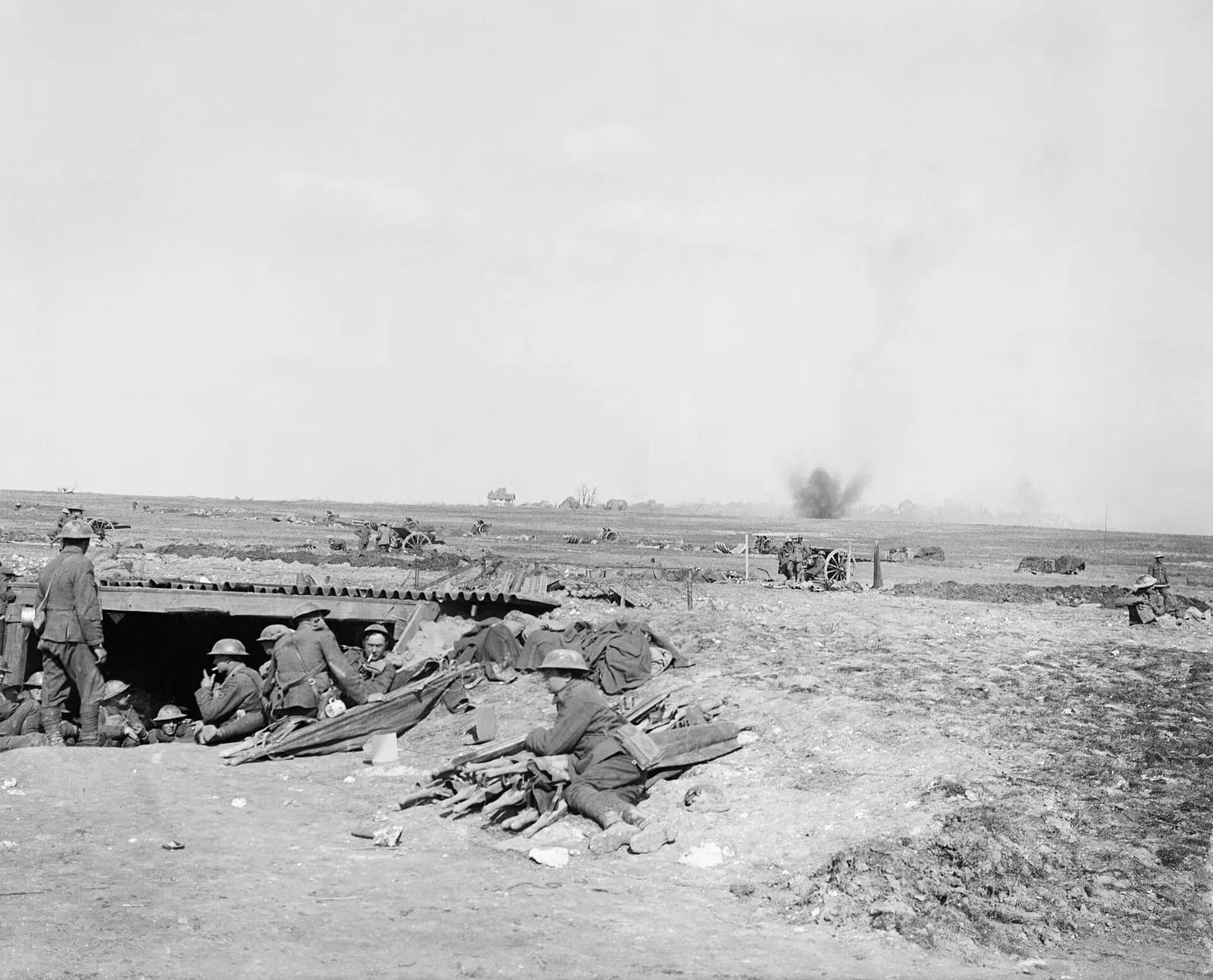
At 4.45 a.m. on 23 April 1917, after an eight-day pause, the British infantry went over the top again at Arras. On a front of about 15 km, from Croisilles to Gavrelle, on both banks of the river Scarpe, nine divisions of General Edmund Allenby’s Third Army and the right wing of the First Army moved forward. It was St George’s Day, the feast of England’s patron saint, and also one of the bloodiest days of the Battle of Arras. The British official history records that many participants called this fighting the hardest they had experienced since the beginning of the war. By evening the British had taken Gavrelle and Guémappe, but almost everywhere else German counter-attacks had taken back what they had won in the morning.
Why they attacked again
The first week of the Battle of Arras was a great success for the British: on 9 April the Canadians took Vimy Ridge, and the Third Army advanced several kilometres along the Scarpe. Then the attack bogged down in snow and mud, and on 14 April Douglas Haig ordered a pause. The British offensive, however, was only part of a larger plan. Its task was to draw in German reserves ahead of the main French offensive on the Aisne, which General Robert Nivelle launched on 16 April. That offensive did not bring the promised breakthrough within 48 hours, and in Paris there was growing talk of breaking it off. On 16 April the French Minister of Munitions, Albert Thomas, warned Lloyd George that France would not agree to protracted, bloody fighting of the kind seen on the Somme. On 20 April a conference in Paris nevertheless decided to continue operations.
Haig did not want to give the Germans time to recover and believed that as long as the French were fighting, the British had to pin down the enemy at Arras. The attack was planned for 20 April, but bad weather and insufficiently cut wire forced a postponement. The commander of the First Army, General Henry Horne, managed to prepare only an attack on Gavrelle, and the Fifth Army at Bullecourt was merely to support its neighbours with fire. The objectives were modest: the ridge above the Sensée valley, Infantry Hill beyond Monchy-le-Preux, the village of Rœux with its chemical works on the Scarpe, and Gavrelle on the road to Douai. This time, however, surprise was out of the question. The German artillery was more numerous than on 9 April, and the new chief of staff of the Sixth Army, Colonel Fritz von Loßberg, had had time to rebuild the defences. The front line was thinly held, while in the rear divisions waited, ready for an immediate counter-attack.
Morning: fog and counter-attacks
A dense mist hung over the damp ground, and the smoke of the shells turned it into an impenetrable screen. It cleared only at about eight o’clock, and a bright, warm day followed. The German barrage came down almost at the same moment as the British one. On the right wing the 33rd Division advanced along the trenches of the Hindenburg Line towards the Sensée stream. A battalion of the Suffolk Regiment, supported by a tank that drove along the trench destroying one concrete machine-gun post after another, advanced almost 2 km, taking hundreds of demoralised prisoners. Between 10 and 11 a.m. the Germans counter-attacked and cut off the forward companies, and a small party that had crossed the Sensée was driven back in the afternoon. The 30th Division reached a German trench and was decimated there. The 50th (Northumbrian) Division took its first objective by the ruins of the Wancourt tower, over which bitter fighting had raged for a week, and sent more than 600 prisoners to the rear, but just before 11 a.m. a counter-attack pushed it back to its starting positions.
North of the Cojeul stream Scottish soldiers of the 15th Division advanced from trench to trench for two hours until they drove the Germans out of Guémappe. When a counter-attack threw back the neighbouring 50th Division, they had to abandon the ruined village, which for several hours belonged to no one. Their outposts on its edge held out, however, and the Germans never returned there. The 29th Division east of Monchy almost reached its objective on the slope of Infantry Hill. A rocket signalled that the ridge by the Wancourt tower had been cleared, and field artillery batteries raced at a trot and a gallop into the valley below Monchy. Many witnesses saw such a sight for the first time in this war. The Germans immediately covered the new positions with fire, but the gun crews held on.
The heaviest fighting took place on the Scarpe itself. The 51st (Highland) Division stormed Rœux, where the village, the château, the station and the chemical works formed a single fortress. The Scots were helped by tank C.7 of Second Lieutenant Victor Smith, which drove into the village and fired about two hundred shells into the windows of the houses from which the Germans were shooting. The Highlanders cleared Rœux, although one of the battalions lost all its officers, and at 11.05 a.m. a battalion of the Seaforth Highlanders took the chemical works. The Germans, however, retook the village house by house, and their battalion commander, who had earlier withdrawn, turned back with a handful of men when he saw a white rocket over Rœux, a sign that his soldiers were still holding out there.
The capture of Gavrelle
Gavrelle was taken by the 63rd (Royal Naval) Division of the First Army, the same division that had fought at Gallipoli in 1915 and on the Ancre in the autumn of 1916. Its battalions bore the names of great admirals: Drake, Nelson, Hood, Anson. During the night before the attack it turned out that the wire in front of the village was not properly cut, but the divisional commander refused to call off the attack: the men were to find the gaps themselves. Companies of the Drake and Nelson battalions passed through gaps in the wire and took the German trench. The Hood Battalion, commanded by Commander Arthur Asquith, son of the former prime minister, moved off right behind them so as not to be caught by the German barrage. After fierce street fighting the sailors and the army battalions accompanying them, among them the 4th Battalion of the Bedfordshire Regiment, took the whole village and reached its eastern edge. Further they could not go: they were raked by machine guns from the windmill on the rise beyond the village, which the Germans regarded as more important than Gavrelle itself. The commanders on the spot judged a further advance to be madness and decided to hold what they had taken. By evening they had beaten off several strong counter-attacks, and the division had taken 479 prisoners.
Afternoon and evening
At 2.25 p.m. Allenby ordered the first objective to be taken that same day “at all costs”. At 4 p.m. the Germans struck in strength at the 29th Division at Monchy and pushed back part of its right wing. The evening attack at about 6 p.m. succeeded only on the 50th Division’s sector: the remnants of the morning’s units, reinforced by fresh battalions, retook the hill by the Wancourt tower, and exhausted Germans surrendered in groups. At Rœux it was the other way round. After sunset a battalion of a German reserve division recaptured the chemical works and the station, and the Scots held only the western edge of the village. To their left the 37th Division, despite fire from the chemical works, advanced 1.4–1.8 km as far as the road from Plouvain to Gavrelle. North of Vimy Ridge a local attack by the 5th and 46th Divisions on German trenches near Lens broke down in front of uncut wire.
In the evening Allenby ordered the first objective to be consolidated and preparations made for an attack on the second, but he soon had to change his orders: the first objective had been reached only in the centre of the 29th Division’s front. The British official history judged that the greatest credit that day belonged to the 15th and 50th Divisions, and remarked with a wink that, although so hard-fought a battle suited St George’s Day, the Scottish 15th Division did not happen to regard him as its patron.
What came next
The next day the Germans withdrew in the Hindenburg Line sector, and the British divisions on the right wing occupied the first objective. At Gavrelle the sailors beat off a great counter-attack in the afternoon, whose successive waves the artillery took as targets as if on an exercise. According to the British official history, the Third Army alone took 2,264 prisoners in two days. For gaining between a few hundred metres and 2 km of ground, however, the British paid, according to various estimates, from more than 8,000 to about 10,000 killed, wounded and missing. Rœux, the chemical works and Infantry Hill remained in German hands. Haig announced further attacks, because the future of the offensive depended on whether the French would go on fighting on the Aisne.
Remember the articles you have read? Only in this browser; nothing is sent anywhere.How it works
Read ·
A voice from the front
“On April 9 Tarbet was killed by a sniper about 11 A.M. while out in the open reconnoitring the approach to the Boche second line. […] On the whole, that day was an absolute picnic. The only trouble was that the Boche ran back too fast in our particular sector […]. Such, however, has not been the case everywhere since. He is fighting desperately hard now.”
Spotted a mistake?Report an error
Meanwhile
(04)Elsewhere in the same days.
- 24 April 1917 · Balkan FrontBattle of Doiran beginsOn the evening of 24 April 1917 the British attacked Bulgarian positions west of Lake Dojran. The Bulgarians, forewarned, repelled most of the attack.
- 25 April 1917 · PoliticsAfonso Costa prime minister for the third timeOn 25 April 1917 Afonso Costa became head of the Portuguese government for the third time, replacing Almeida's "Sacred Union" with a cabinet of Democrats only.
- 20 April 1917 · DiplomacyTurkey breaks off relations with the USOn 20 April 1917 the Ottoman Empire, as Germany's ally, broke off diplomatic relations with the United States. Ambassador Elkus was then ill with typhus.
- 20 April 1917 · War at seaClash of Swift and BrokeOn the night of 20/21 April 1917 the British leaders Swift and Broke caught German torpedo boats in the Dover Strait and sank two of them, G 42 and G 85.
Related events
(04)The same battle, people or subject.
- 14 April 1917 · Western FrontFirst Battle of the Scarpe endsOn 14 April 1917 at Arras a German counter-attack shattered two battalions east of Monchy. The British halted, ending the first stage of the battle.
- 9 April 1917 · Western FrontBattle of Arras (1917) beginsOn Easter Monday, 9 April 1917, the British and Canadians attacked at Arras. In one day they advanced 5 km and took thousands of prisoners.
- 3 May 1917 · Western FrontThird Battle of the Scarpe beginsAt 3.45 a.m. on 3 May 1917, still in darkness, three British armies struck again at Arras. They failed almost everywhere. Only the Canadians succeeded.
- 9 June 1917 · Western FrontCurrie takes command of the Canadian CorpsOn 9 June 1917 General Arthur Currie officially succeeded Julian Byng in command of the Canadian Corps. He was the first Canadian to lead the whole corps.