Germany · The Central Powers
Manfred von Richthofen
Fighter pilot, commander of the fighter squadron Jagdstaffel 11 (1917) and the fighter wing Jagdgeschwader 1 (1917–1918)
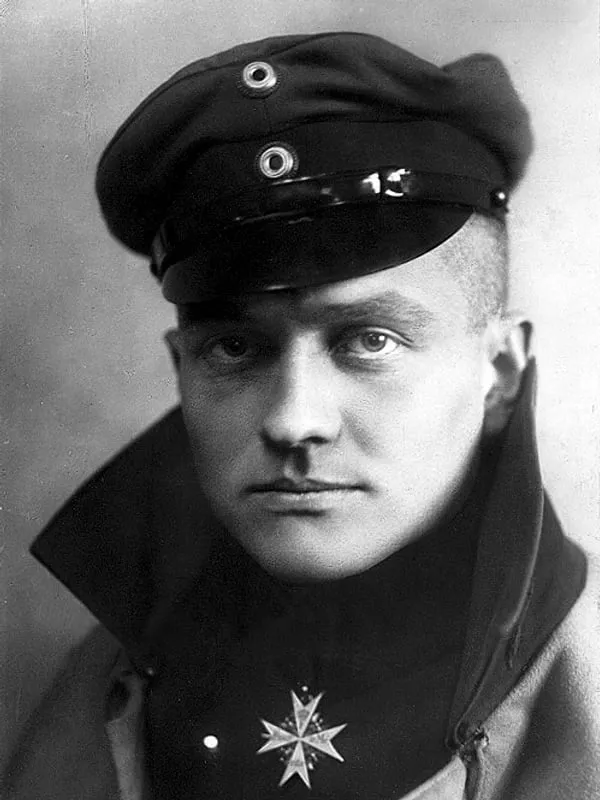
- Born:
- 2 May 1892, Kleinburg near Breslau, today Borek in Wrocław (Silesia, Prussia)
- Died:
- 21 April 1918, Near Vaux-sur-Somme (France)
- Author:
- Łukasz Skowroń
- Photo:
- C. J. von Dühren, domena publiczna, Wikimedia Commons

Manfred von Richthofen was the most successful fighter pilot of the First World War and one of its most recognisable figures. Between September 1916 and April 1918 he was credited with 80 victories, more than anyone else, and exceptionally well documented ones at that. A pupil of Oswald Boelcke, he became a model commander: his squadron inflicted the heaviest losses on the British in Bloody April 1917, and the fighter wing he later led was known to the Allies as the “Flying Circus”. The red colour of his aircraft and propaganda made him a German national hero. He was killed on 21 April 1918 over the Somme valley, aged 25. The nickname “the Red Baron”, under which he went down in history, became widespread mainly after the war. He was born and grew up in Silesia, in lands that became part of Poland after 1945.
Before the war
He was born on 2 May 1892 in Kleinburg, a suburban village near Breslau, today the Borek district of Wrocław, into a Prussian noble family. His father, Albrecht, was a professional officer with the rank of major. Manfred had an elder sister, Ilse, and two younger brothers, Lothar and Bolko. As a child he moved with his family to Schweidnitz (Świdnica) (sources differ on the year), where he grew up. In his memoirs he wrote that the people of Schweidnitz regarded him as one of their own. At the age of eleven, following family tradition, he entered the cadet school at Wahlstatt, today Legnickie Pole, and then the Main Cadet Institute at Lichterfelde near Berlin. He was not a diligent pupil, but he excelled at sport.
In 1911 he joined the 1st Uhlan Regiment “Emperor Alexander III”, garrisoned in Militsch, today Milicz, and was assigned to its squadron in Ostrowo, today Ostrów Wielkopolski. In November 1912 he was commissioned as a Leutnant.
Cavalryman and observer
In the first days of the war his regiment entered the Kingdom of Poland and took Kalisz. Richthofen rode on patrols deep into Russian territory, and when he failed to return for several days, word spread across Silesia that he had been killed near Kalisz. A few weeks later the regiment was transferred west, to France and Belgium. When the front settled into the trenches, the cavalry became redundant and the uhlans were used as dispatch riders and telephone operators. Bored, Richthofen asked for a transfer to the air service and in May 1915 began training as an observer.
In the summer of 1915 he flew as an observer on the Eastern Front, over Galicia during the offensive that began with the breakthrough at Gorlice, and then in Belgium and Champagne. On 1 October 1915 he met Boelcke by chance on a train, already a famous Fokker pilot by then, and decided to become a pilot himself. He struggled through his training and crashed on his first solo flight. In 1916 he flew two-seat combat aircraft over Verdun, where on 26 April he shot down a French aircraft, which was not credited to him because it fell on the enemy side. In the summer his unit was moved to Volhynia, near Kovel, from where it bombed Russian railway stations. There, in August, Boelcke visited him; he was forming one of the first German fighter squadrons and offered him a place in his Jagdstaffel 2.
Fighter ace
Richthofen scored his first confirmed victory on 17 September 1916 over the Cambrai area, in the first fight of Boelcke’s squadron, when he shot down a British F.E.2b. To commemorate each victory he ordered from a Berlin jeweller a silver cup engraved with the date and the type of the enemy aircraft. On 28 October he witnessed the death of Boelcke, who collided with a comrade’s aircraft in combat. On 23 November, after a long duel over the Somme, he shot down Major Lanoe Hawker, one of the most famous British airmen. On 12 January 1917, after his sixteenth victory, he received the Pour le Mérite and took command of Jagdstaffel 11. At about that time he had his Albatros D.III painted red.
In the spring of 1917, during the battle of Arras, his squadron became the terror of British airmen. In April it shot down 89 aircraft according to the tallies, and Richthofen himself more than twenty, including four in a single day, on 29 April. On 13 April, with his 41st victory, he surpassed Boelcke’s score. Promoted to Rittmeister, on 1 May he went home to Germany on several weeks’ leave. In June he took command of Jagdgeschwader 1, the first German fighter wing, made up of four squadrons. The wing moved by rail and lorry to wherever it was most needed, and its brightly painted aircraft led the British to call it the “Flying Circus”.
The wound and the last months
On 6 July 1917, over Flanders, in a fight with British F.E.2ds, Richthofen was shot in the head. For a moment he was blinded and lost control of his body, but he managed to land. The bullet did not penetrate the skull, but it left an open wound that never fully healed. Against his doctors’ advice, Richthofen returned to his wing after less than three weeks, and to combat in mid-August. He suffered from headaches and nausea, those around him noticed that he had become taciturn and depressed, and in the autumn he had to take a long period of sick leave. In 1917 his memoirs, “Der rote Kampfflieger” (“The Red Fighter Pilot”), were published, written at the behest of the propaganda service and heavily censored. He later distanced himself from them, saying he was no longer so insolent. At the end of August 1917 he was one of the first to receive the new Fokker Dr.I triplane, with which he is most often associated today, although he scored only 19 victories in it.
In the spring of 1918 his wing supported the great German offensive in the west, Operation Michael. In March and April Richthofen shot down more than a dozen further aircraft, and on 20 April he reached 80 victories. The next morning, while chasing a young Canadian pilot low over the Somme valley, he flew over the positions of Australian troops and was killed, hit by a single bullet in the chest. The British credited the victory to the Canadian Captain Arthur Roy Brown, but most researchers today believe that he was killed by fire from the ground. Australian airmen buried him with military honours on 22 April at Bertangles near Amiens. Command of the wing passed, in accordance with his written instruction, to Wilhelm Reinhard, and in the summer of 1918 to Hermann Göring.
After his death
His younger brother Lothar, also an ace with 40 victories, survived the war and died in 1922. In the early 1920s the French moved Manfred’s remains to the German military cemetery at Fricourt, and in November 1925 they were ceremonially reburied in Berlin’s Invalidenfriedhof, in the presence of President Paul von Hindenburg. In 1975 they were moved to the family grave in Wiesbaden. In 2009 his death certificate was found in the archives of the civil registry office in Ostrów Wielkopolski, where he had been stationed before the war.
Assessment
Richthofen remains the best-known airman of the war, but his legend has several layers. Aviation historians stress above all that he was an outstanding commander and teacher, faithful to Boelcke’s rules: he attacked with deliberation, from an advantage of height and at close range, and he forbade young pilots rash pursuits. His score is among the best verified: research in British records has made it possible to match most of his victories to specific enemy losses. Many researchers, however, link his death to his breaking of his own rules and wonder whether the effects of his wound of July 1917 contributed to it.
Even in his lifetime Richthofen was a tool of propaganda, and after his death his image continued to be exploited, especially in the Third Reich, when Göring, the last commander of his wing, became head of the Luftwaffe. Since 1961 one of the Bundeswehr’s air force wings has borne his name. To British and Australian airmen he was a respected opponent, and to popular culture, from films to comics, the embodiment of “chivalrous” war in the air. In post-war Poland his Silesian roots were long passed over in silence. In the 21st century Świdnica began to commemorate its most famous resident with a plaque on the family’s former house, a mural and a replica of the triplane, although commemorating a German war hero also raised doubts.
Sources
Spotted a mistake?Report an error
Mentioned in battles
(02)Often appears with
People who appear in the same events.