Germany · The Central Powers
Oswald Boelcke
Fighter pilot, commander of the fighter squadron Jagdstaffel 2 (1916)
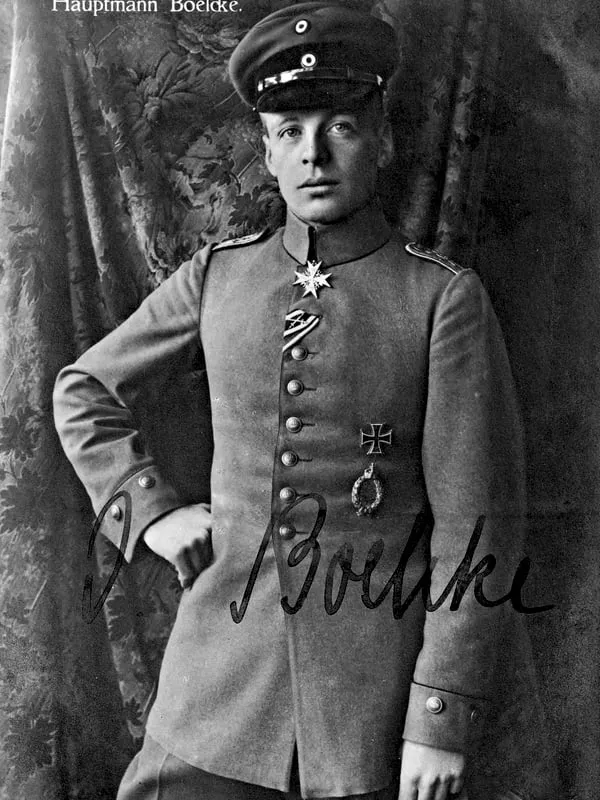
- Born:
- 19 May 1891, Giebichenstein near Halle (Germany)
- Died:
- 28 October 1916, Near Bapaume (France)
- Author:
- Natalia
- Photo:
- Willi Sanke, domena publiczna, Wikimedia Commons

Oswald Boelcke was the first airman to understand that fighting in the air was a separate kind of war, requiring its own tactics, its own units and special training. In the autumn of 1915, flying a Fokker monoplane with a machine gun firing through the propeller, he and Max Immelmann became the heroes of the “Fokker Scourge”, and in January 1916 the two of them were the first airmen to receive the Pour le Mérite. In the summer of 1916 he set down the rules of air combat known as the “Dicta Boelcke” and advised gathering fighters into separate squadrons. He himself took command of one of the first of them, Jagdstaffel 2, which wrested air superiority over the Somme from the British. When he was killed in an accident on 28 October 1916, he was 25 years old and had 40 confirmed victories, more than any other pilot in the world. His pupils, led by Manfred von Richthofen, fought by his rules for the next two years.
Before the war
Oswald Boelcke (originally Bölcke) was born on 19 May 1891 in Giebichenstein, today a district of Halle, the son of a grammar-school teacher. The family had returned to Germany from Argentina only half a year before his birth. He spent his childhood and youth in Dessau, where he finished grammar school. He suffered from asthma from childhood, yet he was an excellent sportsman: a gymnast, swimmer, rower and mountaineer. In 1911 he joined a telegraph battalion in Koblenz as an officer cadet. Flying had long attracted him, and in May 1914 he followed in the footsteps of his elder brother Wilhelm, an aviation officer, when he was sent on a pilots’ course at Halberstadt.
Reconnaissance pilot
He passed his pilot’s examination in mid-August 1914 and went to the Western Front, to a flying unit in which his brother was an observer. The brothers flew together over the front on reconnaissance missions, and Oswald quickly earned a reputation as an exceptional pilot. When disputes arose in the unit, the brothers were separated, and in the spring of 1915 Oswald was posted to the newly formed Feldflieger-Abteilung 62, which was moved to Douai. On 4 July 1915, still flying a two-seat reconnaissance aircraft, he won his first victory: after a half-hour fight his observer shot down a French aircraft.
Fokker
In the summer of 1915 the first Fokker E.I monoplanes began to reach squadrons at the front. They were neither faster nor more manoeuvrable than Allied aircraft, but they had a machine gun synchronised with the propeller, so that the pilot aimed with the whole aircraft. Boelcke and his squadron comrade Max Immelmann were among the first to receive them. On 1 August, when the British bombed their airfield, they took off after them together. Boelcke’s gun jammed, and the first victory went to Immelmann. Boelcke shot down his first aircraft in a Fokker at the end of the summer (sources give 19 August or 19 September 1915). Thus began the “Fokker Scourge”, a period in which a handful of German fighters took a bloody toll of British and French reconnaissance aircraft.
Boelcke was no ordinary marksman. He analysed every fight, attacked from above and out of the sun, opened fire at close range and, contrary to the bans meant to protect the secret of the Fokker, ventured over the enemy’s lines. At the end of August he jumped into a canal and saved a drowning French boy, for which he received the Prussian life-saving medal. The German press made him and Immelmann national heroes, and their rivalry over the number of victories became a public affair. On 12 January 1916, after the eighth victory of each of them, Emperor Wilhelm II awarded both the Pour le Mérite, the highest Prussian military decoration. They were the first airmen to receive it.
Verdun
Before the German offensive at Verdun Boelcke was sent to a secret unit near Metz, and in March 1916 he took over a small detachment of six fighters at a forward airfield at Sivry on the Meuse, barely a dozen or so kilometres behind the front. He connected it by telephone with an observation post in the front line, so that the pilots took off when the enemy approached instead of patrolling endlessly. It was one of the first fighter control posts. The detachment belonged to the 5th Army, and Boelcke became friends with its commander, Crown Prince Wilhelm, whose headquarters were at nearby Stenay. In March he became the first airman in history to reach ten victories.
Over Verdun, however, the Germans soon lost their advantage. The French sent their best pilots there in the new Nieuport 11 biplanes, faster and more manoeuvrable than the Fokker, and began to fly in groups. In the spring of 1916 the “Fokker Scourge” came to an end. Boelcke saw this more clearly than the high command. In a memorandum in March he called the German use of aviation “pathetic” and proposed changes, and in a report on the new Fokker he pointed out its faults. In May, after further victories, the Emperor promoted him to captain in defiance of the regulations. He was only 25 and the youngest captain in the German army.
Dicta Boelcke
On 18 June 1916 Immelmann was killed. The German high command did not want to risk losing a second hero and banned Boelcke from combat flying. He then had 19 victories. He was sent to the chief of field aviation, Lieutenant-Colonel Hermann Thomsen (von der Lieth-Thomsen), who was preparing a reorganisation of the air service. Boelcke then set down his experience in eight short rules that went down in history as the “Dicta Boelcke”. Among other things he advised securing an advantage before attacking and, where possible, attacking out of the sun; carrying through an attack once begun; opening fire only at close range and only when the opponent was squarely in the sights; never losing sight of the opponent; attacking from behind; and, when attacked from above, not fleeing but turning to face the enemy. The last rules concerned fighting in a group: over the enemy’s lines a pilot was to keep his line of retreat in mind, and in a group to attack in fours or sixes, taking care that two pilots did not go after the same opponent. These principles, later circulated to all German fighter pilots, became the basis of air combat tactics and in various versions survived in military aviation for decades.
More important than the rules was his organisational proposal. Boelcke advised not to scatter fighters a few at a time among reconnaissance units, but to gather them into separate squadrons that would fight together and gain superiority at a chosen point. The high command adopted the idea. In July Boelcke left on a tour of inspection to the Balkans and Turkey, where he met, among others, Enver Pasha and Otto Liman von Sanders, and visited the Gallipoli battlefield. On the way back, in August, he visited his brother near Kovel, where he received a summons to the Western Front. An order of 10 August 1916 created the first fighter squadrons (Jagdstaffeln), and Boelcke was to organise one of them, Jagdstaffel 2, from scratch. He was allowed to choose his own pilots. At Kovel he picked two from his brother’s squadron: the young cavalryman Manfred von Richthofen and the 37-year-old Erwin Böhme.
Jagdstaffel 2 over the Somme
Since July 1916 the British had ruled the skies over the Somme. Their reconnaissance aircraft directed artillery fire freely, while Airco DH.2 fighters and French Nieuports forced the German airmen onto the defensive. Jagdstaffel 2 was formed at the end of August near Bertincourt, at first without aircraft. Boelcke flew alone in an older machine and shot down one opponent after another, among them on 15 September, the day of the first tank attack, when he shot down a British captain over Havrincourt Wood. At the same time he trained his pilots: he taught them to fly in formation, in pairs of leader and wingman, and went over every flight with them.
On 16 September the squadron received the new Albatros D.I and D.II biplanes, faster, better climbers and armed with two synchronised machine guns. The next day Jagdstaffel 2 flew into its first fight as a compact unit and shot down several British aircraft. Richthofen won his first confirmed victory that day. In the following weeks Boelcke’s squadron, together with other new fighter units, changed the situation in the air over the Somme. The British suffered ever heavier losses, and German reconnaissance airmen could operate again. On 8 October the Emperor created the post of commanding general of the German air service, and the new command circulated the “Dicta Boelcke” to all squadrons. In October Boelcke shot down eleven aircraft, and on 26 October he won his fortieth victory.
Death
He was, however, exhausted. He was flying several times a day, suffered from asthma and, according to his comrades, was depressed. On the afternoon of 28 October 1916 six pilots of Jagdstaffel 2 attacked two British DH.2s of No. 24 Squadron over the area of Bapaume. Boelcke and Böhme were chasing one of them when the other, fleeing from Richthofen, flashed between them. Both pulled up their machines and, screened by their wings, could not see each other. The undercarriage of Böhme’s aircraft grazed the upper wing of Boelcke’s Albatros. The damaged wing lost its lift, and the aircraft spun down to earth next to a German artillery battery. The impact was not very violent, but Boelcke had neither his straps fastened nor a helmet on and was killed instantly. Böhme, who landed safely, long could not come to terms with what had happened.
A memorial service was held on 31 October in Cambrai Cathedral in the presence of the Crown Prince of Bavaria, Rupprecht. A British aircraft dropped a wreath over the German lines with the dedication “To the memory of Captain Boelcke, our brave and chivalrous foe”. He was buried on 2 November in Dessau with the honours due to great commanders. His squadron was thereafter named Jagdstaffel Boelcke.
Assessment
Boelcke is widely regarded as the creator of fighter tactics and one of the fathers of fighter aviation in general. He was not the most successful ace of the war: his score of 40 victories was surpassed in April 1917 by Richthofen, and later by others. Aviation historians stress, however, that he was the first to combine a pilot’s skills with the thinking of an organiser and teacher. His rules and the idea of fighter squadrons gave the Germans superiority over the Somme in the autumn of 1916 and in “Bloody April” 1917, and of the first fifteen pilots he chose for Jagdstaffel 2, eight became aces. Richthofen, who called him his master, wrote that Boelcke had no personal enemies and was equally courteous to everyone. The respect his opponents showed him also made him a symbol of the “chivalrous” war in the air. This image was later exploited by propaganda: in the Third Reich his name was given to a Luftwaffe unit, and today it is borne by one of the wings of the Bundeswehr’s air force.
Sources
Spotted a mistake?Report an error
Mentioned in battles
(01)Often appears with
People who appear in the same events.