Germany · The Central Powers
Philipp Scheidemann
Chairman of the SPD parliamentary group in the Reichstag (from 1913) and party co-chairman (from 1917), state secretary without portfolio (1918), member of the Council of the People's Deputies, Chancellor (1919)
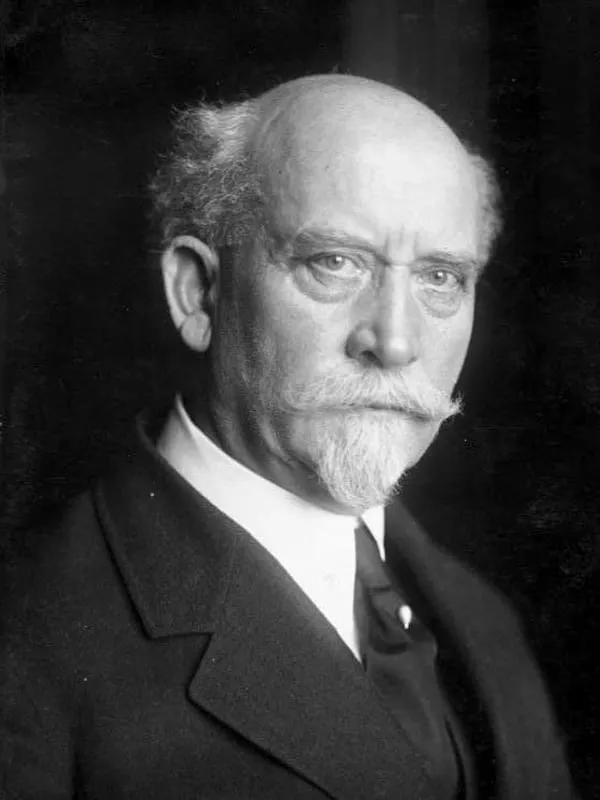
- Born:
- 26 July 1865, Kassel (Prussia)
- Died:
- 29 November 1939, Copenhagen
- Author:
- Natalia
- Photo:
- autor nieznany, domena publiczna, Wikimedia Commons

Philipp Scheidemann, a printer from Kassel who became one of the finest speakers in the German parliament, was throughout the war, alongside Friedrich Ebert, the most important leader of the Social Democratic Party of Germany. He supported the war credits, but more loudly than anyone else in the party he demanded peace without annexations, so that his name became a slogan: the “Scheidemann peace”. In October 1918 he became the first Social Democrat in history to enter the Reich government. On 9 November 1918, without consulting Ebert, he proclaimed the German republic from a window of the Reichstag. That single gesture made him a symbol of the new state and, in the eyes of his enemies, a symbol of the “November betrayal”.
Before the war
He was born on 26 July 1865 in Kassel into the family of a master upholsterer. After his father’s early death the family fell into poverty. Philipp trained as a printer and, while the Anti-Socialist Laws were still in force, joined the printers’ union and the then illegal Social Democratic organisation. He was self-taught, read and wrote a great deal. From 1895 he worked as an editor of party newspapers in Gießen, Nuremberg, Offenbach and Kassel. In 1903 he won a Reichstag seat in the Solingen constituency, and in 1911 he joined the party executive.
In 1912, when the Social Democrats became the largest group in the Reichstag, Scheidemann was elected vice-president of the chamber. As the first Social Democrat in that role, however, he refused to pay the customary visit to the Emperor, so in practice he did not take up the office. He was known for sharp speeches against the Hohenzollerns. After one of them, in 1912, the Chancellor Theobald von Bethmann Hollweg ostentatiously walked out of the chamber. At a rally in Paris that same year he assured the French socialists that the German workers would defend themselves “with the courage of despair” against those who wanted to drag Europe into war. After the death of August Bebel in 1913 he became one of the chairmen of the parliamentary group, alongside Hugo Haase. In the party he was regarded as a man of the centre, and contemporaries stressed his oratorical talent, humour and bourgeois manners, which contrasted with Ebert’s gravity.
Credits and peace without annexations
In August 1914 Scheidemann supported the war credits and the policy of the “Burgfrieden” (civil truce). He believed that Germany had to defend itself and that the Social Democrats could not abandon the fatherland in its hour of danger. In January 1915 he was indignant at those comrades who could not bear the word “fatherland”. At the same time he became the best-known advocate in the party of a negotiated peace. His formula “what is French should remain French, what is Belgian Belgian, and what is German German” enraged the annexationists, who accused him of high treason. Later, activists of the extreme nationalist German Fatherland Party threatened to hang him. A peace without annexations or indemnities was called in Germany the “Scheidemann peace”. His name also became a term of abuse: the right, and later the far left, called the Social Democrats who supported the government “Scheidemänner”.
Even so, he could not prevent a split in the party. From January 1916 he led the parliamentary group together with Friedrich Ebert. In March 1916 it was he who defended the budget in the Reichstag on behalf of the party majority, while Haase spoke against him, which led to the expulsion of the oppositionists from the group. In April 1917 the Independent Social Democratic Party of Germany was founded. Even the Social Democratic organisation in Solingen went over to it, and called on Scheidemann, in vain, to give up his seat.
1917: the peace resolution and Stockholm
In the spring of 1917, after the February Revolution in Russia and with the workers’ growing misery, the Social Democrats began to demand the introduction of the promised reforms. Scheidemann held talks with the liberal Conrad Haußmann and the National Liberal Gustav Stresemann about forming a parliamentary majority that would demand a government responsible to the Reichstag. He assured his bourgeois partners that parliamentarism could be reconciled with the monarchy. In June 1917 he headed the Social Democratic delegation in Stockholm, where socialists from neutral countries were trying to convene an international peace conference. The conference never took place, partly because the Entente governments refused passports to their socialists.
On 19 July 1917 the new majority, the Social Democrats, the Centre and the Progressives, passed the peace resolution in the Reichstag, calling for a negotiated peace without forced annexations. In the debate on it Scheidemann spoke of the “intrigues” to which Chancellor Bethmann Hollweg had fallen victim. At the Würzburg party congress in October 1917 he became party chairman alongside Ebert. In January 1918, when Berlin was gripped by the strike in the armaments industry, he joined the strike committee together with Ebert and Otto Braun in order to prevent the radicalisation of the workers and bring the protest to a quick end. The right never forgave him for this. That same month, in a Reichstag committee, he criticised Chancellor Georg von Hertling for his reply to Wilson’s peace programme.
In Max von Baden’s government
In the summer of 1918 Scheidemann finally took up the office of vice-president of the Reichstag. In September, as leader of the parliamentary group on the inter-party committee, he helped bring about Hertling’s fall. On the next steps, however, he differed with Ebert. He believed that the Social Democrats could not be forced to put a prince at the head of the government, and as late as 3 October he opposed joining the cabinet “at the moment of the worst situation”. Ebert won over the parliamentary group, and Scheidemann, against his own doubts, became state secretary without portfolio in Prince Max von Baden’s government. He was the first Social Democrat in the Reich government, alongside the trade unionist Gustav Bauer.
In Max von Baden’s government Scheidemann pressed for an amnesty for political prisoners. Against the War Ministry, the military judiciary and the Chancellor’s doubts, he secured in October the release from prison of Karl Liebknecht. At the same time he feared revolution. On 5 November, when the government broke off relations with Soviet Russia, he said that Bolshevism was more dangerous than the external enemy. After the Kiel mutiny he concluded that only the Emperor’s abdication could save the country from chaos. On 6 November he told his comrades that the party now had to place itself at the head of the movement, or else Germany would sink into anarchy. On 7 November the Social Democrats presented the government with an ultimatum.
9 November
On the morning of 9 November Scheidemann resigned as state secretary. At noon the Chancellor handed over his office to Ebert. In the early afternoon, while Scheidemann was having lunch in the Reichstag restaurant, he was told that the Spartacist leader Karl Liebknecht intended to proclaim a soviet republic. Not wanting to leave the initiative to the far left, at about 2 p.m. he went to a window of the Reichstag building and addressed the crowd. He announced that the old order had collapsed, the Hohenzollerns had abdicated and Ebert was Chancellor, and ended with the cry: “Long live the German republic!”. The best-known version of this speech, with its words about the “rotten and decayed” old order and the end of militarism, is a later reconstruction, recorded by Scheidemann on a gramophone record in 1920. Ebert, who wanted to leave the decision on the form of government to a national assembly, was furious. Two hours later Liebknecht proclaimed a “free socialist republic”, but it was Scheidemann’s proclamation that went down in history.
From 10 November Scheidemann sat on the Council of the People’s Deputies, where he was responsible mainly for finance. On Christmas Eve he supported Ebert’s decision to have the army attack the mutinous sailors in the Berlin Palace. After the Christmas fighting, banners accusing Ebert, Landsberg and Scheidemann of murder were carried at the sailors’ funeral.
After the war
On 13 February 1919 Scheidemann became head of the first government formed by the National Assembly in Weimar, a coalition of the Social Democrats, the Centre and the liberal Democrats. On 12 May 1919, speaking of the peace terms, he asked in the Assembly: “What hand would not wither that put such fetters on itself and on us?”. When it became clear that the treaty would have to be signed and his government could not reach agreement, he resigned on 20 June 1919. From 1919 to 1925 he was Lord Mayor of Kassel, and until 1933 a member of the Reichstag. In 1922 he survived an assassination attempt by members of the far-right Organisation Consul, who sprayed prussic acid in his face. In 1926 he revealed in the Reichstag the secret cooperation between the Reichswehr and the Red Army. After Hitler came to power he fled the country and from 1935 lived in Denmark. He died on 29 November 1939 in Copenhagen. After the war his ashes were brought back to Kassel.
Assessment
Historians portray Scheidemann as a pragmatic politician, a brilliant speaker and a man popular beyond his party, but a less able tactician and organiser than Ebert. During the war he tried to reconcile the two wings of the party, defence of the country with the pursuit of peace, and although he did not succeed, his “peace without annexations” became the programme of the Reichstag majority. The proclamation of 9 November was a spontaneous act, not agreed with Ebert, but according to many historians it took the initiative away from the far left and settled that Germany would become a republic. For the right Scheidemann was from then on the embodiment of the “November criminals”, for the Communists one of the “Scheidemänner” who had betrayed the revolution. His wartime diaries, 26 volumes of notes from 1914–1919, were confiscated by the Nazi police in 1933 and lost.
Sources
Spotted a mistake?Report an error
Often appears with
People who appear in the same events.