Germany · The Central Powers
Rüdiger von der Goltz
Commander of the German Baltic Division and "German General in Finland" (1918), commander of German forces in Latvia (1919)
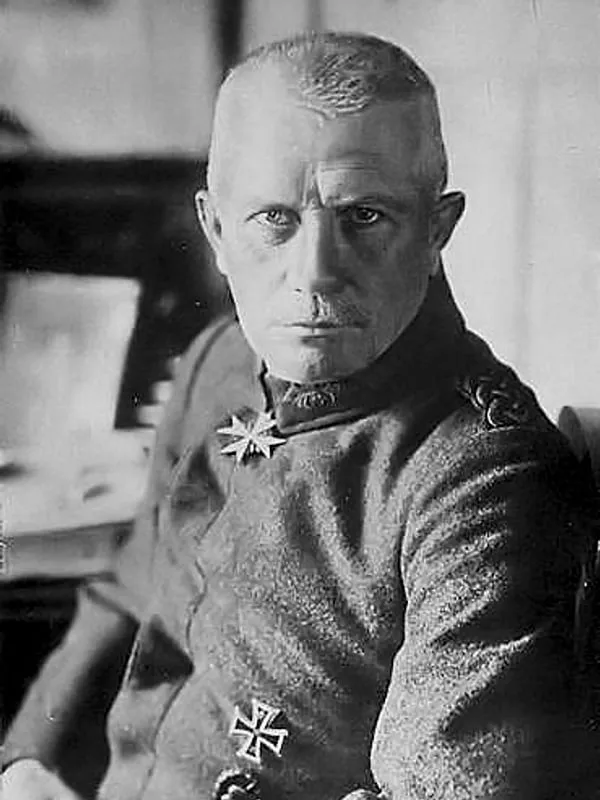
- Born:
- 8 December 1865, Züllichau, now Sulechów (Prussia, now Poland)
- Died:
- 4 November 1946, Bernbeuren (Bavaria)
- Author:
- Łukasz Skowroń
- Photo:
- WSOY, domena publiczna, Wikimedia Commons

Count Rüdiger von der Goltz, of the same widely branched Prussian family as Field Marshal Colmar von der Goltz, was for most of the war one of many capable commanders of regiments, brigades and divisions on the Western and Eastern Fronts. Fame came to him only in 1918. In the spring he led the German Baltic Division across the Baltic; it helped the Finnish Whites win the civil war and captured Helsinki, and for the next eight months he was the man in Finland whose opinion the regent, the government and the army had to reckon with. After the war, in 1919, he commanded German volunteers in Latvia, where he moved from fighting the Bolsheviks to an attempt to subordinate the country to the Baltic Germans. These last two roles made him one of the symbols of German ambitions on the Baltic at the end of the war.
Before the war
He was born on 8 December 1865 in Züllichau, now Sulechów, into the family of a Prussian Landrat. He spent his youth in Potsdam. In 1885 he joined the 1st Foot Guards Regiment, graduated from the War Academy and served for thirteen years on the General Staff, interrupted only by command of a company and a battalion. Among other posts he worked in the English section, and in 1905–1906 he was first staff officer of the corps in Magdeburg, then commanded by Paul von Hindenburg. He was a man of firm convictions: a monarchist, an enemy of social democracy and a believer in strict discipline. In 1914, as a colonel, he commanded the Hamburg 76th Infantry Regiment.
Western and Eastern Fronts
He marched with the regiment through Belgium. He fought at Mons on 23 August, and on 6 September, the first day of the Battle of the Marne, he was wounded in the leg at Esternay. In his memoirs he described how in Belgium his soldiers had fought inhabitants who had allegedly fired on them. This story of Belgian francs-tireurs was repeated by many German officers, and historians long ago showed that it served to justify mass executions of civilians. The autumn of 1914 brought him personal blows: one son was killed and another lost a leg. After four weeks, with his wound not yet healed, he returned to the front, and at the end of November he took over the Mecklenburg 34th Infantry Brigade near Noyon.
In May 1915 he was transferred to the east, to the 5th Guards Infantry Brigade near Przasnysz. His brigade was in the first line of the attack of 13 July 1915 that opened the Battle of the Narew and Biebrza: it broke through the Russian positions, took Różan and forced the Narew. Then, in continuous fighting, it advanced eastwards as far as south of Vilna. Goltz wrote that those three months of advance were his finest memories of the war. In the autumn of 1915 the division returned to the west, to Vimy.
In June 1916 he took over the 1st Guards Infantry Brigade in the division commanded by the Kaiser’s son, Prince Eitel Friedrich. In the same year he was promoted to major general. In the summer the brigade fought defensively on the Somme between Maurepas and Cléry, and in the autumn near Péronne. In April 1917, during the French Nivelle offensive, it fought on the Chemin des Dames. In mid-1917 Goltz received an independent command, the East Prussian 37th Infantry Division, and in the autumn he held its positions when the French routed the neighbouring divisions in the Battle of La Malmaison. As his memoirs show, he was a demanding commander who did not hesitate to call for the death penalty for desertion, and he received the Reichstag Peace Resolution of July 1917 with indignation.
The expedition to Finland
In February 1918 Goltz was given command of the 12th Landwehr Division, which at first looked like a demotion. At headquarters in Kreuznach, however, he learned that its staff and picked units would form the Baltic Division (Ostsee-Division), which would cross to Finland and help the Whites there. He himself wrote that an independent landing of a division overseas was a task no German general had yet been given. After the landing on the Åland Islands in March, ice forced the Germans to change their plan. On 3 April the division, about 9,500 men, landed at Hanko on the southern tip of Finland. Erich Ludendorff ordered him to advance not inland but along the coast towards Helsinki.
On 12–13 April, after street fighting, the Germans took Helsinki, and on 14 April Goltz rode at the head of a parade across Senate Square. General Carl Gustaf Mannerheim, the White commander-in-chief, to whom the Germans were formally subordinate, had opposed this, because he wanted to take the capital himself. In practice Goltz commanded independently. His division and the detachment of Colonel Otto von Brandenstein, which had landed near Loviisa, moved north and east, took Hämeenlinna and Lahti, and at the beginning of May closed the road east to the columns of Reds fleeing from the south of the country. At Lahti, according to German estimates, about 30,000 Red Guards and refugees surrendered. Finnish historians judge that the German intervention did not in itself decide the war, since the decision came at Tampere, but that it shortened it considerably. On 15 May Goltz received the Pour le Mérite.
German General in Finland
After the civil war Goltz stayed in Finland. In the summer the Kaiser gave him the title of “German General in Finland”. He took up residence in the former palace of the Russian governor-general in Helsinki, and Finnish politicians, led by the regent Pehr Evind Svinhufvud and the prime minister Juho Paasikivi, often came to him rather than he to them. According to Finnish studies, General Hannes Ignatius, quartermaster of the White army, wrote in a letter to the envoy in Berlin that Goltz was “the real regent of Finland” and the rest were puppets. German officers were to build a new conscript army. Mannerheim, who did not agree to this, stepped down at the end of May. Goltz and his circle also backed the plan for a monarchy with a German prince on the throne, which led in October to the election of Prince Frederick Charles of Hesse as King of Finland.
Goltz thought of Finland as a base against the Entente and the Bolsheviks. His troops guarded the Karelian Isthmus and the eastern border, and his staff reconnoitred the ground for future operations against the Murmansk railway, where the British were stationed. The British general Charles Maynard in Murmansk feared that Goltz was behind the Finnish volunteers in Karelia who were routed in September at Ukhta. In his memoirs Goltz claimed that in August 1918, on the orders of the Supreme Army Command, he had prepared an attack on Petrograd on both sides of the Gulf of Finland, with the participation of the fleet, and that the operation was halted at the wish of the Foreign Office because of the Supplementary Treaty with Soviet Russia. He also held unofficial talks with Russian monarchists. The claims of a ready plan of attack are known mainly from his own account.
Germany’s defeat ended this role. When news of the Kiel mutiny and the revolution in Berlin arrived in November, Goltz sent the mutinous sailors home and requested the return of his soldiers before the sea froze and before the British appeared in Finland. The Entente demanded the removal of German influence. On 16 December 1918 the last units, together with the general, sailed from Helsinki for Stettin, seen off, by his account, by about 25,000 people.
Latvia 1919
As early as 1 February 1919 Goltz was in Libau as military governor, and soon he took over the VI Reserve Corps, made up of the remnants of regular units and volunteer Freikorps (PL), among them the Iron Division. The Baltic German Landeswehr cooperated with him. The Armistice of Compiègne allowed the Germans to remain in former Russian territory for as long as the Allies thought necessary, because the Western powers feared a march by the Red Army. In the spring Goltz drove the Bolsheviks out of western Latvia, but in April Landeswehr units, with at least his tacit approval, overthrew the government of Kārlis Ulmanis and put the pastor Andrievs Niedra at the head of the country. On 22 May his troops took Riga, where mass executions of real and alleged communists began. In June he advanced north against the Estonians and Latvians, but was defeated at Cēsis. The Allies forced Berlin to recall the troops, and Goltz, who was handing units over to the command of the White Russian Pavel Bermondt-Avalov, gave up his command in October 1919 and returned to Germany.
After the war
In March 1920 he took part in the Kapp Putsch. He was then active in nationalist veterans’ and youth associations, chaired the United Patriotic Associations of Germany, and in 1931 joined the Harzburg Front of the right and the National Socialists. He returned to Finland many times, in 1933 as a guest of honour at the celebrations of the fifteenth anniversary of the capture of Helsinki. He died on 4 November 1946 on his Kinsegg estate in Bernbeuren in Upper Bavaria.
Assessment
In White Finland, right up to the Second World War, Goltz was regarded as a liberator who had come to help in an hour of danger, and his troops were remembered as disciplined. Finnish historians point out that in Helsinki the Germans restrained the Whites from mass executions. At the same time his presence meant the subordination of the young state to Germany: economic, military and political. For the Finnish left he was an occupier and one of the gravediggers of Red Finland, while the moderate Whites, led by Mannerheim, saw in him a man who wanted to turn the Finnish army into an annexe of the German army.
His role in Latvia in 1919 is judged much more harshly. Latvian and Estonian historians see in it an attempt to maintain German dominance over the Baltic against the will of the local nations and against Berlin’s orders, paid for, by Latvian estimates, with the executions of thousands of people. In his memoirs, published in 1920, Goltz himself presented himself as a defender of Europe against Bolshevism, robbed of victory by the politicians in Berlin and the Allies. This legend served the German right well later on, opposed as it was to the Weimar Republic.
Sources
Spotted a mistake?Report an error
Often appears with
People who appear in the same events.