Austria-Hungary · The Central Powers
Franz Joseph I
Emperor of Austria and King of Hungary (1848–1916)
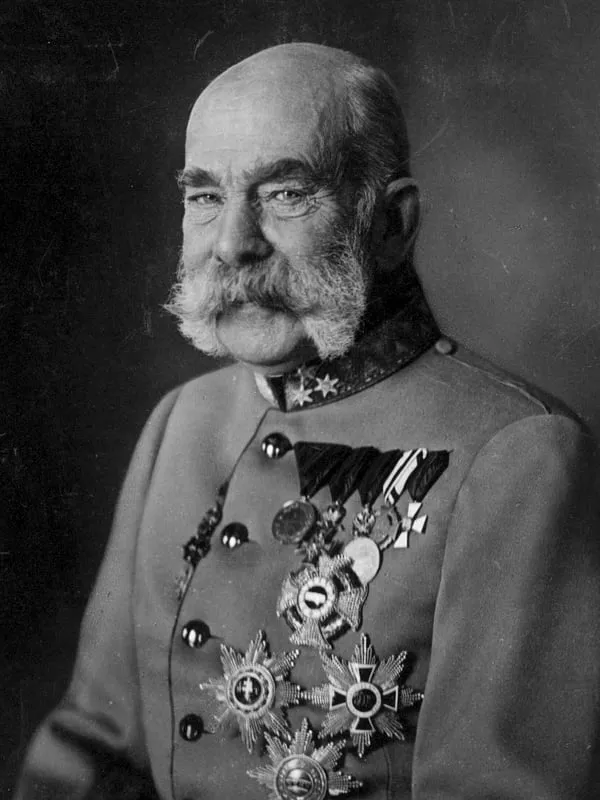
- Born:
- 18 August 1830, Schönbrunn Palace (Vienna)
- Died:
- 21 November 1916, Schönbrunn Palace (Vienna)
- Author:
- Natalia
- Photo:
- Carl Pietzner, domena publiczna, Wikimedia Commons

In 1914 Franz Joseph I was the oldest monarch in Europe. He had reigned since 1848, and for most of his subjects he was the only ruler they had ever known. He was regarded as the embodiment of the multinational monarchy and as an emperor of peace who, after the defeats of his youth, had avoided wars for almost half a century. Yet it was he, as the supreme authority in the state, who in the summer of 1914 approved the ultimatum to Serbia and signed the mobilisation orders and the declaration of war that drew Europe into a world war. During the war, too old to command, he placed the army in the hands of Archduke Friedrich and General Conrad, and made the monarchy ever more dependent on Germany. He died in November 1916, living to see neither victory nor the fall of his state.
Before the war
He was born on 18 August 1830 at Schönbrunn Palace, the son of Archduke Franz Karl and Archduchess Sophie of Bavaria. He ascended the throne at eighteen, on 2 December 1848 in Olmütz, during the Spring of Nations, when his uncle, Emperor Ferdinand I, abdicated. The first years of his reign were spent suppressing the revolution, especially in Hungary, and in absolute rule. In 1859 Austria lost Lombardy, and in 1866, after the defeat at Königgrätz, it was excluded from Germany and gave up Venetia. In 1867 the emperor concluded the Compromise with Hungary, which created Austria-Hungary, and was crowned King of Hungary.
From then on the monarchy sought influence in the Balkans. In 1878 it occupied Bosnia and Herzegovina, in 1879 it concluded an alliance with Germany, and in 1908 Franz Joseph proclaimed the annexation of Bosnia, which deeply alienated Serbia and Russia. The emperor defended the dualist system and rejected projects for reshaping the state, including the plans of the heir to the throne, Franz Ferdinand. National disputes paralysed the parliament in Vienna. His personal life brought him many blows: the execution of his brother Maximilian in Mexico in 1867, the suicide of his son Rudolf in 1889 and the assassination of his wife Elisabeth in 1898. For the Poles of Galicia he was the monarch under whose reign the province gained broad autonomy, Polish offices and schools, and Kraków and Lviv became centres of Polish culture.
The emperor usually restrained the advocates of war. In 1911 he admonished the Chief of the General Staff, Franz Conrad von Hötzendorf, who kept demanding a preventive war with Italy or with Serbia, that policy was made by him alone and that it was a policy of peace. Soon afterwards Conrad lost his post, although he returned to it in 1912.
The July Crisis
On 28 June 1914 in Sarajevo Archduke Franz Ferdinand was killed together with his wife. The emperor was then at his summer residence in Bad Ischl. According to the diary of his aide-de-camp, General Eduard Paar, he is said to have remarked that the Almighty cannot be challenged and that a higher power had restored the order he himself had been unable to maintain. He was referring to his nephew’s morganatic marriage, whose children had no right to the throne. He returned briefly to Vienna, and after a modest funeral, to which no foreign monarchs were invited, he left again for Ischl.
The decisions of the following weeks were prepared by the Foreign Minister, Leopold Berchtold, Conrad and the Hungarian Prime Minister, István Tisza, but the last word belonged to the emperor. His handwritten letter to Wilhelm II, dated 2 July, declared that the government’s aim must be the isolation and diminution of Serbia, which had to be eliminated as a political factor in the Balkans. On 5 July in Potsdam Vienna’s envoys received from the Kaiser an assurance of full support. Franz Joseph then approved the ultimatum, delivered to Serbia on 23 July. When the joint Finance Minister, Leon Biliński, warned him that the note would provoke a European war, the emperor is said to have replied that Russia could not accept it.
On the evening of 25 July, after the breaking off of relations with Serbia, he signed the order for partial mobilisation at Bad Ischl. On 28 July he approved the declaration of war on Serbia, sent by telegram to Niš, and signed the manifesto “To My Peoples!”, in which he wrote that he had examined and weighed everything and with a calm conscience was setting out on the path that duty pointed out to him. On 31 July, after the Russian mobilisation, he ordered general mobilisation, and on 6 August the monarchy declared war on Russia.
The emperor in wartime
The 84-year-old monarch could not command. Supreme command of the army was assumed in his name by Archduke Friedrich, and operations were directed by Conrad, to whom Friedrich left a free hand. The emperor, living at Schönbrunn, read reports daily, received ministers and signed appointments, but rarely interfered in operational matters. The news from the front was bad. In August the troops of General Oskar Potiorek were defeated in Serbia, and in September Conrad’s armies in the Battle of Galicia lost Lviv and most of Galicia. According to the Austrian official history, Franz Joseph, in a conversation with Conrad, predicted that Russia would not yet consider itself beaten. On 2 December, the 66th anniversary of his accession, Potiorek reported to him the capture of Belgrade, but within two weeks the Serbs had driven the invaders out.
The Austrian parliament had not sat since the spring of 1914, and the Prime Minister, Karl Stürgkh, governed by decree with the emperor’s consent. The military authorities received wide powers, and in many lands of the monarchy, especially among the Serbs, Ruthenians and Czechs, people suspected of disloyalty were persecuted. In January 1915, at Tisza’s request, the emperor replaced Berchtold with István Burián. In the spring, with great reluctance, he agreed to talks on territorial concessions to Italy, but they came too late and offered too little. On 23 May 1915 Italy declared war on the monarchy. In a new manifesto “To My Peoples!” the emperor wrote: “The King of Italy has declared war on Me”, and called it a perfidy unknown to history.
In 1915, after the breakthrough at Gorlice, the armies of the Central Powers recovered Galicia. Mackensen, in a telegram, laid recaptured Przemyśl at his feet, and in the autumn Serbia was defeated. The victories, however, were won thanks to the Germans, and in the summer of 1916 the Brusilov offensive shattered the Austro-Hungarian armies in Volhynia and Bukovina. In September 1916 the Central Powers created a joint supreme command under the authority of Wilhelm II, and in practice of the German Supreme Army Command. The monarchy, which the old emperor had defended all his life as an independent great power, was becoming Germany’s junior partner. There was a shortage of bread and coal in the cities, and on 21 October 1916 Friedrich Adler shot the Prime Minister, Stürgkh. One of the emperor’s last important decisions was the appointment of Ernest von Koerber in his place.
The Polish question
The last weeks of Franz Joseph’s reign brought decisions important for the Poles. Under the monarchy’s protection the Polish Legions had been fighting since 1914, with Józef Piłsudski commanding the First Brigade. Some Polish politicians in Galicia counted on the so-called Austro-Polish solution: the union of the Kingdom of Poland with Galicia under the Habsburg sceptre. Germany, on which the monarchy was ever more dependent, would not agree to this. On 5 November 1916, in the name of both emperors, the Act of 5 November was proclaimed in Warsaw and Lublin, announcing the creation of a Kingdom of Poland from the lands taken from Russia. Almost simultaneously a letter from Franz Joseph to Koerber, dated 4 November, was published, in which he announced wider self-government for Galicia. To many Poles this was a sign that Galicia would not be joined to the new kingdom.
Death
The emperor had long suffered from chronic bronchial catarrh, which at the beginning of November 1916 turned into pneumonia. Despite a fever he worked until his last day. He died on the evening of 21 November at Schönbrunn, at the age of 86. According to the most frequently repeated account, his last words to his valet were: “Tomorrow morning at half past three.” The throne passed to his great-nephew Charles I, convinced from the first days that the monarchy had to get out of the war as quickly as possible. On 30 November Franz Joseph was buried in the Capuchin Crypt beside his wife and son. The monarchy outlived him by less than two years.
Assessment
During his lifetime and long after his death Franz Joseph was surrounded by respect and nostalgia as the “old emperor”, a conscientious official on the throne who, tried by fate, held the multinational state together. In Galicia, too, the older generation remembered him as “the Most Serene Lord”. Historians judge him more severely. They point out that for decades he refused any deep reform of the monarchy, so that national disputes grew, and that in 1914, although he knew the risk of war with Russia, he did not restrain the advocates of a reckoning with Serbia, but adopted their plan and gave it force with his signature.
The dispute concerns how far this was a conscious act and how far the fatalistic submission of an old man to his entourage. Some scholars stress that the emperor was fully informed and himself decided that the prestige and future of the monarchy required war. Others draw attention to his age and to the fact that the sentence attributed to him, that if the monarchy must perish, let it at least perish decently, captures his attitude well. The former Prime Minister Ernest von Koerber is said to have remarked that the emperor had done Austria great harm twice: once through his youth and a second time through his old age.
Sources
Spotted a mistake?Report an error
Mentioned in battles
(04)Often appears with
People who appear in the same events.
On the timeline
(23)1879
1882
1908
1914
July
- 25
- Austria-Hungary breaks off diplomatic relations with SerbiaOn 25 July 1914 the Austro-Hungarian minister, Baron Giesl, judged Serbia's reply inadequate, broke off diplomatic relations and left Belgrade.
- Serbian government orders mobilisationOn 25 July 1914, before replying to the ultimatum, Serbia announced general mobilisation, and the authorities began to leave Belgrade.