Key event
Assassination of Prime Minister Stürgkh
- Category:
- Politics
- Date:
- 21 October 1916
- Author:
- Łukasz Skowroń
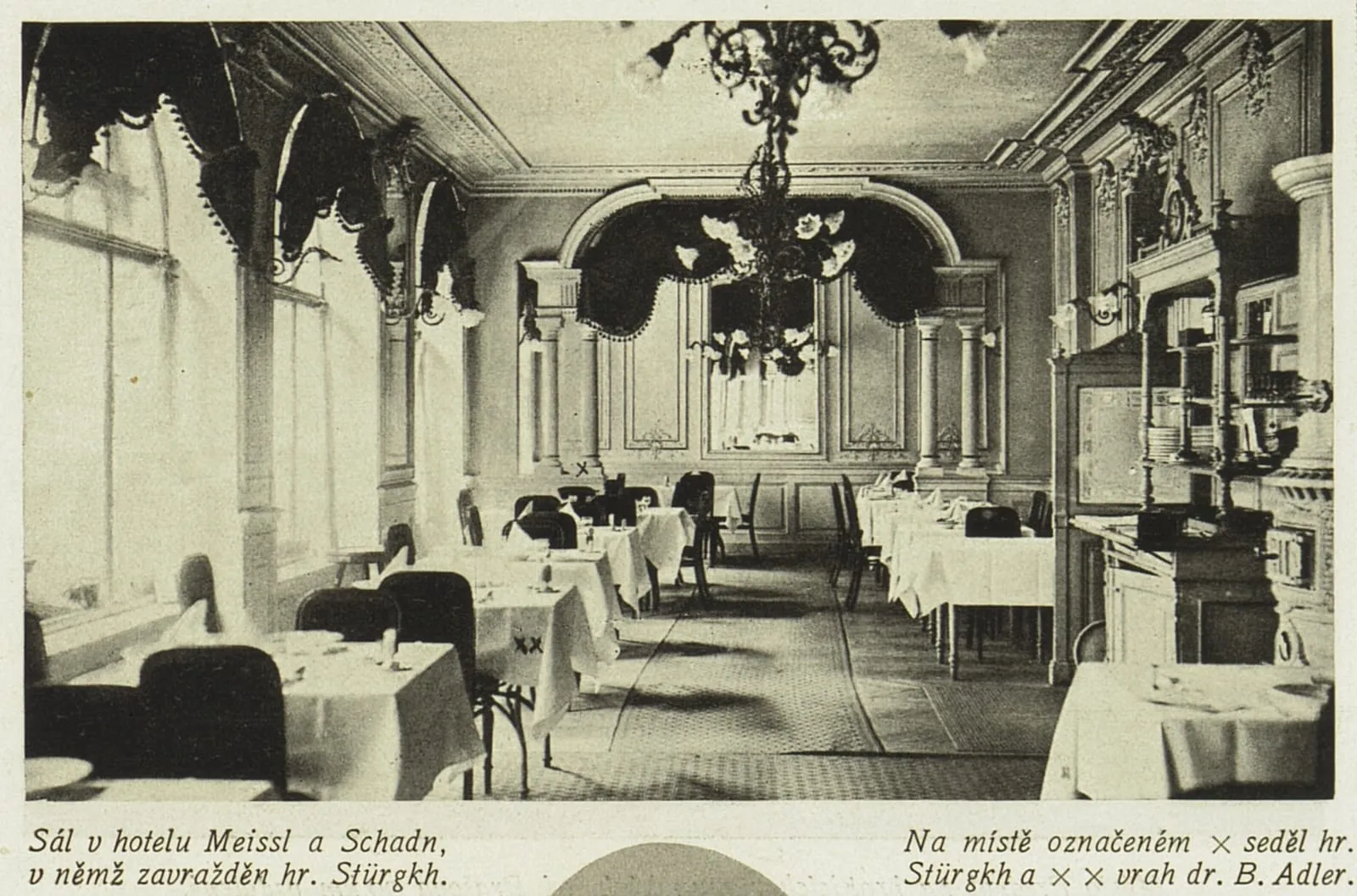
On Saturday 21 October 1916, in Vienna, Count Karl Stürgkh, Prime Minister of the Austrian half of the Habsburg Monarchy, was killed. At lunchtime, in the dining room of the Hotel Meissl & Schadn on the Neuer Markt in the Innere Stadt, he was shot by Friedrich Adler, a Social Democratic activist and the son of the leader of the Austrian socialists, Victor Adler. The assassin made no attempt to flee. He wanted his act to be read as a protest against the government without parliament that Stürgkh had conducted since the spring of 1914, and against the war.
Shots in the Hotel Meissl & Schadn
Meissl & Schadn was one of the best-known hotels in Vienna’s Innere Stadt. Its restaurant was famous for its boiled beef and had regular, well-to-do customers. The Prime Minister was among them. That day Stürgkh sat at a table by the wall in the large first-floor room on the Kärntner Straße side. Adler arrived at lunchtime, easily recognised the Prime Minister, took a seat and waited until the Prime Minister was left alone at his table. As Stürgkh was finishing his meal, Adler walked up and fired several shots from a handgun into his head at close range. Most accounts speak of three shots, some of four; even immediately after the attack this could not be established beyond doubt. Stürgkh was killed on the spot.
According to witnesses, Adler shouted: “Down with absolutism, we want peace!” He offered no resistance and calmly waited for the police. The next day the Viennese Illustrierte Kronen Zeitung carried a drawing of the assassination on its front page. Stürgkh’s body was later taken to the family estate at Halbenrain in Styria (PL) and buried in the family vault.
A prime minister without parliament
Stürgkh came from an old Styrian family of the official nobility. He was born in 1859 in Graz, so he died nine days before his 57th birthday. He was a lawyer and for many years an official of the Ministry of Education, from 1891 a deputy to the Imperial Council for the curia of the great landowners, and in 1909–1911 Minister of Education. Emperor Franz Joseph I appointed him Prime Minister of Cisleithania, the Austrian part of the monarchy, on 3 November 1911, after the fall of Paul Gautsch’s government during the Vienna cost-of-living riots. He was seen as the embodiment of the imperial-royal official, convinced that only strong state authority could save the monarchy.
The Austrian parliament had been paralysed for years by obstruction, especially by Czech deputies, who blocked proceedings with endless speeches. The December Constitution of 1867 gave the government an emergency exit: its Paragraph 14 allowed imperial decrees with provisional force of law to be issued when the Imperial Council was not in session. Stürgkh’s predecessors had already used this loophole. He, however, went further. On 16 March 1914, at his request, the Emperor prorogued the session of the Imperial Council, and from then on the government ruled almost exclusively by decree. The consequences became serious only four months later. During the crisis after the Sarajevo assassination Stürgkh was among the advocates of an armed reckoning with Serbia and supported the hard line of the Foreign Minister Leopold Berchtold and the Chief of Staff Franz Conrad von Hötzendorf, which in mid-July settled the sending of an ultimatum to Serbia. He also saw war with Serbia as a way of severing the ties between Austria’s South Slavs and the Greater Serbian movement. The deputies had no influence whatever on the decision which, at the end of July 1914, drew the monarchy into war.
Wartime absolutism
When on 23 July 1914 Stürgkh informed the government that the ultimatum had been handed to Serbia, the first decisions concerned internal security. The prorogued Imperial Council was formally closed, and the provincial diets were also closed or suspended. Decrees of 25 July suspended a large part of the civil rights guaranteed by the constitution: personal liberty, the inviolability of the home, the privacy of correspondence, freedom of assembly and association, and freedom of the press. Preventive censorship was introduced, and the war could be written about only on the basis of official communiqués. Jury courts, which had until then tried press cases among others, were suspended, and civilians were in many matters placed under military courts. The power of the military War Surveillance Office (Kriegsüberwachungsamt) grew. Tens of thousands of people, mainly Ruthenians, Serbs and later also Italians, were arrested and interned, often on the strength of denunciations alone. It was worst where the army operated, especially in Galicia and in Bosnia and Herzegovina, where arbitrary executions took place.
Month after month of war went by, and parliament still did not sit. Stürgkh brushed aside demands to convene it, raised not only by the opposition but also by influential members of the House of Lords. The German Reichstag and the Hungarian parliament sat during the war, whereas the Austrian Imperial Council did not meet once from March 1914. In the third year of the war there were added ever more serious difficulties in feeding the cities, queues, high prices and war-weariness. On the left Stürgkh acquired the reputation of a “dictator”.
The assassin
Friedrich Adler was 37. He was born in 1879 in Vienna, but his father, fearing his explosive temperament and poor health, sent him to study in Switzerland. In Zurich he studied physics and mathematics, earned a doctorate and became friends with Albert Einstein. In 1909 both applied for the newly created chair of theoretical physics at the University of Zurich, and Adler withdrew in favour of his friend. He chose politics: he edited the socialist daily Volksrecht, and in 1911 returned to Vienna as one of the secretaries of the Social Democratic Party of Austria and editor of its theoretical monthly Der Kampf. Among other things he prepared the congress of the Second International that was to be held in Vienna in August 1914 but never took place because of the war.
The outbreak of war was a double blow for him. The socialists of almost every country supported their own governments, and his party, with his father at its head, adopted the line of defending the fatherland against Tsarist Russia. Adler was one of the few in the party who resolutely opposed this line. In print and at meetings he attacked both Stürgkh, governing by decree, and the leadership of his own party, and became increasingly isolated. On 20 October 1916 he made an exceptionally sharp speech against the party leadership. The next day he reached for a gun. Under investigation he testified that he made the final decision to kill the Prime Minister when the authorities banned a public meeting called for 23 October by politicians of the bourgeois parties. He concluded then that, with parliament closed and the press censored, there was no longer any legal way of expressing protest.
Reactions
The assassination shocked Vienna, but almost everyone judged it the act of a madman. That was the view of the socialists’ opponents, and it was also how the assassin’s family and party reacted in the first days. Friedrich Austerlitz, editor-in-chief of the Social Democratic Arbeiter-Zeitung, wrote that the act was “alien and incomprehensible” to the whole socialist world of ideas, and that Adler was a man who “follows a delusion”. Victor Adler tried to have his son declared insane, which the son firmly opposed. Part of the German-language left-wing press in neutral Switzerland, beyond the reach of Austrian and German censorship, wrote differently: it saw the shots as a final act of resistance to a government that for two and a half years had not allowed parliament to speak.
Stürgkh’s government formally continued. Until the appointment of a new prime minister its work was directed by successive ministers, and a week later Franz Joseph himself named the successor. The eighty-six-year-old Emperor was growing ever weaker. The appointment of the new head of government proved one of his last important decisions: he died at Schönbrunn Palace on 21 November 1916, a month after the killing of his prime minister.
Aftermath
The prosecution wanted a speedy trial and charged Adler as an insane lone perpetrator, but at the defence’s request an opinion of experts from the medical faculty was sought, and the trial took place only on 18 and 19 May 1917 before an exceptional court. Adler, entitled to speak for hours, turned the courtroom into a platform. He accused the government of wartime absolutism, and his own party even more sharply, especially its reformist wing around Karl Renner. He was sentenced to death, but the sentence was not carried out: it was commuted to 18 years’ hard imprisonment, and in the autumn of 1918, in the last days of the monarchy, Emperor Karl I amnestied Adler. He walked free as a hero of the left.
Historians assess the significance of the assassination itself in different ways. It did not directly change the course of the state, and the death of the old Emperor soon overshadowed it in the eyes of the public. It is, however, sometimes linked with the later abandonment of government without parliament and the easing of some wartime restrictions. The assassination and the trial also hastened the Austrian Social Democrats’ turn from full support for the war towards peace slogans, though the party remained united and did not split, as Social Democracy did in Germany. The Imperial Council met again only on 30 May 1917, already under Karl I, after a break of more than three years.
Remember the articles you have read? Only in this browser; nothing is sent anywhere.How it works
Read ·
A voice from the front
“A dozen or so minutes later I walked past that restaurant on my way to Biliński, who was waiting for me in the rooms of the Polish Club. […] “My dear colleague, that bullet was long his due. Whoever stokes the fire under a boiler and shuts the boiler's valve must live to see an explosion... And the ‘old man’ (the Emperor) is not without blame either, for every Sunday they talked over at Schönbrunn what they were to do the whole of the coming week...””
Translated · Original (pl)
W kilkanaście minut potem szedłem koło tej restauracji do Bilińskiego, który mnie oczekiwał w lokalu Koła Polskiego. […] — Panie kolego — ta kula dawno mu się należała. Bo kto pali pod kotłem a zamyka klapę kotła, ten musi doczekać się wybuchu... — A nie jest bez winy i „stary“ (cesarz), bo oni co niedziela omawiali w Schönbrunie, co mają robić na cały przyszły tydzień...
Spotted a mistake?Report an error
Meanwhile
(04)Elsewhere in the same days.
- 20 October 1916 · War at seaExplosion of the battleship Imperatritsa MariyaOn 20 October 1916 the dreadnought Imperatritsa Mariya, flagship of the Black Sea Fleet, blew up and sank at Sevastopol. More than 200 sailors were killed.
- 22 October 1916 · Middle EastEnd of the fighting in the Dakhla OasisOn 22 October 1916 the British finished combing the Dakhla Oasis. More than 130 men of the Senussi order were taken prisoner; the rest fled west.
- 24 October 1916 · Western FrontThe French recapture Fort DouaumontOn 24 October 1916 three French divisions attacked in fog at Verdun. The colonial regiment from Morocco retook Fort Douaumont, lost eight months earlier.
- 18 October 1916 · Western FrontEnd of the Battle of the Transloy RidgesOn 18 October 1916 the British Fourth Army attacked on the Somme before dawn, in rain and mud. It took a few trenches but did not reach Le Transloy.
Related events
(04)The same battle, people or subject.
- 28 October 1916 · PoliticsKörber becomes Austrian prime ministerOn 28 October 1916, a week after Stürgkh was killed, Franz Joseph I made Ernest von Körber, head of government in 1900–1904, prime minister of Austria.
- 21 November 1916 · PoliticsDeath of Franz JosephOn 21 November 1916 the 86-year-old Emperor Franz Joseph I died at Schönbrunn after almost 68 years on the throne. His great-nephew Charles I succeeded him.
- 14 May 1916 · Italian FrontTrentino offensive beginsOn 14 May 1916 Austro-Hungarian artillery opened fire on the Isonzo to distract the Italians. The main blow from Tyrol began at dawn the next day.
- 5 November 1916 · PoliticsAct of 5 NovemberOn 5 November 1916 a manifesto of the German and Austrian emperors was proclaimed in Warsaw and Lublin, promising a Kingdom of Poland without a king or borders.