Poland · The Polish cause
Leon Biliński
Joint Finance Minister of Austria-Hungary (1912–1915), President of the Polish Club in the Imperial Council (1911–1912, 1915–1917), Finance Minister of Poland (1919)
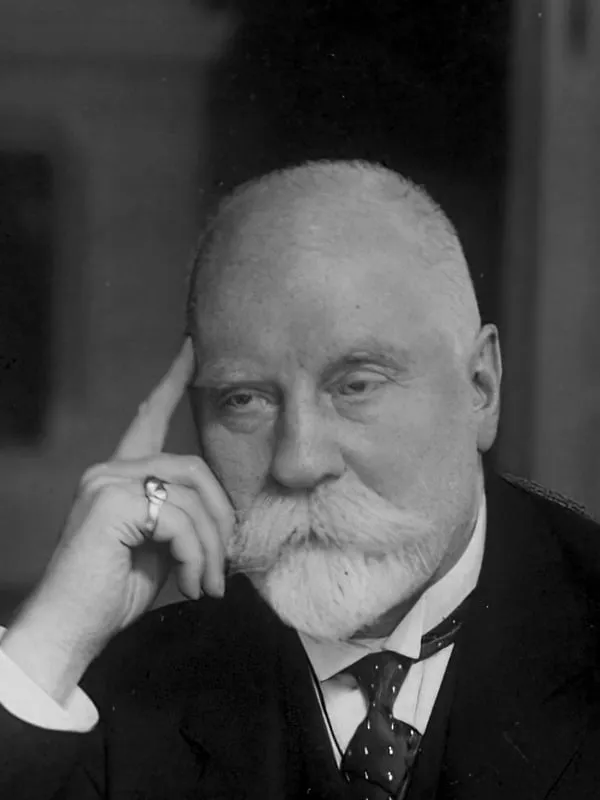
- Born:
- 15 June 1846, Zaleszczyki (Galicia, Austrian Empire)
- Died:
- 15 June 1923, Vienna
- Author:
- Łukasz Skowroń
- Photo:
- Charles Scolik, domena publiczna, Wikimedia Commons

Leon Biliński was one of the Poles who rose highest in the Habsburg monarchy. A professor of economics from Lviv, twice Austrian finance minister and governor of the Austro-Hungarian Bank, in July 1914 he sat as joint finance minister among the men who decided on war with Serbia. As head of the joint finance ministry he also exercised supreme oversight over the administration of Bosnia and Herzegovina, where the heir to the throne was killed on 28 June. During the war he returned to Polish politics: he helped create the political base of the Polish Legions, led the Polish Club (PL) in the Vienna parliament and headed the Supreme National Committee in the last phase of its existence. He belonged to the Austro-Polish camp to the end, and in independent Poland he spent several months of 1919 putting its finances in order.
Before the war
He was born on 15 June 1846 in Zaleszczyki on the Dniester, into a landowning family. He studied law in Lviv, where he took his doctorate in 1867 and his habilitation in economics a year later. From 1871 he was a professor at the University of Lviv, its rector in the academic year 1878/1879, and he played an important part in making the university Polish. He supported women’s access to higher education; in 1897 the first women students graduated from the University of Lviv.
From 1883 he sat in the Vienna Imperial Council and soon became one of the leaders of the Polish Club, a specialist in finance and railways. In the early 1890s he took charge of the Austrian State Railways, in 1895–1897 he was Austrian finance minister in the government of Kazimierz Badeni and carried out a reform of direct taxation, and in 1900–1909 he ran the Austro-Hungarian Bank. In 1909–1910 he was finance minister again. In 1908 he drew up a plan for a Polish-Ukrainian settlement in Galicia, which the Ukrainians rejected. In 1911 he became president of the Polish Club, and in 1912 joint finance minister of Austria-Hungary. The office carried with it supreme oversight over the civil administration of Bosnia and Herzegovina.
Sarajevo and July 1914
Archduke Franz Ferdinand’s visit, linked to army manoeuvres in Bosnia, was prepared by the province’s governor, General Oskar Potiorek, and on the day of the assassination Biliński was in Vienna. In the second half of June the Serbian envoy in Vienna warned him that the visit might provoke some mad act, but so vaguely that no one took it seriously. After the Sarajevo assassination his opponents held Biliński indirectly responsible for having ignored the warning signs.
On 7 July 1914 Biliński took part in the meeting of the Joint Council of Ministers chaired by Leopold Berchtold, which discussed Bosnian affairs and diplomatic action against Serbia. According to the minutes, everyone present except the Hungarian prime minister István Tisza believed that a purely diplomatic success would settle nothing. Biliński, responsible for Bosnia, said that the Serb understood only force, and that a diplomatic success would make no impression in Bosnia and would rather do harm. Paweł Grata writes that the minister supported in the cabinet diplomatic moves which in effect meant the monarchy’s entry into the war. Yet when he warned Franz Joseph that the ultimatum to Serbia would cause a European war, the Emperor is said to have replied that Russia could not accept it.
During the war
While still a minister, in August 1914 Biliński was among the initiators of the Supreme National Committee and the Legions. He left the government at the beginning of 1915 and returned to the Polish Club, of which he was again president from 1915 to 1917, after Juliusz Leo. He had excellent relations at the old Emperor’s court and knew the Austrian state machine better than any other Polish politician. As early as September 1916 he learned that Vienna was giving up the union of the Kingdom of Poland with Galicia. On 3 October he presented to the Club the idea of separating Galicia from the Austrian half of the monarchy, which was meant to sweeten the Act of 5 November for the Poles. In 1916, after the reorganisation of the NKN, he also became, according to some accounts, head of the Committee.
The man who was to carry out the separation, however, was not he but the Minister for Galicia, Michał Bobrzyński, appointed without the Club’s knowledge. Damian Szymczak describes Biliński as the minister’s closest but most difficult collaborator: ambitious, convinced of his own worth and with no intention of being anyone’s tool. Biliński reproached Bobrzyński for not believing in Galicia’s financial and railway independence and wanted everything settled at once, whereas Bobrzyński preferred to win the principles quickly. After Franz Joseph’s death Biliński lost his former influence at court. At a conference with the government at the beginning of May 1917 (on 1 May according to “Czas”, on 2 May according to his memoirs) he made a speech of almost two hours in which he demanded a separation that would be not only political and administrative but also economic. Some listeners felt that what he wanted was a new state entity rather than a provincial government. The speech alienated the government and angered Bobrzyński.
In May 1917 the Galician pro-Austrian front fell apart. The peasant party abandoned the separation, and the Polish Club adopted a resolution calling for an independent and united Poland. Biliński resigned the presidency of the Club shortly before Bobrzyński’s resignation. He stayed with the NKN, which after the appointment of the Regency Council decided on 15 October 1917 to dissolve itself and hand over its tasks to the authorities of the Kingdom. According to Mateusz Drozdowski, the historian of the NKN, the Galician politicians led by Biliński regarded this as a success: the Committee had mobilised the Poles in Galicia and the Kingdom and had given birth to a Polish army. Biliński was convinced that their efforts would not be forgotten.
After the war
On 31 July 1919 Biliński became finance minister in the government of Ignacy Jan Paderewski (PL). He told the Sejm that he had been a deputy in the Austrian parliament for almost 36 years but had never felt so solemn as he did before the first Sejm of a free Poland. His “decalogue”, adopted by the prime minister, subordinated the spending of all ministries to the finance minister and for years became the basis of Polish budgetary law. He tried to halt inflation by draconian currency controls, but the Foreign Exchange Office set up in the autumn of 1919 fixed artificially low rates and fuelled the black market. He left with the cabinet on 9 December 1919. He spent his last years in Vienna, where on behalf of the Polish government he dealt with the liquidation of the Austro-Hungarian Bank and with economic relations with Austria. He died there on 15 June 1923, on his 77th birthday. His “Wspomnienia i dokumenty” (“Memoirs and Documents”) appeared in 1924–1925.
Assessment
Biliński belonged to the generation that built the Poles’ position in the Habsburg monarchy and for whom loyalty to the Emperor and Polish patriotism were not in conflict. In the history of the Great War he is remembered above all as one of the ministers who backed a hard line against Serbia in July 1914, and as the politician responsible for Bosnia at the time of the Sarajevo assassination. Historians of Polish politics in Galicia also see in him one of the last great figures of the Austro-Polish orientation: an experienced but ambitious and difficult partner whose quarrel with Bobrzyński weakened the Polish position on the separation of Galicia. His brief tenure in Warsaw was judged in different ways. Critics pointed to his advanced age and his failed currency policy, but even they admitted that his authority allowed him to introduce principles that brought order to the budgetary management of the reborn state.
Sources
Spotted a mistake?Report an error
Often appears with
People who appear in the same events.