Poland · The Polish cause
Józef Haller
Commander of the Second Brigade of the Polish Legions (1916–1918) and of the Polish II Corps (1918), from 4 October 1918 commander-in-chief of the Polish Army in France
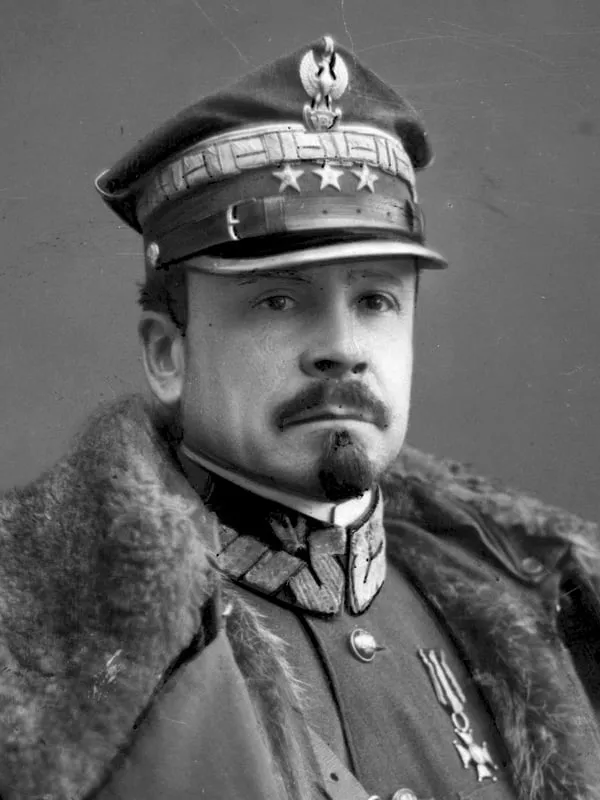
- Born:
- 13 August 1873, Jurczyce near Kraków (Austria-Hungary)
- Died:
- 4 June 1960, London
- Author:
- Łukasz Skowroń
- Photo:
- autor nieznany, domena publiczna, Wikimedia Commons

During the Great War Józef Haller travelled a road that no other Polish commander travelled. He began in 1914 as an organiser of volunteers at Austria’s side, for three years fought in the Legions against Russia, and in February 1918, at the head of the Second Brigade, broke through the Austrian front at Rarańcza in protest against the Peace of Brest-Litovsk. In May his Polish II Corps fought the Germans at Kaniów, and he himself reached France via Moscow and Murmansk, where the Polish National Committee of Roman Dmowski made him commander-in-chief of the Polish Army. Thus a legionnaire who in 1917 had sworn an oath of brotherhood in arms with the Central Powers became the leader of a Polish army on the side of the Entente. The Blue Army, called Haller’s Army after him, returned home in 1919 as the best-equipped part of the Polish Army. Haller was more a soldier than a politician, but his choices of 1918–1919 tied him for life to the National camp and set him against Józef Piłsudski.
Before the war
He was born on 13 August 1873 at Jurczyce near Kraków, into a landed family with insurrectionary traditions and strongly Catholic. His father had fought in the January Uprising, and his cousin Stanisław also later became a general of the Polish Army. He spent his youth in Lviv, and received his military education at Austrian schools in Kassa and Hranice and at the Technical Military Academy in Vienna. From 1895 he served as an artillery officer in the Austro-Hungarian army, mainly in Lviv and Stanislau. Early in the 1910s he left the army, according to various sources as a captain or a major. The circumstances of his departure are unclear.
As a civilian Haller devoted himself to social work. He was active in the Society of Agricultural Circles and above all in the “Sokół” and in the nascent scouting movement, which he helped to Polonise and militarise. He ran clandestine military courses for young people, and according to scouting tradition it was he who proposed the design of the Scout Cross. He did not belong to Piłsudski’s camp. The Galician “Sokół”, with which he was associated, stood largely closer to National Democracy, and its field squads competed with the Riflemen.
1914–1916: the Legions
On the outbreak of war Haller was among the organisers of the Eastern Legion, formed in Lviv from Sokół squads and other organisations not connected with Piłsudski. The Legion did not manage to go into action. The Russians were approaching the city, the unit was evacuated westwards, and under the influence of agitation by opponents of co-operation with Austria most of the volunteers refused to take the oath. On 21 September at Mszana Dolna it was decided to dissolve it. Only some of the soldiers, gathered around Haller, took the oath and joined the 3rd Legions Regiment then being formed. Haller took command of it with the rank of lieutenant-colonel.
At the end of September the regiment was taken by rail to Hungary. The legionnaires, from whom the Second Brigade later grew, helped in October to drive the Cossacks out of Máramaros, and then crossed the Carpathians into Eastern Galicia. Sappers built a road across a pass in the Gorgany, named the Legions’ Pass, and Haller’s units occupied the village of Rafajłowa. In winter the legionnaires held these positions in harsh mountain conditions. On the night of 23–24 January 1915, in Haller’s absence, they repulsed a Russian night attack on Rafajłowa, and in February Lieutenant-Colonel Haller’s group took part in the offensive on Stanislau. In March 1915 he was promoted to colonel.
On 7 May 1915, while on leave, he was injured in a car accident near Częstochowa. He spent many months recovering from a leg broken in several places. After returning to duty, in the spring of 1916, he joined the Council of Colonels, an informal body of Legion commanders who opposed the pro-Austrian Legions Command and the treatment of the Legions as auxiliary units. In the summer of 1916 he took command of the Second Brigade of the Polish Legions, called the Carpathian or Iron Brigade.
The oath crisis and Rarańcza
In the oath crisis of July 1917 the paths of Haller and Piłsudski parted. The soldiers of the First and Third Brigades, at the call of the Commandant, refused to swear the oath of brotherhood in arms with Germany and Austria-Hungary and were sent to internment camps, and Piłsudski himself to a German prison. The Second Brigade, from the start less closely tied to Piłsudski, for the most part took the oath. Haller believed that dissolving the Legions would deprive the Poles of their last army. The brigade became part of the Polish Auxiliary Corps, subordinate to Austria, and in the autumn it was sent to Bukovina.
The break with the Central Powers came a few months later. On 9 February 1918 Germany and Austria-Hungary concluded peace with Ukraine, promising it the Chełm Land and part of Podlachia. For the Poles this was a new partition. The commanders of the Auxiliary Corps debated what to do, and the plan to break through the front to the Polish formations in Russia prevailed. Haller accepted it and took charge of the operation. He sent his decoration back to Emperor Karl I, and the brigade command prepared a proclamation that the legionnaires were leaving for where “a Polish armed force is arising”. On the night of 15–16 February part of the Corps broke through the Austrian lines at Rarańcza. The Austrians disarmed and interned the remaining units.
Kaniów
After several weeks of marching the brigade reached the area of Soroki in Bessarabia and joined the Polish II Corps, formed from Poles of the former Russian army. At the end of March Haller took command of the whole corps, some 7,000–8,000 men, and from then on went by the pseudonym “Mazowiecki”, now as a general. He wanted to lead the corps beyond the Dnieper, out of reach of the forces of the Central Powers, which were occupying Ukraine after the Peace of Brest-Litovsk. In April, on the instructions of the Regency Council conveyed by its envoy General Aleksander Osiński, he halted in the area of Kaniów.
The Germans did not want an independent Polish army in their rear. After Hetman Skoropadsky’s coup they demanded that the corps be disarmed, and when the Poles refused, on the night of 10–11 May 1918 they attacked its quarters. The corps defended itself for a whole day, and when its ammunition ran out it accepted terms of an honourable capitulation. Haller recalled that it was the Germans who asked for talks; sources differ on this point. On 12 May the corps laid down its arms. Haller slipped out of the encirclement, made his way through Kiev to Moscow, where he arrived on 12 June, and came to an understanding with the Polish Council of Inter-Party Union. There he helped to organise a secret command for the scattered soldiers of the Polish formations in Russia.
Commander-in-chief of the Polish Army
On 3 July 1918 Haller sailed from Murmansk and, via Scotland, reached France on 13 July. On 17 July the Polish National Committee unanimously co-opted him as a member. The Committee was just then looking for a Polish leader for the Polish Army in France, until then commanded by French generals, and the fame of Rarańcza and Kaniów made Haller the ideal candidate. He was also a professional officer, a Catholic and a man close to the National Democrats, and at the same time a legionnaire who could hardly be portrayed as a partisan of Russia. Dmowski later wrote that Haller had arrived “just in time”.
After the agreement of 28 September, which recognised the Polish Army as allied and co-belligerent, the Committee appointed Haller commander-in-chief on 4 October of all Polish formations on the side of the Entente. On 6 October he took the oath before the ranks of the 1st Polish Rifle Division. His authority, however, had limits. The army then numbered just over 17,000 soldiers, mostly volunteers from the Polish community in America, many posts were held by Frenchmen, and at the front its units were subordinate, like all Allied troops, to French command. In July the 1st Rifle Regiment fought in Champagne, and in the autumn the 1st Division held a sector of the front in the Vosges. At the beginning of November Ferdinand Foch envisaged its participation in the offensive being prepared in Lorraine, which was not carried out because of the armistice.
1919: return to Poland
The army grew fastest after the armistice, when tens of thousands of Poles from prisoner-of-war camps in France and Italy were enlisted in it. According to most estimates about 70,000 soldiers passed through the Blue Army. Its transport home became a matter of dispute. Dmowski and the French wanted to send it through Danzig, which would have meant a Polish fait accompli on the Baltic. In the face of opposition from the Germans, the British and the Americans, it went by train through Germany. The first transports crossed the border on the night of 19–20 April 1919, and on 21 April Haller arrived in Warsaw, where he was welcomed as a hero. Piłsudski, with whom his paths had parted two years earlier in the dispute over the oath, greeted the army’s arrival by telegram, and the Blue Army, equipped by the French with artillery, aircraft and Renault tanks, became part of the Polish Army.
In May and June 1919 part of Haller’s army fought the Ukrainians in Eastern Galicia, although the Entente had stipulated that these troops were to serve against the Bolsheviks, not the Ukrainians. In October Haller took command of the Pomeranian Front, which at the beginning of 1920 took over for Poland the Pomerania awarded to it in the Treaty of Versailles. On 10 February 1920 at Puck he performed the symbolic wedding of Poland to the sea.
After the war
In the Polish–Soviet War Haller was inspector-general of the Volunteer Army, and during the Battle of Warsaw he commanded the Northern Front. Later he was inspector-general of artillery, president of the Polish Red Cross and of the Polish Scouting Association, and in 1922–1923 a deputy to the Sejm from the Christian-National list. He condemned the May Coup and in 1926 was retired. In the 1930s he belonged to the opposition to the Sanation regime, co-founded the Morges Front with Ignacy Jan Paderewski and Władysław Sikorski, and in 1937 became head of the supreme council of the Labour Party. During the Second World War he was a minister in Sikorski’s government in France and in London. After the war he remained in exile and died in London on 4 June 1960. In 1993 his ashes were brought back to Poland and laid in the garrison church of St Agnes in Kraków.
Assessment
Haller occupies a place of his own in Polish memory. For the National camp he was the leader of an army that fought on the side of the victors and gave Poland a claim to a place at the table of the peace conference. For Piłsudski’s supporters he was a legionnaire who in 1917 took the oath that the Commandant had rejected, and then sided with his opponents. This dispute lasted throughout the interwar period, and the Sanation regime removed the general from the army. Military historians stress that Rarańcza and Kaniów mattered above all politically and morally. Militarily they were minor episodes, but they showed that Poles in Austrian and Russian uniforms were ready to fight the Central Powers for the Polish cause.
His abilities as a commander are judged less unequivocally. Haller was a brave officer, popular with his soldiers, but he never conducted a major operation, and on the Western Front in 1918 the French made the decisions. His merit lay rather in the organisation and spirit of the army than in the art of war. The dark side of the Blue Army was the excesses of its soldiers against the Jewish population in 1919, and Haller himself, a man of nationalist views, was at times accused of tolerating antisemitic sentiment. On balance historians see him above all as a symbol: a general who passed from the Legions to the Entente, combining in a single life both roads by which the Poles went to independence.
Sources
Spotted a mistake?Report an error
Commanded in battles
(02)Mentioned in battles
(01)Often appears with
People who appear in the same events.