Key event
Fighting at Kaniów
- Category:
- Military operations
- Front:
- Eastern Front
- Date:
- 11 May 1918
- Author:
- Łukasz Skowroń
- Battle:
- Battle of Kaniów
- Tags:
- Poland, Germany, Ukraine, Polish Legions
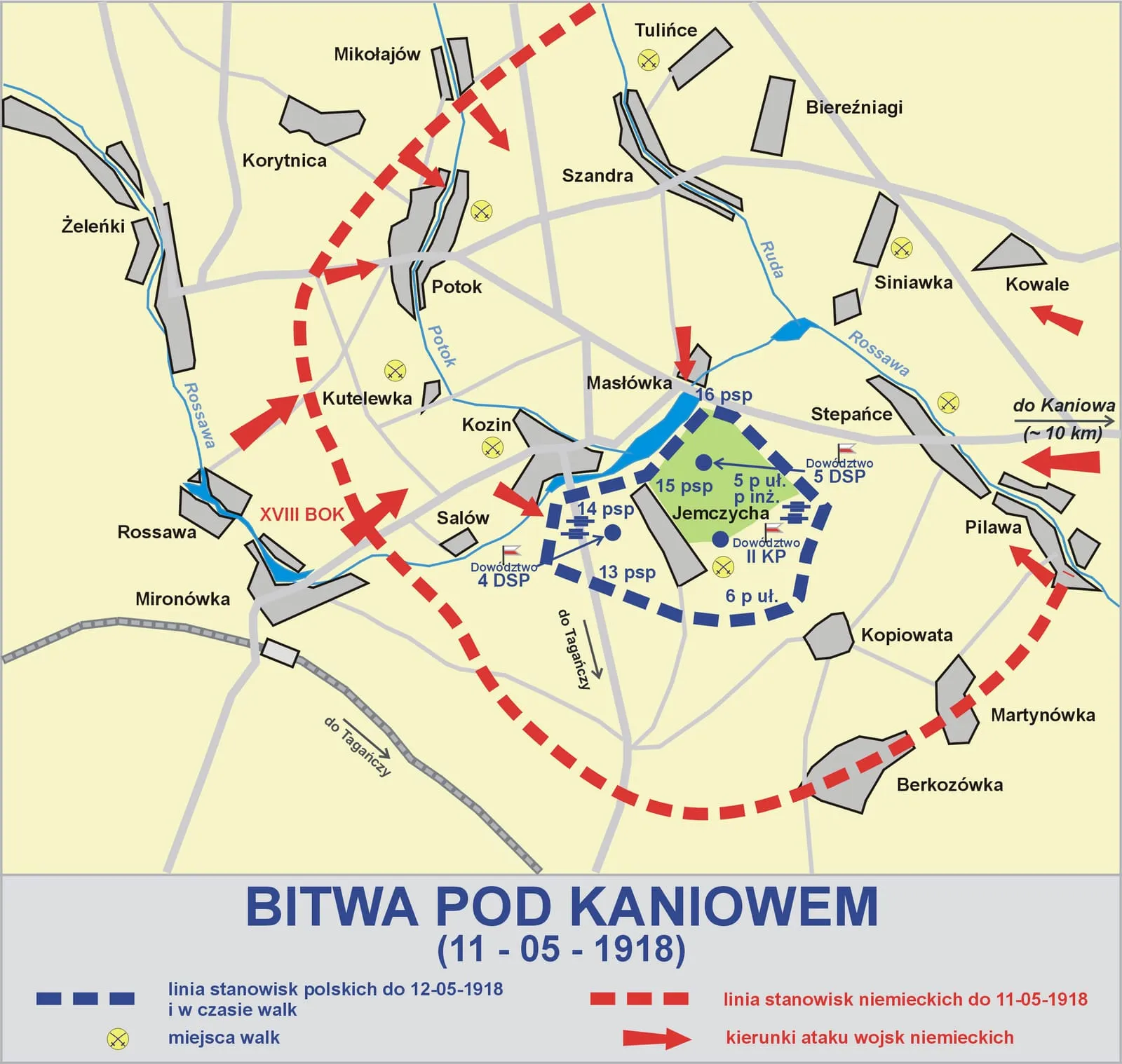
In the night of 10/11 May 1918, in pouring rain, German infantry attacked the quarters of the Polish II Corps, spread out in villages west of Kaniów on the Dnieper. The attack came without warning, a few days after the Poles had rejected a demand to lay down their arms. Taken by surprise in the first hours, the corps of General Józef Haller managed to pull itself together and throughout the day beat off attacks by superior forces. In the afternoon the ammunition ran out. Fire was halted, a capitulation was signed during the night, and the next day the Polish regiments laid down their arms. For the soldiers who in February had crossed the front with Haller at Rarańcza, it was their second open fight against the Central Powers in three months, and at the same time the end of their corps.
Before the battle
The corps, numbering 7,000–8,000 men according to various sources, had been stationed around Kaniów since 18 April. It had stopped there on the instructions of the Regency Council, although Haller had intended to lead it across the Dnieper, away from the German and Austro-Hungarian troops occupying Ukraine. After Hetman Skoropadsky’s coup the Germans ruled the country almost without restraint and did not want an independent armed force in their rear. On 6 May General Franz Hermann Zierold, in Polish accounts usually Zierhold, gave the Poles three hours to capitulate. The corps sounded the alarm and began preparing for defence. Taken aback, Zierold withdrew the ultimatum that same night, explaining it as a misunderstanding. Over the following days, however, he brought more battalions up to Kaniów. According to the Polish Army Museum he assembled about 12,000 soldiers with artillery and a hussar regiment.
The night
The first blow fell on Kutelewka and Potok. The squadron of the 6th Uhlan Regiment stationed in Kutelewka was surprised and routed. According to regimental tradition only one uhlan got away, shot in the hand, who reached Masłówka and alerted the command. Potok, where the staff of the 5th Rifle Division (PL) was quartered, was attacked by the Germans from three sides and taken before the sleeping soldiers could seize their weapons. A Polish battery fell into their hands, and the 16th Rifle Regiment and the Officers’ Legion were cut off. Officers of the Legion, however, briefly freed the captured divisional staff, and the division’s commander, Lieutenant-Colonel Stanisław Machcewicz (PL), gathered several units under fire and withdrew them in good order. The decimated remnants of the division manned the dykes near Masłówka.
An hour later the Germans attacked Kozyn (PL). The 14th Rifle Regiment of Lieutenant-Colonel Orlik-Łukoski, after a short, bloody fight in the village streets, fell back towards Jemczycha (PL). One of its companies, surrounded by the Orthodox church, rejected a summons to lay down its arms. Polish accounts stress that its commander, Captain Brandys, held out to the end. The fighting also spread to Stepańce, Sieniawka and Tulińce, where the corps’ rear services were stationed.
The square at Jemczycha
At about eight in the morning the corps staff, which had set itself up in Jemczycha, drew its units into an all-round defence. It was a square with a perimeter of about 15 kilometres, resting on marshes and dykes. On the west and north-west the riflemen of the 4th Division held out, on the Masłówka side the 15th Regiment, on the east the 5th Uhlan Regiment and the sappers, while the 6th Uhlan Regiment closed the gap towards Kopiowata. In the middle, in a small wood, stood the batteries, the transport and the ambulances. The Polish artillery opened fire on the German battalions assembling in Kozyn and Masłówka.
At about nine two squadrons of the 6th Uhlan Regiment, led by Lieutenants Kazimierz Lenartowicz and Witold Cieśliński, charged the German infantry that was threatening the 5th Uhlan Regiment. The regiment’s historian Andrzej Hlawaty wrote that “many infantrymen were killed by sabre cuts, the rest fled in disorder”. The uhlans took about 50 prisoners and two heavy machine guns, losing one killed and five wounded. Both commanders later received the Virtuti Militari. At Stepańce the Germans ran into camouflaged sappers and suffered heavy losses. They conducted their further attacks more cautiously, and the defenders repulsed them.
Capitulation
The Poles, however, began to run short of cartridges. The corps was cut off, had nowhere to replenish its supplies and could count on no relief. Haller recalled years later that it was the Germans who sent envoys: “They asked for a ceasefire, seeing no need for further bloodshed. Evidently they had heavy losses (…). Although the losses of my units were not great, the reports of a lack of ammunition, both rifle and artillery, were the reason for my decision to break off the fight.” The Polish Army Museum, on the other hand, writes that the talks were initiated by the corps command. According to the Museum, fire was halted at 4 p.m. After brief negotiations the terms of an honourable capitulation were agreed, and it was signed during the night. The soldiers were to be sent home.
On 12 May the Polish regiments laid down their arms. The Germans did not keep the agreement. The disarmed soldiers were robbed and sent to prisoner-of-war camps. What this single day of fighting cost them is still not known exactly. Polish estimates of the corps’ losses in killed and wounded range from just under two hundred to about a thousand men, and the number of prisoners from about 3,250 to 4,750. Polish sources usually estimate German losses at about 1,500 killed and wounded.
Escape
In the confusion after the capitulation some of the soldiers and officers slipped out of the encirclement, Haller among them. Prisoners escaped too. Machcewicz, captured by the Germans, escaped the following day and reported to the secret command of the former corps in Kiev. The survivors sought a way to the Kuban, to the Volga or north to Murmansk. Haller made his way to Kiev, and on 12 June, accompanied by Captain Tadeusz Żółkiewski, arrived clandestinely in Moscow. There he came to an understanding with the Polish Council of Inter-Party Union, and on 3 July he sailed from Murmansk via Scotland to France. By mid-July he was already in Paris, and in the autumn he took command of the Polish Army.
Kaniów was the end of the Polish II Corps. Ten days later the Germans disbanded the Polish I Corps at Bobruisk, and in June the Austrians disarmed the remnants of the III Corps. The battle, lost and of no significance for the course of the front, nevertheless quickly grew into a symbol. Several regiments of the reborn Polish Army later bore the honorific “Kaniowski”, and the inscription “Kaniów 11 V 1918” was placed on the Tomb of the Unknown Soldier in Warsaw.
Remember the articles you have read? Only in this browser; nothing is sent anywhere.How it works
Read ·
Spotted a mistake?Report an error
Meanwhile
(04)Elsewhere in the same days.
- 12 May 1918 · DiplomacyMeeting at SpaOn 12 May 1918 at Spa Emperor Charles I, compromised by the Sixtus affair, agreed with Wilhelm II on a close military and economic alliance with Germany.
- 9 May 1918 · PoliticsSidónio Pais elected presidentOn 9 May 1918 Sidónio Pais was proclaimed president of Portugal, elected on 28 April in the country's first ever direct election of a head of state.
- 9 May 1918 · DiplomacyAllied trade committee in the NetherlandsIn spring 1918 trade envoys of four Entente states formed a committee in The Hague to ensure that imports into the Netherlands did not go on to Germany.
- 9 May 1918 · War at seaSecond Ostend raidOn the night of 9/10 May 1918 the British scuttled the old cruiser Vindictive in the entrance to Ostend harbour. The wreck blocked only part of the channel.
Related events
(04)The same battle, people or subject.
- 15 February 1918 · Eastern FrontBattle of RarańczaOn the night of 15–16 February 1918 Colonel Haller's Second Brigade of the Legions broke through the Austrian front at Rarańcza in protest at the Ukraine peace.
- 29 April 1918 · Eastern FrontSkoropadskyi proclaimed hetmanOn 29 April 1918 a congress of landowners in Kiev proclaimed General Pavlo Skoropadskyi Hetman of Ukraine. With German backing he overthrew the Central Rada.
- 9 February 1918 · Eastern FrontPeace of Brest-Litovsk with UkraineOn 9 February 1918 the Central Powers made peace with the Ukrainian People's Republic at Brest. For grain they promised it Chełm Land, angering the Poles.
- 9 May 1918 · Eastern FrontLyzohub governmentIn early May 1918 Hetman Skoropadskyi entrusted the government to Fedir Lyzohub. Kadets dominated the cabinet; the Ukrainian socialists boycotted it.