1918: The Eastern Front
Battle of Kaniów
- Dates:
- 11 May 1918
- Front:
- Eastern Front
- Location:
- The area of Kaniów on the Dnieper, the villages of Potok, Kozyn, Stepańce, Masłówka and Jemczycha, from a dozen or so to about 30 kilometres west of the town, Kiev Governorate (today Kyiv and Cherkasy oblasts, Ukraine)On the battle map →
- Sides:
- Polish II CorpsJózef Haller, Michał Żymierski, Franciszek Zieliński, Stanisław MachcewiczGerman EmpireHermann von Eichhorn, Franz Hermann Zierold
- Result:
- A German victory. After a day's defence the Polish II Corps, out of ammunition, accepted terms of capitulation and laid down its arms on 12 May. Most of the soldiers were taken prisoner; some, including General Haller, managed to escape.
- Author:
- Natalia
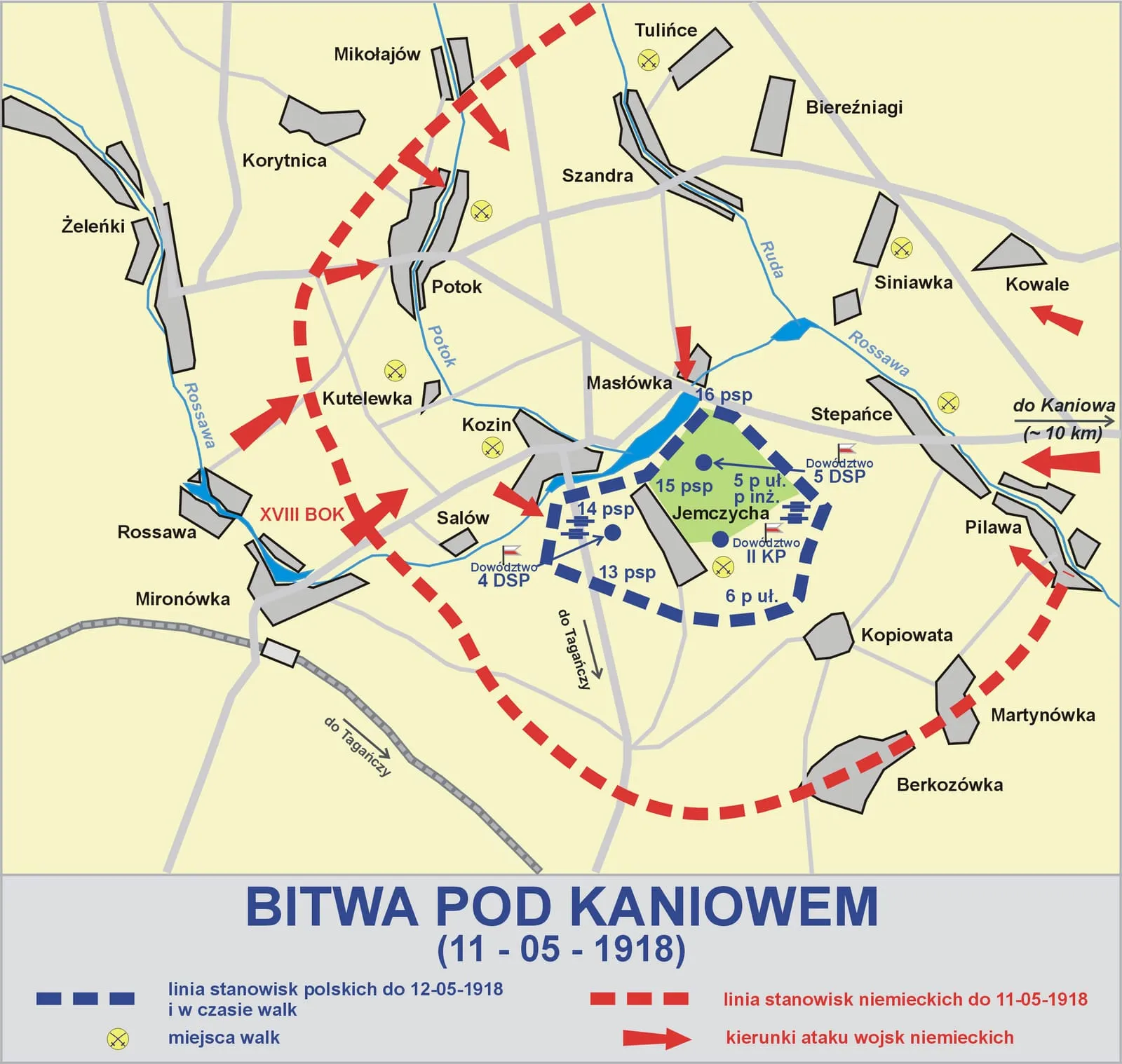
The Battle of Kaniów was the last battle of the Polish II Corps, a Polish formation made up of soldiers of the former Russian army and of legionnaires who in February 1918 had broken through the Austrian front at Rarańcza. In the spring the corps took up quarters near Kaniów on the Dnieper, in Ukraine, which was occupied by German and Austro-Hungarian troops. The Germans had no intention of tolerating an independent Polish force in their rear and demanded that it be disarmed. The Poles refused. On the night of 10/11 May 1918 German units with a clear numerical advantage surrounded the Polish quarters and attacked without warning. General Józef Haller’s corps defended itself all day, and when its ammunition ran out it accepted terms of capitulation. Militarily it was a minor clash on the margins of the Great War, but in Polish memory Kaniów became a symbol of armed opposition to the Central Powers.
Name and dates
In Polish literature the name “Battle of Kaniów” (bitwa pod Kaniowem or bitwa kaniowska) has become established, although the fighting took place not in the town itself but in several villages to the west of it, above all in Potok, Kozyn (in older accounts Kozin), Stepańce, Masłówka and Jemczycha (PL).
We date it to 11 May 1918. The Germans moved off on the night of 10/11 May, according to some accounts shortly after midnight, according to others towards dawn. The Polish Army Museum states that the battle began at four in the morning. This is why the English Wikipedia dates the battle to 10–11 May. Firing stopped in the afternoon of 11 May, according to the Polish Army Museum at 4 p.m., the capitulation was signed during the night, and the soldiers laid down their arms on 12 May. Some studies regard that day as the date of the corps’ dissolution.
Background
Formation of the Polish II Corps began in December 1917 in Bessarabia, from Poles serving in the Russian armies of the Romanian and South-Western Fronts. In March 1918 Haller’s legionnaires joined it at Soroki on the Dniester. The corps then numbered about 7,000–8,000 men and was divided into the 4th Rifle Division (13th and 14th Regiments) and the 5th Rifle Division (15th and 16th Regiments). It also had an Officers’ Legion, an artillery brigade, the 5th and 6th Uhlan Regiments, an engineer regiment and two armoured car detachments. At the end of March Haller took command of the corps, from then on going by the name of General “Mazowiecki”. Generals Sylwester Stankiewicz and Władysław Glass (PL), who had wanted to lead the corps into the Austrian zone near Vinnytsia, were removed from command. Colonel Michał Żymierski became chief of staff, Colonel Franciszek Zieliński (PL) commanded the 4th Division and Lieutenant-Colonel Stanisław Machcewicz (PL) the 5th Division.
From Soroki the corps set out eastwards, through Krzyżopol, Berszada, Humań and Bohusław, amid rebellious villages and the chaos following the collapse of the Russian army. Haller wanted to lead it across the Dnieper, out of reach of the Central Powers’ troops, which after the Treaty of Brest-Litovsk with Ukraine were occupying the country. On 18 April, after four weeks’ march, the corps reached the Kaniów area. There it received a demand from the Regency Council not to cross the Dnieper and not to take any action that would prejudge its further decisions. It was issued by General Aleksander Osiński (PL), to whom the Council had entrusted command of the Polish forces in Ukraine and who was trying to negotiate the corps’ status with the Germans. Haller complied. The Polish regiments were quartered in a triangle formed by the villages of Potok, Kozyn and Stepańce.
The halt proved fatal. The Germans, who with Skoropadsky’s coup of 29 April had taken real power in Ukraine, wanted to disarm every formation they did not control. Supplies to the Polish quarters were cut off, and small, isolated detachments were disarmed. Troops subordinate to Field Marshal Hermann von Eichhorn, commander of the German army group in Kiev, gathered around the corps. According to the Polish Army Museum, on 2 May General Osiński was presented with an ultimatum: the corps was to lay down its arms immediately and disperse. On 6 May the commander of a German Landwehr brigade, General Franz Hermann Zierold (in Polish sources usually Zierhold), demanded that the corps command capitulate within three hours. The Polish units were put on alert and began to prepare their defence. A surprised Zierold withdrew the ultimatum that same night and explained that there had been a misunderstanding. In the following days, however, he brought up reinforcements. The number of his brigade is given differently: the Central Military Archives names the 33rd, the English Wikipedia the 28th.
Course of the battle
According to the Polish Army Museum the Germans assembled about 12,000 soldiers: 14 infantry battalions, a hussar regiment and three artillery batteries. There were about 7,000 Poles, in four weak rifle regiments and two uhlan regiments, but with strong artillery. On the night of 10/11 May, in pouring rain, the German infantry first attacked Kutelewka and Potok. A squadron of the 6th Uhlan Regiment stationed in Kutelewka was routed, and Potok, where the headquarters of the 5th Division was quartered, was attacked from three sides. There the Germans captured a Polish battery and cut off the 16th Rifle Regiment and the Officers’ Legion. Under fire Machcewicz gathered several units, organised a defence on the edge of the village and withdrew the division in good order, and the Officers’ Legion briefly recaptured the divisional staff, which had been taken prisoner. The remnants of the 5th Division fell back to the dykes near Masłówka.
An hour later the Germans attacked Kozyn. After a bloody fight in the village streets the 14th Rifle Regiment fell back towards Jemczycha. At about eight in the morning the corps command organised an all-round defence, a square with a perimeter of about 15 kilometres amid marshes and dykes. The western and north-western sector was held by the 4th Division, the approaches from Masłówka by the 15th Rifle Regiment, the eastern sector by the 5th Uhlan Regiment and the engineer regiment, and the gap towards Kopiowata by the 6th Uhlan Regiment. In the middle, in a small wood, stood the batteries, the transport and the ambulances, and the corps headquarters was in Jemczycha. At about nine two squadrons of the 6th Uhlan Regiment made a successful charge against German infantry, and near Stepańce the Germans ran into the camouflaged positions of the sappers and suffered heavy losses.
The Germans conducted their subsequent attacks more cautiously, and the Poles repulsed them. In the afternoon, however, rifle and artillery ammunition was running out, and there was nowhere to expect help from. Talks began. According to Haller and the Central Military Archives they were proposed by the Germans, surprised by the resistance and their losses; according to the Polish Army Museum they were initiated by the corps command. Firing stopped, and during the night a capitulation on honourable terms was signed. The soldiers were to be sent home. On 12 May the corps laid down its arms. The Germans did not keep the agreement: they robbed the prisoners and sent them to camps. Some of the Poles, Haller among them, slipped out of the encirclement in the confusion.
Casualties
The figures given in Polish studies differ considerably. The corps’ losses in killed and wounded are estimated at nearly a thousand men (so, among others, the Polish Wikipedia and a series in “Polska Zbrojna”), at 200–250 men (the Polish Army Museum) or at several dozen killed and about 150 wounded (another “Polska Zbrojna” article, following older literature). According to various authors, from about 3,250 soldiers, including 250 officers, to about 4,750 men were taken prisoner. The rest, often without weapons, scattered across Ukraine. Polish sources usually estimate German losses at about 1,500 killed and wounded, some at about a thousand. We have not been able to find a German tally, so these figures should be treated with caution.
Significance
The battle had no effect on the course of the war. It was, however, of great political importance. Henryk Bagiński, historian of the Polish formations in the East, wrote that the fight at Kaniów, waged “at the moment of the Germans’ greatest victories in the west and the east”, was “an armed protest against the violence of the occupiers”. Kaniów also closed the period of the Polish corps in Russia. On 21 May at Bobruisk the Germans dissolved the Polish I Corps of General Dowbor-Muśnicki, and in June the Austrians disarmed the remnants of the III Corps.
Soldiers who escaped captivity made their way to the Kuban, the Volga and Murmansk, where new Polish units were being formed. Haller got through Kiev to Moscow, and from there via Murmansk to France. In mid-July 1918 he reached Paris and joined the Polish National Committee, and on 4 October he took command of the Polish Army in France, established by a decree of June 1917. The fame of Rarańcza and Kaniów meant that the Committee, which was just then looking for a Polish leader for this army, admitted him to its ranks without lengthy discussion.
In the Second Polish Republic the honorary name “Kaniów” was borne by, among others, the 28th, 29th, 30th and 31st Rifle Regiments and the 6th Kaniów Uhlan Regiment. Veterans formed the Union of Kaniów Veterans, and the inscription “Kaniów 11 V 1918” was placed on one of the tablets of the Tomb of the Unknown Soldier in Warsaw.
Spotted a mistake?Report an error