Key event
Arrest of Piłsudski
- Category:
- Politics
- Date:
- 22 July 1917
- Author:
- Łukasz Skowroń
- Tags:
- Poland, Józef Piłsudski, Germany, German occupation
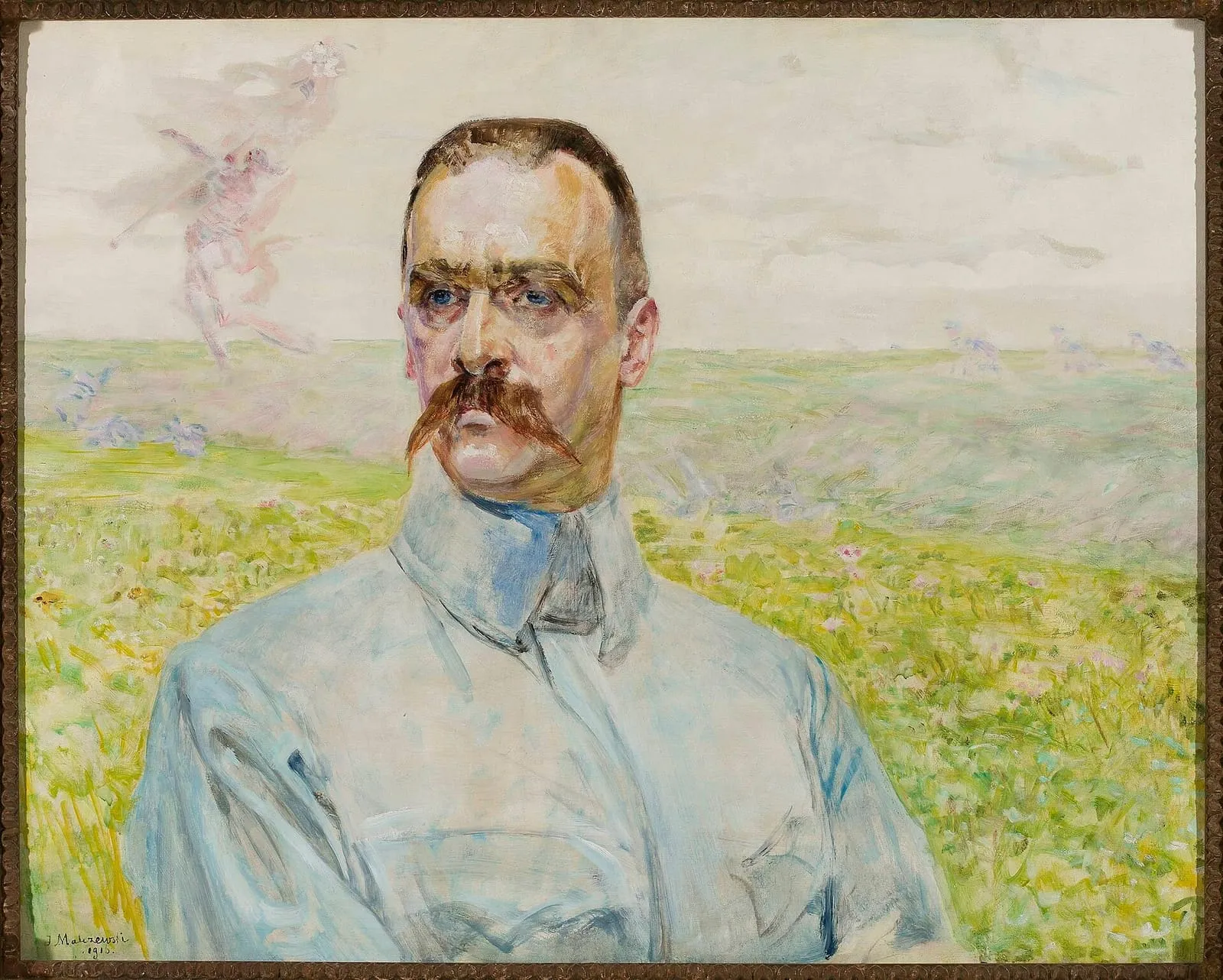
On the night of 21–22 July 1917 German gendarmes arrested in Warsaw Józef Piłsudski, the creator of the Legions and until recently head of the military department of the Provisional Council of State. Detained with him was his closest associate and chief of staff, Colonel Kazimierz Sosnkowski. Some accounts place the arrest on the morning of 22 July. Both were immediately taken out of the city. The man who in August 1914 had led the first Polish unit out of Kraków to fight Russia alongside the Central Powers had become a prisoner of Germany.
Why Piłsudski
The arrest was a direct consequence of the oath crisis. Two weeks earlier, on 9 and 11 July, legionaries of the I and III Brigades, at Piłsudski’s call, had refused to swear an oath of “brotherhood in arms” with Germany and Austria-Hungary, and the German occupation authorities had disarmed and interned them. The plan of Governor-General Hans Hartwig von Beseler, who wanted to build a large Polish army at Germany’s side, lay in ruins. The Germans had no doubt who was behind it.
They were particularly worried by the Polish Military Organisation (POW), a clandestine organisation answering to Piłsudski, which in January had formally placed itself under the Council of State and was now changing sides. Justifying the arrest to the Council of State, Beseler pointed precisely to the change in the POW’s attitude under Piłsudski’s direction and argued that the situation called for swift action: behind the Eastern Front the Germans would not tolerate an organisation that might turn against them. In the summer of 1917 the occupation authorities also arrested other activists of the independence camp, among them Walery Sławek, Wacław Jędrzejewicz and Adam Skwarczyński.
The road to Magdeburg
The arrested men were brought under guard to the Vienna Station (PL) and taken in a second-class compartment via Posen to Danzig. According to accounts collected by the German-Polish portal Porta Polonica, Piłsudski travelled in his Legion uniform and Sosnkowski in civilian clothes. They reached Danzig during the night of 22–23 July and were put in the prison on what was then Schiesstange (today Kurkowa Street), where they were held on separate floors. A prison warder recalled that Piłsudski was polite but silent. A week later both were moved on, separately, deeper into Germany: to the prison in Spandau in Berlin, and from the beginning of August to the fortress at Wesel on the Rhine.
Piłsudski’s last place of imprisonment was Magdeburg, where he arrived at the end of August. In the citadel (PL) he lived in a small wooden house with a garden, where officers of the garrison had previously served their terms of arrest. Sosnkowski was held in another prison in Magdeburg, and for a year the two had no contact. Studies differ on the details of this journey. Some short biographical notes say that Piłsudski was taken from Danzig straight to Magdeburg, but Andrzej Garlicki’s biography and archival research mention Spandau and Wesel on the way. Both were taken to Magdeburg around 22–23 August.
Reactions
The arrest of the Commandant was a blow to the Provisional Council of State, which was losing its raison d’être anyway. Without Piłsudski and without the army it was supposed to create, it lasted barely a month: at the end of August its members resigned their seats. The Polish Military Organisation, whose activists the Germans began to hunt down, went deeper underground and turned ever more clearly against the occupiers.
Birth of a legend
The Germans wanted to get rid of a troublesome leader, but in reality they gave him what he could not have won as a member of a Council appointed by the occupiers. Until July 1917 Piłsudski’s opponents, especially the pro-Entente National Democrats, had portrayed him as a tool of the Central Powers. From then on the prisoner of Magdeburg was a victim of the Germans and a symbol of the struggle for independence against all three partitioning powers. His popularity grew with every month of captivity, even among those who had previously distrusted him.
Piłsudski spent more than a year in Magdeburg. When the German Empire was falling apart in November 1918, the Germans released him together with Sosnkowski and sent them by special train to Warsaw. He arrived there on 10 November, on the eve of Poland’s regaining of independence.
Remember the articles you have read? Only in this browser; nothing is sent anywhere.How it works
Read ·
A voice from the front
“In the summer of 1917 I was arrested in Warsaw by the German occupation authorities and taken deep into Germany. For some time I was moved from prison to prison, at times held in the worst conditions […]. I was born, it seems to me, for prison life. I bear solitude very easily, without feeling its whole weight as others do, and knowing how to soften the hardest side of prison life, longing, by the work of the mind.”
Translated · Original (pl)
Latem 1917 r. zostałem aresztowany w Warszawie przez władze okupacyjne niemieckie i wywieziony w głąb Niemiec. Przez pewien czas przewożono mnie z więzienia do więzienia, nieraz trzymając w najgorszych warunkach […]. Do życia więziennego, jak mi się zdaje, byłem urodzony. Bardzo łatwo znoszę samotność, nie odczuwając, jak inni, całego jej ciężaru i umiejąc łagodzić pracą myślową najcięższą stronę życia więziennego — tęsknotę.
Spotted a mistake?Report an error
Meanwhile
(04)Elsewhere in the same days.
- 22 July 1917 · Balkan FrontBattle of Mărăști beginsOn 22 July 1917 Averescu's Romanian Second Army opened fire on German positions in Vrancea. It was Romania's first offensive in six months.
- 19 July 1917 · Eastern FrontThe counter-offensive in Eastern Galicia beginsOn 19 July 1917 the Germans struck the Russian Eleventh Army near Złoczów. Within hours they broke through all its lines, and Russian soldiers began to flee.
- 19 July 1917 · War at seaCarson leaves the AdmiraltyIn July 1917 Edward Carson moved from the Admiralty to the War Cabinet. The railwayman and organiser Eric Geddes became First Lord of the Admiralty.
- 19 July 1917 · AfricaBattle of NarungombeOn 19 July 1917 the Kilwa columns assaulted the German trenches at Narungombe all day. The Germans withdrew at night, but the British lost more than 600 men.
Related events
(04)The same battle, people or subject.
- 9 July 1917 · MilitaryOath crisisOn 9 July 1917, at Piłsudski's call, I and III Brigade legionaries refused an oath of brotherhood in arms with Germany and Austria-Hungary. Internment followed.
- 6 April 1917 · PoliticsProvisional Council of State replies to the Provisional GovernmentOn 6 April 1917 the Provisional Council of State welcomed Russia's recognition of Polish independence but rejected a military union and borders set by Russia.
- 14 January 1917 · PoliticsFirst session of the Provisional Council of StateOn 14 January 1917 at the Royal Castle in Warsaw the members of the Provisional Council of State received their appointments. Wacław Niemojowski was marshal.
- 12 September 1917 · PoliticsPatent on the Regency CouncilOn 12 September 1917 Germany and Austria-Hungary issued a patent giving power in the Kingdom of Poland to a three-man Regency Council, under occupiers' control.