Poland · The Polish cause
Kazimierz Sosnkowski
Chief of staff and deputy commander of the First Brigade of the Polish Legions (1914–1916), deputy military head of the Provisional Council of State (1917), prisoner of Germany (1917–1918)
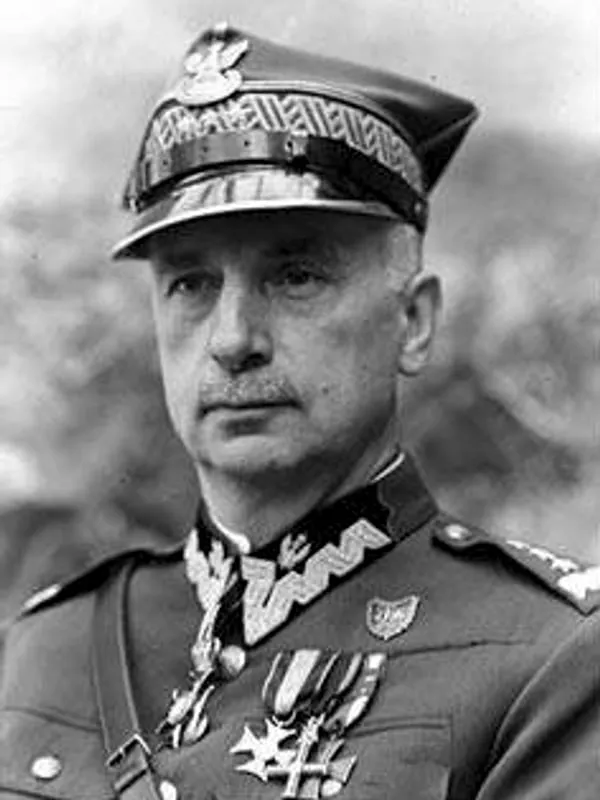
- Born:
- 19 November 1885, Warsaw (Kingdom of Poland)
- Died:
- 11 October 1969, Arundel (Canada)
- Author:
- Łukasz Skowroń
- Photo:
- Polish Army, domena publiczna, Wikimedia Commons

Throughout the Great War Kazimierz Sosnkowski was the right hand of Józef Piłsudski. As chief of staff of the Riflemen’s Association he prepared the Riflemen for war, in August 1914 he sent off the First Cadre Company from the Oleandry in Kraków, and then he was chief of staff and deputy commander of the First Brigade of the Legions. In December 1914, in Piłsudski’s absence, he commanded it in the hardest fight of that year at Łowczówek. He also shared the Commandant’s political choices: together they worked in the Military Commission of the Provisional Council of State, together they left it, and together they were arrested by the Germans in July 1917. They returned from Magdeburg to Warsaw on the same train on 10 November 1918. In the Second World War Sosnkowski was commander-in-chief of the Polish Armed Forces, but his name remained for ever linked with the Legions.
Before the war
He was born on 19 November 1885 in Warsaw, into the noble family of a chemical engineer. Because he was suspected of belonging to an illegal self-education circle, he could not take his school-leaving examination in Warsaw, and passed it with a gold medal in St Petersburg. In 1904 he began studying architecture at the Warsaw Polytechnic Institute, but the revolution absorbed him. Impressed by the demonstration in Grzybowski Square in November 1904, he joined the Polish Socialist Party, as he himself wrote, not for the slogans of proletarian revolution, but because the party was waging an armed struggle for independence. In 1906 he met Piłsudski, and in the PPS Combat Organisation he became commander of the Warsaw district and directed the actions of the so-called Bloody Wednesday of 15 August 1906.
His cover blown, he went abroad, and from 1907 he studied at the Lwów Polytechnic. In June 1908 the Union of Active Struggle, a secret cadre organisation from which the whole Riflemen’s movement grew, was founded in his flat in Lviv. Biographers differ on whether the idea came from him or from Piłsudski, but there is no doubt that Sosnkowski was its organiser and chief of staff. When in 1910 the open Riflemen’s Association was created on the basis of the Union, he became Piłsudski’s deputy and his chief of staff, and his colleagues simply called him “the Chief”. He was to sit his final examinations at the Polytechnic in the autumn of 1914. The war prevented him.
1914–1916: chief of staff of the First Brigade
Sosnkowski coordinated the mobilisation of the Riflemen, ordered on the night of 1–2 August 1914, and sent off the first cavalry patrol of Władysław Belina-Prażmowski. On 6 August, together with Piłsudski, he dispatched from the Oleandry the Cadre Company, which crossed the border of the Kingdom of Poland, and on 12 August they entered Kielce at the head of the Riflemen. There Sosnkowski led the Riflemen’s first fight with the Russians. Piłsudski wrote that he had a whole cavalry division against him, but proved prudent and fell back slowly. On 8 October he was promoted to lieutenant colonel. A few days later Piłsudski sent him for talks with officers of German military intelligence and, according to the Polish Wikipedia, also with Erich Ludendorff, and entrusted him with liaison with the Austro-Hungarian high command in Teschen.
On 19 December 1914 Piłsudski’s units were turned into the First Brigade of the Legions, and Sosnkowski became its chief of staff and deputy commander. The very next day the brigade was summoned to Tarnów, where the Russians had broken through the Austro-Hungarian front, while Piłsudski was at talks in Vienna. Sosnkowski led it himself in the Battle of Łowczówek on 22–25 December. In the Brzezie inn at Lichwin he received the order to retake Hills 360 and 343, and decided to attack at once, before the Russians could dig in. For three days the brigade beat off counter-attacks, and its commander, keeping his composure, repeatedly asked for it to be relieved. According to the Polish Wikipedia, Austrian officers from the broken neighbouring units placed themselves under his command. Piłsudski officially commended him, the Austrians awarded him the Order of the Iron Crown, and in independent Poland he received the Virtuti Militari for this battle.
In 1915 Sosnkowski directed the brigade’s fighting, alone or together with Piłsudski, first in the Kingdom and then in Volhynia. In May he fought at Konary, in the summer at Kowaliki and Vysokaye, and in the autumn for six weeks he commanded one of the First Brigade’s groups on the Styr. The Commandant then sent him secretly across the front line to inspect the Polish Military Organisation. In February 1916 he joined the Council of Colonels, an informal body of Legion commanders who opposed the pro-Austrian Legions Command and wanted to become independent of the Supreme National Committee, whose military department was headed by Władysław Sikorski. From April 1916 he held the rank of colonel. On 4 July, the first day of the Battle of Kostiuchnówka, fought during the Brusilov offensive, he was with Piłsudski in the front line, under Russian artillery fire.
When in the autumn of 1916 Piłsudski left the Legions in protest, Sosnkowski replaced him on 26 September as commander of the First Brigade. The Austrians, however, removed him after only three days, judging that he thought about Poland’s future exactly as the Commandant did.
The Council of State and Magdeburg
After the Act of 5 November the Germans and Austrians set up the Provisional Council of State in Warsaw. Piłsudski headed its Military Commission, and Sosnkowski, who was at the same time active in the Chief Command of the POW, became his deputy in April 1917. Both soon concluded that the occupiers were interested only in Polish recruits and that independence was making no progress. At the beginning of July 1917 they left the Council together, which opened the way to the oath crisis: the legionnaires of the First and Third Brigades refused the oath of brotherhood in arms with Germany and Austria-Hungary.
On the night of 21–22 July 1917 German gendarmes arrested Piłsudski and Sosnkowski in Warsaw. Both were taken via Posen to Danzig, where they were separated. Sosnkowski was then moved to the fortress of Wesel on the Rhine, and in the second half of August to Magdeburg, where he was put in the prison of the higher military court. Piłsudski was held in the same city, in the citadel, but for a year they had no contact with each other. In the summer of 1918, in August according to the IPN and the Polish Wikipedia, in September according to the Józef Piłsudski Institute in London, Sosnkowski was moved to the cottage where the Commandant lived. From then on captivity was easier for both. They spent their time in long conversations and playing chess, and under escort they could even go outside the citadel.
On 8 November 1918, in the days of the revolution in Germany, both prisoners were freed. They travelled through Berlin by special train to Warsaw and on the morning of 10 November stepped off at the Vienna Station.
After the war
On 16 November 1918 Piłsudski appointed Sosnkowski commander of the Warsaw General District, and a few days later promoted him to general. In December his only daughter died of Spanish flu, and he himself fell seriously ill. From March 1919 he was deputy minister, and in 1920–1924 minister of military affairs. During the Polish-Soviet War he was responsible for expanding and supplying the army. After the May Coup of 1926, which he did not support, he attempted suicide, which the Piłsudskiite camp took as proof of disloyalty. In 1939 he commanded the Southern Front, and in exile he was commander of the Union of Armed Struggle and, in 1943–1944, commander-in-chief. Dismissed in the autumn of 1944 after an order in which he reproached the Allies for failing to help the Warsaw Uprising, he settled after the war in Canada, where he died on 11 October 1969 in Arundel.
Assessment
Sosnkowski was regarded, even by his opponents, as an outstanding mind: an intelligent organiser with an excellent memory, an intellectual and a patriot. He went down in the history of the Legions as one of Piłsudski’s closest associates, his deputy in the Riflemen’s movement and in the First Brigade, and Łowczówek is regarded as his greatest command success of this war. In an assessment of 1922 Piłsudski praised his open mind and his ability to judge matters beyond the military, but faulted his weak operational training and a character that was not very strong and prone to losing heart in adversity. Similar reservations, a lack of decisiveness alongside great analytical gifts, were later repeated by critics of his command during the Second World War.
Sources
Spotted a mistake?Report an error
Commanded in battles
(01)Mentioned in battles
(01)Often appears with
People who appear in the same events.