Poland · The Polish cause
Władysław Sikorski
Head of the Military Department of the Supreme National Committee (1914–1916), commander of the replacement command of the Polish Auxiliary Corps (1917–1918)
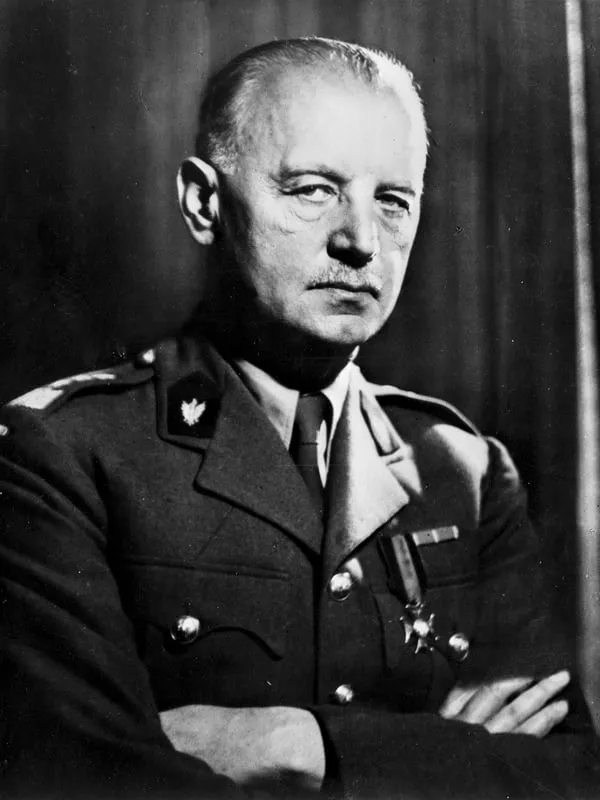
- Born:
- 20 May 1881, Tuszów Narodowy (Austria-Hungary)
- Died:
- 4 July 1943, Gibraltar
- Author:
- Łukasz Skowroń
- Photo:
- Collection of the Office of War Information, domena publiczna, Wikimedia Commons

Władysław Sikorski went down in history as prime minister and commander-in-chief during the Second World War, but his road began in the Legions. An engineer from Lviv and a co-founder of the Riflemen’s movement, in August 1914 he became head of the Military Department of the Supreme National Committee and for two years was responsible for the organisation, recruitment and rear services of the Polish Legions. He believed that a Polish army had to be built at Austria’s side, and this set him at odds with Józef Piłsudski, who from 1915 made the expansion of the Legions conditional on political concessions from the Central Powers. The dispute, which began during the Great War, lasted throughout the interwar years. Yet when in February 1918 Austria and Germany handed the Chełm region to Ukraine, Sikorski broke with Austria and ended up in an internment camp. In the autumn of 1918 he was organising Polish troops in Galicia.
Before the war
He was born on 20 May 1881 in Tuszów Narodowy near Mielec, into the family of an organist and teacher who died when Władysław was four. He studied at the teachers’ seminary in Rzeszów and then at a gymnasium in Lviv. He studied road and bridge engineering at the Lwów Polytechnic. After his studies he worked as an engineer, among other things on the regulation of the San, and ran construction ventures. In 1904–1905 he did his one-year military service in the Austro-Hungarian army and became a reserve second lieutenant.
In Lviv he drew close to Piłsudski’s camp. In 1908 he was one of the co-founders of the Union of Active Struggle and lectured in its school. In 1910 he co-founded the Riflemen’s Association in Lviv, which according to the IPN he chaired. He was active in the Polish Progressive Party, and on its behalf from 1912 directed military affairs in the Provisional Commission of Confederated Independence Parties, which coordinated preparations for the struggle against Russia.
The NKN Military Department
At the start of the war Piłsudski appointed him military commissioner for Galicia on behalf of the fictitious National Government. According to the Polish Wikipedia, Sikorski then drew up a memorandum on forming a Polish auxiliary corps alongside the Austro-Hungarian army. When on 16 August 1914 the Supreme National Committee was founded in Kraków and took the Polish Legions then being formed under its patronage, Sikorski became head of its Military Department, attached to the Committee’s Western Section in Kraków. At the end of September he became a lieutenant colonel of the Legions and the first commandant of their officer cadet school.
The department was responsible for organising the Legions, above all for recruiting volunteers and for rear services. Sikorski himself was regarded as a supporter of close cooperation with Austria-Hungary. He and Piłsudski parted ways in the summer of 1915. When the Central Powers occupied the Kingdom, Sikorski wanted the Legions expanded with volunteers from those lands. Piłsudski, who after the Germans entered Warsaw halted recruitment, believed that the Poles should provide soldiers only in return for clear commitments from Vienna and Berlin on the Polish question. Despite the dispute, the Austro-Hungarian High Command and the Legions Command kept Sikorski in his post. In February 1916 Legion colonels, among them Kazimierz Sosnkowski, Edward Rydz-Śmigły and Józef Haller, formed the Council of Colonels, which sought to make the Legions independent of the department headed by Sikorski.
In the summer of 1916 Sikorski became a colonel and briefly took command of the 3rd Infantry Regiment of the Legions, but soon returned to his previous work. After the Act of 5 November he took part in Austro-German talks on creating a Polish army, and in March 1917 Governor-General Hans von Beseler appointed him head of the National Recruitment Inspectorate for the Polish Armed Force then being formed. Piłsudski, however, held that without political concessions recruitment should be halted.
The oath crisis and internment
After the oath crisis of July 1917 the Legions fell apart. Piłsudski ended up in a German prison, and Sikorski was taken back into the Austro-Hungarian army. In Bolechów he took over the replacement command of the Polish Auxiliary Corps. The corps, made up mainly of the former Second Brigade of the Legions, was again under the Austrians, and was commanded by General Zygmunt Zieliński.
The turning point came in February 1918. On 9 February the Central Powers signed the peace with Ukraine, promising it the Chełm region and part of Podlasie. The Poles saw this as a new partition. On the night of 15–16 February part of the Auxiliary Corps under Haller broke through the Austrian front at Rarańcza. Sikorski protested against the treaty and backed the break with Austria. According to the IPN, together with the soldiers under him he renounced obedience to the Austrian authorities, while according to the biography on dzieje.pl he issued an order approving the action of the Second Brigade. In February the Austrians interned him in the camp at Dulfalva in Hungary. According to the Polish Wikipedia he was charged with high treason. In April 1918 he was released and returned to Galicia, according to various sources to Lviv or to Kraków.
Autumn 1918
After leaving the camp Sikorski joined General Tadeusz Rozwadowski, who advised the Regency Council and from October was chief of staff of its army. On his instructions Sikorski began in October to organise units of the Polish Army in Galicia, mainly from former soldiers of the Auxiliary Corps. On 30 October the Regency Council appointed him chief of staff to General Stanisław Puchalski, commander of the Polish troops in Galicia and Silesia. Austria-Hungary was falling apart before everyone’s eyes, and the Polish organisations in Lviv knew of the Ukrainians’ preparations, but the politicians did not believe in the threat. Sikorski left for Przemyśl on 30 October, and on the night to 1 November Ukrainian soldiers seized Lviv.
The outbreak of the Polish-Ukrainian war caught him in Przemyśl. He avoided capture, took command of the defence of the western part of the town, and then went to Kraków to organise relief for Przemyśl and for besieged Lviv. On 21 November, the day before the Ukrainians were driven out of the city, he became quartermaster in the command of Operational Group “East”.
After the war
In January 1919 Sikorski commanded an independent operational group in the fighting against the Ukrainians near Lviv. In the Polish-Soviet War he commanded the 9th Infantry Division and the Polesie Group, and in August 1920 the 5th Army, which during the Battle of Warsaw struck towards Nasielsk and Ciechanów and tied down Bolshevik forces north of Warsaw. He was later Chief of the General Staff, prime minister in 1922–1923 and minister of military affairs in 1924–1925. After the May Coup, Piłsudski removed him from his posts in 1928. Sikorski went into opposition and, with Ignacy Jan Paderewski and Haller, co-founded the Front Morges. From September 1939 he was prime minister of the government-in-exile and commander-in-chief of the Polish Armed Forces. He was killed on 4 July 1943 in an air crash at Gibraltar. In 1993 his remains were laid in the crypt on Wawel.
Assessment
The dispute over Sikorski in the Great War is part of the dispute over the roads to independence. For the Piłsudskiites he was during the war above all the advocate of cooperation with Austria, against whom the Legion colonels formed the Council of Colonels. It should be remembered, however, that in February 1918 he himself broke with Austria and paid for it with internment. The historian Tadeusz P. Rutkowski recalls that his critics called him in turn a “client” of Austria-Hungary, France and Great Britain. Piłsudski, who was his rival, wrote of Sikorski’s “intelligent, lively mind” and his “light character alongside great ambition”, while admitting that he would easily cope with commanding an army. His command abilities were confirmed by the war of 1920.
Sources
Spotted a mistake?Report an error
Commanded in battles
(01)Often appears with
People who appear in the same events.