Poland · The Polish cause
Edward Rydz-Śmigły
Commander of the 1st Infantry Regiment of the Legions (1914–1917), commandant of the Polish Military Organisation (1917–1918), minister of war of the Provisional People's Government (November 1918)
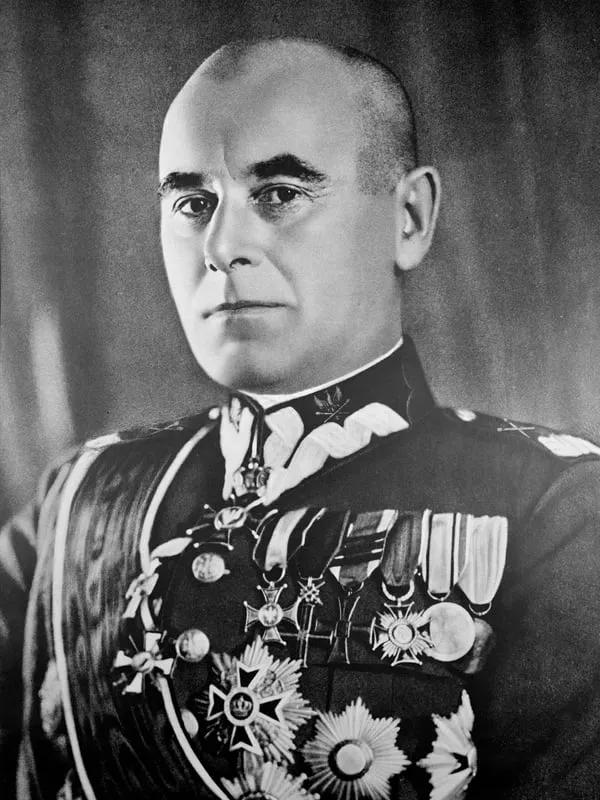
- Born:
- 11 March 1886, Brzeżany (Austria-Hungary)
- Died:
- 2 December 1941, Warsaw
- Author:
- Łukasz Skowroń
- Photo:
- Harris & Ewing, photographer, domena publiczna, Wikimedia Commons

Edward Rydz, known during the Great War mainly by his pseudonym “Śmigły”, was one of the ablest line officers the Legions produced. A painter by training, for three years he commanded the 1st Infantry Regiment of the First Brigade, the most experienced unit of Józef Piłsudski. His greatest role, however, came while the Commandant sat in a German prison. From the summer of 1917 Rydz led the Polish Military Organisation, the underground that in November 1918 disarmed the partitioning powers’ troops and carried the independence left to power. In the Lublin government of Ignacy Daszyński he was minister of war. He later became a Marshal of Poland and commander-in-chief in 1939, but that part of his life lies outside the Great War.
Before the war
He was born on 11 March 1886 in Brzeżany in Eastern Galicia. His father, an uhlan NCO and later a police sergeant, died when Edward was two, and his mother when he was ten. He was brought up by his poor grandfather and then by a friendly family of the intelligentsia, thanks to whom he was able to study. In 1905 he passed his school-leaving examination at the Brzeżany gymnasium, where he belonged to youth independence organisations, and began studying at the Academy of Fine Arts in Kraków under Leon Wyczółkowski and Teodor Axentowicz.
In 1908 he joined the Union of Active Struggle, the secret military organisation of Piłsudski’s camp. In 1910–1911 he did his one-year service in the Austro-Hungarian army in Vienna, which he treated as a school for the future struggle for independence. In the Riflemen’s movement he used the pseudonym “Śmigły”. In 1912 he completed the officer courses of the Riflemen’s Association and ran a Riflemen’s course in Kraków, and in 1913 he became commandant of the Lviv district and editor of the monthly “Strzelec”. He returned to the Academy and finished his studies just before the war. Piłsudski already thought highly of him.
1914–1916: in the First Brigade
In July 1914 Rydz was mobilised into the Austrian 55th Infantry Regiment, but Piłsudski had him released to his own units. On 13 August he took command of the III Battalion of Riflemen, which took part in the capture of Kielce and then took Nowy Korczyn. Rydz also helped to create the first Legion intelligence service. On 9 October he became a major. In October his battalion distinguished itself in the fighting at Laski and Anielin, in front of Dęblin, during the Battle of Warsaw and Dęblin. At the end of November he surprised a Cossack detachment at Chyszówki.
On 18 December 1914, as Piłsudski’s units were being turned into the First Brigade, Rydz took command of the 1st Infantry Regiment. A few days later the regiment went into the attack at Łowczówek. In the Commandant’s absence the brigade there was commanded by Kazimierz Sosnkowski, and the 1st Regiment stormed Hill 360, where it ran into wire entanglements and machine-gun fire. The brigade spent the winter in the trenches on the Nida. When in May 1915, after the breakthrough at Gorlice, the Russian front began to fall back, Rydz’s regiment fought at Konary and later at Tarłów. On 3 June 1915 Rydz was promoted to lieutenant colonel. In the autumn, in Volhynia, during Piłsudski’s dispute with the Legions Command, he commanded part of the First Brigade on the Styr for several weeks.
In July 1916, during the Brusilov offensive, Rydz’s regiment fought in the Battle of Kostiuchnówka, the bloodiest fight of the Legions, and then on the Stokhid. When the Austrians refused to Polonise the command of the Polish Auxiliary Corps, as the Legions had been renamed, Piłsudski resigned. Rydz followed his example and also asked to be released. Rydz’s Legion career ended in July 1917. In the oath crisis his regiment refused the oath of brotherhood in arms with Germany and Austria-Hungary, and the commander himself was discharged without the right to wear the uniform. He went to Kraków. The Austrians wanted to conscript him into their army, but he fell seriously ill and then, according to his biographers, feigned illness to avoid the draft.
Commandant of the POW
After the arrest of Piłsudski and Sosnkowski in July 1917, Rydz took charge of the Polish Military Organisation. According to some biographers he was appointed to the post by Piłsudski himself, but before his arrest the Commandant had no time to give him any instructions, so the new commandant had to rely on his own judgement. He moved the organisation’s leadership to Kraków, extended its activity to Galicia and took it deeper underground, because the Germans had begun to hunt down its members. The POW cells were in future to take up armed struggle against the partitioning powers, this time not only against Russia. Rydz sought contacts with Poles in the Russian army and with the soldiers of Józef Haller, who in February 1918 broke through the Austrian front at Rarańcza.
In 1918 Rydz, together with Michał Sokolnicki, Andrzej Strug, Józef Beck and Bolesław Wieniawa-Długoszowski, travelled to Ukraine and Belarus. There he tried, together with Haller, to build a new Polish army out of the scattered formations. No army could be created, but according to his biographers the Entente was given a signal that besides the Polish National Committee of Roman Dmowski there was a strong Piłsudskiite camp in the country. While in Kyiv he met Marta Zaleska, with whom he remained for the rest of his life.
In the autumn of 1918, when after the Regency Council’s proclamation the regents were looking for a minister of war, the portfolio was offered to Rydz, standing in for the imprisoned Piłsudski, in the government of Józef Świeżyński. Rydz, however, failed to reach agreement with the National Democrats and the talks collapsed.
November 1918: Lublin
The collapse of Austria-Hungary gave the POW the chance it had been waiting for. Rydz ordered the organisation mobilised for 1 November and proposed creating in Lublin, in the former Austrian zone of occupation, a republican government independent of the Regency Council. On 3 November he arrived in Lublin. The Regency Council’s commissioner Juliusz Zdanowski offered him an agreement under which Rydz became commander of the Polish troops in the former Austrian zone, and on 5 November the chief of staff, General Tadeusz Rozwadowski, who had come from Warsaw, wanted to give him a brigade formed of POW members, intended to fight the Ukrainians near Hrubieszów. Rydz did not, however, abandon his political plans. On the night of 6–7 November Daszyński’s Provisional People’s Government of the Polish Republic was formed, and Rydz, standing in for Piłsudski, took the post of minister of war in it. The Lublin government made him a general.
Piłsudski, who returned to Warsaw on 10 November, received the news from Lublin coldly. According to the account of Bogusław Miedziński, Rydz’s trusted man sent to him, he spoke badly of the creation of the people’s government and even doubted his subordinate’s loyalty. When Rydz came to Warsaw the next day, the Commandant treated him very formally. Rydz supported his demand that the Lublin government step down, and the government dissolved itself. Piłsudski did not recognise the promotion granted in Lublin. On 16 November he appointed Rydz commander of the Lublin General District, and only on 21 November a brigadier general. In December Rydz took command of the Warsaw General District.
After the war
In 1919 Rydz commanded in Volhynia, and in April led the Legions division that took Wilno. At the turn of 1919 and 1920 he directed the Polish-Latvian operation that recaptured Daugavpils from the Bolsheviks. In the Polish-Soviet War his 3rd Army took Kyiv on 7 May 1920, and in August he commanded the right wing of the strike group on the Wieprz. In 1920, under a law allowing a military pseudonym to be added to a surname, he took the surname Rydz-Śmigły, and later used the form Śmigły-Rydz. After Piłsudski’s death in 1935 he became Inspector General of the Armed Forces, in 1936 Marshal of Poland, and on 1 September 1939 commander-in-chief. After the September defeat he was interned in Romania, from where in the autumn of 1941 he made his way through Hungary to occupied Warsaw. He died there on 2 December 1941 and was buried at Powązki under the assumed name Adam Zawisza.
Assessment
Rydz-Śmigły is remembered today above all as the commander-in-chief of the lost campaign of 1939, and historians judge him in that role mostly harshly. His soldier’s path in the Great War is judged far better. Piłsudski considered him an excellent line commander who carried out his tasks well, and in an assessment of 1922 named him among the candidates for commander-in-chief in the event of war, though he doubted whether he could cope with overbearing generals and with matters of state beyond the army.
Leading the POW in 1917–1918 was his first political task. Rydz held the organisation together after the Commandant’s imprisonment and prepared it for the autumn of 1918, when it became one of the main forces taking over power in the Kingdom and in Galicia. Joining the Lublin government, his first independent political decision, nevertheless weighed on his career. Daria and Tomasz Nałęcz cite a rumour that Piłsudski rebuked him for it in contemptuous words, and argue that for the next seventeen years he kept him away from politics.
Sources
Spotted a mistake?Report an error
Commanded in battles
(03)Mentioned in battles
(01)Often appears with
People who appear in the same events.